Painting with Wilson Bickford
Wilson Bickford "June Afternoon" Part 1
Season 4 Episode 4 | 26m 34sVideo has Closed Captions
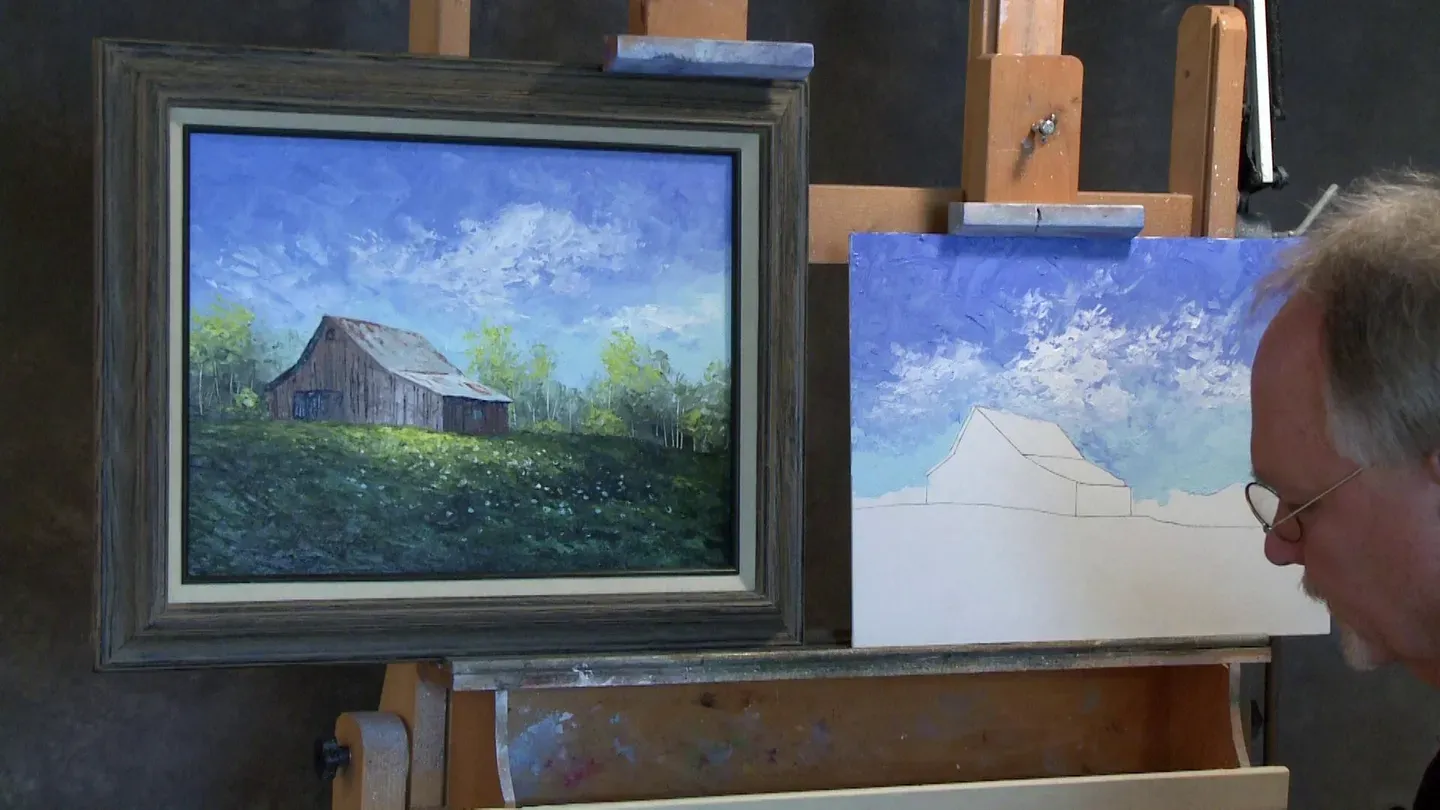
Wilson paints a rustic country barn sitting near a meadow full of summer flowers.
Armed with just two painting knives and a few select oil paints, Wilson paints a rustic country barn sitting near a meadow full of summer flowers.
Problems playing video? | Closed Captioning Feedback
Problems playing video? | Closed Captioning Feedback
Painting with Wilson Bickford is a local public television program presented by WPBS
Sponsored by: St. Lawrence County &nbps; &nbps; The Daylight Company &nbps; &nbps; J.M. McDonald Foundation
Painting with Wilson Bickford
Wilson Bickford "June Afternoon" Part 1
Season 4 Episode 4 | 26m 34sVideo has Closed Captions
Armed with just two painting knives and a few select oil paints, Wilson paints a rustic country barn sitting near a meadow full of summer flowers.
Problems playing video? | Closed Captioning Feedback
Where to Watch Painting with Wilson Bickford
Painting with Wilson Bickford is available to stream on pbs.org and the PBS app.
Wilson Bickford: Have you ever been impressed with Impressionism?
Join me next on Painting with Wilson Bickford and I'll show you some really neat knife painting techniques to paint "June Afternoon."
[MUSIC] [MUSIC] Hi, thanks for joining me today.
I'm Wilson Bickford and I'm gonna show you a nice little knife painting today.
Knife painting technique is very popular right now, I do a lot of 'em in my classes.
My students just love 'em.
You gotta think more Van Gogh, and less Da Vinci.
We're gonna go after a really thick textured look, impasto paint, it's gonna be really, really nice.
I think you're gonna enjoy it.
This one's entitled "June Afternoon," it's all done with just a couple of painting knives.
If you go to the WPBS website, you'll be able to download a sketch and a supply list explaining all the supplies that you'll need for this, and I'm gonna run through 'em here momentarily.
There's a sketch to transfer, you'd want to take the sketch, place it on your canvas, put a piece of graphite transfer paper underneath.
You can trace the design on and it'll bring you right to this point where I'm at right now to begin.
For the actual oil paints today, we're gonna be using cerulean blue, ultramarine blue, sap green, burnt sienna, cadmium yellow pale, and titanium white.
I also have an alkyd gel medium here that's made for textural work for use with oils.
This medium will make the oils dry faster.
This painting, even though I'm going to put the paint on thick and heavy today, will be dry probably within a couple days rather than a couple of weeks.
The idea behind the gel medium is if you put the paint on thickly, it dries the paint throughout the whole layer as one whole unit, it doesn't dry from the top down and skin over.
That's where you get that cracking and aligatoring in those old paintings that you see, it's because the uneven dry rate of the oils.
This will dry everything uniformly and it's nice and thick and pasty so you can build up the texture in the paint film.
For tools, I'm gonna be using a small painting knife and a large painting knife.
Believe it or not, that's all we need for this.
There's no brushes in this whatsoever.
You'll notice this has a totally different look than a brush painting, it's not a slick and smooth, and it's not meant to be.
So to get this off and running, I'm gonna start out with my small knife, even though we're painting with knives, we still want to think about perspective, and value, and contrast, all the same rules the art principles apply.
I'm gonna make the sky lighter here in the distance on the lower bottom portion of the sky, that adheres to aerial perspective.
The sky will be lighter farther away, it'll be darker closer, which is the sky above up here.
So I'm gonna start with cerulean blue and white here, grading it up to ultramarine blue and white at the top, and then some white clouds over the top of that.
I don't need to tape it out, I could've taped it out.
You've probably painted with me before, and seen that I cut around and use masking tape a lot.
Because the building is so square, and the knives are straight and square, it's pretty easy just to paint in around it.
If I infringe onto the barn a little bit, it's no big deal.
I can cover it up easily because I'm using a lot of paint.
So I'm gonna take my small knife to cut in around the barn first, and I'll switch over to the big knife for the bigger area.
I'm gonna start with a little bit of white, and the rule of thumb of using the alkyd base medium here, they call that butter.
It's a slang term, painting butter.
The idea using the alkyd based gel is that I use about 1/3 of that to 2/3 of paint.
So you'll see if I mix up a color here, I'm using white and a little bit of cerulean blue for that lower sky.
I want it pale.
If I scrape that together and look at that, and consider that 2/3 of the whole, I'm gonna add at least a 1/3 of this much butter to that.
They call this painting butter for the slang like coffee is a cup of Joe.
This is painting butter.
I mix that in thoroughly, I'm just gonna cut right in around the barn.
Now, typically how I load this, I'll have 'em look at the palette here ...
Typically, how I load this is I pull it out like this, and I plow through it and I get quite a little bead of paint at the bottom, it's like frosting a cake.
I'm using quite of paint here.
You'll see when I do it, it looks almost like stucco.
The idea is to leave it a little thick and chunky with the ridges in it and that texture throughout, that's what gives it the character of a knife painting.
This is a really fun way to paint.
It's very free, you don't have to be so precise with it, it's not meant to look slick and perfect, so it takes a lot of pressure off you, and it has its own character when you're done with it.
Now because my trees are gonna go in down here lower, I don't necessarily have to go all the way to that line, so I don't have to worry about that.
I'm gonna get close enough to where I know my trees will cover that and take up the remainder.
Now different people do it different ways, I typically have my own style of doing it where I just pad it on like this every which way and you'll see I turn the blade different angles.
Some people like to put it on like this, and part texture into it this way, so it has more of a pebbly surface.
It's all good, it depends on what you want, how you feel about it, what you want to have for a final result.
So I'm just gonna put this on, once I get around the barn, I'm gonna switch over to a larger knife.
The small knife is just much easier to cut in around the barn to get started.
When I get up here, we use a larger knife.
What do you want to shovel the barn out with?
A shovel or a teaspoon?
Same idea, I want to use a shovel on here, so I'm gonna switch over to the big knife.
Now if I had run out of paint, I haven't yet, but if I had run out of paint, I just simply would've mixed up more, it's white and blue, pretty easy color to get, and I did run out a little bit.
So I will mix up a little more of that.
I'm gonna set this knife to that side, I'll come back to it.
For right now, I'm gonna switch over to the large knife.
I want to bring this color up at least to here, so I do need a little more of that same color, and since it's a sky, it doesn't have to be exactly the same color, but I'm gonna take cerulean and white again, a little bit of the alkyd gel, and sometimes you'll hear me scrape.
I'm just scraping off some of the excess, to spread it around the ... Buy myself a little more space here, take up a little more real estate, so to speak.
There we go.
This looks like too much fun, doesn't it?
It is, you really gotta give this technique a try, it's really not as difficult as it seems.
Everybody's afraid of it until they try it.
Most of my students really like it.
The first time they come, they're very apprehensive and 'oh, I don't think I can do anything with that knife.'
Notice how loose and free this is, I don't have to worry about it, that's the beauty of it.
Okay, I want a darker value up here near the top, I'm gonna start with some white.
I can go right into the same little puddle of cerulean too.
I'm gonna take white, ultramarine blue, don't forget your alkyd gel here, put some of that in it.
I want a much darker, richer blue, darker value.
Value just simply means how light or dark a color is.
Oh yeah, I love blue, so that right there makes me pretty happy.
Now if you don't want it that intense, you don't have to, obviously.
You just put more white with it.
It would be muted down.
But I want a fairly strong blue so when I put my cloud indications, and I have a contrast there.
Just working off the edges.
Now you see this bigger knife takes in a bigger footprint, so I can really lay this on here.
I know already I'm gonna run out.
So I'm gonna take a little more white and blue.
You won't know until you get into this.
Some people use far more paint than others, and you might find yourself remixing a lot.
Remixing a color 'cause you run out, that's okay.
You're channeling Van Gogh if you're doing that.
He used a lot of paint too.
Although I don't believe he necessarily used knives, I think he just used big, thick, stiff oil brushes to apply it, but it had more of this type of a look, a much more carefree approach.
Now the tricky part with knife painting is the blending.
Where you hear that knife scraping, I'm just ...
I can see there's ridges on here, and I'm just combing some of it out, just picking up some of the excess paint so I can use it.
I could leave it on there that thick, but that's not particularly my style.
I have a certain way that I do it.
If I wanted more paint, I would just simply mix more up and put it on there, and I could leave that without all the scraping it back.
But the tricky part with knife painting, I shouldn't say tricky, it's not tricky, but the part that people have a hard time getting used to is the blending.
See, I need to bring those two areas together, can't just leave 'em like that, they need to just seamlessly melt together.
I'm gonna switch back to that small knife, still have paint on it from the previous step.
I'm gonna wipe it off, just like when you're brush painting, if there's paint on your brush you're painting, if there's not, you're blending.
Same with this, if there's no paint on my knife, I can blend with it.
See, this is what I call a pat, drag, and smear, I pat it, I drag a little bit and I smear it.
I'm smearing 'em together.
You'll notice I still have a rag in my hand because I'm gonna pick up a lot of paint by doing this.
See how that line is starting to dissolve.
I got a long ways to go yet, but it's getting there, and you'll see where it starts to break it.
I keep picking up paint, so you need to keep wiping that knife off.
Eventually you'll see that these just kind of start melting together a little bit.
They become friends, hold hands on the playground here.
Watch this, notice how often I keep wiping that off.
I can tell because if I'm depositing too much paint off the blade, I can tell my knife is dirty, comes from experience, and I'm not gonna get a perfect smooth blend like you would if you're using brushes, and I'm not trying to.
You have to let that go, just realize that you're not gonna get something that perfect and then don't knock yourself out trying to get it, don't agonize over it.
Alright, looking pretty good so far.
It's about what I want, and I squint at it, I had my eyes half shut as I'm doing this, so I can see where the edges are.
It's easier to see those edges if you have your eyes half shut.
Believe it or not, it doesn't make sense, but it's true.
You get the same effect if you stand back 10 or 12 feet and look at it.
Alright, that looks pretty good.
I think that's about all I need for that.
That's not that hard, right?
You can do that, sure you can, I know you can.
Okay, I'm gonna wipe this off, I'm gonna take white and some of the alkyd gel here.
This'll be my clouds.
I'm gonna do the clouds with just a light grazing touch.
How I load the knife for that is I pat it on the back like this, on the back blade, and you'll see I get little peaks on it.
If I just use a really light grazing touch ...
I want to give the clouds some movement, so I'm not just gonna paint 'em straight across.
I'm gonna let 'em swoop a little bit, and just like when I paint clouds with a brush, I try to soften the bottoms away so they look like they roll underneath.
Like I said at the beginning, just because I'm using a knife, doesn't mean I'm gonna forget about perspective, and contrast, and value, and all the important art principles.
They're still in place.
I'm just apply the paint in a different manner, but all those elements are what make a painting.
See how nice and loose that is?
I'll sneak a little bit down here behind the barn so it looks like it goes behind.
I didn't in that one, but in this one I will, what the heck.
Every time you paint, you're gonna paint differently depending on what you feel right at that given moment.
Some days I get up and I want to paint a lighthouse, and other days I get up and I want to paint a deer, or a barn, or whatever ... flowers, whatever it might be.
See how loose and free that is?
That's all it takes, guys, there's not much to it.
It's not rocket science, most people just worry about it too much, you want to try to get it too perfect, the whole idea of using knives is so that it doesn't look perfect.
It should have a certain character to it.
See, I can wipe the knife off and go back and just fluff it out a little bit too if it's a little harsh.
You can always lay the paint down a little more, it's no big deal.
It's an easy adjustment.
Okay, I think that's all I need to do for that sky.
That's looking pretty good to me, I'm gonna leave it.
[MUSIC] Don't be afraid to draw your own building, but make sure you get the perspective correct.
Notice this one, all the lines are straight, there's no angles to that building, nothing recedes into space.
A lot of beginners make the mistake of doing this.
You want your lines to converge toward the horizon line.
You'd have a horizon line in behind here, everything converges towards the horizon line.
It's gonna give you a much more realistic looking representation.
I'm gonna come in and start putting the background trees in.
I want to start with a darker green, shadowy green, so I'm gonna take ...
I'll go right into this blue that I got mixed blue in it anyway.
I'm gonna take sap green, little bit of the ultramarine blue, so it's a cool blue green.
We'll use a warmer yellow green for the highlights.
So this is sap green and ultramarine blue.
You know what else I need in that?
Yup, you're right, the alkyd gel, I heard ya.
Don't let me forget it.
Put about a 1/3 as much of that alkyd gel into that, mix it in thoroughly.
I'm gonna keep adding a little more blue, I want a little darker, and little cooler, there we go.
That looks pretty good.
From here, I'm pull from the ground line up.
I'm not thinking trees yet, I'm just conforming to that line, so don't get ahead of yourself and think you're gonna do this and you're gonna have a tree, that's not gonna happen.
See I'm just working in tightly around the barn and down to that grass line, and then I'll start making it fluffier and looser on the top to suggest trees.
When I say suggest, that's all it is, is a suggestion.
If I got some down here below that level of my sketch, it's okay, I'm gonna come in there later with my grass color anyway, and there's gonna be a lot of paint I can cover anything that happens down here if I get paint down here now.
Knife painting is probably the easiest type of painting to correct.
If you get something where you don't want it, you just literally take your knife and scrape it away.
Notice how the trees go behind the barn a little bit.
Now this is a much darker value than what I had here, and that's okay.
I wanted it dark so it's gonna show up on camera for you.
You always want to think about your darks and your lights.
I lost a corner of the roof right there a little bit, that's okay, I'll paint that back, no big deal.
Like I said, I could've taped it out, and that would've been a f fool-proof, sure-fire way to preserve that, to protect it.
Okay, now I'm gonna start thinking trees.
Notice I take the knife, I'm gonna slow down a little bit here.
I take the knife and I just keep pulling up and I get a looser edge against the sky behind it.
It's also getting a little bit lighter 'cause it's melting into the blue a little more.
I'm not using as much paint there, so it kind of softens the color, which is good 'cause we're gonna put a highlight on that anyway.
See it's a suggestion of trees, you're not gonna see actual trees, but it's gonna tell the viewers brain that these are trees back here.
Alright, do a little bit on this edge, I'll come in on my highlight.
Sometimes you can use just the tip of the knife like this, and just pounce and stipel, a little bit looser edge too.
Alright, alright, that's looking pretty good.
I'm gonna wipe the knife off, I'm gonna come back with a lighter value, a yellow green to suggest some sunlight on these trees.
So if I take white, maybe a little bit of this green I just had, not much, just a little bit 'cause I don't want it to be pure yellow.
I want a yellow green, so I'm gonna take white yellow, a little bit of the previous green, a little bit of the painting butter, mix it all together.
I can compare the two values right here.
I'm making sure I'm going plenty light enough that it's gonna contrast against that first green.
Again, I'm gonna pat this on the back like this, like I did for my clouds, so I get that nice spiky texture on the back of the blade, and if I just lightly ...
It's a very light touch, I just lightly graze over the top of that green.
The paint pulls apart and gives you a certain texture.
If I bare down too hard and scrape it, it's just gonna be solid yellow, I don't want it solid, I want it to look loose and broken, a broken texture like leaves.
Alright, let it fade out, stay a little darker down here at the base.
Usually trees are more ...
Especially in a thick grouping like this, a little darker at the base where all the shadows are, the undergrowth.
See, it's a suggestion of trees, you're not gonna see actual trees.
You won't be able to pigeon hole it, and say, 'oh that looks like an oak tree,' or 'that looks like a maple tree.'
These aren't that specific, it's just a suggestion, some greenery, very impressionistic.
Okay, I think that's coming together pretty nicely for the background.
We don't want a lot of hoopla in the background anyway.
The barn is the star of the show.
Okay, I'm gonna wipe that off, I'm gonna take the tip of the knife and go straight in like this, and I'm just gonna indicate a few little trunks standing back in there.
You'll hear the knife scrape, I'm literally just scraping away some of the paint.
Now they're gonna look a little harsh.
I'm gonna go back and soften 'em in.
Usually when you're painting, you have to do something first and then influence after the fact.
Sometimes you just have to get the paint on there first and then go back and do what you need to do with it.
This is one of those instances.
Notice that they look like they're scraped over the top.
If I wipe the knife off clean with nothing on it, and I just pat, it picks up some of the surrounding paint, and it breaks the line every now and then, so it looks like there are leaves hanging from it.
It pushes the trunks back into the grouping where they need to go.
Essentially I'm just repainting over them, but I'm just tapping to do it.
See how it breaks the line?
If you take too many of them out, and that happens sometimes too, just scratch a few back in, it's no big deal, easy adjustment.
Okay, that's looking pretty good.
Looks like the woods out back there, doesn't it?
See how easy that is?
You guys can do this, I know you can, very simple.
You just don't have to ... Don't think about it so much, just get in there and do it.
Be free with it, have fun with it.
Okay, I'm gonna start working on the barn here a little bit in our last few minutes.
Notice that the light is coming from this side, so this side is the lighter portion of the barn, this is the shadowed side.
To get these brown tones, I'm gonna take some white ...
I'll just use this white that I have for my clouds.
I'm gonna take white, burnt sienna, a little bit of the ultramarine blue will gray it.
Now I can ideally get a black and a almost gray that you would achieve the black and white if I use burnt sienna and ultramarine blue.
I can get a virtual black and by adding white to that, it gets a true gray.
I want this a little bit more toward a brownish gray, but just realize you can get that color using these.
More of an authentic barn board ...
I'm gonna warm it up, go a little browner on this one.
Right here I'm just gonna fill in this side of the barn.
Notice I want a strong emphasis of light here, but light on this side of the building, light ... Or dark on this side, so you have a distinct corner there.
It needs that three dimensional feel, and this ... Like I said a moment ago, sometimes you gotta get the paint on there first.
I'm not worried about barn texture, I'm just filling this is in and blocking it in.
I'm not worried about barn board.
I need to get the paint on first and then I'll influence it differently later.
I did let it get a little darker as it went across the face, just so it's not all the same exact value, so I'm gonna darken that down just a whisker.
I'm gonna take a little more sienna, a little bit of the ultramarine blue ... That's too much blue, now see I got too much blue in that?
I'll put a little sienna back to bring it back, check the value, there we are.
It's looking pretty good.
A little darker than what I had ... You'll see once I get this block, then we'll start adding the details, and that's when the barn actually comes to life.
There are people out there, other artists who this is all they do, they paint exclusively with knives, that's all they do, and they do some fantastic work, I'll tell you.
Some of it you look at, and it's hard to believe they did it with knives, but it's just a different approach, it's nice to know different ways to paint, so you're not putting all your eggs in one basket.
Now see I'm just gonna blend these together a little bit.
This is gonna be a two part lesson, so we're gonna come back and finish this up on the next episode, and you'll see that they'll really start coming to life once I start adding the details into that.
I'm gonna darken this side down, this is a much darker value on this side, so if I take what I've got already as a base, and I just darken it a little further with more sienna, speck more blue, I want a much darker value overall.
That's got butter in it from the previous mixture I've already added into it, but just to be safe, I'll put a little more in there, make sure this is gonna be dark enough.
Yup, that looks good.
I'm gonna fill this in like this.
Be careful around the edges a little bit.
Get a nice distinct corner right here, like I said, if you get it down below your barn, down in the grass area, it's no big deal, not worried in the least.
See, I kid of lost the overhang there near the barn, but when I paint that, I'll bring that out.
I'm not worried about that either.
Alright, definitely want a distinct corner on the building, so it has that three dimensional feel.
Alright, I think that's gonna do it for this episode.
Join me on the next one, we're gonna finish this up.
Til next time, stay creative and keep painting, guys.
ANNOUNCER: All 13 episodes of Painting With Wilson Bickford, Series #4 are now available on DVD or blu-ray in one boxed set for $35 plus $4.95 shipping and handling.
Or learn the techniques used to paint "Evening Choir Practice" or "Majestic Mountain" with the in-depth Wilson Bickford "Paint Smart Not Hard" series instructional DVDs.
Order online or watch or download directly to your computer or mobile device.
More information at wpbstv.org/painting.
[MUSIC] [MUSIC] [MUSIC]


- Home and How To

Hit the road in a classic car for a tour through Great Britain with two antiques experts.
 New Season





 New Episode
 New Episode



Support for PBS provided by:
Painting with Wilson Bickford is a local public television program presented by WPBS
Sponsored by: St. Lawrence County &nbps; &nbps; The Daylight Company &nbps; &nbps; J.M. McDonald Foundation