
Camping on Three Mile Island
Season 8 Episode 1 | 26m 45sVideo has Closed Captions
Willem visits Three Mile Island Camp on Lake Winnipesaukee.
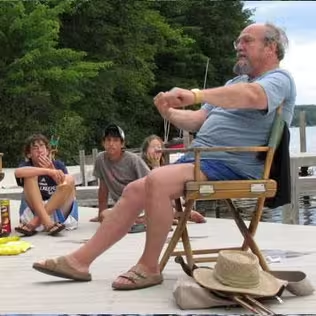
Willem visits Three Mile Island Camp on Lake Winnipesaukee. The AMC site has been surprisingly untouched by modernization over the past 100 years, as its campers enjoy swimming, canoeing, sailing, walking and the rustic nature of the island.
Problems playing video? | Closed Captioning Feedback
Problems playing video? | Closed Captioning Feedback
Windows to the Wild is a local public television program presented by NHPBS
Camping on Three Mile Island
Season 8 Episode 1 | 26m 45sVideo has Closed Captions
Willem visits Three Mile Island Camp on Lake Winnipesaukee. The AMC site has been surprisingly untouched by modernization over the past 100 years, as its campers enjoy swimming, canoeing, sailing, walking and the rustic nature of the island.
Problems playing video? | Closed Captioning Feedback
Where to Watch Windows to the Wild
Windows to the Wild is available to stream on pbs.org and the PBS app.
Related to This Episode
Providing Support for PBS.org
Learn Moreabout PBS online sponsorship♪ I'm standing on the shore of Lake Winnipesaukee near Meredith, New Hampshire.
It's a big lake.
Big name, too.
And some people think they can spell it.
Others think they know what it means, but they never seem to agree.
Well, it doesn't make any difference.
What does make a difference, though, is that we're going to take a voyage out here today to an island full of very happy people.
So, sit back and relax, because the next half hour is going to be a lot of fun.
♪ Welcome to Windows to the Wild.
I'm Willem Lange.
Lake Winnipesaukee has over 250 islands, some of them pretty tiny and all of them pretty rocky.
We're going to visit one of them today, Three Mile Island, which, starting in 1899 with a series of gifts and a purchase, has become the property of the Appalachian Mountain Club.
The club runs a very popular summer camp on the island for families, and we're going to pay it an overnight visit.
The usual way to get out there is by the camp shuttle, which leaves from here at Shep Brown's Boat Basin, in Meredith.
But we're going out in a reproduction of a 150-year-old boat, a Swampscott Dory built by my friend Charles Johnson.
Charles, welcome to Windows to the Wild.
Thank you, Will.
A pleasure.
And a pleasure to be going out in this beautiful conveyance.
Let's hope we get a little wind, then it'll be just fine.
Yes.
Otherwise, we'll be rowing, right?
That's right.
C’est la vie.
Okay.
Why don't we get going?
We’ll talk about the boat on the way.
Sounds good.
I see there's nothing much more than a foot of water on the bottom of it.
[laughter] I fixed that leak just before we came.
Okay!
Let's go!
Okay.
♪ I'm told it's about a 40-minute row from the marina to Three Mile Island.
That'll give me time to talk with Charles about the dory he built.
It was inspired by the old, old designs the old classic wooden boat design.
And there's nothing like a wooden boat.
I mean, you can tell it a mile away.
It's got character.
It speaks to you.
So... It’s a labor.
It took four and a half years, but it was all a labor of love, for sure.
♪ All the wood used in the dory is native to Vermont.
The knees where are they?
Up there.
These are all apple, which is, again, traditional in boat building because they're very strong.
Only somewhat rot-resistant, but they look nice.
They're beautiful.
Those four knees up there came from the State House lawn when they were cutting down an apple tree.
[Willem laughing] And they thought I was crazy when I said, Can I have those crotches?
♪ And the centerboard is oak.
You can't see that, obviously.
I hope we won’t see that today!
The masks are all red spruce from a neighbor's property.
Not a bad job for four years.
Thank you.
Yeah, it gets a lot of attention.
You pull into a gas station and you can’t get out of there.
People come over.
[Willem laughing] We haven't got a lot of wind, so we're going to just sort of flop around for a while.
It's still pretty good.
♪ So, it's either this island or that island.
Well, good!
Let's try it.
We can always move it... Well, once we got close enough to shore, we figured out which island was the right one.
♪ Three Mile Island is pretty much the same as it was about a century ago when the Appalachian Mountain Club acquired it.
A lot of waves from the boats, but I guess with the bumper she’ll be alright.
Good.
Let's see if we can find... Ha ha!
I think we found.
Willem!
You’re Will Holmes?
I am.
Is that right?
You're the manager!
I am.
Good!
Charles Johnson.
Hi Charles.
Welcome to Three Mile Island camp.
And I've been told that you're going to give us a tour of this place.
Yes.
I'll show you around.
♪ People do lots of things here.
There are rowboats to use.
Obviously, a diving board and a slide.
And that raft is pretty fun out there.
A lot of kids, sort of a part of their story is when do they finally jump off of the top of that?
[splash] So, is it Three Mile because it’s three miles long or... It’s a 43-acre island, but it's three miles from Center Harbor, New Hampshire.
Oh, okay.
So, three miles that way is Center Harbor.
And three miles that way is Six Mile Island.
[chuckling] That’s right.
You know, we were just on the Main Dock and this is the Main Path and we're going to the Main House.
But this is the Main House.
This is where three meals a day some people call this Three Meal Island because the food's so good.
[ceramic clattering] [chatter] So this is the Ridge Path, and it goes right down the middle of the island.
And there's the West Shore and the East Shore.
After a quick tour, Will made it clear that, laptop computers and cell phones should be shut down.
I talked with someone a couple weeks ago who said he meant to bring he’d never been here before.
He meant to bring his laptop, and he didn't.
And he was so glad he didn't because it allowed him to be that much further away, and it would have just ended up collecting dust in this cabin anyway.
But it would have been that temptation, that draw.
♪ This is my first trip to the island, and I found people of all ages and backgrounds eating, playing, [splash] [laughter] taking it easy.
For some families, this is it this is their big one week or two weeks of the summer that they come here.
And it's a chance to play outdoors.
And so people come, they eat outdoors, and they go jump off Rock Island.
That's like a wicked high jumping spot.
That's one of those Remember that summer that Billy started jumping off of Rock Island?
You go, My dad will come here and go sailing.
He doesn't get a chance to go sailing when he's working six days a week in Boston.
♪ But it's also the kind of place that... you know how if you rent a house for a family reunion, and there are three generations of people, and who's cooking, who's cleaning up, who's buying the groceries?
One of the nice things about Three Mile is your food is taken care of, and you can get time to yourself if you want it.
You're not on top of each other, so you can go off to your own space, kid can take a nap, grown-ups can take naps, and then you can come back together when you want to.
♪ There's enough space on the island to get away from it all.
Hah!
That changes at mealtime.
[trumpet sounding] The Croo (crew) are sudents who spend the summer having fun and working hard.
We're here for ten weeks total.
There's nine camper weeks.
And then, a week before the campers come, we'll be here as the Croo just getting the island ready for everyone to come for the summer.
This is my first year.
I've been on Croo for three years now.
Today, I had to do a trash run and a demo on power tools.
There's nowhere else I'd rather be over the entire summer.
Get paid to have an amazing time in nature off the grid no phones or anything else.
But I've done everything from flipping over the compost to cleaning the outhouse.
I'll be doing anything from waiting on a table to painting a cabin to working on the dock and putting canoes away, helping campers out, anything like that.
The Croo does its part to keep the island, well, the way it was over 100 years ago.
I do a raised bed... They grow some of the food served here and compost leftovers.
And then there are three little pigs that do their part.
We generate a fair amount of food that can't go in the compost bin.
And so, for a few years now, I've been thinking about and talking with people who are pig farmers about getting pigs.
And so, just on Tuesday afternoon, we welcomed three little pigs onto the island.
How are ya?
So, they're taking care of some of the slop that we no longer have to take off the island.
Anybody here,’ I whispered the next day.
Many of the Croo know about Three Mile Island because they played here as kids.
The sound of the trickling water gave me an idea.
My dad came here when he was young with my grandpa and my grandma, so it's sort of like a multi-generational thing.
So, I've been coming since I was young.
I started when I was six years old the first time I was up here.
Pat Costell isn’t a Croo member, but a long time camper... > There's the Mount Washington when it was a paddle boat.
> whose great grandfather was a founding board member here.
You know, this was really a pretty cool place.
My brother was four.
My sister We left home.
She was too young, because you had to be four to come here.
The trails are kind of rough, but yeah, we definitely remember swimming and eating and the bugs They look like they’re doing the same things we do Hanging out on the dock, swimming, canoeing.
What keeps you coming back?
The sense of connectedness to nature and to people and the relaxation.
And it’s just, you know, historic.
Our family’s been coming my daughter is fifth-generation.
This is in 1915.
This is, I guess, the launch house.
I can kind of relate to how it's changed for me.
When I was younger, I definitely I was always, like, wanting to swim, wanting to swim, do everything, try to do as much as possible in one week.
And now, especially this year, I'm kind of wanting to relax more, especially like try to reconnect with nature in the same kind of way, because, especially with the lack of technology, you just want to be with nature.
Especially this morning on a kayak ride, the whole lake felt like it was yours.
It was so beautiful.
And that's just what I love most about it.
It seems as though many of the folks I met have a connection to the camp’s history.
There's a sight, a sound, or a memory that stays with them.
My great great grandfather was on the board when they found this place and started to kind of create this place and everything, and just thinking about how my great great grandfather was walking on these pads is just so cool to me.
And, like, I never, got to meet my grandfather, and I know he loved this place, and there are so many pictures of him in the Main House in the photo albums.
And just looking at him like, Oh, I was right there in that same place, that's great.
I love that so much.
I have, sort of, faint memories of the first couple of years.
And then, when I was 10 or 11, for me, I had the the camper piece you come here and you're with those other kids for the week, and certainly being here with my parents and my brothers.
But the Croo is what hooked me.
Ever since I was 10 or 11, that dish room we went by earlier, I would spend my vacation working in there and eating with the Croo because it was what did it for me.
It means the world to me.
You know, I'm hoping that, in a number of years, I can come up as a grandmother.
That’s the one thing I haven’t experienced yet.
I've been a kid, a teenager, a young adult.
You know, I’ve brought my own kids.
Then there will be grandkids, and watching them play in the kiddy pool and doing all the things and being able to sit there as grandmama or whatever they're going to call me.
Hello!
It's a joy to, you know, know that my daughter will some day bring a sixth generation of her family to this island, and it'll be the same.
She'll look back in the photo books and laugh at what her dad used to be like you know, 30 years ago.
So, it's pretty cool.
It's really cool.
♪ That’s what’s so amazing about this place.
You keep it in the back of your mind, you carry it with you all year long, and then you come back and it's exactly the way you remember it the smells, the sounds, the sights.
It’s a pretty special place.
♪ Where do you find that in this world?
You know, in the year 2012, where do you find something that you can tie back 100+ years that’s very much the same experience that people had, you know, decades and generations ago.
It's not something you can have.
So, it’s like stepping back in time.
♪ If you've never been to or even heard of Three Mile Island, your chances of landing here are as good as those of the old-timers.
The town meeting we have down here on the dock every Saturday night, I always ask, Can we see the hands of new campers?
because you want to welcome people in because we love it so much and we want people to love it, too, and they quickly fall in love and it becomes theirs.
So, it's not exclusive.
It's not that only people who've been coming come back.
We actually have a lottery in January, which is how the reservation process works.
I heard someone say once, Oh, it's hard to get in there.
But I come the same week every year with the same people.
And every year, there's somebody new who's just getting introduced to this group.
So, there are new people.
We made friends up here that were just newcomers not too long ago.
I think, for some people, you're going to walk onto this island and you're going to just say, I'm home.
You know, I feel that connection.
♪ Part of the experience that the Appalachian Mountain Club hopes people take away is a better appreciation of what's around us.
I'm talking this morning with Marge Holland, who's the amateur naturalist out here on the island.
And in another life, a professor of biology at the University of Mississippi.
Now, you obviously go back a way here.
I do, yes.
I've been coming up to Three Mile Island camp since I was 12.
Oh, is that right?
Yes.
So, you’re from around here originally?
Originally, I was living in Brookline, Massachusetts.
Look at all the ants carrying stuff.
Oh yeah.
I am involved in sampling some permanent plots that we set out in 1978 because the Three Mile Island Camp Committee had adopted a land use management plan in 1973.
And the folks in the AMC headquarters wanted to know how we would know if the plan was working.
So, that's when we started sampling permanent plots.
What's the plan?
You mean laying out different areas for different uses?
Yes, exactly.
You have a wild area over here and then a productive area here for firewood?
Exactly.
An urban area down here?
The urban area, yes.
The overall goal was to try to keep human disturbance in the urban area and protect the rare species and habitats in what is called the protective zone.
And then we had the productive zone that you just mentioned.
We would cut for firewood and maintain wildlife habitat.
And then, where most of the cabins are located are in the compromise zone.
What if we kind of use this area?
Then we have some natural trees for the fairy house and kind of some rock areas.
Now, if people come here, you take them on what we used to call nature walks and show them... Well, I'm a botanist, so I like to point out different species of plants.
One of the things that's really interesting is that the plants at Three Mile have been studied ever since 1900 when the AMC first acquired the land.
Exactly.
So, we know what was here back in the early 1900s.
And we also know that some of the plants were introduced to the island.
Really?
Yes.
One of the original committee members was a landscaper.
And so, his contribution to the island was to bring in some plants.
But they were all from the southern Appalachians.
They weren't native up here.
So, well, there are several that have survived.
They didn’t survive?
Well, there are several that have survived.
A lot of them didn't, but several of them have survived.
And some of the rhododendrons that are in what we call Rhododendron Swamp were introduced to the island.
So, they're introduced.
But what we wanted to look at last summer was whether or not any of these introduced species were becoming invasive.
Right.
And they were not.
Oh good.
♪ The cabins aren't powered, but they do have kerosene lamps.
The real energy as evening creeps along can be found down at the boathouse.
♪ ♪ [PA announcer] This place is amazing.
It is.
I've never seen families having so much fun as families, you know?
And young people enjoying old people.
Yeah, that was great.
That was unusual.
Very unusual.
Good day.
Now, what's up tomorrow?
Tomorrow?
Well, big breakfast.
Ah yeah.
Coffee.
Good idea!
And then we’re going to meet a family and build a boat in a weekend.
Wait a minute.
A family will build a boat in a weekend?
A whole boat a whole sailboat in a weekend.
Took you four and a half years?
Maybe if you pay attention, you can pick up some tips.
[laughter] Save me quite a bit of time, that's for sure!
Well, that should be fun.
We're going to see them after breakfast, I presume?
Then, we’ll get back for a big lunch.
Oh yeah, that too.
Hope we'll be hungry again.
And then we'll either row or sail back to harbor.
Then head back.
That'll be nice.
Okay.
I'm about ready for bed.
I don't know about you.
I am too.
It's a little cooler tonight than it was.
And we took a dip in the lake.
That lake... wonderful.
Yeah, that was a lifesaver.
Okay.
Good.
See you in the morning.
Yeah.
No snoring and we'll be good.
No snoring?
It's forbidden?
Well, yeah.
I could be in trouble here.
But off we go!
[power tools whirring] The boat-building family that Charles mentioned is from Sandown, New Hampshire.
They took part in the springtime event sponsored by the University of New Hampshire.
It's a family project sponsored by the UNH Marine Docents.
And they do a project every year where they pick six families who apply with an application and fill out a... and they write an essay and submit them.
And they pick six families every year out of all the applicants who apply, and then they build a boat.
I didn't really know what I wanted for my birthday, so I decided to try to learn some new skills, like with woodworking, that I can use through through my whole life, and have fun sailing.
And they have a bunch of volunteer docents like this man here, Doug.
This is really fun because I'm a woodworker.
So, you know, this is kind of my primary love.
And you can see each group has 1 or 2 docents working with them.
It can hold about three adults and like four kids.
So, you can pack a good amount of people in there.
So, it's a way that we can get families onto the water and they can learn to enjoy it and appreciate it.
And a lot of family bonding.
And it's a great volunteer thing for people that just enjoy being around people and being harassed!
They like torture.
You really have to follow the directions.
You know, we've got a 55-page manual and if you follow it line by line, it'll come out perfect.
[power tools whirring] By Sunday night we're all pretty tired, though.
Families are tired and we’re tired.
It's a long three days, but it's asking a lot to build a really nice sailboat in three days.
I hope it doesn't sink.
That’d be a lot of time wasted.
Well, as it turns out, the sailboat didn't sink.
Parker and his friends sail around the harbor a few bays south of Three Mile Island.
Part of the boat-building project is that UNH Sailing Club has a day of training.
Parker's older brother couldn't make it that day, so we invited Jake, and Jake was selected because his family owns a cottage two doors down.
So, we knew that they'd be sailing a lot, so we figured he might as well learn from the experts.
Now Parker, working on this boat is kind of like a flash mob, right?
Everybody comes running in and does his thing for three days.
Yeah.
You worked on it.
What did you do?
We started off by just screwing the stem into a jig.
And then we put what are these called?
The frame.
Yeah, we put on the frame.
Then we put on sides and bottoms and everything went in.
So you did pretty much everything on the boat?
Yeah.
That's great.
And you've sailed it a few times?
Yeah.
Just in the harbor here?
We sailed it back at our house because this is our grandparents’ house.
So, we’ve sailed on a little pond near there.
You haven't dumped it yet?
Nope.
That's a good idea.
Jake.
You've been out in this thing even more than Parker, right?
Yeah.
How does it sail.
It sails very well.
It's very smooth.
It's a beautiful boat.
Thank you.
You're going to have a few years of enjoyment.
Hopefully, yeah.
Now, this is what you do when you come up.
Do you come up weekends or spend a whole summer?
Just some weeks at a time.
Just whenever we can get up here.
Oh, what a life.
And you'll spend as much time as you can in this.
Yeah.
That's great.
And you too?
Yeah.
You live right near here?
Yeah.
Oh, that's handy.
Okay.
Well, thank you.
It's been a pleasure to I wish I could stick around and go sailing with you.
I think... I wish I could go sailing with you.
[chuckling] You're certified experts now.
Oh, are they?
Oh, you're experts!
♪ We return to camp on an evening when many families are packing up to leave.
I can't help but notice how easy it is to feel like part of the family here.
Life gets in the way, and you come back here.
Spouses die, divorce happens, and a lot of people will still make it back here as a place to touch in with because you might have... Someone was talking with me today about a journal he was looking for in which he wrote in the late 80s, early 90s.
And I know a little bit of his backstory that what he was looking for are some thoughts that he had back in that time, which was a different time than that which he’s in right now.
So, coming here, you walk up that Main Path to this Main House, you see these tables, you hear that bugle, and people are different, but the spirit’s the same.
♪ A little while ago, a large boatload of campers left for the mainland after spending perhaps a week or two here, and a few minutes later, I met one of the Croo walking up the path to the dining hall with tears coming down her cheeks.
I said, What's the matter?
She said, Oh well, after people have been here a few days, a week or two, you get very close to them and, you know, you're not going to see them again for another year or so.
Yeah, I get a little tensed up when they leave.
I said, I'm very sorry, but I could see what she meant.
We've been here ourselves less than 24 hours now, and already I can feel a connection with this place, with the other people who were just so great.
The company is fantastic here.
We're going to have to leave ourselves in a few minutes.
I do hope we're going to be able to get back.
I'm Willem Lange, and I hope to see you again, too, on Windows to the Wild.
♪ ♪
 New Episode
- Drama

Hugh Bonneville stars in a crime drama inspired by one of the largest robberies in British history.
 New Episode
- Drama

Benjamin Wainwright stars as Maigret in the contemporary adaptation of Georges Simenon's novels.


 New Episode
 New Episode


 New Episode
Support for PBS provided by:
Windows to the Wild is a local public television program presented by NHPBS