
Cave Of The Winds
Season 7 Episode 2 | 26m 48sVideo has Closed Captions
Hiking the ridge line of Mt. Mansfield.
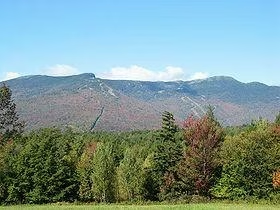
Willem Lange hikes the ridge line of Mt. Mansfield overlooking Stowe, VT, with the director of The Natural Areas Center at UVM and a viewer inspired by Willem to take up hiking. Will the trio make it to the Cave of the Winds near the summit?
Problems playing video? | Closed Captioning Feedback
Problems playing video? | Closed Captioning Feedback
Windows to the Wild is a local public television program presented by NHPBS
Cave Of The Winds
Season 7 Episode 2 | 26m 48sVideo has Closed Captions
Willem Lange hikes the ridge line of Mt. Mansfield overlooking Stowe, VT, with the director of The Natural Areas Center at UVM and a viewer inspired by Willem to take up hiking. Will the trio make it to the Cave of the Winds near the summit?
Problems playing video? | Closed Captioning Feedback
Where to Watch Windows to the Wild
Windows to the Wild is available to stream on pbs.org and the PBS app.
Related to This Episode
Providing Support for PBS.org
Learn Moreabout PBS online sponsorshipToday on Windows to the Wild, we're going to take you to one of the coolest places in Northern New England.
Coolest no matter what time of year.
♪ Welcome to Windows to the Wild.
I'm Willem Lange.
I'm standing today at the Summit House at the head of the toll road on Mount Mansfield in the Green Mountains near Stowe, Vermont.
The snow shower we had a few minutes ago has stopped for the moment, so maybe a halfway decent day.
We'll see.
And as you can also see, I'm far from alone.
On my left is Rodney Gonyea from Sunapee, New Hampshire.
You're a let me get it.
Respiratory... Therapist.
Oh that goes.
I almost said theologist.
[chuckling] Theologist?
It's good to have you here.
I might need you.
And on my right is Rick Paradis, a professor at the University of Vermont.
They're here for different reasons.
Rick is here because he knows the mountain.
He works up here with the students who are studying conservation.
And he also knows the trails.
You do, yes?
Why, I think so.
I'm happy to hear that.
And Rodney has a unique story.
A couple of years ago, you had an open-heart surgery.
Right.
And took up hiking.
Spring of last year.
For the first time in your life?
Yeah, yeah.
That's great.
And it's working for you?
My wife and I did.
That's great.
We do a lot together.
If she were [on this hike], it would be the last hike she would take.
You're probably right.
[laughing] Well, we're going to hike up the ridge here about a mile toward the summit of Mount Mansfield.
We have a little secret we're going to let you in on if and when we get there.
We’ll surprise you when that happens.
So, stick around, because the next half hour is one that you won't want to miss.
♪ Before we get too far down the trail, I have a confession to make: we drove up the toll road to the ridgeline.
If we'd hiked from the parking lot at the base, we wouldn't have had time to take you where we want to go.
♪ Well, on a clear day, you got a great view over to Burlington and Lake Champlain and the Adirondacks beyond, but I don't think we're gonna... Not today.
No, we're going to... resort to more intimate views of things.
♪ There are lots of hiking trails on Mansfield.
Some are simple and others are not.
We're on the Long Trail.
It's about two and a half miles each way and a fairly easy hike.
But remember the surprise that I promised you?
Getting there is going to be tricky.
All right.
And the secret place we're going to is the other side of...?
Of the lips, before we ge to the chin.
Right.
We're going to scoot down a little side trail called the Cliff Trail to get to it.
Okay.
Can't wait.
All right.
♪ The trails are well-marked to help keep hikers on track and off the alpine vegetation.
I noticed that there are strings here.
Yeah, there's kind of a... theory; we call it string theory.
[chuckling] Yeah.
This will actually keep people on the straightened arrow and keep them from stepping off the trail in places.
And it's pretty cheap to administer.
It's biodegradable cotton twine.
And the reason is what?
Keep them off the alpine vegetation?
Right.
Keep them on the on the trail and keep them from stepping on the the fragile alpine plants that we find right along the way here.
Mount Mansfield has the largest expanse of alpine habitat here in Vermont.
♪ It was all stranded here after the glaciers left.
That's right.
There are even some signs of glacial activity.
A little bit later on, we'll see some of that.
Rodney mentioned earlier he's been hiking for about a year following heart surgery.
He's using the hills to get better.
Living in Sunapee, New Hampshire, all he really needs to do is walk out his back door.
Do you have favorite hikes around Sunapee?
Yeah.
Andrew Brook Trail on the backside of Mount Sunapee is really nice.
It takes you up to Lake Solitude, which is probably around a three-mile hike.
And then another mile after that brings you to the summit of Sunapee.
And that's like 15 minutes the trailhead from my house.
Twenty minutes away, I can go to Kearsarge, and there's a shorter route which is about 1.7 miles, and that takes you to the top.
And a longer route, which is over four miles each way.
It's very nice.
♪ If my wife and I have a full day, then we'll just drive 2 or 3 hours to the White Mountains, and we've done a lot of that too.
I love the White Mountains.
So it was a life-changing experience for you?
Yes, it has been.
It's been great.
Unless you use the toll road or gondola, hiking here is free.
Richard spends time on the mountain because his employer owns part of it.
This area is what, a conservation area?
Yeah, the University of Vermont owns much of the ridgeline.
We acquired it way back in the 1850s.
We bought it off of a local Stowe resident who had acquired quite a bit of land up here from some of the previous settlers who couldn't figure out anything to do with it.
And so he sold the university about 400 acres.
But the university has been managing the land here as a natural area since then.
And so we have a number of conservation initiatives in place, including efforts to try to keep hikers on the trail and not stepping off onto the fragile vegetation.
All right.
We had something coming up.
A bog?
Yeah, we got a bog up along the side of the trail here we can take a look at, kind of an interesting feature, Après vous, monsieur.
♪ This is an alpine bog.
And only a couple here in the state of Vermont, they’re along the ridgeline here on Mount Mansfield.
And these are a good examples of a glacial feature.
The glacier carved out a little depression here.
It filled in with water, and then slowly, over time, with vegetation that really doesn't decompose very quickly in kind of a cold, acidic environment.
And so that organic material just accumulated, probably several meters in depth here.
Really?
Yep.
Like peat, sort of.
Yeah.
It is peat.
Yeah.
Just like the bogs you have down at low elevation, except this one is forming up here along the ridgeline.
♪ I'm leaning against what is called a glacial erratic.
It's a rock that's not where it was born.
It has been moved here by a glacier.
This one wasn't moved very far.
You can tell because it's still pretty rugged and shaggy.
So it probably just came off a little bit farther up the mountain and got dragged here and dumped by the ice.
Yeah.
In fact, you can see the scratches in the rock.
It's a little hard to see today because everything is so wet, but on a sunny day, if the sun is low and just right, you can actually see the scratches and the striations that the rock left when it was kind of dragged over to this location.
All right.
We'll continue on.
The weather is not lightning up too much, is it.
♪ Mount Mansfield is the highest mountain in Vermont, and it draws a lot of hikers about 40,000 a year.
The only time it's closed to foot traffic is for a brief period in the spring to protect the vegetation.
Winter is cold and snowy here, which for a lot of hikers just adds to the fun.
They do.
It's pretty popular.
There's a lot of downhill skiers and snowboarders that will ride the gondola lift.
And then from the gondola, they'll hike up to the top and ski off trail.
It's very popular.
♪ In case you're wondering, the device on my chest is not a rescue beacon; it's a camera, so you can see what I'm seeing.
How far have we come?
Oh, we've wandered probably close to a mile, and we're now at a junction.
We're going to leave the Long Trail and head down the Cliff Trail.
The Cliff Trail.
Right, to our surprise.
Why does that sound threatening?
Well, there's a bit of a cliff down below here.
[chuckling] Great!
It will eventually take you to the Cliff House.
I see.
Okay, but we’re looking for our surprise first, right?
Right.
Before we get to the Cliff House.
Should we tell him yet what it is?
Oh, I don't think so.
We should leave it for the suspense.
And if we find it, that'll be a surprise to us.
It will be as well.
Okay.
Let's go.
This will be no ballet here.
♪ Cliff Trail it is.
Bring good boots and prepare to move on all fours.
♪ [water streaming] ♪ [rustling] That’s one way to get down.
♪ [rustling] In a fairly secure spot.
[water streaming] [Willem laboring] Now you know why they call it the Cliff Trail.
Yeah.
What I'm doing right now is an old French alpine technique called [inaudible].
It's true.
It is.
The [inaudible].
Down we go.
Okay.
Holy mackerel.
Kind of a nice view from right here.
Oh, yeah.
Look at that.
Isn’t that nice?
This big cleft in the rock here.
The Cliff Trail doesn't end here.
♪ Look at that a level spot.
[sighing] ♪ Describe that for viewers.
What's that?
Describe that for viewers.
Well... all I can think of are those $160 rain pants sliding over those rough rocks.
It breaks my heart to think of it.
And this brook as we go down, have you noticed, it's getting larger.
And much larger it'll be; it'll have a name.
There.
Oh, isn’t that something?
♪ [chuckling] Am I enjoying this?
Yeah, I love it.
When you consider all the people my age who couldn't be here, who can't be here, and the smart ones who wouldn't be here, yeah, I'm enjoying this.
This is just wonderful.
And I'm with two great guys, one of whom wouldn't be here except for modern science.
So, you know, it's about as good as it gets.
Well, little sunshine could make it better, but these are the trips you don't forget right away.
♪ This is the surprise, right, Rick?
Oh, isn't that something?
Look at that.
Well, we have arrived at your surprise.
This is the so-called Cave of the Winds on the east side of Mount Mansfield ridge.
It's a huge chunk of rock that has slumped away from the mother cliff and left this cave behind us that goes down about 60 or 70 ft.
It may, but we're not going to.
We don't have the ropes or ladders or the helmets to do it.
But we are going to poke in there a little bit.
I had to congratulate you, sir, for leading us unerringly to this spot.
Well, you two are very welcome.
I'm also drying my gloves, as we shake hands.
This is one wet place!
It is a little foggy and damp.
We're going to drop down in here a little bit and take a look around.
At the back of the room that you can see is a big chalk stone that's fallen in from the roof, and you have to clamber up over that and down behind it to get to the rest of the cave.
But we'll take a look at the at the antechamber anyway.
So, here we go.
♪ So uh... We've arrived!
That's the rock that we have to climb over to get down To get any further.
Yep.
Woah.
This one probably came out of the ceiling.
Who knows?
A few hundred years ago or maybe last week.
Yeah, probably a while back.
A couple of rocks jammed up there, huh?
Yeah.
One over your head.
[laughing] Yeah, I see that.
I don't think I'd want to spend the night right in this spot.
I don't think that rock could get through that slot.
It's a little bit like four inches smaller.
Uh huh.
Uh huh.
Well this is it, huh?
This is the Cave of the Winds.
Right.
And I read somewhere that on certain days you can feel a wind.
Wind blowing out.
There may be another entrance, small, somewhere along the way to allow the wind to blow through.
Now, you were telling us that this was one of the coolest places in northern New England.
Well, it is.
It'll hold the cold temperatures well into the summer months.
And it's not uncommon to find ice in here, maybe some snow, although I think we're protected enough that snow probably doesn't blow in here in any great quantity.
But certainly, as you can see, everything is so damp that you can see where the ice comes from.
Right.
So I imagine it accumulates and then serves as a natural refrigerator to hold that temp and that ice through the summer months.
Very nice.
So if you had a hotel on the summit, you could send somebody every day to come down here and get some ice.
There you go.
Yeah, you come down here Run down to get a dozen eggs.
[chuckling] Bring a block of ice for the refrigerator, please.
Yeah.
It's not that I'm concerned about getting back out, but... You have a cell phone with you?
In my backpack.
♪ [rustling] Yeah, I think this is as far as we're going to go.
Here's what you gotta get your rope out.
Oh, geez.
Look at that.
Wooh!
Yeah.
Boy, if you were to fall down in there, and you didn't have the ropes.
I'm not sure you'd be able to get back out.
Whew.
Well, Rodney, you've now made it to the Cave of the Winds over the perilous ridge of Mount Mansfield.
[chuckling] in a blizzard.
Sort of.
Was it worth it?
Yes it was.
It was totally unexpected what I saw.
It was really neat going down as far as we could, you know, 80, 90 ft, and I was really surprised.
It was a great hike.
wish the views were better, but something I can do another time.
But you shouldn't use the past tense when you say, It was a great hike.
It's only half over.
That's right.
[chuckling] We gotta get out of here.
And it's nice down here.
There’s no wind.
Nice and quiet.
I know.
No wind.
But we think when we climb back up on that ridge, it may be.
Well, we'll see.
Yep.
It is what it is.
[chuckling] That's right.
All right, so back up the brook to the summit, the ridge, and then back on the I guess we're going to take the Subway Trail back, which is not a gentler trail than the one we came on, but it'll get us there.
Yeah.
Okay.
So we go.
♪ On the way back, I began to wonder whether to retrace our steps on the Long Trail or take the challenge of the Subway.
It's probably one of the more difficult trails on the mountain.
They rate the trails here E for easy; M for moderate, and D for difficult.
Cliff Trail’s a DD and the Subway’s at DDD.
There's a famous New York expression my wife frequently uses: Fuh-get about it.
[laughing] Do I feel guilty about passing up the Subway?
Yeah, a little bit.
But I won't deny you the chance to see what it's like.
So I'll send Richard and one of the camera guys.
♪ You want to go down this way because that will take us back further north.
♪ It's just fun to kind of scramble around on the rocks.
I get... considerable, I guess, satisfaction out of, you know, still being able to do it and then also just the aesthetics of the jumble of rocks and being able to sort of drop down, you know, not quite underground, but down into these little slot canyons, looking up at rocks that have sort of jammed up into the rock walls above you.
And I just wonder about, when are they going to fall?
I mean, things are changing here.
Even though the geology is old, things change.
It doesn't take too long for some of these rocks to shift around.
And they will drop from time to time.
In fact, there was a story I heard a couple years ago about a fella who was hiking, I think somewhere through here, where he went to reach up to grab... a handhold, and he pulled a rock about the size of, oh, I don't know, a stove or a washing machine down.
And it pinned him.
It didn't pin him directly on to the, the floor, but it pinned him enough where he couldn't get out, and he sort of hollered for a while until a few other hikers heard him, and they came over, and then they were able to get some additional assistance and either lift the rock or pry it out of the way and rescue him.
And he ended up with some bruises but that was about it.
So you got to be a little careful around that loose rock.
We've dropped down a bit into the sort of the high-elevation balsam fir, and there might be some red spruce here.
So we're down below tree line in kind of a high- elevation conifer forest.
These will eventually get shorter and shorter in stature until they hunker down pretty low to the ground often referred to as krummholz, which is a German word that, I guess, loosely translates to crooked wood or stunted wood.
And when we were up along the ridgeline, we were kind of walking through a combination of the alpine habitat and the krummholz.
So we're dropped down into a place where the trees are a bit more statuesque, but they're still not all that tall.
♪ That's the Canyon North Trail there.
That's where they're supposed to come out, right?
They haven't done that yet.
Do we wait for them or do we keep going?
That's the big question.
What do you think?
♪ Well, we made it back to the ridgeline here, back to the windy weather.
And we're just going to continue to hike south along the Long Trail back to the parking lot where we started this morning.
♪ Well, as you can see, we have reached we've been on terra firma, but this is terra not-so-slipperia, and it's a lot more comfortable than the trip we just made over the mountain.
Now, on the way back, Rick had this brilliant idea that there was an alternative trail we could take, and we asked, How difficult?
He said, Well, it's a little a little more difficult than this.
So... I made again one of those prudent decisions for which I am famous and came back the way we went, which was bad enough.
And you went...?
I took the Subway.
I did.
And?
Well, I must admit, you made the right choice.
[laughing] What was it like?
Well, if you can imagine scrambling down into a Subway, maybe in New York City.
Oh God.
It was dark and a little damp, but it was quite an adventure.
We had a good time just sort of scrambling around on the rocks.
And at one point we had to get down onto our chest and sort of crawl do a little wiggle through a slot up and up out the backside, went down a ladder.
Somebody left a ladder for us.
That's nice, I guess.
Yeah, yeah.
You must have been slow-going because we were going slowly and we beat you.
I think we were walking in the opposite direction for a while before we actually got back to the Long Trail.
Rodney also made the intelligent decision.
He did.
He did indeed.
We got back in one piece.
That's great.
Which brings us, once again, to that time of the program I dislike the most.
Although today I might I might change that opinion a little bit.
This is not necessarily the worst part of the show when I have to say bye-bye.
We're going to get in our vehicles and go find hot baths.
You bet.
Somewhere.
We are soaked and wet and happy and successful.
I really can't thank you enough for coming along.
It's just been super to meet you.
Mr.
Paradis.
Yes, Willem.
Again, we’ll do it, I hope.
Absolutely.
Let's just check the weather next time.
Okay.
Okay.
We'll order up something different.
Well, we hope to see you again on Windows to the Wild.
♪
 New Episode
 New Episode
- Drama

Lesley Manville and Tim McMullan return in the final installment of the Susan Ryeland mysteries.

 New Episode

 New Episode
 New Episode




Support for PBS provided by:
Windows to the Wild is a local public television program presented by NHPBS