
Exploring the Night Sky
Season 8 Episode 12 | 26m 47sVideo has Closed Captions
Willem and NH astronomer John Gianforte head outdoors to explore the wilderness above us.
Willem and NH astronomer John Gianforte head outdoors to explore the wilderness above us – the night sky. Gianforte, who's also known as "The Sky Guy," shows Willem where to look and how to use new technologies to identify planets, stars and constellations.
Problems playing video? | Closed Captioning Feedback
Problems playing video? | Closed Captioning Feedback
Windows to the Wild is a local public television program presented by NHPBS
Exploring the Night Sky
Season 8 Episode 12 | 26m 47sVideo has Closed Captions
Willem and NH astronomer John Gianforte head outdoors to explore the wilderness above us – the night sky. Gianforte, who's also known as "The Sky Guy," shows Willem where to look and how to use new technologies to identify planets, stars and constellations.
Problems playing video? | Closed Captioning Feedback
Where to Watch Windows to the Wild
Windows to the Wild is available to stream on pbs.org and the PBS app.
Providing Support for PBS.org
Learn Moreabout PBS online sponsorship-Space.
It's been called the final Frontier.
Well, today we're going to show you how to start exploring that final frontier from your front porch, your neighborhood, or your favorite hiking trail.
So stick around.
It's going to be fun.
♪♪ Welcome to Windows to the Wild, I'm Willem Lange.
Since the dawn of humanity, people have been gazing skyward, intrigued by the bright show that comes to life every evening after the sun goes down and the lights go out.
The night sky is full of stories and drama and mystery.
But knowing where to look and how to look is pretty important.
Luckily, we have with us this evening somebody who's going to help us do just that.
John Gianforte is an astronomer, educator, and our guide to tonight’s sky right?
-Yes.
-Welcome to-- pleasure to meet you.
-Thank you, pleasure to meet you too.
-Now, you-- do you know what you're up to here tonight?
-I do, I do.
-And it is, what-- -We're going to we're going to try to give some people some basic information on how they can enjoy the night sky when they're out doing other things during the day, hiking, sightseeing, barbecuing, and when the sun goes down, how do they find out and determine what it is that's looking down at them?
♪♪ If people are interested in doing some stargazing, you really don't have to do anything different.
You can, where, when-- wherever you are when the when the sky gets dark, you ought to be able to look up and at least find a couple of stars or constellations, like, say you're hiking and it gets dark and you're tired and you're sitting there by the campfire and you, you've got to you've got to look up at least some point, and when you do, after you've seen beautiful scenery and enjoyed hiking all day, stargazing is kind of a natural, relaxing activity that is something, that is best done in the place where you've been hiking.
I've been on some hiking trips myself with my wife, one in particular, on a rafting and hiking trip on the Colorado River down at the, in the Grand Canyon.
And, as hard as people will hike and, and, strain themselves during the day, once you get a campfire going, you get a good meal, you start talking and it gets dark when you look up with no light pollution at all, -Yeah [Willem chuckles] -you can see stars-- you get so, confused because the stars are so many.
You even if you have a star chart with you, it takes you a while to find your bearings because you just don't see that many stars and I remember this past year, last year we went on an April trip, one of the first trips down the river.
And, we'd always camped in a tent overnight you, the raft pulls over and you make your tent and this year we didn't do that.
We actually got cots and we slept under the stars.
And I brought my camera with me, which my wife advised me not to because it was heavy.
-Yeah?
-Because we had to hike out of the canyon from the bottom.
So, but I was it was a beautiful, clear night.
We're in cots, and I took lots of photographs of the night sky with just a single lens reflex camera, nothing fancy.
And, you take a few minute exposures, and I did this all night, and finally, I, I must have shot probably 40 or 50 pictures over the night of different rock formations with stars just above the rock formations.
And I noticed there was a kind of, a kind of a yellowish cast in the east and I said, what, what could that be?
There's no whites out here, and I realized it was the sun-- -You’d been up all night!
-All night and that, that's, that's just unbelievable to-- the night just flies by, on the few winks of sleep that you do get, you notice the Milky Way crossing the sky above you, it's just-- and to know what some of those constellations are is very satisfying.
♪♪ -We have, what, maybe half an hour to sunset?
-Yeah, just about.
-And then we're going to do something like spotting something important right?
-We're going to try to view tonight comet PanSTARRS, which is just a it's a, it's a comet that was discovered in 2011 that's just made its way up from the skies of the southern hemisphere and entered into the skies of the Northern hemisphere, just a few nights ago.
-It's the first time it's been spotted by anybody?
-Well, there was a few people up in the Northern hemisphere that have seen it, since Saturday night.
We'll be able to view it after the sun goes down.
While the sky is relatively dark, it'll still be bright because the sun will be close, but, I think enough nights have passed and the comet is separated enough from the sun, we should be able to get a good view of it if the clouds cooperate.
-Well that's great.
And we're going to be up on this bridge here, right?
-Yes, we are.
-To do that, all right.
John and I are walking on the center span of the General Sullivan Bridge.
We can do this without getting run over because the bridge has been closed to everything but pedestrians and bicycles.
It was built the year I was born, and it's showing its age some, flaking paint, rust and gaps in the pavement.
[puckering] [faintly] Hey there.
To the west, Little Bay glows in the sunset, stretching toward the distant hills of lowland New Hampshire.
Perfect for viewing comet PanSTARRS.
A little bit of a sliver of a moon up there, eh?
-Yup and that's what we, that's what we'll be using to help us find the comet tonight.
-Oh really?
-Yeah.
-Where is the comet in relation to that?
-Well, the comet is a little less than halfway between the crescent moon-- -Yeah?
-and the top of those trees off the horizon.
-Uh huh.
-Those sky conditions are perfect.
Perfect, perfect, perfect.
-Yeah they are, very nice.
-I mean that's, the comet is right is right there, right, right in that blue, nice part of the sky.
It's just gorgeous.
-When does it turn on?
[John clears throat] -Well, [Willem chuckles] it's still rush hours.
-Besides John Gianforte who’s here with us, there are three other star watchers on the bridge.
They all know each other and John, and they're all looking for the same thing.
This is fun for you then?
-Yeah this comet will be visible for about ten more days.
It's, It's in between Mercury and the sun now-- -Yeah?
-and it's heading on it's, around the sun and of course, then it'll head back out of the solar system.
-This is, this is a new thing, never been here before?
-This one actually has never been here before, and I believe it won't come back I think it's on an orbit that doesn't make a closed loop it's an open orbit, so it's this will be the last time we see it but being at so close to the sun, it's possible that it might essentially heat up and, and, out gas or even explode-- -Yeah?
-causing it to become tremendously brighter.
We're all hoping for that.
-Wait a minute let’s leave the poor comet-- -I know.
sorry.
-geez!
[chuckling] -Well there’s plenty more out there where it’s coming from.
-Yeah, I guess, all too many apparently.
It's cold.
A little above freezing, I'd guess, but the northwest wind is bringing in an Arctic cold front, and it's just a bit biting.
So here we stand, distracting our attention by peering through binoculars and telescopes toward a space in the western sky about halfway between that sliver of moon and the spot where the sun is just going down.
We keep trying to fight off the cold by talking about comet PanSTARRS.
[traffic thrums] Ted was saying he kind of hoped it blew up, so we get a good look at it.
-Well, we were hoping that when it made its closest approach to the, to the Sun on the 10th, -Yeah?
-we were hoping that it would really, something would really happen.
-Yeah.
-We’d have some kind of, you know, like a disconnection event where comets actually get disrupted.
-Yeah.
-And they really gain a lot of brightness and, luminosity when that happens.
♪♪ -A low bank of dark gray clouds hovers just above the horizon.
♪♪ Above that, the sky is clear as a bell.
And somewhere in that patch of clear sky, still invisible to us because of the brightness of the sunset, is a comet.
♪♪ -This should be, it should be close to when we should start to see something.
-The sun just set, but it's still a little too light to see PanSTARRS, so John talks about how to get your bearings in the night sky.
-I always tell people when they go outside to, with the intent on finding things in the sky, is to go out where they are comfortable observing, whether it's a school yard or their backyard or their front yard, and get oriented to the four cardinal directions first: north, south, east and west.
And the way to do that is to kinda, and it's a great example of what we're doing right now.
We, we, we we all just watched the sunset just a few minutes ago.
So we know that the sun rises in the east and sets in the west.
So if you stand outside and, point your your left outstretched arm toward where the sun went down and then extend your arm, your right arm out the other opposite that you've got two of the four cardinal points set.
-Especially at this time of year because almost it's almost-- -It's almost due east and west, right?
-Right, yeah.
-So now you've got two.
And when you're standing here like this, hopefully while nobody's watching you, [Willem chuckles] you’re facing due north and due south is right behind you.
-Yeah.
-Once you do that, you can use a star chart or any of the app applications on mobile devices to find your, find your way around the sky, because we describe things, in astronomy, where they rise, what horizon they rise above, where they are in the sky relative to the cardinal points.
♪♪ -I camped out on, Arches National Monument in, southern Utah, Arizona and there you had to book about 18 months in advance to get a site, but take a chance, which I did and in the middle of the night there, I had my head out the door of the tent, and the sky is like black velvet.
There was this black velvet and the stars were like little gems hanging down there you feel like you could pick em out of the velvet.
-That’s great.
-So beautiful.
[chuckling] -So, around the big cities we get a lot of light in the sky, and it makes it.
-Yeah.
-Yeah, but it's still great to see everything up there.
-A bunch of us climbed Mount Marcy in the Adirondacks once on New Year’s Eve, -Yeah?
with a parachute we were gonna use for a tent.
-Wow!
-Quiet, cold, cold night We slept like a radial engine on an airplane.
-Yes.
-Feet in and our heads out.
-Yes.
-And you could lie with your head out of the tent.
-Yeah, yeah.
It was hot?
-It was full moon, it was unbe-- and I'm sw-- -That’s spectacular.
-I swear, I heard the ringing of the spheres [chuckling] [Willem makes ringing noise] -You’re talking about heat out the tent.
I'm claustrophobic in a small tent, so I had my head out the tent all night and unbeknownst to me because I'd never been there before, A ranger came past in the morning and he said, I forget [inaudible] You realize, I walked past that you were sleeping outs-- out, with your head outside he said there’s scorpions running outside and tarantulas.
[laughter] That'll do it for ya!
♪♪ -So let's take another look.
♪♪ -We shiver some more and do aerobics up on the bridge, and then one of the amateur star watchers hollers: There it is!
-Got it?
♪♪ Does he have it?
-It's much higher than we thought it would be, look more up toward the moon.
My heart sinks as I realize we'll be here longer than I'd hoped.
But the excitement of spotting PanSTARRS at last is making up for the discomfort.
John spots the comet with his camera and begins taking digital photos.
[camera whirrs] ♪♪ [camera whirring] ♪♪ Notice how the long exposure times of the photos make the sky appear brighter in the west.
♪♪ -Now that we've seen the comet, it's a little bit higher than we thought, which is a good thing.
And, the longer we wait, as the sun gets further and further below the horizon, ♪♪ the darker the sky that the comet will be visible against, and the longer an exposure we can take of it.
And that will show, ♪♪ a bigger comet, more detailed, it'll reveal more of the tail, which is substantial right now.
So the longer we-- then then then Western sky is clear.
It's dry.
And, it looks like it's going to be, we're going to get some good images.
♪♪ -Tonight we've got PanSTARRS.
Not as bright as some I've seen, but a respectable, fiery presence above the western horizon.
I could use some of that fiery presence right here, right now, but just seeing it at least takes our minds off our cold digits and noses.
♪♪ -When I explain to my astronomy students, or anybody that I talk to about space, I tell them that going out and doing, observing in-- at any level, just taking a walk at night in a dark location or coming to the observatory and looking through a telescope or sitting out in your back deck using a pair of binoculars that is rediscovering the universe for yourself.
[indistinct chatter] That is so important.
It's like taking a walk in a national park.
It's-- it's exploring nature, at a grand new level, at a different scale.
It's just a different kind of nature walk in a different place in the universe.
It's-it's every bit as real, and enjoyable as taking a walk through the woods on a nice, quiet day.
♪♪ -So now we're going to go down to where there's less light from streetlights.
-Yes.
-And then shoot down here on the, on the grass down below here in the park.
-Well, we've got stars above us, and, we're going to go and point out some of the brighter stars that people can see even on, even in an urban location.
-Yeah?
-Which is great that means people can go right off their front steps, ♪♪ unless they live in New York City or something but, I mean, certainly from nearly any place in New Hampshire, they're going to be able to go outside and, find out what are those bright stars out there?
-Great, let’s go do it.
-Alright!
-Alright.
♪♪ Orion is high in the sky now.
-Yes.
-That’s the dog-- the dog star which rises in August, which makes it the dog days, right?
-Oh yes, Canis maj-- Sirius in Canis Major?
Yes, the big dog.
Sirius is a relative clo-- relative neighbor of the sun, just under nine light years away, which makes it a neighbor.
-Yeah?
-But it's the brightest star in the sky, as you know, and makes it a great guidepost for people trying to find their way around the night sky in the winter or spring.
-Yeah.
-So if you step outside on a March or April night and face south or southwest low in the sky, you're going to see a bright whitish star-like object.
If it doesn't move, it’s Sirius.
The-- also called the dog star.
The heart of the dog as it's the brightest star.
-Yeah?
-Not only is it the brightest star in the sky, but it's the brightest star in the constellation Canis Major, the big dog.
And I think that's one of the few constellations that the brightest stars of the constellation actually looks like a big dog.
And let me-- I know I'm using a little imagination as opposed to Canis Minor-- -Yeah?
-and the bright star Procyon.
-Procyon?
-Which is not very far geographically in the sky from Sirius, also in the south, but a little bit to the east or to the left of Sirius.
There's only two stars.
-Yeah?
-In, two bright stars in Canis Minor so it's really a little dog.
But Procyon is a is a pretty bright star.
Not quite as bright as Sirius, but it's bright enough to see, even in a in a city.
Now, we're not very far from from Portsmouth, New Hampshire.
And even though we're just a few miles from Portsmouth, it's pretty dark here.
We can see quite a few stars in Orion, and not just the brightest ones, but, and the-- some of the brighter stars in Canis Major, Taurus the bull, all very prominent winter constellations.
-Yeah.
-We should probably mention, just for a moment, probably one of the most famous three in a row patterns of stars.
It's not a constellation, but it's, what astronomers refer to as an asterism.
It's like a subset of bright stars within a constellation.
-Asterism?
-Yes.
-That would be, the belt?
-Yes!
-And the sword?
-Yes, the stars that are the three in a row stars that make the belt of Orion, even if you don't know anything about astronomy, if you walk out on a winter or early, spring night and you find, Sirius and you go a little bit to the west or a little bit to the right of Sirius, you will find the great hunter Orion, marked by bright stars, but this three in a row pattern of only moderately bright stars attracts so much attention because they're almost the same brightness and they're almost a perfect straight line.
-That's called an asterism?
-Yes, an object, like, it's like a subset of, of a constellation.
-Yeah.
-Usually it involves the, the brighter stars of a constellation that makes some familiar shape or easily recognizable shape.
-Yeah.
-And, and I have more people who don't really know their constellations, but they sure know the belt of Orion, because those three stars are close enough together where you can just look up and see them.
And when you see that, you know, you're looking at the great hunter Orion.
-Got it.
And you know that over your right shoulder there’s gonna be the Big Dipper.
-Yes, yes because if you're looking at Orion this time of the year, you're facing south and-- -And, and-- -North of us-- then suddenly everything goes dark.
[Willem narrating] Wow!
It's really dark!
Great for watching the night sky, but, not so hot, for doing an interview.
But in just a minute or two, the crew had the lights back on.
♪♪ Anyway, what I was, what I was saying, [laughter] -Nowadays people can get a night sky app for their iPad, right?
-Yes.
-Wherever you hold it up, it shows you what you're looking at.
-Yes.
-And names what you're looking at.
-Well, there's lots of these free applications or apps for, any mobile device, iPhone or an Android phone or an iPad and you, it basically gives you a picture of the night sky and because of the devices within the smartphone, the accelerometers, it knows where you're pointing, it knows where you’re pointing.
-It knows where you are too.
-It knows where you are because if it has any kind of GPS capability.
So in astronomy, you have to know what time it is and where on the planet you are.
-Yeah.
And if you-- the device knows where you're pointing, you could point it to the bright star Sirius, and right in the field of view, right in the display, it would say Sirius, and it would draw the stick figures of the constellations, so you would know that-- the extremities of the constellation -That is so great.
-Everybody has a story about when they were a kid that they went on hikes or they went to a, a cabin or a cottage on the lake, and they just laid on the boardwalk and looked up and they counted meteorites, meteors, or satellites.
♪♪ [on speaker] Welcome, everyone.
Students, parents, faculty members, amateur astronomers.
♪♪ We talked to a lot of people who come to the UNH Observatory on our public nights, and now most people will have a story that relates, when they were a kid, -I liked space since I was little, and, I always wanted to go to space camp, and I finally got to go.
-That relates to something astronomical that they saw.
Maybe it was Halley's Comet.
-And ever since then, I wanted to be an astronaut.
-Maybe it was Comet West back in 76.
-And I’m, now getting my PhD, so hopefully I'm still on that path.
Maybe it was Comet Bennett in 1971.
♪♪ I've talked to people that, that remember Comet Bennett in 71, Comet West 76.
-I saw West, didn’t know what it was.
-But that was that was quite a while ago and yet it's still resonates in your mind.
Many people have, stories and memories of doing something astronomical.
I think it touches a lot of people in a lot of different ways.
-They always say, that's the last great-- it's the last frontier, right?
So, you think about the people who have been, you know, we've only had 12 people ever in the history of mankind that have ever set foot on another world.
And just the idea that there's not only our world and the moon, which are the only two we've ever explored, but there's seven other planets in our solar system alone, moons orbiting those planets.
And then we know of over 700 planets orbiting other stars.
So if you extrapolate that, that's just one part of one galaxy.
So if you think about it, there must be hundreds of thousands of planets with people probably just like us, or maybe entirely different from us thinking about the same thing.
You always want to think about what else is out there.
I think that's probably one of the greatest questions that mankind is ever going to have is what else is there?
Where haven't I been?
Where can I get?
And I think space is just it's the largest playground for an explorer.
So it definitely fits in with that theme of getting someplace you want to go that you've never been and most people haven't been.
-Makes it even more fun when you can go out and point out the bright stars, the planets that might be out at that time of the year.
And it just makes it, if you're gonna go somewhere and enjoy scenery and hiking and gorgeous animal life during the day, why not garnish it with something observing at night?
-Yeah, good, I never did see a satellite when I was a kid.
-Yeah.
-They didn't go up till I was about 30.
[both laugh] Well, that's good reason for you not to-- having seen any.
[Willem chuckles] -John, I have learned more this evening than I ever dreamed I would.
It's just fantastic.
How do you know so much?
-Well, I've been studying the stars for a long time, since when I was about seven years old.
So after that long, you kind of pick up things here and there?
[Willem chuckles] -Well I picked up about seven years worth of knowledge tonight, thank you so much.
-You're welcome.
-It’s been a tremendous pleasure I hope we can do it again sometime.
-Pleasure's mine Will, I had a great time, and I look forward to that.
-Okay.
I hope it's a little warmer next time.
-Me too, let's do this in July.
-Oh, yeah.
I wouldn't even mind the bugs.
[both chuckle] Okay which brings us once again to that time of the show, I have to say goodbye, so I will.
Goodbye, I'm Willem Lange, I hope to see you again on Windows to the Wild.
♪♪ ♪♪
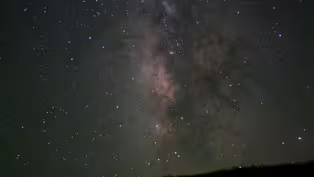
Exploring the Night Sky (Preview)
Preview: S8 Ep12 | 21s | Willem and NH astronomer John Gianforte head outdoors to explore the wilderness above us. (21s)
Providing Support for PBS.org
Learn Moreabout PBS online sponsorship New Season
- Drama

Hugh Bonneville stars in a crime drama inspired by one of the largest robberies in British history.
 New Episode
- News and Public Affairs

Top journalists deliver compelling original analysis of the hour's headlines.


 New Season
 New Episode
 New Episode

 New Episode


Support for PBS provided by:
Windows to the Wild is a local public television program presented by NHPBS