
Soaring Over Franconia
Season 8 Episode 7 | 26m 46sVideo has Closed Captions
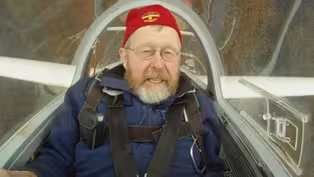
Willem soars the thermals in a glider plane piloted by Peter Stauble.
Willem soars the thermals in a glider plane piloted by Peter Stauble of the Franconia Soaring Association. They enjoy views of the stunning fall foliage of Mount Lafayette, the Cannon Balls and the Kinsman Range.
Problems playing video? | Closed Captioning Feedback
Problems playing video? | Closed Captioning Feedback
Windows to the Wild is a local public television program presented by NHPBS
Soaring Over Franconia
Season 8 Episode 7 | 26m 46sVideo has Closed Captions
Willem soars the thermals in a glider plane piloted by Peter Stauble of the Franconia Soaring Association. They enjoy views of the stunning fall foliage of Mount Lafayette, the Cannon Balls and the Kinsman Range.
Problems playing video? | Closed Captioning Feedback
Where to Watch Windows to the Wild
Windows to the Wild is available to stream on pbs.org and the PBS app.
Providing Support for PBS.org
Learn Moreabout PBS online sponsorshipToday on Windows to the Wild, you're going to see New Hampshire's White Mountains as you probably have never seen them before.
♪ Welcome to Windows to the Wild.
I'm Willem Lange.
Some of you may remember that a few years back, I went hang gliding strapped to the bottom of a giant kite.
Well, that was fun, but once was enough!
Well, you'll be happy to know that I'm going to take another flight today, but this time not hanging from a kite, but inside a glider at the Franconia Soaring Association in Franconia, New Hampshire.
My pilot today is Peter Stauble, Who is you're an engineer, right?
That is correct.
That's comforting.
You're under 60, right?
Yes, sir.
[laughing] That's comforting.
And you were flying since you were 17?
Yes I have, yeah.
That's amazing.
Power planes and gliders.
Wow.
And you’re commercial?
You have a commercial license?
Correct.
Commercial license and an instructor rating.
Yeah.
So I couldn't be in better hands.
Is that correct?
That's the rumor.
[laughing] All right.
The tow plane’s going to come hook up to us, we'll take off and go up to how high?
If the clouds will allow, we'll go up to 5,000 ft above the ground here.
And then just kind of circle around and... Yeah, enjoy the view and have some fun.
Now, I got this parachute on, and I have the feeling that means something.
Well, in case we decide you're having lots of fun and you'll have more fun, we might try a loop or something.
And if we do any sort of aerobatics, we have to have parachutes per the FAA regulations.
I see.
We might try a loop.
We just might.
Do you ever try one and not make it?
Nope.
Okay.
Good.
Every takeoff has resulted in a landing.
Yes.
I'm sure.
And we end up landing here.
That’s Right.
Good.
Well, I suppose we might as well do it.
Yeah, let's do it.
Thank you, Peter.
All right.
♪ We'll be in the air in just a few minutes.
But before we take off, let me tell you how today began.
♪ The morning broke with a thin layer of frost and a thick layer of fog everywhere.
Didn't look too hot for our chances of flying.
♪ But by 8:30 A.M., the ground crew at the Franconia Soaring Airport... was warming up the tow plane a 1956 Cessna reconnaissance craft whose camouflage paint barely covered its original French Air Force markings.
It was actually employed by the U.S.
Army for a number of years as a spotter plane used to spot enemy formations and other enemy concentrations for artillery use and things of that sort.
So, it was used for many years by the U.S.
Army.
We also know that we've seen pictures of it actually being flown by the French Air Force; pictures of it at French airfields.
And we have no idea how it got there or how it got back.
But the important thing is it's here today, and it's our tow plane that we use for towing our gliders here out of the Franconia Airport.
Parting words?
Adios!
I'll be back.
Peter, is part of the appeal of flying a glider the affordability?
Yeah, so that's why I do it.
It's a lot cheaper than power planes.
And, for the club members, the rental of the glider is $20 an hour or $15 an hour depending on which glider it is.
So, the only real expense is the tow, because the tow planes are very expensive to operate.
But, if you can take one tow and stay up for a couple of hours 2 or 3 hours it's really affordable.
And instruction in the club is free for students.
Are you coming up with us?
No.
You’d have to strap me to the wing in that case, so... I see.
Okay.
I guess... I'll tell you what I'll actually help you take off.
Oh, bless your heart.
I'll run the wing and make sure you have a successful launch.
But we'll have a more confident pilot in the back seat.
[Willem chuckles] Okay?
Okay.
That's fine.
Let's go.
Looking forward to it.
Here we go.
♪ Get yourself into that.
This is my rocket pack is it?
Yeah.
Okay.
Let's get you strapped in.
All righty.
Good idea.
Imagine the thing coming off when you pull the door.
You don't want that to happen.
[Willem chuckling] I can imagine it.
Right.
Put it on right here.
All right.
It's like a climbing harness.
Pretty much.
Yeah.
Why is a parachute needed?
In case we decide to do any maneuvers.
Aerobatics.
It's required by the FAA regulations.
Don't do this in the air.
No, no, I won’t.
I got my instructions and planted myself in the narrow seat up front.
The film crew fastened little video cameras here and there on the glider.
Yeah, well, safety procedures... [canopy latching] So, if you have to open the canopy, just pull back and lift up on the... Okay.
And this safety harness, it's snug right now.
Of course, you're all snugged in.
It's all secure.
To release it, you just turn this left or right.
It just pops right off.
Clockwise?
Either way.
Oh, either way.
Either way works.
Okay.
Got it.
Okay.
And these are the controls: rudders and stick just leave them free so Peter can operate those controls.
Okay.
Yes, Dan, it looks like the rope is all set for flying today.
The tow plane hooked its line to our nose... Gland prop!
[engine starts] And we were off jouncing down the grass runway, which was built during the Second World War.
[vibrating] Finally, the jouncing stopped and we were up climbing toward Mount Lafayette.
♪ Peter, what keeps the glider in the air?
I was wondering about it.
Well, the glider is always coming down at a particular rate, perhaps 200 ft a minute, you know?
So, the trick is to find air that's going up faster than 200 ft a minute.
And there's really three sources of lift: there's thermals, which is the sun heating the ground and the hot air rising.
And with thermals in New England the highest you’re going to get is probably around 10,000 ft above the ground.
Another source of lift is what we call ridge lift, which is the wind blowing perpendicular to the ridge and being deflected upwards.
With ridge lift, you can fly anywhere from treetop level to 1,000 ft above the ridge.
And the final source of lift is wave lift, which is when the wind blows up a mountain and down the other side; it compresses and then bounces back up similar to a rock in a river.
With the atmosphere, the upper winds get deflected upwards also.
This builds higher and higher, and forms a mountain wave that can go up to 20, 30, 40, or 50,000 ft.
♪ Everything's great.
Yes, sir, it is.
♪ Peter, what's the farthest you've ever flown?
When I went down to Pennsylvania, I flew about a 270-mile triangular course down there.
That particular day, I was up for 6.5 hours, but a lot of that was just sightseeing.
I wasn't trying to rush.
Say again.
Will do.
What kind of planning do you have to do to ride thermals?
I'm the type who doesn't do a lot of planning.
I just do it.
Yeah, I fly for fun, so I'm not out setting records.
Okay, we're going to release in about 5, 10 seconds.
Yep, we're about to release When we release he's going to turn left.
[cable releases] Thank you for the tow, Henry.
We drop the tow line somewhere above 5,000 ft, and we're on our own.
Low clouds streamed over Cannon Mountain and ran down its sides.
With the glide ratio of 38 to 1, the sailplane felt, to me at least, just like a regular light plane, but a lot quieter.
Nothing but the wind whistling past the canopy.
[wind streaming past] We have winds out of the west or northwest.
And then with this ridgeline off our left Cannon Ridge we can stay up all day.
It’s lots of fun.
The location is ideal.
It's just a few minutes by air from Mount Lafayette, Franconia Notch, and the Kinsman Range of the White Mountains.
The views are incredible, and the waves of air flowing over the mountains and rising from the fields create great updrafts.
You can't see them, but when you get in one, it's like a great invisible elevator.
Hawks and eagles use them too.
It's called ridge and thermal soaring.
Some flights have reached 35,000 ft.
On a good day, sailplanes can fly either east to Mount Washington or west into Vermont, and back too.
That's fairly important.
♪ The Franconia Soaring Association was incorporated in 1989 by a group of 14 pilots.
Five of them are still active.
They pooled their money to buy their first sailplane, and they were off and flying.
Over the years, they've had between 25 and 40 members.
Currently, the club owns several sailplanes and their really funky tow plane a 1956 Cessna L-19 Bird Dog.
It offers scenic glider rides, holds an annual field day for local residents, and gets kids flying by offering reduced rates to its junior members.
Several junior members who got their start here have gone on to careers in aviation.
♪ Right now, we're just doing about 45 knots.
The pilots here at the Franconia Soaring Center claim they can teach almost anyone to fly a sailplane.
There's a twin seat ship here that's ideal for instruction.
It's not cheap, and it takes time an average of about 30 flights to get ready to solo.
Some students do it after only 20.
Others have taken as many as 100.
All the instructors, like Peter, are FAA certified flight instructors.
One boy is just 11 years old.
And I’m giving him lessons.
He just started.
There are a couple of members I soloed one student at 14 years of age in the glider.
It's not uncommon to get started real young and enjoy flying early.
So, you can solo a glider at 14.
Ah.
That’s great.
You don't have to pass any written exam or anything?
Not to solo.
To get your license you have to take an exam.
Up all by yourself.
Make sure they know what they're doing before we turn them loose!
Oh, yeah.
But the kids learn young.
Yeah.
Key is proper instruction and... giving them lots of what-to-do and what-not-to-do.
They pick it up pretty quickly.
And what to do if .
Exactly.
[laughing] Yes.
Yes.
Joe Kwasnik is the president of the Franconia Soaring Association.
He's been flying gliders for about 18 years, I have just as many takeoffs as landings, which is important!
When you're missing one of those, that's the problem, you know?
Yeah, I can see that!
No, wait a minute.
You couldn't have more landings than takeoffs.
They gotta be exactly the same.
If you have one more takeoff and landings.
There's something missing.
Yeah, something missing.
Yeah, you!
Yeah.
But, you know what’s interesting?
This airport was built in the late 40s, right at the end of World War II with the idea of shipping war material that would be manufactured in Littleton.
The war ended before it was really used for that purpose, but it's been a glider airport for probably about 50 years.
And it's the last surviving glider port in New Hampshire.
That's perfect because of the all the ridges.
It's an exceptional place to fly in New England.
It’s probably the best place in New England.
Wow!
And we do our part to try to keep this airport functioning and available to the public and for future generations of glider pilots.
♪ The sport of soaring began in Germany between the two world wars.
The Treaty of Versailles in 1919 forbad Germany from, among other things, developing an air force.
So, the Germans turned to sail planes to train their pilots.
And they actually, instead of using tow planes to tow up gliders, they actually used to launch them with large bungee cords off of ridges.
[Willem chuckling] Like this: they shoot them off like a little balsa airplane.
And that's how they trained the pilots so that when they started to build more warplanes in the late 30s, their pilots were well trained.
So, one of the German aces of World War II learned how to fly in gliders.
And also, in the United States, gliding actually started in the late 1920s out in a place called Torrey Pines on the California coast.
And one of the early licensed glider pilots was actually Charles Lindbergh and his wife Anne.
No kidding.
After his flight across the Atlantic when he was a celebrity he went out to Torrey Pines, California, in the late 20s and actually was one of the first licensed glider pilots in the United States.
When the wind’s out of the South like it is today, it tends to be a little bit bumpy.
Yeah.
♪ I've flown in quite a few bush planes.
They're pretty noisy.
And nowadays they want you to wear earplugs.
The sailplane felt just as solid as a powered plane, at least to me.
And it was so quiet that Peter and I could chat without raising our voices.
Okay, I’ll hold it straight on course, and just let me know which side you’ll be on.
♪ Down below us, the forest was in fall colors, and we drifted over it as silently as a hawk.
I'd expected to be anxious about getting back to the airport, but after a while I could see there would be no problem with that.
♪ Peter popped the question I had been half dreading.
We're going to do a loop, okay?
Yep, I said, but with a little trepidation.
One quarter-mile west, coming over the highway, I got you in sight.
Okay.
We’re gonna accelerate a little bit.
First, build some speed.
Peter put the plane into a steep dive.
The horizon disappeared, and I was looking at dense hardwood forest.
[wind streaming past] [wind streaming past] I absolutely forgot the cameras and the microphone when we were looping.
You can't imagine how relieved I am that all I said when we straightened up was Holy Toledo.
♪ Doing just one loop was enough for my constitution, but we had five cameras rolling when we did that 360.
So, we're going to run it again to show you all the different views we captured.
Check out the fall foliage in the background when we're upside down.
♪ Holy Toledo!
♪ Are you having fun?
Would you like to do another loop?
No more loops.
No more loops, okay.
Peter is the perfect pilot for a newbie like me.
He's steady as a rock.
He's 55, lives in Hollis, New Hampshire, and works as an engineer for an ultrasonic transducer manufacturer.
He started flying power planes in 1974 and gliders in 1975.
He's done over 4,000 hours of flight time and 1,650 glider flights.
He's been up to 27,000 ft in altitude in an oxygen-equipped sail- plane over Mount Washington.
He is FAA certified as a commercial pilot with an instrument rating and clearly loves what he's doing here.
I do.
I enjoy flying.
It's what I do best.
I always find it a challenge, whether it's a simple matter of trying to do a smooth landing or gaining some altitude or just sharing the fun of flying with somebody else.
Sure!
Have all the fun you want!
What was it like the first time you did a loop in a glider?
Of course I was young, so no fear when you're young.
I enjoy loops and it's a lot of fun to do that.
One time when I had excess altitude and just had it to burn, I did ten in a row.
How high do you have to be to do a loop?
FAA regulations require that you got to be above 1,500 ft.
I’m gonna turn and come around back on your other side.
Okay.
I'm going to have to get crosswind here pretty soon.
Peter, you've been flying since you were 17, any the close calls or oopsies or I-don't-think- I’ll-try-that-agains?
I've never had any accidents in over 4,000 hours of flying.
There are things you have to deal with, but if you train properly and you remain calm, you can deal with them.
I landed once in a golf course in Jackson, New Hampshire but it all worked out just fine.
It was in the fall; I was actually flying up North Conway and I was trying to get into the mountain wave behind Mount Washington, but North Conway is 17 or 18 miles downwind that's back when North Conway had an airport and they had me in a lower- performance glider and it's penetrating into that headwind to connect that wave and it just didn't connect.
So yeah, landing was inevitable.
So I just picked a nice golf course to land and that's all.
Which hole?
[Peter laughing] It was long ago.
I don't remember which one it was!
Hope nobody was out there playing!
It was late October, so no one was on the course.
Well, you can see those clouds rolling over the hill there.
That weather’s really moving up from the south.
A lot of the higher-performance and newer gliders have flight computers with GPS; they have a moving map and it’ll tell you with your altitude how far you can make it.
Or if you want to set it to a particular airport you want to get to, it'll tell you you're going to be there with, you know, 825 ft of altitude by the time you get there based on this speed or you’re going to be 400 ft low when you get there, so you got to stop and find some lift before you get there.
So, these compute the lift and everything It takes the average lift you've encountered on your flight and computes your airspeed and knows the sync rate of your glider at the different airspeed you fly, and maps it all out for you.
So, it makes it easier.
Of course, the gliders I fly are a little older; don't have that technology.
So, I kind of use the rule of thumb and it works that way.
Yeah.
[wind streaming past] I always look for wildlife when up here I see moose.
I have seen them a couple of times.
One time we landed at the airport with a student and there was a bear on the runway We came to a stop about 50 ft away from the bear, and then he scampered off.
♪ After about half an hour, it's time to set up for a landing at the wings.
it's time to set up for a landing at the wings.
If you look at the wings you’ll see the spoilers on top there.
See my wings?
Yep.
That's how I control the glide path of the landing.
♪ Gotcha.
♪ So what I’m doing is I'm just looking at the runway, asking myself over and over, Am I high?
or Am I low?
or Am I on target?
Then, I adjust my spoilers accordingly.
♪ Well, we're lined up with the runway and letting down very gently.
It's so much smoother than a powered plane, slower and quieter, and you have the feeling it's so much lighter.
It's like a swallow landing on a fencepost.
[vibrating] But I plan my landing so I don't have to use the brake at all.
My goal was to stop here at this hangar on our left, and I'm obviously about 20 ft short of where I wanted to end so... Well, as you can see, we're safely back on the ground.
We beat the rain.
Plane is all covered up neatly and put away for the day at least, and, in keeping with my practice of doing one new thing every week, we did a loop.
[chuckling] That's it.
No more loops.
But it was really exciting.
Well, Peter, I cannot thank you enough.
It's just wonderful.
Quite welcome.
It was a pleasure flying with you.
Oh, was it really?
It was.
You're welcome back anytime.
Okay, good.
Which means we've come once again to that part of the show that I like the least the time we have to say goodbye, so I shall.
I'm Willem Lange, and I hope to see you again on Windows to the Wild.
♪
Soaring Over Franconia (Preview)
Preview: S8 Ep7 | 21s | Willem soars the thermals in a glider plane piloted by Peter Stauble. (21s)
Providing Support for PBS.org
Learn Moreabout PBS online sponsorship New Episode
- News and Public Affairs

Top journalists deliver compelling original analysis of the hour's headlines.
 New Episode
 New Episode
 New Episode

 New Season

 New Episode
 New Season

Support for PBS provided by:
Windows to the Wild is a local public television program presented by NHPBS