Women in Leadership
Entrepreneurs
Episode 1 | 26m 46sVideo has Closed Captions
Women in Leadership: Entrepreneurs
Women in Leadership: Entrepreneurs
Problems playing video? | Closed Captioning Feedback
Problems playing video? | Closed Captioning Feedback
Women in Leadership is a local public television program presented by PBS Michiana
Women in Leadership
Entrepreneurs
Episode 1 | 26m 46sVideo has Closed Captions
Women in Leadership: Entrepreneurs
Problems playing video? | Closed Captioning Feedback
How to Watch Women in Leadership
Women in Leadership is available to stream on pbs.org and the free PBS App, available on iPhone, Apple TV, Android TV, Android smartphones, Amazon Fire TV, Amazon Fire Tablet, Roku, Samsung Smart TV, and Vizio.
Providing Support for PBS.org
Learn Moreabout PBS online sponsorshipWomen in Leadership, a local production of PBS Michiana-WNIT, is presented in partnership with Mr. Jerry Hammes.
Mr. Hammes is proud to present this program in memory of his late wife, Dorene Dwyer Hammes and all the women who continue to impact our community for the better.
Additional funding provided by NIPSCO, The South Bend Clinic, and First Source Bank.
Thank you!
The most important thing that I teach is listening, awareness, compassion for yourself as well as other people.
I want it to be not just a bookstore, but a community space, a gathering space.
I was minding my own business, graduating from college, and CNN approached me and said, hey, we want to do an article on your pollinating drone.
Like, well, sure!
Let's go for it!
As we journey through life, our priorities often change and Suzy Vance uses her personal experiences to help others become their best self.
I graduated from law school in the mid 70s.
And at that time, when I went to law school, only a third of my class was female.
And it was the first class that had more than eight women in it and we had our challenges in law school.
So when I got out of law school at the age of 30, I have to say, I wasn't particularly surprised that I would have interviews at all kinds of law firms, but then they would realize how old I was; they'd ask me about children.
They'd ask me how I was going to take care of my children if they got sick.
It just there were all these obstacles.
Kathy Burnette's desire to learn helped her on her path to owning, The Brain Lair.
I bought a book called Owning a Bookstore for Dummies.
And then I enrolled in a course about opening your own bookstore so I could learn all the ins and outs of it.
I became a school librarian since I didn't think I could afford to own a bookstore.
And I felt, OK, this library is dead.
No one would go, it's a middle school library.
How can I make changes that might inform what I want to do later?
I also used to work at the Notre Dame bookstore because you think you know how something works and then you get there.
And you're like: a lot more work than I thought it was.
When I think about what was I like as a kid that led me to this space right now, when I was maybe in fourth or fifth grade, I was identified as gifted and sent to a different school.
And at that school reading was valued.
I was exposed to C.S.
Lewis, Isaac Asimov.
So like reading these fantasy books like, wow, this is fantastic and talking to people about books.
So that's where my love of books started.
I was really not young.
I was fourth or fifth grade.
When opportunity knocks, Anna Haldewang knows exactly how to answer.
Growing up, we didn't have TV and we were told to go play outside.
So we were always creating and playing in the woods and building things in the trees.
And so, it was a wonderful childhood, at the time I didn't think so.
But now, looking back, I can see how those experiences shaped who I am today.
And I am the oldest in our family, and so I am the rule follower and leader of the group.
And so I, I do enjoy roles.
But being an entrepreneur is not completely opposite that.
But that's you know, you do break boundaries when you're creating something very different.
And so it's pretty cool to see how I've grown and how I've challenged myself from being that very astute rule follower to now, OK, how many boundaries can we push?
What can we change and how can we revolutionize the industry today?
And then I had a friend who I'd worked with in politics who said, who's a banker, who said to me, Suzy, what if the bank loaned you enough money to start your own law firm?
And I said, Oh, my gosh, could that really happen?
And so we started the first women's law firm in the city of Chicago.
One of my biggest successes, practicing law, was arguing before the US Supreme Court and winning.
That was wonderful.
It was Justice Stevens' first decision when he came on the bench and it was before there were any women there.
I don't know if I see myself as an entrepreneur.
I think it depends on how you define that word.
What I like to do is figure out what the problem is and how can I solve it.
So in this case, I thought it could be solved with fiction, with books.
We mostly sell fiction.
The name Brain Lair is an anagram of the librarian, which I was a librarian for about twenty years, school librarian.
And that is what when Twitter opened in 2007, that was my Twitter handle.
The Brain Lair is primarily a children's book store.
We focus on books that uplift marginalized voices, so we look for books that feature black, indigenous, Latino like different kids of color, LGBTQ and characters that may have disabilities, both mental and physical.
My grandfather founded a company when during his time and it was a family business, and then my father sold the company.
So I kind of have a bit of that entrepreneurial blood in me.
I was minding my own business, graduating from college and CNN approached me and said, Hey, we want to do an article on your pollinating drone.
Like, well, sure, let's go for it!
So did the did the interview and it went viral worldwide unexpectedly.
I was a lawyer in downtown Chicago and I had in my law practice, I represented husbands, wives and children and employers and employees.
I did everything about personal conflict, you can imagine, and people always were spending way too much money doing what they could ultimately be arriving at.
Because I used to ask my clients, who do you think decides what justice is?
And they'd all say the jury or the judge.
The bottom line is that people solve their own problems.
And so I quit the practice of law in 1988 and said, I'm done with this.
But people wouldn't let me alone.
They kept calling me on the telephone.
So I morphed into being a life coach before there ever was such a term.
I am a very curious person.
I love research, I love trying things.
I do not stick with things long.
I think being a librarian was probably the longest I've ever been in one job because I was allowed to try different things each year.
And we did the one book, one school, because I want to see how does that work?
How does bringing an author in work?
How does, how do we do these things?
How do I convince teachers to incorporate different books in the classroom?
So just all the things that I thought would help me as a bookseller, I did.
And with those experiences in hand, Kathy Burnette founded a bookstore that promotes and validates all kinds of voices.
Traveling from being a lawyer to a life coach is not necessarily rocket science for somebody who has been in the law doing personal and professional relationships and divorces and those.
Going from there to being an artist... First of all, I wouldn't say that I have left life coaching to be an artist.
I don't think life is linear.
It's that I've given myself permission to play with the stuff around me that I love and that has morphed into something I never really ever thought it would.
If you don't take the risk, you can't learn anything.
I don't worry about failing at something because I know I could still get a lesson out of that.
Plan Bee started out because we had a pollinating drone.
And because of the word B E E that really cornered us in with pollination.
And so from that lesson, I learned that we needed a more broader name, something that can tell a little bit about what we do.
But it doesn't hone us in specifically so that we can have a larger umbrella where we can pivot into other industries and seasonal methods as well.
Every single bookstore makes a choice about which books they will put on the shelves.
And so that's the same thing with an independent bookstore.
I have a mission that I want to support.
I have a way that I would like for people to live, and I believe that I don't have to carry things that are against what I believe in, because one thing, it's difficult to sell something that you don't have a stake in.
It's a lot easier to sell something that you're passionate about.
There are certainly, you know, common things between being a lawyer and life coach.
Because being a life coach, for me at least, was dealing with all the stuff that I used to deal with in the practice of law without the ongoing conflict.
It was all about strategy, which I love to do.
And I love to help people who aren't strategic realize the steps that they can take.
It's like, you know, people come to me and they're here and they want to get here and they can't for the life of them, understand what it what you need to do to get from here to here.
Part of getting from here to here.
I've done, so, I have a life experience of it, but everybody does it differently.
So I came back to Indiana, where I live, and I spoke to a well-known grower in the area.
I said, hey, I don't have a background in robotics and agriculture, at the time.
And he said, go for it.
So I founded the company in 2017, and we took a pollinating drone out to Australia because, at the time, they needed, well, almond blossoms require 100% pollination.
So every year they take millions of hives out into the orchards.
And so that was my target market.
And at the time Australia, it was their bloom season.
So we built a pollinating drone prototype, took it out to Australia and it did not go well.
We had wind issues, battery issues.
And from that experience we decided, OK, where can we go from here?
And so we moved the pollinating drone to a ground robot.
I have a bunch of notebooks that I've always written in.
I don't go back a lot and look at them again, but I like to write stuff down.
I always have ideas of what if I do this?
What if I try this?
What if I tried this thing?
Being true to oneself is the core of what Suzy Vance teaches.
As Sister Corita Kent says: "We all do this every day.
We're creators.
Every time we do something, we fit something together, like a loaf of bread or a child or a life, we're creating."
We aren't necessarily painters, but we all do this.
One of my great workshops is How to Make Bread.
It's a great team building exercise and I have people gathered upstairs all around the counter and I teach how to make three different kinds of bread in three hours.
And it's because I teach different phases of it at different times.
But people go nuts.
They, people love to make bread.
It's really fun.
I love to watch the ones that are uptight at first, try to knead the bread and then those with, you know, they finally get it.
It's amazing how many people are empathetic towards an entrepreneur and the struggles that they go through and how they also want to be a part of the process.
I hired a third party development company up in Zeeland, Michigan, called DISHER, and they have been with me from the beginning of the pivot to further understand the market.
And there's an actual need for the product and they have developed, help develop the autonomous side and the rover as a whole into what it is today.
And not only with the development team, but then I also have a wonderful group of mentors, as well.
For example, I have an advisor from Blue Diamond Almonds that sits on my board and is a wonderful mentor, mentor and resource.
I joined Nerd Camp starting in, I think it was 2012 and there wasn't one last year, but every summer, for two days, a bunch of nerds, a bunch of authors and illustrators, get together and talk about how we can get kids to read.
And this is basically that's what it is: We read, we talk about reading, and we share our reading with other people.
Some of the greatest skills that I teach are listening.
It's probably the most important thing that I teach is listening, awareness, compassion for yourself, as well as other people.
I created a list for a friend called "This List is Anti-Racist."
Teachers were asking what should we be teaching in schools?
What should be what should we be reading right now?
I'm like, oh, here's this list of these books.
And I just threw it out there.
And then Oprah Winfrey's book club retweeted it.
People from the star of Gossip Girl, Blake Lively, she retweeted it and it kind of went crazy.
By keeping an open mind, Anna Haldewang has been able to revolutionize an industry.
So we had this pollinating ground robot that we took out to California during their pollination time for the almond blossoms.
And while I was out there, we were running into some efficiency issues and I was having lunch with one of my advisors.
And he came to me in a really bad mood and he told me about Navel Orange Worm and Mummies.
And I said, well, I have a I have a prototype that can do exactly what you need.
So the growers have to target this pest when it's at its weakest, when it's hibernating inside of this mummy.
So what they have to do is they come in with shakers and they'll shake the bottoms of the trunks for a few seconds and the mummies will drop.
However, this only works during a fog or after a rain when mummies are at their heaviest.
If a grower comes in with a shaker, on bright, sunshiny, dry day, it's just not effective.
And if that doesn't work, then as a last resort, growers have to hire hand pullers, which are labor contractors, and they'll come in with 15 foot bamboo sticks and hit and poke each mummy out of the tree.
And as you can imagine, it's very costly and backbreaking work.
So we've invented a way to automate this method.
I would say my greatest accomplishment with the store was making sure that the homeless shelter had books.
So we raised money.
I have a nonprofit, I didn't before, I would just give money, to kids who don't have books.
We work with the South Bend schools and make sure the kids that are from Title I families have books at home.
We deliver them personally also.
So those are kind of my biggest successes, I think.
Working with the schools, making sure that kids who don't normally have access to books, have access.
Because we know that if you just have books in your house, you are a better reader, you have a better vocabulary.
There's something about the presence of fiction that improves reading.
And so that's usually what stops families.
One, parents may not know what books to choose for kids, and then they don't know how to interact with the kids with the books.
So that's another thing I do with the South Bend schools.
We had a reading round up.
So I go to different schools, I bring books, I read to everyone.
And as I'm reading, I demonstrate how to hold a book, how to talk about a book, and then I give books to kids to read.
So they practice reading and we just walk around and do games and they get to take those books home when we're done.
I do life coaching, I do healing, I do fiber painting, I do all kinds of things.
And I began to play with fiber in other ways.
I had knit since I was 12, and all of that led finally to playing around with felting, which is a way of using water and soap to take fabric without knitting it and taking fiber without knitting it and making it into fabric.
The fiber work I do is pretty novel.
I have to say, I've seen some nuno felting that is clothing and things like that, but nothing like the frame stuff I've done.
I just don't see it out there.
So we have a ground robot that'll roll down the middle of the orchard and we use a target, remove, report method.
So it will target, it'll identify the mummies in the tree with its orchard ID camera system.
And once the mummy is targeted, it's removed using biodegradable pellets in a safe, accurate and eco friendly way.
However, while the rover is targeting and removing mummies from the tree, it's also collecting valuable data about every tree, every acre and every variety.
So, for example, at the end of removing mummies from an orchard, we'll be able to deliver a spreadsheet to the grower and we'll be able to show them how many mummies we removed, how many mummies were removed per variety, and how many mummies were removed in total.
And we'll be able to show them where they were heaviest with in the orchard, with mummies, essentially like a heat map.
And over time, the grower is able to overlay this information and problem solve as to why certain parts of their orchard received mummies the heaviest.
And growers have never received data like this before.
It is the first to market with something this impactful.
Some of the challenges that we faced at The Brain Lair, was first growing too fast with me being the only person that's working there, both online and in person, trying to do all the things, that was my first.
How do I make that work?
And the set up of the store was my second challenge.
And I took a class about that because parents are the ones who have money.
Children don't have any money.
So how much space did I want to devote to adult books?
And did I want to still have the same mission that I had with kids books, with adult books?
Or was I willing to do something different?
If I were to say the biggest challenge for somebody, for anybody, is to honor who they are.
At all times.
It can be crazy, it can be very frightening.
It can be I mean, in my example is that I quit cold turkey.
I just really got to a place where I realized I was frozen.
I just I wasn't doing anything that I wanted to do.
And the product that I was turning out wasn't making me very happy either.
And so I quit cold turkey.
When I say I quit cold turkey, I walked in one day to the partners in the law firm that I was with, which was a large law firm in Chicago, and said, I'm ready to leave.
I would like to be of counsel for a year to wind down my practice and then I'm gone.
I mean, it was a year of self reflection, something that I was lucky enough to be able to afford.
But at the same time, all of that was happening.
The phone kept ringing and when the phone rang, I would say sweetly to somebody, I'll be glad to help you out, but I'm not going to the court, I'm not going to be in the courtroom.
I will help you figure out what it is you want and I'll coach you to approach the people you need to approach to make what it is you want to have happen, happen.
And one thing led to another and the phone never stopped ringing.
The pandemic was insane.
I noticed back in March of 2020, the online sales went from ten a day to 100 a day.
And I didn't know what to do because it was just me and I have a full...
I have a part time job that I do three days a week, so I could only do it at night and the days I wasn't working.
And then when George Floyd died in June, a lot of people started ordering from black bookstores.
So I went from 100 orders a week to 300 orders.
I'm sorry, 100 orders a day to 300 orders a day.
And I actually had to turn the ordering system off because I didn't know how I was going to be able to fill all those orders.
Being as sustainable as possible and being mindful of what we're putting back into the soil and having something that degrades over time is important not just for the Earth itself, but for the processing plant as well.
I mean, you don't want those little pellets going to the processing plant and being sorted through because that's just another thing they have to worry about.
So and growers care that their orchards are clean.
The difference between ordering from a small independent shop is I have to look at every single order and decide how it's going to be fulfilled.
Do I send it to the warehouse?
Do we have stock inside?
How do we do it shipping?
So that was crazy.
I hired four people, two online and then two in the shop so that we could make it through that.
And one of them is still an employee that I have online.
So eventually we'll have a rover that's in the orchard 24/7, 365 days a year, performing a certain role for the grower every single season, not just with almonds, but also into other fruits and nuts as well.
My creativity just flows, you know, when I'm out walking in the morning and I take pictures, I have a series of pictures that also have haiku poetry with them that are, sort of, prayers to the Earth.
There isn't a specific set of rules that launches someone on a guaranteed path to success.
But while Suzy, Kathy, and Anna represent a diverse palette of vocations, they have one thing in common.
After reaching a turning point, each fulfilled a bigger dream.
I think some of the greatest successes I've had in founding my own company, would be the learning experiences along the way.
And there have been a lot.
And each time we come out of testing, there's always something unexpected that happened that, you know, you can plan all you want, but it's never going to go the way that you imagined it.
And while, in the moment, it's a little bit frustrating, you have to embrace it.
And it is wonderful to look back on those times and say, OK, well, we learned from this experience, which now has led us to what we're creating today.
And, you know, just being able to look back on those times, it's all been a success and it's not going to go the way you planned it, that's for sure.
I want it to be not just a bookstore, but a community space, a gathering space.
They could come and sit and just talk to somebody who understands what they're going through and just... Or just kind of sit.
But it's been a journey and it's been wonderful to look back and look at all the lessons that we've learned.
For someone who wants to start their own business, you really just have to dive straight into it.
If I were to say the biggest challenge for somebody, for anybody, is to honor who they are.
InsightTRAC is a game changer for the almond growers.
I'm not a good manager, but I'm a great boss.
I would like it if people remembered me as somebody who lit somebody else's fire.
Women in Leadership, a local production of PBS Michiana - WNIT, has been presented in partnership with Mr. Jerry Hammes, Mr. Hammes is proud to support this program in memory of his late wife, Dorene Dwyer Hammes and all the women who continue to impact our community for the better.
Additional funding provided by Thank you.
This WNIT local production has been made possible in part by viewers like you.
Thank you.
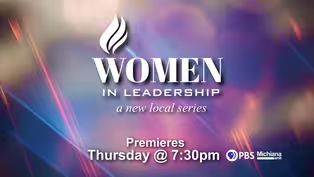
Women in Leadership Entrepreneurs Preview
Preview: Ep1 | 20s | Women in Leadership Entrepreneurs Preview (20s)
Providing Support for PBS.org
Learn Moreabout PBS online sponsorship














Support for PBS provided by:
Women in Leadership is a local public television program presented by PBS Michiana