
Work
Season 2 Episode 3 | 55m 33sVideo has Closed Captions
The human story of work is the story of how work has been transformed by energy.
Modern energy transformed work over time. From farm to factory to office and the “work from home” revolution, energy is embedded in our systems of employment. What is the future of energy and work?
Problems playing video? | Closed Captioning Feedback
Problems playing video? | Closed Captioning Feedback
Work
Season 2 Episode 3 | 55m 33sVideo has Closed Captions
Modern energy transformed work over time. From farm to factory to office and the “work from home” revolution, energy is embedded in our systems of employment. What is the future of energy and work?
Problems playing video? | Closed Captioning Feedback
How to Watch Power Trip: The Story of Energy
Power Trip: The Story of Energy is available to stream on pbs.org and the free PBS App, available on iPhone, Apple TV, Android TV, Android smartphones, Amazon Fire TV, Amazon Fire Tablet, Roku, Samsung Smart TV, LG TV, and Vizio.
Buy Now
Providing Support for PBS.org
Learn Moreabout PBS online sponsorship[Narrator] Work and energy are intimately related.
Energy is needed for all the work we do.
What is the future of energy?
What is the future of work?
Will we still work 40 hours a week from 9 to 5?
Where will we work?
Will humans work at all?
Or, will energy-powered machines replace our jobs?
- Before the Industrial Revolution, there was a very profound ceiling on economic growth.
In a way, modern energy removes that ceiling that exists for the organic economy.
- The dictionary definition of energy is the capacity to do work.
- The story of energy and how it's impacted work is fundamentally the story of transitioning away from human physical force and labor into energy force and labor that then human beings are directing.
- It's like opening Pandora's box.
You let out some really good things, massively increase productivity.
You can now harness mechanical energy rather than sweat from human beings.
- Making cloth is one of the first things in the world that gets fully mechanized.
Water power was the driving force.
The machines were big, had lots of moving parts.
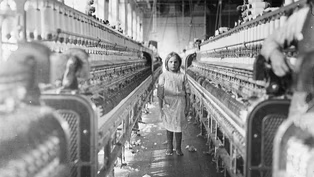
- The conditions in the factories are really very brutal.
Child workers.
Children lose their limbs, people lose their limbs.
- People gravitated towards these large cluster cities because that's where the jobs were.
- You sense everything is shifting.
- We've got to get a fair day's pay for a fair day's work and we ain't getting it now.
- You see a massive rise in what we call now the middle classes.
- You have electricity, you have lighting.
It's not the case you have to go and toil in the field 16 hours a day and if the crop fails, you're gonna die.
You've got a new source of income which hasn't existed before.
[intriguing music] [Narrator] Today, every kind of work we do depends on energy.
Lifting, moving, lighting, heating, cooling, making, selling and buying.
From the farm to the factory, from the office or at our desk at home, energy is the invisible force that transforms work.
[upbeat theme music] [Narrator] To understand ourselves and each other, we must understand the force behind the global events that shaped the world.
[helicopter blades whirring] [ship horn blasts] [thunder rumbles] This is "Power Trip: The Story of Energy."
[bright music] We use machines to do work and machines need energy.
Before machines, work was done by humans, but we need energy too.
A typical human takes in 2,000 nutritional calories per day and can output energy at a rate of about a hundred watts.
Enough to power a light bulb.
- Buildings built hundreds of years ago are different than today because it took so much longer to build.
It would take many generations of people to build a beautiful cathedral.
They got there because humans or maybe humans and animals cut and moved and stacked the stones.
It's just incredible.
I look at these ancient monuments, these pyramids, aqueducts, canals, roads that span hundreds of miles and I'm just in awe because they were built before they had diesel machines or steam shovels to do the digging and trenching and placement of the stones.
Because it took so many materials, it took so many people to build, there was a lot of slavery and forced labor.
So this is one of the horrible downsides of older times.
It's impossible to fathom how much energy was required to build these monuments, so people make up theories.
The aliens did it.
Because an alien seems otherworldly and magical, which is kind of like what energy is.
[mystical music] [Narrator] Energy and magic aren't really that different.
Both transform darkness into light, cold into heat, water into ice or steam.
[geyser gushes] Unlike magic, energy isn't conjured from thin air.
The First Law of Thermodynamics states that "Energy can neither be created nor destroyed.
It can only be converted from one thing into something else."
[dramatic music] How did early humans get energy?
They used manpower and that often meant enslaved humans.
Thousands of slaves built structures like aqueducts.
Another ancient form of energy was animal power.
Eventually, the power of water was discovered.
People harnessed the ocean's tides for power and later built water wheels.
Then came windmills.
All of these crude forms of energy powered our work, but still, we sought a better way.
[train chugging] - When I think of the first and second Industrial Revolutions and the rise of steam power and coal power, I think of the United Kingdom.
- Before the Industrial Revolution, the wealth was definitely concentrated in the land.
- It was the really teeny, tiny percentage of British families, these top men, and they were men, they're all titled, they held land and that's how they generated their money, through land, through rents.
Some of them had sheep and they used wool for an export.
Of course, these families intermarried between each other to make each other richer.
There's no way that any working person or even lower middle person could ever get into that echelon.
So if you are poor, you are never going to move.
You are always going to be working.
- The United Kingdom doesn't have the mountain ranges that are as prominent as the Alps on continental Europe, so it doesn't have the flowing water the same way.
It doesn't have the same kind of movement of wind the way the Netherlands did.
So it needed other ways to harness energy.
- Mechanical power comes from human muscle and animal muscle.
Heat energy comes from wood, forests, they take up land.
- Before modern energy, work was almost exclusively manual.
It was manual labor to cook or to farm or to construct or build things or to make leather goods.
Whatever it is, it was done by hand.
If you go back to the rhythms of society, it was driven primarily by agriculture.
We would start working when the sun rose and stop working when the sun went down.
We didn't have modern indoor lighting, maybe some candles or some torches.
So our work was mostly outdoors and we would do it during the daylight.
[harvester engine whirs] - If you could transport someone in time from a few hundred years ago to today, they would be amazed at how easy life is.
How effortless it is because we use modern energy to reduce the burden.
[Narrator] Today, the first sign you'll see of a city that's growing quickly are construction cranes.
Those cranes are using electricity, diesel or some modern form of energy to lift heavy objects.
Energy moves materials where they are needed and energy is embedded in the materials themselves, like steel and cement.
All of this energy makes the work of construction easier and requires fewer people.
But how did we get here?
It may have started simply with the need to keep warm during the cold winters in Britain in the 16th century.
[dramatic music] [fire crackling] - It's the world of the classical economist.
An organic economy is one where mechanical power and heat energy are derived from the land.
And competition for the land that's available is intense and the land available imposes a ceiling on that economy.
It's an organic economy that really is dependent on the annual plant cycle, on photosynthesis.
You couldn't have industrialized on the basis of an organic economy.
- United Kingdom also had cut down most of their trees.
Before coal, you would use wood to get that heat.
But they did have robust coal seams.
- You know there's surveys across the country.
They produce these amazing maps of the whole of the UK and they're really just saying, "Wow."
[Michael] With the trees gone and coal abundant, they switch their resource to use coal.
[gentle music] - Coal also starts to play a role in replacing that mechanical energy, which before had to be from animals or from human beings and that's through, of course, the steam engine.
You can talk about how many horses a lump of coal can replace, but it's a fabulous magnifying process.
- There are a lot of motions that could be achieved with steam power that before that had to be done manually.
Someone raising water out of a mine with buckets, someone spinning threads themselves by hand.
- It was really textiles to a large degree that drove the Industrial Revolution and Britain's always been a great textile country, partly because we have a great climate for sheep.
Before the Industrial Revolution, what you have is you have textiles, wool in particular, being made in the home.
What the inventors are doing is efforts to speed up and make more profitable what had been home woolen cloth creation.
These inventors know that somehow this steam is going to really create industrial strength, really speed things up.
Really up until then, they have very shallow coal mines.
There's only so much they can get out.
What steam could do was create these incredible, powerful draining machines so that this very low water could be taken out.
And actually that meant that the miners could get much deeper.
Coal mining could be much more efficient.
- Coal is really expensive for fuel, so you try and use as little of it as you can.
- The price of coal literally doubles 10 miles away from the pit head.
These engines are using lots of coal, so that's their really primary use, at pit head to pump the water out of the coal mines.
[gentle music] [Narrator] In 1765, a young Scottish engineer called James Watt created the first efficient steam machine.
Now people could build factories almost anywhere.
By 1800, there were over 400 steam machines scattered around the country.
The cotton industry and brewing were all transformed by steam energy.
Steam power made large-scale coal mining possible and by the late 19th century, there were hundreds of thousands of new jobs created, energy jobs.
Coal mining employment in Britain peaked in the early 1900s with over a million workers, more than five percent of the total workforce.
The power of steam and coal transformed work with an energy revolution.
Coal was virtually everywhere underground in Britain, so transportation links were created to move coal across the country.
Steam and coal rebalanced British society.
As new jobs were created in the cities causing a large-scale migration of people seeking new work opportunities.
- People are increasingly networked.
Energy from coal was in a way an essential step.
We couldn't have done things without it.
- England starts to use coal much earlier than many other European countries.
So London rapidly grows to become a very large city providing a very serious concentrated market for manufacturers and that's one of these virtuous circles that coal production engineers.
- You don't have to live in a tiny community and you don't move outside your village.
People are tending to move to cities and urban areas.
What can you send along a network?
You can move people, you can move information, news and knowledge.
Everyone actually knows for the first time much more what is going on.
So it's much less insular and much more being aware of the wider world.
[dramatic music] - Increasingly through the Industrial Revolution, you see a huge scale transfer of the economic wealth from the hands of the landed gentry to these middle class, factory-owning men and their families.
The middle class has become incredibly powerful.
- The challenge of having these innovations that come along with energy is it disrupts the workforce.
New jobs are created.
Factory jobs, for example, textile workers and that meant a loss of other jobs where people weren't making textiles by hand anymore.
They would go to a factory and make it with machines.
- On one hand, the old structures in which the peasants were perhaps better looked after in which the whole family made the wool together and the old people and the children were employed, those have all gone.
- People who were angry about the rise of machines started to fight back.
They started to attack the factories or attack machines and set them on a fire.
The word sabotage comes from the French word "sabo" or boot, throwing boots in a machines to ruin the machine.
This wave of resentment became later known as the Luddites.
People who are suspicious of modern technological advances.
In particular with modern lighting, we could move indoors, we could also move our jobs indoors.
We could start to move to shift work, 24-hour work days at a factory where you have three 8-hour shifts right in a row.
- There's no way that you can say that working in a mill was less dangerous than working on the farm for making cloth.
Machines are very close together, they have moving wheels and pulleys and gears and parts that are banging back and forth.
[Narrator] Textile machines were never turned off because to turn them off would lead to a loss of profit.
Children were sent under the looms while they were operating, causing many children to lose their limbs.
- More people are actually gonna have other problems such as losing their hearing or getting dust and lint into the lungs and getting lung problems or diseases.
- If you go back far in time, everyone did manual labor, men and women alike.
Over time, men did more of the manual labor and women did more of the factory labor because the nimbleness and dexterity of the smaller fingers were desirable.
Same is true for children.
And so you see women and children working in factories and the conditions weren't safe and they also were less empowered to protest.
You would have children working these factories and they wouldn't have things like a fire exit.
So if there was a fire in the factory, a hundred kids might die.
There's a famous fire in New York, the Triangle Shirtwaist fire, where a lot of people died 'cause they couldn't get outta the factory.
- Although on one hand, there are a lot of jobs created, these jobs are insecure, they're brutal, and you really have to bring in laws.
[Narrator] An industrial reformer named Richard Oastler campaigned for the end of child labor in factories.
Motivated by his Christian faith, he made a case that children deserved rights and should be protected.
Just as activist William Wilberforce before him advocated an end to the slave trade, Oastler sparked a movement against child labor leading to worker reforms.
Eventually, childhood came to be viewed as a time for education, not work.
- People, they're injured all the time, and unless the factory owner feels like giving them a present, there's nothing.
When there's less work, they can be laid off, just sacked and there's no unemployment benefit.
These are brutal jobs, hard on your health, hard on everything.
And at the same time we have these middle class factory owners who are very pious.
They talk about philanthropy.
This is partly due to their Protestant religion, the hardworking Protestant religion, the idea of giving back.
And it's also a way of them distinguished themselves from debauched aristocracy.
They want to be different.
These industrialists build villages around their factories.
They build housing.
And they build amenities like libraries, leisure centers and art galleries.
This is an interesting question because on one hand, yes, the workers have got houses, but on of their other hands, they only have houses if they work and it's quite a repressive ideology, often there's a teetotal and their behavior is controlled.
- If you look at the rise of factories, which depended on extracted forms of energy, these extractive industries are very dangerous and required a lot of work, but made a lot of money.
[carts rumble] An extractive industry is an industry that makes money by extracting things from the earth.
This is primarily mining like coal mining or copper mining, but also oil and gas production.
- There really is no sympathy for people who can't work anymore.
It's all about profit and if you can't work, if you're not a strong man who can go down the mines anymore, if you lose a limb, if you perhaps lose your mental health, that you are just outta the window.
- If you were here in about 1850, you'd be getting up at say 4:30 in the morning, you'd be at your mill by 5 o'clock, and in the summertime work until about 8 o'clock at night.
So basically a 15-hour workday plus an additional probably 8 hours on Saturday.
Wealth was definitely being created.
Their version of the one percent, perhaps.
These wealthy, wealthy folks who run these mills who own these mills and are making a lot of money.
[Narrator] Employment in en ergy-related jobs skyrocketed as a new generation migrated to the cities to train for a career that hadn't existed before.
- The questions about what actually, who's benefiting from this, they tend to find that people who run mills and factories, they're the people who are really taking the money.
There's a bit of more nuance when you start to think about, well, who are the workers, who are the workforce?
- It's not unusual for mine collapses to happen or for there to be explosions.
- It left scars on men and on communities.
The effects through pneumoconiosis, through other kinds of lung disease and the effects on local environments is really a very significant cost.
With the growth of working people enjoying slightly higher standard of living, maybe working in different conditions, you get working people wanting some kinds of political input.
[crowd shouts indistinctly] - The long working hours really angered a lot of workers and so you see the rise of the union movement primarily in extractive industries, but also eventually in factories and on railroads and other places.
[Narrator] During this time, socialists like Robert Owens ad vocated for a shorter workday with the slogan "Eight hours labor, eight hours recreation, eight hours rest," leading to the eight-hour workday.
Over the next century, labor unions in the U.S. pushed for eight hours as a standard workday across other industries.
In 1940, Congress officially set the Am erican work week at 40 hours.
[gentle dramatic music] - The whole concept of a 40-hour work week or an eight-hour workday or a weekend off was really brought by unions fighting for different kinds of working conditions, primarily for safety and comfort and quality of life.
- Increasingly, you start to see the sympathy towards Marxist ideas, towards Communist ideas saying, "Well, why is it we're doing all the work?
Why is it that they get to get rich?"
[sparks crackle] - If you look at the history of labor movements and famous labor leaders like Joseph Stalin, he got his start organizing oil workers in Baku in Azerbaijan, a dominant oil-producing region in the early 1900s.
- Stalin was intent on rapidly industrializing the Soviet Union, particularly in the areas that tended to be more rural than agricultural, in the South and in the East.
And to do that, required a major mobilization of energy resources.
[dramatic music] - Part of the Stalinist approach to industrialization was to mobilize as much labor as possible by often relocating workers all over the Soviet Union to work in new factories.
In order to advance the manufacturing part of the economy rapidly to catch up with the West.
[upbeat music] - If you look at the history of manufacturing, it is almost always one towards greater automation.
And greater automation almost always leads to higher quality at lower cost, and this is great for consumers.
- What becomes, I think, the most popular leisure pursuit in Britain, which is shopping, that all starts in this period, the huge consumer culture.
Now you have factories and factories are creating textiles, but increasingly through the Industrial Revolution, they are making everything.
At the same time, the British Empire, the colonization of the rest of the world accelerates and you see the growth of empire.
Very often, the rapacious colonization of other countries and these are the countries become the key export markets for Britain.
By the end of Victoria's reign, Britain rules a quarter of the world's population.
She knew that thanks to the Reform Act, which enfranchised all these middle class men of property, that they were her key power base.
She was the perfect middle class queen, looked humble, looked hardworking, spoke a great pious game, and she was obsessed with new innovations.
[upbeat music] - Automation changed the world of fabrics.
It led to a lot of demand for cotton for the United States.
That cotton was going to textile mills either in the Northeast or in the United Kingdom and elsewhere.
In the United States, we didn't have a lot of steam power, but we had a lot of falling water and the falling water could be harnessed for these textile mills.
So New England and the Northeast United States became a global center for textiles, depending on cotton from the South.
[dramatic music] [Narrator] Most cotton was produced by enslaved people in the Southern United States.
The consumers of this cotton were people in cities like New York, Boston or London.
- In the early 1800s, the plantation economy in the South, it's gonna be using enslaved people producing cotton and that is gonna grow along with the mills.
They're intertwined, they're connected.
[dramatic music] [Narrator] In the early 1800s, the plantations of the Southern United States depended on the forced migration of African people and their enslavement to grow and harvest cotton.
This cotton was then shipped to the Northern mills like this one in Massachusetts.
The town of Lowell sprung up in 1835 alongside a canal system.
Using water energy, this mill flourished as more cotton from the South could be processed by the machines.
- Lowell was one of the biggest industrial textile centers in America up to the late 1800s.
Here, they had the Merrimack River, which was a very large river and a over 30-foot drop that they could use to power the mill.
People from around the world were coming here to see this new idea about how to manufacture cloth on a huge, large scale.
[dramatic music] Factories here in Lowell would take bales of cotton, break them open, comb it, clean it and get it ready, made in a thread, run it through more machines to make the thread, run that thread through other machines to get it ready to be into a loom, put it onto looms, weave it into cloth, and then in some cases bleach it or dye it and then send it off to a wholesaler where they would send it to New York or someplace else to go and be made into cloth.
There are a lot of jobs created here in Lowell and in all of the mill towns.
Lowell was just one of many, many mill towns and in every case they had the jobs that were specific to the mills and then innumerable jobs that came about because of that.
If you were here the early days of these mills, you're gonna find mostly young women here.
Beyond that, of course, they were other people.
The men were here were doing things like mechanics and the heavy work and the ones who were actually in charge, the owners and managers.
The number of reasons why women were leaving the farms.
There was a time when farms were getting divided up and harder to run, but beyond that, a lot of women were coming here because this was an opportunity to make money where they probably didn't have one before.
And saving some of that and opening bank accounts and having money to buy goods.
[dramatic music] [Narrator] The mill towns in the northern United States grew because of increasing demand for cotton around the world.
Although the mills created jobs, the symbiotic dependence on enslaved people caused moral outrage.
Pressure from Protestant activists in Britain caused industrialists to rethink their operations.
The relationship between the mills and enslaved peoples in the United States was severed after the American Civil War began.
The mills in the North shut down during the Civil War and eventually the Northern mill towns were a thing of the past.
Large scale mill operations migrated South to be closer to the cotton.
As modern energy gradually mechanized the mills, fewer workers were needed.
- Most people who lived through the Industrial Revolution didn't even notice the Industrial Revolution.
When the 1842 Royal Commission on conditions in the coal industry, coal mining, produces its report, people didn't realize women worked below ground.
They didn't realize that children were part of the coal mining labor force.
So when they see these very vivid depictions of labor underground... the people who are reading the newspapers, the London political elite, they're completely shocked.
[somber music] [dramatic music] - What you tend to find in this country is that generating electricity is quite localized.
A particular area would have a generating system, but you know a water mill or windmill.
That ties a long-established community traditions like everyone would have water-milled white flour, so later on you tend to find things down that local level.
What you get in the 20th century is the rise of these electricity-generating grids.
So you get the huge generating stations which just haven't existed before and you tend to get this idea of this spread of networks.
You've had networks of communications, now you have networks of power.
- The dominant fuel source changed rapidly from wood to coal and then there was oil.
[dramatic music] [Narrator] In Texas, the spindle top geyser in 1901 marked the beginning of the oil era, fueling the greater world economy.
Within a year, more than 1,500 oil companies had been chartered creating thousands of new jobs which hadn't existed before in the history of work.
Oil also fuels an explosion of work in the transportation and construction industries.
- The 1920s was at a time when oil and gas was starting to replace coal as the main source of energy.
The backlash against colonialism and imperialism occasionally had to do with the extraction of energy resources by the colonial mother country, like Britain extracting oil and gas from Iran and other places.
Come out of the 1930s with the Great Depression with massive unemployment.
Then we go to a wartime footing just to make a bunch of things for the war effort.
[ominous music] - The war Manpower Commission wants some of us to change over to war industry.
Leo, you want a job?
- Okay with me.
[ominous music] [Narrator] During the second World War in the United States alone, 17 million new civilian jobs were created as industrial productivity increased by 96%.
[Radio Announcer] By the end of 1943, one out of every three women will be at work.
[Narrator] Driving that growth was oil, gas, coal and electricity.
[celebratory music] - The painful, slow rundown of the coal industry then takes place and that's associated with the post-war sluggish international economy.
There's battles between the police and the coal miners.
The police trying to ensure order.
The coal miners seeing the brutal demise of their communities and the ending of their livelihoods.
[somber music] - And then after the war, when we could turn our attention to just improving quality of life and consumer goods, there are a rise of these factories.
And in the 1950s, the rise of these factories really seemed to change things.
If you look at magazines from the 1950s, they talk about things like "the manager."
This is sort of a new concept of having managers.
This was not something that's been around for hundreds of years.
New types of jobs show up and new outfits show up at work because not everyone's doing manual labor so people start to wear like coats and ties to work, these managers.
- When oil came in, it didn't eliminate coal.
It provided new forms of fuel, especially for mobility.
[upbeat music] - We start to see the rise of the automobile and so it transforms human society.
Energy was part of the story along the way.
Cars really were sort of the preeminent, desirable consumer good 'cause it opened up this life of travel and liberty, all powered by gasoline.
[upbeat music] There was also the development of the highway system.
The interstate highway system was launched in the 1950s, so the idea of a road trip and a motel, all these things start to pop up around the same time, all feeding off of each other.
By the 1960s and '70s, we had the rise of these commercial centers, office buildings where people go sit together, working on whatever they're working on and we would drive to work, say in the American view, park in this parking lot, go into this building, work all day, then get back in a car and drive home.
And this office park concept is mocked in movies like "Office Space" or others where it's just like monotonous and homogenous and kind of became a cultural joke as well as the status symbol.
- Told, I told Bill that if they move my desk one more time then I'm quitting, I'm going to quit.
[upbeat music] - If you look at the energy for manufacturing, say in the 1950s, it was mostly heat-based using heat.
[sparks crackle] [steam spews] Electricity starts to rise in homes in the very late 1800s, maybe early 1900s, primarily for lighting but eventually for heating and for other devices, maybe a clothes iron or an oven.
Now, here we are decades into the 21st century, our work's not driven by heat, it's driven by electricity for the most part.
In the middle of the 20th century, the rise of the transistor and the microprocessors enable computing, which eventually leads to like information technology and smartphones and tablets.
A semiconductor is a core material inside transistors and transistor is essentially an electrical switch.
It could be on or off, a one or a zero.
And this binary digit or bit is what lets us form the basis of microprocessors.
By having a lot of transistors, they could turn on and off, we can do a lot of math and we can use that math to store things like a document we're working on, a digital document or a photograph.
This is our new tool.
Instead of having a hammer or a saw, we have a keyboard and a monitor.
Computers change work because we could share information and create it and edit it very differently.
Instead of writing by hand on a piece of paper, we could type on a keyboard into a digital file and that made it easier to change, but also to mass produce.
If you look at the industrial heartland in the '50s, think of like Pittsburgh with steel or Detroit with car manufacturing.
Flash forward a couple decades and the heart of industrial activity was the Silicon Valley.
Silicon is a core material used to make microprocessors and that's based on the materials for the semiconductors and computing.
So there's a shift in where a lot of the industrial activity is, but also where the value creation is, where some of the jobs are and where the high paying jobs are in particular.
The goal all along has been to make our lives easier to do less lifting or less manual labor, let the machines do it for us, the machines powered by some form of energy.
- Energy is everywhere in making cloth.
It's invisible perhaps because it's done through electricity today.
And of course it's not just the machines that are running in the factory that are going at high speed and doing this.
Today, in our modern world it's a international business where things may be happening in different parts of the world.
[dramatic music] - Multinational corporations may enter a market and their behaviors may have adverse effects on certain communities, particularly those that are in previously protected sectors who may lose jobs and livelihoods.
- If you think about coal mining, the steel industry, the automobile industry, when those contracted, we had a huge number of people that were unemployed and needed to be retrained and I don't think we did it well.
We've seen it in places like Detroit.
When a big industry pulls out, you have a lot of unemployment.
That leads to blight.
We're gonna pay for it one way or the other.
We can either pay to retrain workers and do it well so that they have other opportunities or we can not pay to retrain workers and then we feel it in terms of higher crime, more people on unemployment and a lot of other social issues that we will end up paying for.
Retraining is an urgent issue.
[Narrator] Is the future of work tied to the future of energy?
Cars that drive themselves will change the daily office commute.
Robots can now assemble anything.
Algorithms direct people to buy products based on user feedback.
Artificial intelligence will ch ange the creative industries.
These technologies are all replacements for work that humans once needed to perform.
This is cause for alarm for some people.
- If you look at modern assistants, like robots, the fear has always been that they will displace us.
If you see a robot coming along who doesn't need a cigarette break or a bathroom break or doesn't need healthcare or doesn't need food and can work 24 hours a day without rest, that looks pretty scary.
But for the most part, those robots take on jobs that are more dangerous and they can do it more safely and more precisely.
One area I expect to see a lot more automation in, for example, is coal mining.
Because of machines and automation, there are fewer workers who are needed in the mines and more and more of the mines are on the surface rather than below ground.
It's a great place to have robots.
If we can get the humans out of the danger zone of working in a coal mine, robots would be a big step forward for us.
Usually what happens is those robots or those automated machines or those microprocessors give us more productivity so we have more time to do other things and then we create wholly new industries.
The whole idea of having like influencers or TikTok creators didn't exist 10 years ago really, or at least not in that form.
There are more of us who have the luxury and the time to use our brain and to be writers or thinkers or scholars or artists or musicians.
And in the old days, there were just fewer people who could do that because more people were needed just to feed society, just to build the things we needed.
[Narrator] We now have more leisure time than at any point in history, but today, most people see themselves as suffering due to overwork.
- It's kind of imprinted in people's DNA that it's important to work hard and work long hours, but isn't that kind of a result of a culture that doesn't apply to society as it is now?
- On the 40 hours, 9 to 5 question, I would say we should stop counting hours.
We should stop counting number of days in the office.
We should stop counting the number of times I've met my manager this week.
The benefits to families are countless.
- In 1971, here in Iceland, the 40-hour working week was set by law.
Women were mostly working at home.
There were mostly men in the labor market.
We had no computers, we had no cell phone, we had no internet.
The development of the working time is not based for how long you can work, but from trade unions pushing back and demanding that people get rest.
We know that people are not working as much physical work as when the working week was created.
A lot of the jobs we have today sort of require cognitive skill or caring skills, even emotional skills.
A lot of jobs have been automated, so there's been a lot of changes in the last hundred years.
- All these developments, they feed into that, that you can make it possible to work shorter hours, you should work smarter and not harder.
[Narrator] Iceland's four-day work week trial was launched by the country's federal government and the Reykjavik city council in collaboration with trade unions.
In all, 2,500 employees reduced their work schedules to four days per week.
- One of the biggest lesson was that it can be done.
Many managers said it had the increased productivity within the workplace.
- Sick days were fewer, people were happier.
- And then because of, again, very positive results, they decided to expand it.
There was a lot of opposition to the matter, like in public debate, there were sentence like, "A shorter working week would create a economic crash in Iceland."
- We didn't have to convince everybody, but of course we had to convince the employers, our counterparts, and also some workers as well.
- One of the main arguments people have against a shorter working week is their workers that of a type that they cannot reduce their hours.
- You kind of have to listen to those voices.
- A majority of shift workers within the public sector are women working in hospitals or elder care or nursing homes and with children.
We can see that you can't just reduce the working week without having more staff.
- A lot of the reasons people feel like they have way too much to do is because of disorganization within the workplace.
- But you can do kind of both.
You can reorganize and then kind of save up a little bit of time there and then estimate how many people you need.
- If I can do well working 30 hours, so be it.
That's the mindset these companies I've studied have.
They don't count hours.
They have very, very clear productivity metrics based on output.
It's just a mindset which needs to be changed and it'll take time.
[upbeat music] [Narrator] As we've seen throughout history, innovations in energy can transform work, so can pandemics.
In the 2020s, due to fears about getting sick or exposing others, people worked from home.
This was possible because we finally had the digital tools and electricity to do so.
- If we look at the portion of the American workforce that worked from home regularly before COVID, it was about four percent.
At the peak of stay-at-home quarantine isolation movement, in about the middle of 2020, it was 50%.
A lot of people liked the flexibility of working from home or at least working from home a few days a week.
The energy implications of telecommute are really dramatic because if you don't drive to work and back, you're shifting your energy consumption from gasoline to get to and from work to electricity at home.
And in the end it's a lot less energy overall.
The real future work that I expect to see is flexibility in work location.
- For a one-company town, when that one company leaves, it just creates tremendous problems.
Everybody's outta work at that point.
We're in a better situation now in the sense that people don't have to be place-bound so you can live in one place and work virtually.
- And there are different forms of remote work.
You can now pack your bags and relocate to the city or town or state or even country where you want to live.
- According to the U.S. census, there are about a little over 3,200 or so counties in the U.S. Five of them now account for more than 15% of the U.S. economy.
Five counties.
Los Angeles, New York, Harris County, Texas, Cook County in Illinois, and Santa Clara County, Silicon Valley.
When you get to about 30 counties, that's one third of the U.S. economy.
- The idea has been that we all need to be in very close physical proximity, in an office, in a cluster like Silicon Valley to share ideas and get to know each other really well.
And that has forced people to leave their hometowns, leave their countries, migrate across large distances and that has led to brain drain from the perspective of emerging markets and has led to hollowing out from the perspective of small American towns.
They have lost talent.
- In the past, when the one company left, there was nothing.
And if people were place-bound, you know, if they've lived in that community for generations and can't imagine living anywhere else, there was nothing for them.
- Now work is no longer a place.
Work is what we do.
Modern energy is definitely one of the big drivers.
Talent can flow back to emerging markets and we all are better off because of that.
- This is a massive shift we're going to feel for decades.
We'll probably look back decades in the future and conclude that the pandemic in 2020 was a turning point for labor.
[Narrator] In the 21st century, energy employs 65 million people worldwide and accounts for two percent of global employment.
Worldwide, energy infrastructure showed its age with increasing power grid failures and blackouts in almost every part of the world.
Some said that our power grids were built for the weather of the past.
There's a demand for more investment in upgrading our aging grids, power plants, pipelines and power lines.
The world needs more skilled energy workers.
- There has been a stigma around trade skills just because oftentimes it's manual labor and you work with your hands.
I think that that's changing.
If we look back a hundred years ago, education would be more critical now than then.
The range of what was taught was much narrower.
Education's purpose at that time was to make people literate, so the breadth of knowledge they needed was much less.
Today, we're making scientific discoveries all the time, so that adds new topics to the curricula all the time.
- Artificial intelligence and machine learning, additive manufacturing, big data analytics and large scale computation, simulation, modeling, connecting it to decision sciences, this whole set of advanced materials that allow new things to happen.
All of these foundational technologies, they will have as big an impact in the energy sector as they do in a lot of the more visible things.
You know, social media and the like.
- Of course now we're at the stage where people are really looking at that growth and development and starting to question that and say actually, you know, "Is this the right way to go?"
- Work never really stabilizes, it's always going through transitions, but there are eras where it seems to go faster than others.
[Narrator] By the third decade of the 21st century, energy costs returned to center stage.
Our work remained dependent on petroleum, natural gas and coal.
In 2023, inflation skyrocketed in part the result of higher energy prices.
A year earlier, Russia invaded Ukraine, and the ensuing war exposed the fragility of the interconnected economy.
Russia was the largest gas producer in the world, and gas shortages swept the globe.
Some of the nations that had relied on Russia for energy, like Germany, questioned their policies.
And at the same time, governments struggled to promote an energy transition away from fossil fuel to solve climate change.
The energy workforce struggled to adapt amidst this chaos.
- The history of energy is a history of energy additions.
Most people do not remember that gasoline, they used to literally dump into rivers 'cause it was a useless byproduct.
We were pulling oil outta the ground because we were making kerosene to light our homes.
Before kerosene, there was whale oil.
We used to have a global fleet of thousands of whaling ships emptying out the world's oceans of the largest mammals on the planet so that we could bring them back and render the fat down and use it to burn oil in our homes, right?
So thankfully we have transitioned away from that and the whales are recovering and that's good.
At home, most estimates say we've picked up a day of chores that we were all doing, and I mean you could think about it picking up years of your life that used to be spending washing clothes and doing dishes and cooking that have been so condensed due to energy and modern appliances.
- Energy transitions have happened many times over the last few centuries as we use coal instead of wood, for example, or the rise of oil instead of coal.
- The energy transition we're talking about today is different.
We are talking here about a rather breathtaking energy transition.
- If we look at energy transitions historically, because it takes 50 to 80 years for a transition to happen, it doesn't affect one person's career so much, necessarily.
Now for a variety of national security, economic and environmental reasons like climate change, there is a desire to use policy to accelerate the transition.
- We've actually really never transitioned away from any of the historical sources of energy.
We still use wood to heat a lot of people's homes and in some cases to heat whole power plants like in the United Kingdom where they do that using American hardwood.
For the first time, there's now a conversation about taking out whole categories of energy production and replacing them, so transitioning energy economy.
That would be a first.
That would be something that is quite disruptive to the hundreds of millions of people who make their livelihood in the traditional sources in the energy economy.
- There's eight, nine million energy jobs in the United States.
It's a commodity business.
It is eight, nine percent of the economy.
Well, you take eight, nine percent of the U.S. economy and you're talking couple trillion dollars just in the United States.
This is a big business with lots and lots of jobs.
- If you do a labor transition the wrong way, it's very disruptive because basically a lot of jobs are just tossed aside and there might not be any hope for those people to get the kinds of jobs they want.
- We have to face the fact that we have an enormous infrastructure challenge.
There's every reason for concern and there's every reason for all of us to work together to address those concerns.
[Narrator] Will the energy transition to lower carbon undermine our economic and financial security?
Will more jobs continue to be created or will the availability of work shrink as our policymakers attempt to curb fossil fuel industries?
- If we look at modern energy, it created millions of new jobs in the United States alone, around the world even more.
As we've gone through these transformations, it has taken us to a better, cleaner, more lucrative place, but there are a lot of bumps along the way and a lot of disruption.
We see this over hundreds of years with agriculture where it used to be a vast preponderance of humans in a society were focused on growing food.
And now it's just a couple percent of all the people feed the other 99%.
More people can participate in the workforce today than hundreds of years ago.
We have people who have different abilities who maybe can't lift heavy things, but they can type or think or write.
So we have all sorts of abilities that can participate in the economy and that's not the way it was a couple hundred years ago.
As some industries or factories or entire sectors shut down, new sectors or factories, industries come to be.
The same kind of skills for mining coal can be useful for mining some of the critical earth materials we need for renewables.
The same kind of drilling expertise that we use for oil and gas could be used for drilling places for carbon sequestration or for geothermal.
The offshore industry, which is really built by oil and gas, can be used for offshore wind and solar.
This leverages all sorts of skills from the existing energy system.
[upbeat music] [Narrator] What is the future of work?
Were the Luddites wrong to be suspicious of technology replacing workers?
As we look to undertake the biggest energy transition in history, can we make sure this transition leaves no worker behind?
[dramatic music] ♪ ♪ ♪ ♪ ♪ ♪ ♪ ♪

Energy Transitions and the Workforce
Video has Closed Captions
Clip: S2 Ep3 | 3m 13s | Do energy transitions have a negative impact on workers? (3m 13s)
Video has Closed Captions
Preview: S2 Ep3 | 30s | The human story of work is the story of how work has been transformed by energy. (30s)
Providing Support for PBS.org
Learn Moreabout PBS online sponsorship
- Science and Nature

Capturing the splendor of the natural world, from the African plains to the Antarctic ice.

- Science and Nature

Explore scientific discoveries on television's most acclaimed science documentary series.






 New Season



Support for PBS provided by: