Articulate
Written from Life, Itself
Season 6 Episode 13 | 26m 46sVideo has Closed Captions
Singer-songwriter Rufus Wainwright and composer David Serkin Ludwig
The singer-songwriter Rufus Wainwright has done things his way, struggling, at times, with himself and the world. Yet, he says, these rough periods haven’t made him tough. Against the backdrop of a global pandemic, composer David Serkin Ludwig created a new work about life in forced isolation.
Problems playing video? | Closed Captioning Feedback
Problems playing video? | Closed Captioning Feedback
Articulate is a local public television program presented by PBS39
Articulate
Written from Life, Itself
Season 6 Episode 13 | 26m 46sVideo has Closed Captions
The singer-songwriter Rufus Wainwright has done things his way, struggling, at times, with himself and the world. Yet, he says, these rough periods haven’t made him tough. Against the backdrop of a global pandemic, composer David Serkin Ludwig created a new work about life in forced isolation.
Problems playing video? | Closed Captioning Feedback
How to Watch Articulate
Articulate is available to stream on pbs.org and the free PBS App, available on iPhone, Apple TV, Android TV, Android smartphones, Amazon Fire TV, Amazon Fire Tablet, Roku, Samsung Smart TV, and Vizio.
Providing Support for PBS.org
Learn Moreabout PBS online sponsorship- [Announcer] "Articulate" with Jim cotter is made possible with generous funding from the Neubauer Family Foundation.
(soft music) - Welcome to "Articulate".
The show that explores the big ideas behind great creative expression.
(soft music) I'm Jim Cotter and on this episode, "Written From Life, Itself", the singer, song writer, Rufus Wainwright has done things his way, but it's made for struggles, both internal and with the world, yet he says the times that were rough didn't make him tough.
- In the end of the day, it doesn't make you stronger.
Or it doesn't make you more kind of implacable.
If anything, it makes you more sensitive and more kind of vulnerable, as you get older.
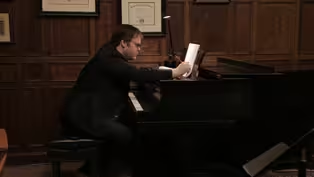
(upbeat music) - [Jim] Composer David Serkan Ludwig, comes from a long line of exceptional musicians.
But it took him decades to accept his place in this storied heritage.
- I was very resistant to people knowing about my family for a long time.
I wanted to cut my own teeth.
- [Jim] That's all I had on "Articulate".
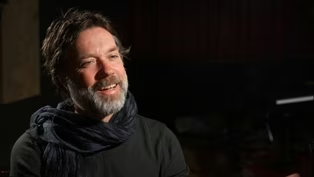
(upbeat music) (strings music) (upbeat music) ♪ Cigarettes and chocolate milk ♪ ♪ These are just a couple of my cravings ♪ Rufus Wainwright loves life and he expresses that love through intimate and frank examinations of his own experiences.
Wainwright snack for meticulous self-reflection on total candor, a field, three decades of songwriting.
He's played sold out stadium tours.
And Elton John wants to describe him as the greatest songwriter on the planet.
While behind closed doors, he wrestled with his inner demons.
Often teetering on the edge of collapse.
But he hasn't collapsed.
And today, he's as surprised as anyone to see just how well it's all turned out.
- I'm doing very good job.
(laughs) I'm doing very good job.
(upbeat music) - [Jim] In retrospect, it almost seems like a life in music was inevitable for Rufus Wainwright.
He and his sister, Martha were raised by two of the 1970s, most well-respected folk musicians, Loudon Wainwright the third, and Kate McGarrigle.
Songwriting was a way of life for his parents.
And no topic was off limits.
One day's fight could become next day's lyrics.
And the wider musical world was never far away.
Loudon and Kate were friends with at the time other up and coming musicians like Linda Ronstadt and Bruce Springsteen.
- So I kind of had this sense of just the workings and the kind of just the, almost the monotony of the business.
In a good way.
It was very demystified for me growing up.
And also, incredibly inspiring, there were songs written about me and I could also, led people backstage at the age of four.
(laughs) It was a great upbringing.
- [Jim] But music wasn't enough to keep Wainwright's parents together.
When Rufus was just three years old, they separated.
But their short-lived relationship had a lasting impact on him.
While they were together, even something as intimate as watching him breastfeed was fonder for his father's music.
But these sort of potentially scarring experiences didn't stop Wainwright from writing his own confessional music.
(piano music) If anything, they taught him to draw out the lyrical substance from anything and everything around him.
♪ The boys and girls of Millbrook ♪ ♪ Are on the train from New York ♪ ♪ Wearing new hats ♪ Deep in the heart of Dutchess County, bounty ♪ - I just had this mechanism instilled within me.
I think my parents, to just make, write the best songs you can.
Make the most interesting music possible.
Go for the artistic jugular above all else.
♪ I eat dinner at the kitchen table ♪ ♪ By the light that switches on ♪ ♪ I eat leftovers with mashed potatoes ♪ ♪ No more candlelight ♪ No more romance ♪ No more small-talk ♪ When the hunger's gone I was a late teenager or in my early twenties when they were writing these amazing songs about, like my mother wrote, "I Eat Dinner", about just being a single mom and having no romantic life.
And at that time, and which is one of the masterpieces of that-- - How did that affect you, 'cause your mom mourned her relationship with your father for a long time.
For probably longer than she was with him.
- Yes.
Oh Yes.
- And you were growing up in that atmosphere.
- Yeah.
My mother was forever dedicated to my father and not not the healthiest of ways.
She would definitely suffered from guilt.
From being divorced.
There was, I think for her generation, even though everything was all groovy in the '70s, and we were all over this and over that.
There was still a lot of religious... - Stigma.
- Stigma that sort of built into her being.
- But isn't that What taught you about what the end of her relationship was?
- Well, yeah.
I mean, that was a factor.
My whole life is littered with breakups.
(piano music) - [Jim] Rufus Wainwright songs, give voice to yearning.
As a young teenager, he gravitated towards opera.
He was drawn to the way the music express the raw emotions of life and death.
Decades later, he would go on to write his own opera, "Prima Donna".
About an aging diva, reflecting on her long-gone on youth.
(orchestral music) And his early songs reflected these operatic leanings.
Big emotionally laden oaths to love and loss.
♪ You broke ♪ My heart ♪ Danny boy (upbeat music) ♪ Not your fault ♪ Danny boy ♪ I was had at the doorstep ♪ Played ♪ Like a two to a four set ♪ Had like poor Job in the Bible ♪ ♪ By God (upbeat music) Wainwright's forthright songwriting extended to his sexuality.
He had grappled with being gay as a teenager, struggling to win the approval of his parents.
By the time he signed his first record deal with DreamWorks he was in his early twenties, he made it clear, that he wouldn't hide his sexuality.
- I will attest that once my mind was made up there was no shifting things.
The main issue, was that, it was the '90s and I was still deathly afraid of AIDS.
I just didn't want this nightmare scenario to occur where I was sick and dying, and then I had to like come out at the same time.
It just was so tragic to me that whole scenario.
And I was told at that time, by certain people, can't you just be more obtuse about it and maybe say you're bisexual, or say just like kind of make it a little more mysterious.
And in retrospect, I do believe strongly that if I hadn't have been so honest about it, I would have had a far more opportunities to kinda like, blend into the pop world.
- Or blindened.
- Blindened.
That's true.
That's a good way to put it.
And I don't regret this decision at all 'cause as I said, now, 20 years later, there's a legion of people, young and old who were incredibly, affected and influenced and inspired by my choice to be brutally honest about who I was.
- [Jim] His record label, heavily promoted his debut and the investment paid off.
Wainwright launched to massive critical approval.
RollingStone even named him 1998, "Best New Artist".
- [Wainwright] It was very auspicious beginning.
- [Jim] Did that go to your head at all?
- Well, yes, completely.
And understandably so.
(upbeat music) ♪ Ain't it a shame that at the top ♪ ♪ Peanut butter and jam they served you ♪ ♪ Ain't it a shame that at the top ♪ ♪ Still those soft skin boys can bruise you ♪ ♪ Yes I fell for a stripper - [Jim] But what Rufus Wainwright had in talent, he lacked in maturity.
He was completely unprepared for how to navigate his emotions, in the midst of his rising celebrity.
As he produced his second album, 2001's "Poses", he was frequently relying on alcohol and drugs, including cocaine and methamphetamines.
Wainwright stresses that he wasn't using substances to escape life, so much as to heighten his awareness of it.
But he took it too far.
At one point his drug use caused him to go temporarily blind and have disturbing hallucinations of his father.
- I am amazed at the fact that I've done all these things and gone out on all these cliffs and so forth, and live to tell the tale.
Now I was going into that territory.
I was facing my fears.
- Yeah.
- In order to garner information.
I mean, I wanted to know what was behind the curtain and so forth.
- [Jim] In 2002, Rufus Wainwright checked into rehab for a month.
Once out, he went on a songwriting spree, resulting in two back-to-back albums.
2003's, "Want One", and 2004's, "Want Two".
The twin albums were proof, that on the other side of his substance abuse, Rufus was energized, ready to tear into the world around him.
He wanted more than ever to make music, out of his accumulated pain and joy.
But he also wrestled with more ambiguous feelings and the song, "Dinner At Eight", he processes his difficult relationship with his father.
♪ So put up your fists ♪ And I'll put up mine ♪ No running away ♪ From the scene of the crime ♪ God's chosen a place ♪ Somewhere near the end of the world ♪ ♪ Somewhere near the end of our lives ♪ It despite this somehow tortured relationship with his father, Wainwright maintained a close bond with his mother, Kate.
Months before she died in 2010, Wainwright told her that he and his husband Jorn, were considering having a baby with Lorca Cohen, a long time family friend, and the daughter of Leonard Cohen.
His mom was thrilled.
- Once the idea was around, and my mother was also around, and her health was declining, I asked her, I said, now, what do you think mom of this concept, of having a baby with Lorca and she emphatically stated that I had no choice, but to do this.
It was sort of a commandment.
And I do feel, that's a multi-pronged kind of response that she gave me.
In the sense that, I think on one hand, she certainly loved the idea of uniting, the McGarrigle's and the Cohen's and the Wainwright.
Continuing this dynastic tradition, which I had grown up then.
- She also a woman, to know she'd be a grandmother, right?
(Jim laughs) - Being a grandmother, (murmurs) I think she knew she was gonna die.
And the end that there was going to be, and that she was, arguably the strongest and even my husband, Jorn can attest to this.
I mean, she was the most influential person in my life.
Kinda by a long shot.
And she knew that she was gonna be exiting that role, and that for me to have a child, would be a way to, whatever, possibly continue that kind of connection.
Deep connection that, which I have with Jorn, but it's still different.
- [Jim] Today, Rufus Wainwright has cultivated his own version of domestic bliss.
In his 10th and latest album, 2020's "Unfollow The Rules", he's more grounded, but no less sharp as he writes about this next phase of fatherhood and marriage.
The musician who made a name for himself with his disarmingly blunt music.
Has discovered a new layer of honest expression.
The sort that only comes, with the maturity of experience.
♪ There's always trouble in paradise ♪ ♪ Don't matter if your drinks are neat or on ice ♪ ♪ There's always trouble in paradise ♪ ♪ Don't matter if you're good or bad or mean or awfully ♪ - Right now, I'm singing better than I ever did.
All of those kind of triumphs and tribulations are sort of, they have managed to instill themselves in my-- - [Jim] So it's wisdom-- - My interpretation of songs.
- It's wisdom as well as physical.
- It's a whole load of emotion.
- [Jim] And life.
- And just having gone out there.
And what's interesting about it though, in the end of the day, it doesn't make you stronger.
It doesn't make you more kind of implacable.
If anything, it makes you more sensitive and more kind of vulnerable, as you get older.
It's a great ability to have now.
It's also a little scary.
- [Jim] And Rufus Wainwright thrives by instinctly leaning into what's scary, because at his core is what he calls his beast.
Indefatigable, and constantly pouring of the heartbeat experience, concerned only with expressing a role, sometimes brutal honesty.
- But that beast, is completely oblivious to what people think and what should happen and what the next move should be, and just kinda goes for it ferociously.
And that is the force that I've chosen to lead the parade.
♪ I hope you find your way ♪ For the sake of what we've lost ♪ ♪ And that there comes a day ♪ When you realize the precious cost ♪ ♪ Yes, I remember smiles ♪ Yes, I remember wiles ♪ Behind the Square of Sloan ♪ Under the English moon you in your disguise ♪ ♪ So much (upbeat ♪ You got exactly that (upbeat music) ♪ Will you forever be ♪ A damsel in distress ♪ Will you forever be ♪ A damsel in distress ♪ Will you forever be ♪ A damsel in distress (soft music) (string quartet music) - [Jim] The celebrated composer, David Serkin Ludwig, did his very best not to follow his family's footsteps, into a life in concert music.
He played clarinet in a funk band, drums in a rock group, studied art history.
Even wrote a few plays.
But however far Ludwig has strayed, he's always ended up right back at home.
- My canvas is concert music.
It's what I know.
It's what I grew up with.
It's the way that I feel like I can express myself with the most nuance, with the most detail, and in the widest way, too.
- [Jim] Ludwig has written music about everything from climate change, to gun violence, to humanity's role in the universe.
In 2013, his composition about the so-called American melting pot, "The New Colossus", opened the private prayer service of President Obama's second inauguration.
(singing) Now 46, David Ludwig has found his place in music and in his family tree.
There's uncle Peter, the Grammy winning pianist and composer, who passed away in February, 2020.
Ludwig's maternal grandfather, Rudolf Serkin, widely considered, one of the finest Beethoven interpreters of the 20th century.
And his great-grandfather Adolf Wilhelm Busch, a violinist, conductor, and composer.
So beloved in Europe, that Adolf Hitler besieged him to return home.
After Busch had fled Nazi, Germany for the U.S. - So Hitler wrote him a telegram and said, come back to be with me in Berlin.
I'll make you an honorary Nazi.
You'll have everything you want.
You'll have your own orchestra.
It'll be amazing.
Busch wrote back, I will return to Berlin, when I see you and your Gestapo hanging by trees.
- [Jim] Busch sacrificed his career to stay in the U.S. By the time he died in 1952, his son-in-law Rudolf Serkin, had already eclipse to success, and was charting a path to superstardom.
One which would bring him a Presidential Medal of Freedom, a National Medal of the Arts, and the Kennedy Center Honor.
As a child, David saw his grandfather in concert countless times.
When you were growing up David, you were in a very musical family.
Was there ever a rebellion in you where you said I'm going to become an insurance salesman or something?
- Right.
It's interesting.
It was still something so far off.
And it was not something actually that my near family really supported, to be honest.
- Why not?
- Well, there's a kind of mythology about being a musician.
First of all, when you come from this kind of family.
And there's also a feeling that even if you're successful or maybe especially if you're successful, you can't have any kind of normal life.
That you're just kind of always doing it.
It's always on your mind.
- [Jim] Over the years, he developed a close relationship with his uncle, Peter, who was open about the complications of carrying the Serkin name, through his own life in music.
David, on the other hand, had to contend with what it meant to make a name for himself.
- I was very resistant to people knowing about my family for a long time.
I wanted to cut my own teeth.
I was just David Ludwig.
David Andrew Ludwig for a very long time, and then changed my name to Serkin Ludwig, just over the past couple of years.
- But why?
- I wanted to feel connected publicly to my family.
I wanted that to be acknowledged 'cause it is something that's very important to me.
- [Jim] David Ludwig has reached a settled yet joyful stage.
Married to the violinist, Bella Hristova.
He's chair of composition studies, at The Curtis Institute of Music.
And has established a reputation that allows him to explore wherever the music takes him.
Like when a couple of years ago, he took a detour into the medieval world, to create a musical model drama, based on a set of poems by Katie Ford.
That imagines a day in the life of the anchoress.
A member of a woman's movement, committed to hermetic isolation.
♪ Though I mistook ♪ Night as a healer ♪ Sleep as erasure ♪ Vespers as lumbering dissolution ♪ ♪ Towards matins - They would enclose themselves within the wall of a church so that there was a cell, anchor hold, it was called.
And they would be in there 24 hours a day.
They couldn't leave.
There was no door.
And so they had something called a squint that looked into the church.
And people would go and consult with the anchoress or the anchorite in the church.
Because they were seen as oracles as well.
These living spirits, these... You couldn't see them.
You just spoke through the squint.
It became in a way, one of the few ways that women could actually have agency over their lives.
So it's really interesting by enclosing themselves in a space.
And withdrawing from society, was the only way they could have agency over creative expression and self actualization.
♪ It was then ♪ I could to the Lord ♪ Say ♪ Yes (orchestral music) - [Jim] In 2020, Ludwig's romantic notions about solitude were tested more personally by the COVID-19 pandemic.
After several months in isolation, the violinist, Jennifer Koh, asked him to write her a solo piece, on any subject of his choosing.
Ludwig had just one question.
- Is it okay if I ask you to scream at the end?
And she said, that sounds like it would feel really good.
(screams) - Was there any sense of catharsis for you when you wrote?
- Yeah, I had some sense of catharsis.
I thought about protest music and I thought about punk rock, but I also thought about death metal which is this really rage filled protest music of kind of all types, all categories.
And so, I wanted to emulate that for the violin and have these kind of wild solos and these power chords and all this, and that at the end, just a big scream.
And so for me, it was very cathartic to watch and hear her play it.
(violin music) - [Jim] Like many of us, Ludwig has experienced mixed reactions to isolation.
Locked inside his home in Philadelphia, he has at least been able to stay busy.
But he says writing music in a pandemic, is just about as troublesome, as writing music has always been.
- Every piece kinda takes a pound of flesh.
It's always a struggle.
Part of the problem is before you start a piece, I say this to students a lot.
The piece is perfect.
It's perfection before you start it, right?
But as the piece, calcifies, it becomes more and more human.
(violin music) - [Jim] These days, David Serkin Ludwig, as always, continues to compose music that reflects the intrinsically human.
Safe in the knowledge that he is the worthy heir of a tradition for making music, that is drawn from all of life's possibilities.
(violin music) For more Articulate, find us on social media, or on our website, articulateshow.org.
(upbeat music) - [Announcer] "Articulate" with Jim Cotter, is made possible with generous funding, from the Neubauer Family Foundation.
(upbeat music)
David Serkin Ludwig: Music in the Heir
Video has Closed Captions
Clip: S6 Ep13 | 9m 16s | Composer David Serkin Ludwig (9m 16s)
Rufus Wainwright: Learning from Yearning
Video has Closed Captions
Clip: S6 Ep13 | 16m 52s | Singer-songwriter Rufus Wainwright (16m 52s)
Providing Support for PBS.org
Learn Moreabout PBS online sponsorship















Support for PBS provided by:
Articulate is a local public television program presented by PBS39