
Written in Wax & More
Season 17 Episode 13 | 26m 21sVideo has Audio Description
Explore the beauty and folk art of writing on eggs, a middle school rivalry that’s 100 years strong.
Explore the beauty and folk art of writing on eggs, a middle school rivalry that’s 100 years strong, a hand-sewn quilt made by a Civil War nurse, preserving sacred indigenous seeds and, a scenic walk to the iconic Chimney Rock. Pysanky is a form of batik painting on eggs where layers of wax are applied in stages between dyes. Two Grand Island middle schools may be the longest in state history,
See all videos with Audio DescriptionADProblems playing video? | Closed Captioning Feedback
Problems playing video? | Closed Captioning Feedback
Nebraska Stories is a local public television program presented by Nebraska Public Media
Written in Wax & More
Season 17 Episode 13 | 26m 21sVideo has Audio Description
Explore the beauty and folk art of writing on eggs, a middle school rivalry that’s 100 years strong, a hand-sewn quilt made by a Civil War nurse, preserving sacred indigenous seeds and, a scenic walk to the iconic Chimney Rock. Pysanky is a form of batik painting on eggs where layers of wax are applied in stages between dyes. Two Grand Island middle schools may be the longest in state history,
See all videos with Audio DescriptionADProblems playing video? | Closed Captioning Feedback
Where to Watch Nebraska Stories
Nebraska Stories is available to stream on pbs.org and the PBS app.
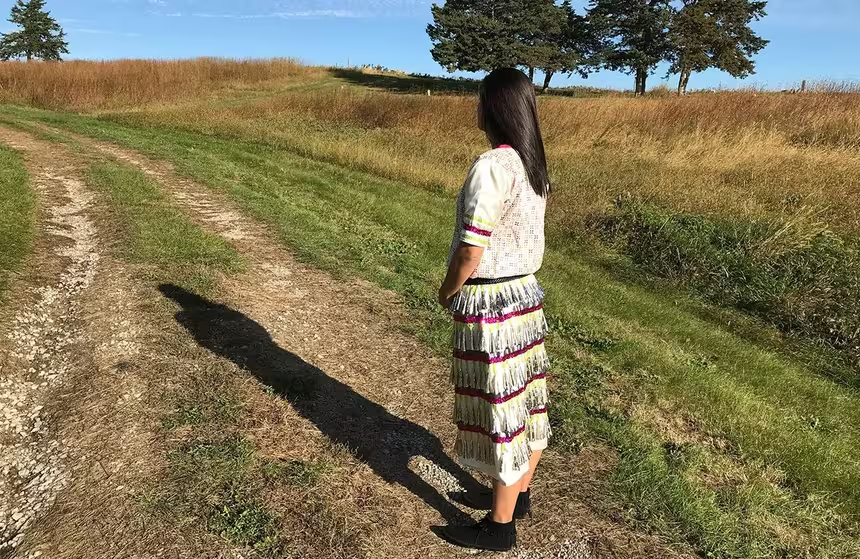
Do you have a Nebraska Story?
Do you have a story that you think should be told on Nebraska Stories? Send an email with your story idea, your name, your city and an email address and/or phone number to nebraskastories@nebraskapublicmedia.org. Or, click the link below and submit your information on nebraskastories.org.Providing Support for PBS.org
Learn Moreabout PBS online sponsorship(upbeat music) -[Narrator] Coming up on Nebraska Stories.
Explore the beauty and folk art of writing on eggs.
(upbeat music) A middle school rivalry that's 100 years strong.
(upbeat music) A hand-sewn quilt made by a Civil War nurse.
(upbeat music) Preserving sacred Indigenous seeds and a scenic walk to the iconic chimney rock.
(upbeat music) (gentle music) -[Darla] A group of us got together and would learn a new craft because we all like crafts.
And one day one of the ladies brought a kit for each of us with the Ukrainian eggs.
(gentle music) They were unlike anything I had ever seen.
(gentle music) I had never known anybody that had done them.
(gentle music) The way the black just makes the colors pop was so different than anything I had ever seen.
(gentle music) And I fell in love.
I've been doing it ever since.
(gentle music) It's therapy.
If I'm having a bad day, I can go in my studio and sit down, turn the music on and start doing this.
And after a while, the headaches gone.
(gentle music) In Czech, its kraslice.
In Ukrainian, it's Pysanky.
Pysanky is the word in Russian for the technique.
And it literally means to write.
You aren't painting the egg.
You aren't drawing it.
You're writing it.
You're writing your prayers on it.
You're writing your intentions on it.
(gentle music) It's very much a cultural thing.
Some of the true purists get a little upset when you ask them to paint them an egg.
You write the egg.
(soft scratchy sound) Anything that you want to stay white on the egg, you cover it up with wax.
So you draw your line, what I call the basic bones.
And then from there your design goes.
If you can do a line, doesn't have to be straight.
If you can do a line, you can do a circle.
You can do a square or a triangle, you can do this.
It's not hard.
You're just building line upon line upon line.
(gentle music) These would be the traditional wax batik or wax relief where you put on the wax and then you dye it, and then you put on more wax and take the wax off at the end.
(gentle music) Since it's folk art, it keeps evolving.
(gentle music) When you're looking at the egg, yeah, it's pleasing to the eye, but usually it had some meaning to it too, when it was done.
(gentle music) When the ladies would sit down to do it, they did their prayers at night.
And so as they're writing, they're writing prayers.
(gentle music) But yellow is the first color (gentle music) and they're just water.
The dye powder and vinegar.
Vinegar sets it.
So we've got it plugged and it goes into the dye and pull it out.
If you want it darker, put it in a little longer.
So now anything I want to stay yellow on this egg I have to cover with with wax.
We're going to add a line inside here.
(gentle music) I've done ostrich eggs, goose eggs, turkey eggs, dove, quail.
Quail eggs are little bitty.
Emu eggs are very unique.
They're rough, they're textured, and they're absolutely beautiful.
(gentle music) Okay, so then we dye orange.
(ruffling) (glass clinking) And red can be finicky.
Reds and blues tend to be a little bit finicky sometimes.
They don't always want to take.
And you can see how we got a nice deep color.
(scruffing sound) I've connected on Facebook with a lot of people from Czechoslovakia, Germany, Poland, Romania, Hungary, Ukraine, just all over.
Each one, if they've done it for a long time, they have a style kind of all their own.
It's almost like a signature.
Like you can recognize a Degas painting or a Renoir.
You can recognize the artist.
(gentle music) A lot of times in classes, people come in and it's like, oh, I can't do this.
I'm so nervous.
I'm so scared I'm going to do something.
And it's like, just don't worry about it.
We get in about halfway and it's like, oh, this is really calming.
(laughing) And then you'll hear them going around the room.
Yeah, I feel real calm.
This isn't hard.
(gentle music) But now it's ready to die Black.
Wax off.
That's the magic.
And a lot of people really bothers them putting it in black.
They just oh, shudder.
All that work.
And it's like, you can kind of see how you can see the colors under there.
(gentle music) Now this is where the magic is.
You see the wax start to melt.
(hair dryer blowing) (gentle music) And just scrub it.
Don't push or you'll push in the wall of the egg.
There's your finished egg.
See, I told you it might look really yucky with the wax and stuff, but when you take the wax off, everyone's amazed at how nice they look.
(gentle music) One of the old traditions in Ukraine is as long as there is somebody making eggs like this, the world will not end.
We'll keep it going a little longer.
(laughing) (gentle music) ♪ ♪ (band music) -[Larry] My first year there.
I said, well, the big game's tonight, and I didn't really realize how big.
And came here to Memorial Stadium and went, Holy cow!
It was unbelievable how many people came to that.
(band music) -[ticket taker] Thank you, I appreciate it.
(band music) Hello.
Hello.
- Greg doesn't have his retirement.
- It's kind of one of those make or break.
I'm not saying it's Ohio State, Michigan or Auburn, Alabama.
It's not the Iron Bowl, but it is ours.
- No they're not.
You have to choose your heart.
It is hard to go when you're hurting a little bit.
It is hard to go when you're tired.
You know what else is hard?
Living with regret.
(band music) -[Jeff] You're part of that 100 year tradition.
And that's just.
It's amazing.
For Grand Island to keep it going.
(upbeat music) - Barr and Walnut started at the at the advent of the junior high system.
(upbeat music) The fact that they were both right there produced this great rivalry where it meant it was always the most important game.
(upbeat music) - Good morning, Barr Bulldogs.
Today, our school makes history.
Tonight we will be celebrating the 100th anniversary of Barr versus Walnut football rivalry.
Let's pack the stands and be loud with Bulldog pride.
Let's go.
(clapping and cheering) - So this is definitely the longest junior high rivalry.
I think it probably has a good chance to be the longest played high school rivalry continuously that they haven't missed a game.
They've played 100 years.
(upbeat music) -[Tom] Our coach in Walnut was Vic Ashley.
(upbeat music) Uh, he came to Grand Island in 1925, (upbeat music) coached over at the Old Walnut, uh, on 10th Street.
And then when they moved to Fifth Street, he was still the coach.
(upbeat music) And he was there, like, I don't know, 30 or 40 years until he finally, our last year when I was a ninth grader was his last year as head coach.
(upbeat music) They hauled us out in a cattle truck.
(upbeat music) It was a straight truck where they had the racks up on the side.
That's how we got transported to practice.
(upbeat music) - Let's go.
Hey, they're going to pinch.
That's a lot of pressure on you.
(cheering) (applause) (crowd cheering) -[Mike] I've had the privilege to work with a lot of Grand Island natives who have coached in town, that got to play in those games in the 60s and the 70s, and then in the 80s and 90s.
It puts in perspective a little bit how the game has changed.
I think it just shows that it doesn't matter (upbeat music) what the kids are like, how diverse or how not diverse your community is.
Athletics and football in general are a way to bring people in the community together and try and work towards a goal.
(upbeat music) - I'm going.
(upbeat music) - That is slippery.
(upbeat music) - It is Heads, right?
(upbeat music) You guys want to defer to the second half.
So I'm assuming you guys want to receive.
(upbeat music) (clapping and cheering) - One year when Barr and Walnut were both undefeated and we played here and they had a little over 5000 people at the game.
And 2 or 3 weeks later, Grand Island played Creighton Prep for the state champion title.
And there were more people at the Barr-Walnut game than the state championship game.
(upbeat music) (crowd cheering) -[Kelli] You can talk to any boy that played in that game and they'll remember the score.
They'll remember how the game went and that memory is never going to leave them.
In fact, my husband I'll give you an example.
He read the article and goes, well, I played in the Barr-Walnut game and I scored three touchdowns.
And he knew every every play of the game.
What happened at the end.
It's just a memory that's never going to leave him.
(upbeat music) -[Announcer] If Standing.
When you played in this game, the Barr-Walnut game previously.
Would you please stand and be recognized?
Thank you.
(clapping and cheering) - You don't think about, you know, history.
You know, at the time you're playing it.
-[Larry] I'd look back, I've been around it for half the time, 50 some years.
So, there aren't a lot of people that probably can say that.
I just hope that it never dies and that it keeps getting more kids involved.
(crowd cheering) -[Mike] It was a huge deal to be a part of a Barr-Walnut rivalry, and I think being able to experience that again on the 100th anniversary is.
I mean, it's cool for me and I'm a 39 year old man.
I can't imagine what some of these guys are thinking, being 13 and having this be one of their first big game experiences.
(crowd chanting) (crowd cheering) - I was just happy and excited that we could finally, you know, get another win.
(cheering) - Rylan.
This guy right here.
This guy right here.
Good job.
- What are you gonna do tonight?
(upbeat music) Go to bed early.
- Probably go get some Cane's.
- There you go.
-[Interviewer] Some Raising Cane's.
There you go.
What's your order?
- Box combo.
Extra sauce.
(upbeat music) - We're down 2-0.
We were losing (upbeat music) We got stuck at half and you won.
(team cheers) - [Jeff] This is it.
This was my last one.
So it's a great way to go out.
I just hope this keeps going.
That we keep building it up.
When kids have big things to shoot for, good things happen.
-[Coach] 11 on three.
Everybody ready?
One.
Two.
Three.
Go!
(clapping) ♪ ♪ WOMAN: I'll let you all put that on the table.
CAROLYN DUCEY: The Log Cabin Quilt is probably the most iconic of all quilt patterns.
They're one of the most successful and most interesting patterns that we see in American quilt making.
NARRATOR: Functional and beautiful, quilts have traditionally been the art form of women.
Here at the International Quilt Studies Center and Museum, these meticulously crafted textiles are preserved from around the world, and though the quilts are preserved, the stories of their makers are usually lost to time.
But even then, there are exceptions.
CAROLYN: Caroline's story is so interesting because it really tells us about a woman's life at a time when we don't know a lot of women's stories.
(gentle music) NARRATOR: Quiltmaker Caroline Boston lived during one of the most polarized times in American history.
She was a young married mother when her husband James left to fight in the Union Army during the Civil War.
Within six months, James was gravely wounded.
When he was moved to a military hospital in St.
Louis, Caroline would make an unusual decision for a woman of her time.
RICHARD BOSTON: Caroline left the children with family in DeKalb, Illinois and had volunteered to become an army Civil War nurse.
She had no previous training, but she was trained at Benton Barracks.
NARRATOR: Caroline would be one of 20,000 women to volunteer in military hospitals during the Civil War.
She would remain at Benton Barracks until her husband's medical discharge in April of 1864.
RICHARD: Every time I think about that story, I can't imagine making the decision.
It wasn't to leave the children, it was to do something.
It was to help the war effort.
NARRATOR: The extent of Caroline's charitable efforts didn't end with the war.
When James was medically discharged from the army, the Boston's began a new life on a homestead near Du Bois, Nebraska.
(calming violin music) NARRATOR: It was while living here that Caroline's generosity and quiltmaking was first noted in the local newspaper.
For the next 30 years, the Boston's were a part of the Du Bois community, but when they lost their farm in the depression of the 1890's, they moved on to Kansas.
RICHARD: I think there's a strong connection with Smith Center, Kansas where the great-great-grandparents moved in 1894, and those soldiers that are on the quilt.
NARRATOR: Sometime around the turn of the 20th century, Caroline made a quilt inscribed with the names of 320 Union veterans of the Civil War and their associated military units.
CAROLYN: Caroline Boston was obviously making this quilt because that time for her in the Civil War when she served obviously was hugely impactful for her and she wanted to memorialize that over time.
NARRATOR: When the Boston's moved to Smithfield, Kansas, they became involved with the Grand Army of the Republic, a veterans organization for Union soldiers.
James was a member of the GAR and Caroline a member of the Women's Auxiliary called the Woman's Relief Corps.
Caroline's descendants believe it was her association with this group that inspired her to create a quilt honoring war veterans.
RICHARD: We've researched all 320 names, we nailed down at least 315 individuals, we know who they were definitely.
There's two Black soldiers, at least one Black soldier, Benjamin Davenport, we know was a slave before the war.
William McKinley is on the quilt.
CAROLYN: It's in impeccable condition for a quilt that's well over 100 years old.
NARRATOR: Civil War era quilts are rare.
Caroline's is especially unique, not only because of the names inscribed on it, but also because we know the story of the maker.
Caroline's quilt was handed down through four of her descendants before it was recently gifted to the International Quilt Studies Center and Museum.
CAROLYN: The family wasn't sure what they were going to do with the quilt.
They weren't quite ready to give it up.
RICHARD; We were so impressed with the museum and the staff, just a wonderful group of people and facility that's world class.
narrator: Today, Caroline's family gathers to officially present her quilt to the quilt center.
JONATHON GREGORY: It was nice to meet you Gladys, and I wanted to say thank you very much for trusting this piece to us.
We will take very good care of it.
GLADYS KITE: My vision was that someday I was gonna die and they were gonna sell it for five dollars at a yard sale.
We decided this was really the best place for it.
EARL BOSTON: Gladys is the end of the maternal line, so she never got married, never had kids, so what's gonna happen to it?
CAROLYN: I'm sure that Caroline Boston had no idea that her quilt was going to end up in a museum 130 years later.
It's a benchmark in our collection and it's become really important, and as time passes, it will only gain in importance as a record of that.
RICHARD: Just knowing the quality of this museum and the care they'll give it, Gladys felt that it was coming back home.
It was coming back to Nebraska.
(string music) ♪ ♪ (indigenous singing music) TAYLOR KEENE: This is what was formally known as my backyard, and is now home to the four sisters, corn, bean, squash, and the sunflower.
My western given name is Taylor Keene, but I carry other names as well among the Omaha tribe.
I carry the name Bageeja, which means Buffalo Mane.
This effort here is called Sacred Seed.
(indigenous singing music) Sacred Seed is, for the most part, around the four sisters.
From the four sisters comes all the bounty and all of life.
First sister is the corn.
We know, scientifically speaking, that takes a lot of minerals, most of which is nitrogen.
And so, the second sister, the bean.
We like the pole-climbing beans, but they put the nitrogen right back into the soil.
The third sister, squash.
Where there's squash, I don't know if it's in the little hairs on the vines or the flowers or what, but the raccoons will not step foot into my backyard here.
The sunflower, they pull a lot of the heavy metals out of the ground if there's any.
So it helps purify everything.
Their main purpose is, I discovered again this summer, is as a windbreak.
It's an obstacle course back here.
We put a considerable amount of time and effort trying to find non-GMO, indigenous heirloom seeds.
Experimented with some southern varietals.
I have a green Mohawkan.
We're fighting a cultural bias within it as well.
Corn, especially here in Nebraska, is synonymous with apple pie.
Our "Indian corn" is only ornamental, and is sold only around Thanksgiving time.
And most people don't even think it's edible, but where does corn come from?
It comes from us.
After I begin to find seeds, and then I sat down with many of the elders within our tribe and asked for their advice and blessing, as it were, that it'd be a good thing to do again.
In my mind, I envision a future where everyone in my tribe could be corn planters again.
Somehow, we could sustain ourselves.
Be economically self-reliant again.
The whole notion that I refer to is living red is getting back to living the way indigenous people should.
Grow your own food.
Deep Red.
Take care of it, foster it, love it, and then it will love you back.
(indigenous singing) ♪ ♪ (birds chirping) (birds chirping) (serene music) (birds chirping) (serene music) (birds chirping) (serene music) (birds chirping) (serene music) (birds chirping) (serene music) (birds chirping) (classical music) (birds chirping) (classical music) (classical music) (classical music) (classical music) (upbeat music) (upbeat music) - [Narrator] Watch more Nebraska stories on our website, Facebook and YouTube.
Nebraska Stories is funded in part by the Margaret and Martha Thomas Foundation, and the Bill Harris and Mary Sue Hormel Harris Fund for the presentation of cultural programming.
(upbeat music) (upbeat music) (upbeat music) (upbeat music)
 New Episode
 New Episode
- Drama

Lesley Manville and Tim McMullan return in the final installment of the Susan Ryeland mysteries.

 New Episode


 New Episode

 New Season

Support for PBS provided by:
Nebraska Stories is a local public television program presented by Nebraska Public Media