WVIA Special Presentations
Wyoming County Voices - Battling the Opioid Crisis Together
Season 2025 Episode 7 | 54m 40sVideo has Closed Captions
Find out how Wyoming County is addressing the opioid crisis.
This powerful town hall brings together local professionals, community leaders, and residents to share real-life stories and expert insights on how Wyoming County is addressing the opioid crisis. We'll explore key themes including stigma, the role of emergency services, current substance use trends, and pathways to recovery-offering hope as the community confronts this ongoing challenge together.
Problems playing video? | Closed Captioning Feedback
Problems playing video? | Closed Captioning Feedback
WVIA Special Presentations is a local public television program presented by WVIA
WVIA Special Presentations
Wyoming County Voices - Battling the Opioid Crisis Together
Season 2025 Episode 7 | 54m 40sVideo has Closed Captions
This powerful town hall brings together local professionals, community leaders, and residents to share real-life stories and expert insights on how Wyoming County is addressing the opioid crisis. We'll explore key themes including stigma, the role of emergency services, current substance use trends, and pathways to recovery-offering hope as the community confronts this ongoing challenge together.
Problems playing video? | Closed Captioning Feedback
How to Watch WVIA Special Presentations
WVIA Special Presentations is available to stream on pbs.org and the free PBS App, available on iPhone, Apple TV, Android TV, Android smartphones, Amazon Fire TV, Amazon Fire Tablet, Roku, Samsung Smart TV, and Vizio.
Providing Support for PBS.org
Learn Moreabout PBS online sponsorship- [Announcer] From the Dietrich Theater in Downtown Tunkhannock, WVIA.
And the Wyoming County Opioid Settlement Committee present "Wyoming County Voices: Battling the Opioid Crisis Together."
And now, moderator Julie Sidoni.
- Hi, I'm Julie Sidoni.
I am the Director of Journalism at WVIA.
We are here at the Historic Dietrich Theater in Downtown Tunkhannock for a very special discussion.
It's all about battling opioid abuse and misuse in Wyoming County.
We have assembled a amazing panel of experts to help us wade through this sometimes very complicated topic.
You're gonna hear what officials are doing here in Wyoming County to combat the opioid crisis and crucially what we can all do to keep our communities as safe and healthy as possible.
Let's begin by introducing the panelists and I'm actually gonna have them introduce themselves if that's okay.
Go ahead and tell us who you are, what brings you here today, or who you might be representing.
We'll start with you, District Attorney Peters.
- Thank you Julie for being here and WVIA for doing this important town hall.
I'm the District Attorney of Wyoming County.
I come to this job as a former police officer where I began to see the drug problem so many years ago.
And then a police chief of the statewide undercover narcotics agents and then the state's chief drug prosecutor and a federal mafia prosecutor.
And believe it or not, the mob makes money in drugs.
And then I ended up in the White House, serving two presidents of different parties.
And that's a good thing because it sends the message as I came out of the Clinton White House and the George W. Bush White House, that there are no Republican heroin needles or democratic opioid pills.
We are all in this together.
- Thank you very much for being here.
Dr.
Scheller.
- Hi, my name is Dr.
Dr.
Arianne Scheller.
I am a treatment provider in Wyoming County.
I also am a mental health advisor for Wyoming County Treatment Court.
And I am here obviously because of a professional interest, but I also have a very personal interest in the treatment of opiate use disorder and addiction.
And thank you very much for including me.
- My pleasure.
We'll get to that in a moment.
Cammie welcome.
- Hi, thank you.
I'm Cammie Anderson and I work for Robinson Counseling Center.
We're a service under Children's Service Center.
I am a drug and alcohol prevention education supervisor and I do the drug and alcohol prevention for the Tunkhannock Area School District.
And I have been here for 34 years, so this is very important to me.
- It's great to have you.
- Thank you.
- And finally, Bob.
- My name's Bob Carpenter.
I'm the Executive Director at EMS of Northeastern Pennsylvania, which is a regional EMS council that covers the northeast corner of the state.
I'm also a paramedic and have worked in Wyoming County for the past 20 years.
- What an amazing panel we have here.
Thank you so much for your time.
Let's kick it right off here with you, DA Peters.
I'd love for you if you could, to set the scene for people who might not have an idea of the issue here in Wyoming County.
Why are we all sitting here?
Why are we here today talking about this?
- Well, we're actually here because every county like ours receives money from something called the opioid trust, which recovered dollars from those who perpetuated this problem.
And thanks to our opioid settlement committee as we call ourselves and our county commissioners who take our recommendations for funding, one of the things we chose to do was to focus on, and I know I'm gonna get criticized 'cause everyone expects me to say, let's just arrest our way out of this problem or let's lock them up.
That is not the answer with this problem.
So we have chosen to focus on prevention and education and a town hall is the perfect place to do that, to solicit comments and to engage the community, educate the community, but then leave here all working together toward one goal.
- I like to say it's the start of a bigger conversation.
We can't get into everything in one hour, but we hope it would be a start of a bigger conversation.
Our talented production crew has put together a number of videos to give you different perspectives and we'd like to start with the first video now.
And I believe, DA Peters, you are in this one.
Let's take a look.
- The biggest trend now, and I don't think it's just now, it's been happening for a little while now, is fentanyl.
The smallest amount can kill.
- If I had a salt shaker and it was full of fentanyl and I sprinkled one or two grains outta that salt shaker, that would be enough fentanyl to kill you.
- We're finding it in every drug.
You know, you can find it in marijuana now.
And I'm not saying that people are purposely putting it in marijuana, but they may be distributing their fentanyl on a table that they then put their marijuana on that same table.
- Now let's exacerbate that even further by saying it's so easily and readily obtainable on the internet through different platforms, which means our kids get access.
- So you have children and juveniles who are now buying things like just marijuana and it's not.
- We need to work with our kids in the schools.
We need to work with them on social media, wherever we can reach them.
Our kids are way more tech savvy than we are, but they're not as educated as we are.
- Another trend recently was Xylazine, it's a synthetic drug coming from China.
Thankfully we haven't seen it too much here in Wyoming County, but they are changing a legislature now to add Xylazine as a controlled substance.
So that's an example of how a trend comes out and we're trying to get ahead of it as fast as we can.
- The more challenging part is reaching our young people, that 12 or 13-year-old and trying to educate her or him that if you buy something on the street, any drug including marijuana, it's likely gonna have fentanyl in it.
And if you think you're gonna be smart and go online and think you have found a safe website because it's got a picture of a real drug, that is probably pure fentanyl.
- The Pennsylvania District Attorney's Association is always working on trends.
And there's also the Pennsylvania Association for Treatment Court Professionals.
And they're heavy on all the new trends.
- Because we have morphed, and I have seen this problem working in it for more than 35 years, where the opioid crisis, a number one trend, last year, we saw over a hundred thousand people die in this country.
If we were at war and we lost a hundred thousand people, we would really be mobilized.
- So I can't help but think about when you think about drugs, what a typical high school or college student might be able to get their hands on.
It seems like we are in an entirely different world now.
You are nodding a lot during that.
What's out there now, Cammie?
- Well, you're right, they can pretty much get ahold of anything they want.
The world has become much smaller with the internet, with social media.
They can pretty much find anything.
I think some of the biggest challenges we face in schools is marijuana right now.
That is what we're seeing, concentrates THC.
But they can get ahold of pills through the internet and as Joe said in the video, it's not safe.
If you want to talk prevention, I think all we need to understand is if we go back those 30 years, like Joe said, if we look at before opioids were in every medicine cabinet, we weren't talking about it because we didn't have to.
And I think that was one of the many factors that led into the crisis of the opioid crisis that we're in today.
'cause nobody was talking to kids about, and I was in the field then and I was not talking to kids about it 'cause they weren't in medicine cabinets.
I think that is the one statement we need to make to say that yeah, prevention does work and we need to talk to kids and families about this.
- Why is marijuana, since you brought it up, so concerning when we're talking about opiates in general, opioids in general.
- Oh, I think marijuana is concerning because of the high, the concentrates have such a high level of THC, not stuff that we were looking at 30 years ago.
And because, and I think it was brought up in the video, cross contamination, when someone is mixing fentanyl in a lab, it's not a lab where there's regulations and cleanliness and we're not cleaning the table.
So if there's marijuana there, THC concentrates, cocaine, any other drug, that fentanyl's gonna get in there.
- Go ahead - If I may.
- Yes, please.
- Part of the problem is defining the problem, defining what opioid crisis means because it's very dynamic and what it was two years ago is different than 10, than 20 years ago.
And if we're going to attack this problem, we need to define it.
You know, years ago it used to be no one wanted to be the heroin user because of the thought, the image, that that meant I was somebody in an alley in a dirty t-shirt with a needle stuck in my arm.
The opioid crisis had its precipitous rise because we were duped in a sense.
You had physicians who were not willingly to be harmful, but were told by the manufacturers of things like Oxycontin that this is a painkiller and oh, by the way, it's not addictive, when their truth was exactly the opposite.
So we were delivered a whole group of opioid addicts from within, not people trying to use drugs, but it was that mother who had a root canal and was given 30 days of Oxycontin.
And by the end of that 30 days, she was an addict.
And when those pills ran out, she was on the street looking to buy heroin or at that high school wrestler at 15, hurt his back.
The doctor overprescribed opioids.
So we've had to reeducate our medical community because they were part of the problem, again, unwittingly with this crisis.
And now where are we, this dynamic opioid crisis?
We've been delivered to fentanyl, which is a killer and it's in every drug on the street.
Kids trying not to poison themselves because that's what's happening.
They're poisoning or murdering themselves.
They hear our messages about don't buy anything on the street.
So they're going online and they're being duped by the cartels with fake websites that look like real companies with the real picture of the pill they want, the Adderall, the Percocets.
- So easy - And they're buying it and this is all happening with their parents up the hall on the second floor where the bedrooms are and they're finding this 13-year-old slumped over two days later after the pill arrives.
- How many of you have come to work in this field because you have had a personal connection with addiction?
It's happened, yes?
- Absolutely, yes.
- Do you find that that's pretty common in people in this field?
- I think it's very common in the field of substance use treatment to have a personal connection with recovery or with addiction.
My personal connection came from my father.
My father is now in long-term recovery, 30 years now, but I was a very active part of his recovery.
So before I even got into the field, I was going to meetings with him and meeting people and understanding the whole process of recovery.
And then school kind of led me this way and my relationship with my father sort of pushed me into the direction of substance use treatment.
So, yeah.
- And you as well.
- Well, I came into it a little differently.
So I was someone who grew up in this house, I always say of chaos.
So there was a lot of like, addiction.
I didn't go into the treatment side.
I wanted to become the person that I needed when I was a kid.
And I was blessed to find a job that allows me to do that every day, to talk to kids who have to go home and they may have someone there that they love very much, but that struggles and they go home to this house of, as I always said, chaos.
When I was growing up, nobody was talking about it.
So, I became that person.
- And she is that person.
I actually just heard a story about Cammie because our jobs intersect and one of my employees, actually, her father went through treatment after treatment, after treatment, finally got sober and Cammie helped her through everything in high school.
And she absolutely sang your praises.
So it doesn't just affect the parents, there's a trickle down and that's where our jobs intersect.
- And I can only imagine what you have seen after how many years being in the front line of treating people who've had issues with drug addiction.
- Yeah, absolutely.
So I would say when I started my career 20 years ago, you know, we would have some opioid overdoses and we'd go out and we'd give Naloxone or Narcan and we'd give a lower dose than what we're given today because the drugs are much stronger.
You know, so the amount of Naloxone or Narcan that we're administering now is much higher dose than we were 20 years ago because of the potency of the opioids.
- I wanted to talk a little bit about those personal connections because of stigma, which is what we're going to get into next.
I know you all deal with some form of trying to battle stigma before you battle opioid addiction.
So we have a video on that as well.
- Stigma is a challenge because we're human beings and we are always worried about being judged.
And as people we often fall into the trap of judging others without knowing anything about their lives.
And that's one of the biggest challenges we have in battling opioids.
- The community is fueled by a lot of fear about what's really going on.
And when they see people, they also don't always understand how things work.
Maybe even about substances such as opioids.
- In a rural community, you're typically in a small town, in small towns, everybody knows everybody.
Everybody talks in a small town.
So I think it's harder to ask for help.
There's a better chance you're gonna know the person at the place you're going to.
- They feel that if they ask for help, if they talk about it, they are going to be judged.
- Or that your family will.
And that is sometimes you don't want to embarrass your last name.
That that goes along with it too.
It's not just you, you're now embarrassing your entire family in a small town like this.
- If someone had cancer and was seeking cancer treatment, we would be applauding them.
We be assisting them, we would be facilitators for that.
- A lot of people that are in active addiction are embarrassed of their addiction.
So it is hard to sometimes get help.
A lot of times your family disowns you, the people closest to you are the ones you usually hurt the most.
- They don't understand the process of outpatient therapy, inpatient how things go.
There's a lot of things out there that need to be educated on.
And I think the community doesn't always understand that.
- So imagine going to someone and saying that you're struggling with some kind of substance use disorder.
You can't stop using fentanyl.
You know, to some people, that's disgusting and that's terrible.
- Another challenge for us as we battle opioids in the law enforcement arena, in the educational context, in public awareness, we need to be sure to spread the word that this is a stigma free issue.
Let's not be ashamed, let's battle it together to encourage people to ask for help and it's okay.
And then to help carry them through that.
- So we could sit here and say, there is no stigma, there should not be stigma.
But in the actionable world here, what do you do?
There's stigma all over the place.
How do you battle that Cammie?
I suppose this is kind of your territory when you're going into schools.
- Yes.
Well, I think, obviously, it's confidential for kids, so that makes it a little safer.
But there is stigma.
And I think one of the things I try to do is let people know that they're not alone.
That this happens, this is a disease.
I kind of go a little bit into that scientific part of it to say like these aren't choices that people are making.
And a lot of times for me, it's their family.
So we talk about it's okay to love them and separate that from their disease.
- Ooh, say a little bit more about that.
- Well, the part you can love a person and hate their behaviors.
So you can love this person, but you can hate that disease they have.
I think one of the other things that I'd like to do is not just school stuff, but if I go into colleges and talk to nursing students about stigma and stigma reduction 'cause I think it's a lot of times, and I know Dr.
Scheller can speak more to this, but the person going in the hospital with an overdose, sometimes that nurse is going to be the, whether I go to treatment or whether I go back out.
And again, that's not my realm, that would be hers.
But I like to talk to people who are going into that field to remind them that these are someone, you know, somebody's someone.
Somebody loves this person.
- Somebody's someone.
I like that.
Go ahead and add onto that doctor.
- That's something that I've ran into quite often.
I have had numerous conversations with healthcare facilities, doctors, eye doctors, dentists, and you know, all of the extraneous professionals that we're not really thinking about stigma.
And that's what I talk about.
We're not treating some monster from nowhere, the middle of nowhere, we're treating your father who was just like my father, we're treating your sons, we're treating your daughters, your mothers.
So you have to personalize that and look at this person as somebody who needs help.
And we've faced that a lot.
I think that we've made an impact on the local community with the work that we've done.
I've found that a lot of the stigma arises from people just not knowing.
And people want to be involved.
They wanna be involved in the treatment process, they want to be involved in the different community events.
Something that we do is we get out and volunteer so that we see people and they see us, they see us as a family, they see us as mothers, daughters, sisters, brothers.
So I think that's very helpful in fighting that stigma.
And that's what people want, that's what the community wants.
They wanna be a part of everything.
If because of stigma, oh, were you gonna say something?
- Even first responders, and whether it's out of the fatigue or our own PTSD.
Because when you're a first responder, he sees tragedy eight hours a day all day long.
And that affects you.
So when you hear people say, "Well, this is the third time I've narcaned this same person.
Why am I doing this?
Or a business person that I talk to about putting Narcan in his business.
And he said to me, "Let him die on a floor if they're going to use drugs."
To which I said, "If that was your granddaughter, you wouldn't say that."
"Well, that would be different because she's my granddaughter."
So we have to humanize this.
It would be easy to hide as the DA, to hide behind this notion and say, my job is to arrest people.
No, our action tells people well beyond our words what we're about.
So it's through innovative programming and it's through pushing success stories out front.
Those women you saw in that video, my assistant DA, she is a treatment court graduate.
She was in jail locked up by the state attorney general's office years ago.
And through programs like drug treatment court, went through college, law school.
Now she's a prosecutor who helps those in recovery and locks up those who are trafficking drugs.
The other person, Cheyenne, she's been through her own trauma in mental health and drug addiction.
She's come through it.
Who better to help others?
And again, I said innovation.
Now she responds with the police to a call.
And if it's a substance use problem or a mental health problem, she takes that call from the police.
Once everybody's safe, they go on doing their cop work, she delivers them to treatment.
- Is mental health and trauma a through line with drug abuse, misuse, overuse?
- Absolutely.
There was kind of this old thought, and it still exists today that addiction is a primary diagnosis.
I don't agree, research doesn't agree either.
There is always trauma.
Trauma opens the door to addiction.
So of course, access opens the door to addiction, which we're trying to prevent, which we, utilize different tactics through the DA's office and through prevention efforts.
But trauma is the door that opens to addiction.
Also, different other mental health disorders, depression, anxiety, it's all one and the same.
- You brought up treatment court, which leads us right into another video.
So we'll take a look at that now.
- My name is Kathy and today I am proud to say that I am graduating treatment court and I have been sober for almost four years now.
(audience clapping) - Treatment court celebration.
I mean, this is a great night for the graduates, a great night for the community.
- And this is a testament to the fact that you can be successful in beating the problem and continuing to succeed.
- It's an opportunity to help people be the best version of themselves.
And that's why events like this are so rewarding because you see that transformation.
- I take a look at when this journey began, who I was then, who I am now, I'm amazed at the way I've changed, come where I have come.
- You've proven the change isn't just possible, it's powerful.
- The transformation that has taken place within body, it's truly a miracle goal.
- I didn't expect to get this far and everybody here has helped me get there.
- Just this past Sunday, I had the honor of presenting her with her three year sobriety chip, a milestone that represents not only your dedication to recovery, but also her courage and resilience.
- They're heroes to all of us.
And the impact that they're having on their families, their children, and our community is amazing.
It's hard to quantify.
- My name is Eli and I'm an addict and alcoholic.
Let me start by saying that I'm so grateful for this program.
The Wyoming County Treatment Court saved my life.
I was sitting in group of triage one day, about two months into the program when I got a text from my sister saying that my mother was done from a car accident.
And with every person I shared them with, you're slowly dwindled away.
I didn't get high.
I'm so thankful I was in the place I was when I got that text.
There's no saying where I would be today if I wasn't.
- We don't do the work for people, we provide people with the tools, but they're the ones that actually do the work and become the success stories.
- Witnessing this is a testament to their hard work and tenacity.
- And we're sort of walking them back into that, walking back, celebrating everything that we knew that they could be, that they did themselves, pull themselves up.
- Today, I wanna say sober is better than my best day high.
- I love you.
Thank you.
(audience clapping) - That one made me a little teary when I first watched it to see people cheering one another on.
I'm gonna throw this one to you.
If you could explain what treatment court is and how that works.
- People think mistakenly that it's a free pass.
It's actually much more difficult than sitting in prison.
And I'll tell you why.
And this program's been around when I worked in the White House.
It started in 2001.
And I've seen people around the country given the choice treatment court or jail.
"I'll go to jail, your honor."
Because I'll get in, I'll get out, I don't need to deal with my issues, I'll be fed.
And there's no responsibility.
The first tenant of treatment court for those who think it's a free pass, and we can be tough on crime and smart on crime at the same time, and this is an example.
Accountability first.
You have to, for two and a half years, put yourself before the judge and the DA and the treatment court team and account for yourself, were you working, were you volunteering?
Is spirituality part of your life every week?
Are you going to Alcoholics Anonymous?
Are you volunteering in helping the community?
Who wants to do that every week and have to physically account for it?
That's drug treatment court.
And oh, by the way, you're getting the mental health and the substance use disorder treatment because where there's one, there's the other, everything is co-occurring disorders.
So out of that comes this, and there are failures.
And if you fail, you go to state prison.
So that's the incentive.
That's the carrot.
And out of that comes reinvented people like you saw.
I wish we could show, and some treatment courts do this.
They show a picture of the person when they entered treatment court.
And then they show this bright, shiny person with hope on the back end after two and a half years.
That's treatment court.
- I wanna go back, I just a little bit here to, we were talking a a bit earlier about someone who, I guess this involves a little bit of stigma, but if you are trying to do this on your own, if you think you might have an issue with opioids, you're trying to do this by yourself because you don't want to go through drug treatment court, you do not wanna go through the legal system, you don't want to, as that one interview said, you know, drag your family name through the mud.
If you're doing this on your own, how often, Dr.
Scheller is someone going to be successful in weaning themselves off of drugs?
- I've never seen it happen, honestly, in my career.
I've been doing this for 25 years and I have not once seen somebody on an opioid who was truly addicted to them and had a true problem, do it completely by themselves.
There are different pathways to treatment and different pathways to recovery and everyone is different.
But there are some things that will absolutely increase your odds of success.
When you're on an opioid and you are addicted, most people need a detox protocol.
So that's the first one, getting the body healthy, and then fellowship.
So that's we hear AA and NA and it's really all the same.
It's 12 steps, it's treating your lack of connection to a positive community.
It's treating different mental health disorders.
All of that needs to happen in order to have true success.
The longer the treatment, the better.
So all of the research shows that the longer you spend in treatment, whether it's inpatient, outpatient, support groups like AA or NA, the longer you are in that program, your own program, the higher the success of staying sober.
- I'd like to kind of get a little bit into more about the school, the prevention, the key messages, I should say.
Are there different messages for say, high school students versus adults that might need to hear it?
And how do you even begin to figure that one out?
- So while I think it's important to know that the messaging is for all ages.
So it's not never too early to start, it's just that we have to be age appropriate.
So when I do classroom education, which is universal, any kid, regardless of risk, I start in kindergarten.
So it may have to do with medicine safety and then what's good to put in our bodies, what isn't, and then move up.
So by the time we're in high school, we can talk about why we shouldn't be taking pills that were not prescribed for us.
We build on that.
We could talk about feelings, which brings a lot of that other stuff into play.
So if we can deal with what's happening now and talk about it and learn to find a professional to talk about, then maybe we aren't keeping that stuff inside.
And then when we talk about adults, I think what's really important for me, I always say prevention is a three-pronged approach.
So we do that universal, any kid.
We do more targeted.
So it's those kids that I work with really closely who may have something going on at home or may have something themselves that they're using.
But then the third part is really the community.
It's really important, I think that when kids get a message about the dangers and what they need to do, I think the message needs to come from me, but consistently then from teachers, their families, their coaches, their church leaders, anyone in the community should have that same messaging that we're giving to our kids consistently.
- And Bob, I'd like to talk to you a little bit about the rural aspect of where we are here.
Do you think it's a more difficult or in any way different treating an opioid battle here in a rural area than in an urban area?
- So from an EMS standpoint, I believe that it is.
I believe that it is because we're so far away from facility, we lost our hospital here in Wyoming County.
So, you know, EMS agencies, ambulances are also struggling.
So the time that it takes an ambulance to get to a residence could be a significant amount of time to treat a patient who had overdosed and bring the life saving treatments to them.
And many of those, really, the lifesaving treatment, the Narcan or the Naloxone, they can have at home, you know, that's in the community.
But again, we go back to stigma and the stigma of even harm reduction.
So there's a stigma tied to using Naloxone or Narcan.
- I was just gonna say, could you, I mean this is a strange question, I suppose, but since no one has the perspective that you have of going in, figuring out what has happened, let's treat it this way.
Give us a sense of what you might have to do when you walk in someone's house and you see there's an issue.
- Yeah, absolutely.
So when we get dispatched to the call, we take the information that we're dispatched with and that may give us some clues as to what we're gonna be walking into.
But then when we arrive on scene, you know, we have to think about situational awareness, what else is going on?
And then we find, say a patient that's unresponsive, you know, we're worried about treating them, making sure that they have an airway, breathing for them if we need to, looking for clues on scene, what's on scene to point us in a direction of what may have caused this issue.
And then, you know, if it is an overdose or we believe it's an overdose and we're gonna administer Nalaxone or Narcan, sometimes once we do that, the person that we treated could become a little bit aggressive and that adds an extra challenge to us as EMS providers and making sure that we're protecting ourselves as well as making sure that we provided protection and treatment for that patient and their family or whoever else is there.
- What's some of the pushback you get if it's suggested that Naloxone or Narcan is around in case of an overdose?
Do you get pushback for that?
- Yeah, we get pushback from, you know, the community as well as professionals.
A lot of people believe that if you give naloxone or you give Narcan and you push that into the community, that's sending a message that it's okay to use the opioids, when that in fact, is not true.
The opioid itself changes how the brain's wired and that person is gonna need their opioid whether we give them the naloxone or not.
So it's all about harm reduction and making sure that we save more lives to give them a chance to get to where they need to be with treatment.
- I think you, Joe brought some props here.
- At least there are props.
- We have props.
- Something that Cammie said is very important too.
She mentioned the buy-in with teachers and other professionals, school nurses.
I think that most people at this point now, because we're talking about it so much, understand what Narcan is.
But there was a time not too long ago where I was talking to some school professionals, school nurses, and they said to me, "Well, we can't have Narcan in the classrooms.
Kids are gonna be using the Narcan."
So the trainings that Cammie is doing with Narcan trainings, it's a very simple process, but the most important part is the education that Narcan is not harmful.
You can give it to a newborn baby and it won't hurt them.
If the person did not take an opiate, it's not gonna do anything.
The only thing it's going to do is save a life.
So I think it's very important to integrate all of the other professionals, teachers, nursing, law enforcement, to get them to understand how important this is - And what we've been able to do- - Pull that up for us, please.
- In this county too, is to engage all of our community organizations.
In addition to all of us as professionals, I have this little army, which we call- - Pull up so the camera can see it- - Our community awareness group.
- There you go.
- Which goes out and distributes Narcan, whether it's the rotary, the school district, the Chamber of Commerce, they're helping us get this out there.
We're getting it free.
Why go to a pharmacy and pay $40 for this?
Sorry, CVS.
But as was mentioned, you can't hurt anybody.
You're protected under the Good Samaritan law, criminally and civilly, an infant, someone who's 90 and on all kinds of cancer meds.
You're only gonna help them.
How many things in life can you only save a life and never hurt somebody?
And to show you.
- [Julie] Oh.
- I just gave it to myself.
It's harmless unless I have opioids and then it's gonna bring me back from death.
- Go ahead, Bob.
I was just gonna say, I really truly believe that the only way that we're ever gonna battle this epidemic is by a whole community approach.
It takes all of us, including the community members.
- Let's get to our next video here, which has to do with recovery here in Wyoming County.
- I started out as a peer support specialist and then I became a recovery specialist.
I started the work because of my brother.
My brother had a problem with drugs and alcohol and he died when he was 25 years old.
A certified recovery specialist works mainly with those who are recovering in substance use disorder.
And a peer specialist works in mental health.
They almost always run together.
Something fuels each other.
Things are bothering them in their mental health, like they can't fix things right away, they don't know how to deal with stresses, they don't know how to take care of things, so instant gratification is drugs, whether it be alcohol, whether it be taking pills, whether it be graduating to something stronger than pills.
That's what we see.
When the police get a call and they notice that it is a mental health call, they'll call me - And she responds with the police to a call which is clearly driven, not by a criminal mind, but by a mind unstable due to mental illness.
- That's a lot harder to fix a person and treat the person than just throwing them in jail.
- Writing them a ticket isn't gonna fix today's problem.
Like they need help.
Why don't we intervene right now?
Because when we wait too long, we're gonna charge them and we're gonna go through the court systems and then we're gonna go to jail.
Then they're gonna come out and get on their feet again.
We've lost all this time.
I'll put them inpatient for mental health.
I'll put them inpatient for substance use disorder.
I'll still call them the next day.
I'll still go out and see them the next day.
Even a month later, I'll still follow up with them.
We don't just leave them anymore.
And that's what I like.
- I think that when it comes to substance use disorder and mental health, we may never actually have a handle on it.
Now, we may be able to identify it quicker and we may be able to help those in need, but I think it's something that we're gonna always have to realize is a problem.
And we're just gonna always have to work on.
My name's Jessica, I'm the assistant district attorney here in Wyoming County.
And I'm a person in long-term recovery, celebrating 19 years sober this June.
I was one of the first people accepted into the treatment court program in Luzerne County, and I was a member of their first graduation class in 2007.
- Success is measured differently for everybody.
Sometimes they have to go back and get some help again, and that's okay.
- I think it helps me a lot to be able to navigate, both the criminal justice system and the drug and alcohol system.
But it helps me navigate with the person as well.
Being able to tell them, I've been there, I've been arrested, I've been in their shoes.
And that treatment court does help people.
I think it gives people hope that people do recover.
- And what she said there kind of mirrored what I heard from you, which was that, this is not just a treat and done, you have to check up on people.
Explain what you meant by that.
- You do have to check up on people.
And also something else that was talked about in that video, the word mental health keeps being spoken, mental health, when it's not really mental health, it's all physical health.
We're talking about the brain.
So like you said, opiates change the brain.
So it changes the brain in the way that you process different chemicals, serotonin, norepinephrine, dopamine.
So basically what people have told me, I mean, we could talk about all the research all day long in statistics, but what people, actual patients tell me is that they don't know how to feel real happiness anymore.
So that's why we have them out in the community, volunteering, going outside, doing physical things, exercising so we could get those chemicals working again.
So that's why it does take time.
Relapse can be a part of recovery because of that, especially with opiates.
So we have to be sensitive to that.
We have to be sensitive to the fact that we are dealing with physical health.
We're dealing with the most important organ in our bodies.
If we get into a car accident and we end up in the hospital and they say to our families, there's no brain activity, we're dead.
So the most important organ in the body, we're separating from physical health.
So we need to really talk about that and realize, and I think that's where we can break down some of that stigma, when we realize that it is physical health, it's our brain health and it's our family.
Our family is our suffering.
- I don't think most people realize how much it changes physical and mental health.
What were you going to say?
- Well, I was gonna say, when we talk about recovery 'cause I see, obviously how it impacts the family because addiction is a family disease.
We're not just looking at the person who is using, we have to look at everybody.
But recovery can't, we talked about naloxone or Narcan.
Recovery can't happen if somebody dies.
So that is the first step is really trying to keep them alive so we can get them in to a program and work a program and be in recovery and get back to that family.
Because I've seen both, I've seen kids who've lost parents to overdose.
They can't come back from that.
That's forever.
There's no closure there, there's no way to make amends.
I see kids who get their moms and dads back or brothers and sisters and that family comes back together.
That's powerful and beautiful.
- And I've seen with the brain being rewired in my days as on the street, I've seen mothers give up their children.
If I have to choose between my child and that addiction, that drug to satisfy it, give up their children, give up their children to sex traffickers.
- Wow.
- In order to get that pill.
That's how strong it is.
And that's the other issue here.
This opioid crisis intersects with so many other problems we have in society.
Human trafficking being one of them.
It's the drugs that keep children, young girls, they're not women, they're 12 and 13-year-old girls in this sex trade after school while mom and dad thinks she's at gymnastics and she's turning tricks for this trafficker who lured her in initially, groomed her romantically and now he owns her because he's got her addicted to opioids typically.
- And is that happening here in Wyoming County?
- It is.
And we have vets fodder for another show and we are getting way ahead of the curve.
And I'd like to think we're doing it with this problem too.
You saw in that treatment court graduation, a Pennsylvania Supreme Court justice, DA from the neighboring county, judges from other counties who are coming here, and thanks to our team and it's never one person, it's a team.
We're innovative and we're leading the way for other counties as well.
- And I heard them call the person in treatment court a hero.
I liked that part.
They're calling them the heroes.
- Yep, these are my heroes.
Those two women in that video, Jessica and Cheyenne, they're my heroes helping others.
- I don't wanna put you on the spot with facts and figures here, but since we are in Wyoming County, give me a sense of even if you do not have a family member or a friend, maybe addiction and opioids have not hit you personally, give me a sense of what Wyoming County is losing in this.
- I'll give you a positive statistic.
We are almost at the end of 2025.
We have not lost one person, I hate to say yet, to an overdose death.
- In this year.
- In this year.
Have we had overdoses?
Thank God for EMS.
Have we prevented people from going down that road?
Thank God for education in our schools and for substance use and mental health treatment.
Thank God for our community and this coalition and this attack on all fronts.
So that's a good news story.
I can ask Bob about the bad news or other losses.
- Yeah, so I mean the, across the entire country, across our state, we're seeing overdoses.
We've had quite a few overdoses in Wyoming County that EMS responded to in the last year.
But again, it seems like we're getting ahead of that here.
And you know, we don't have as many that are dying here in Wyoming County, thank God.
And that's even with, you know, the longer response times for ambulances and that sort of things.
But when you look across the state, it is not all as positive as it is here in Wyoming County.
And that's why we have to continue, continue what we're doing here, continuing with the education.
I think that that's key from every aspect.
If somebody doesn't know something, then they don't know and they can't understand it.
And that's some of where we lose compassion and we have trouble with stigma.
So it's all about education and getting ahead of it.
And I think what we're doing here in Wyoming County, other counties can certainly model.
- You teed up perfectly.
Our final video, which has to do with emergency services, which I'm hearing now in this panel, really play a very big role in this.
So we'll take a look at that now.
- Typically when you think about EMS, we always looked at say cardiac arrest.
Somebody goes into cardiac arrest, we do CPR and we save their life.
And that's a save.
And I truly believe that the real save is preventing injury illness in the first place.
- We're always reactive.
We come on the scene after the damage is done.
- When I became a paramedic 20 years ago, we had maybe heroin, some of the prescribed drugs, and now we're in the fentanyl, carfentanyl and things that are even stronger than that.
- But we have better resources today than we did 17, 18 years ago.
We have peers, we have certified recovery specialists, we have certified peer sports, we have certified family recovery specialists who work with families.
- It's the prescription drug takeback days.
It's sending to every household Deterra drug destruction, pouches, all of these things collectively, prevention, education, awareness, treatment.
- Depending where you live in a rural area like here in Wyoming County, it could take 20, 30 minutes before an ambulance could get to someone.
We treat patients in the field who never end up going to the hospital and we don't get paid for those types of things.
So what EMS gets paid for is actually taking somebody to the hospital and not the cost of readiness.
- It's never Monday through Friday, 9 to 5, nobody overdoses or has a mental health psychosis at Tuesday morning at 9:30 when it's convenient before your kid's t-ball game.
It just doesn't happen that way.
- EMS needs to understand the whole process and how substance use disorder changes the brain so that they have more of an understanding and they're able to be more compassionate.
Some community members who don't understand, sometimes they believe that if you give a patient nalaxone, that is ultimately telling them it's okay to use whatever substance they're using, which in fact is not true.
You get dispatched to a call, say three o'clock in the morning, you get in your ambulance, you respond to that call.
- My phone went off last night, 7:17pm and at 9:55, I was calling the state police barracks.
- And you can have somebody who is upset, agitated, you could get dispatched to an active threat scene.
And you don't always know exactly what you're walking into to be able to help them.
It's really all about what people know and what they don't know and the amount of education they have related to substance use disorder.
- So perhaps there is the difference between rural and urban, that 20 to 30 minute in some cases, of course, not all cases, time for an ambulance to get you to a hospital rather.
So let's talk about that a bit, Bob.
20 to 30 minutes seems like far too long if you are in the midst of an overdose.
- Yeah, absolutely.
20 to 30 minutes is absolutely too long if you're in the midst of an overdose.
So what the opioid is, it's gonna cause is respiratory depression and it's gonna cause the person to stop breathing and you can't be without oxygen.
You know, within minutes, you start to die, your body starts to die.
So the 20 to 30 minutes is way too long.
And that's where we need, you know, community members to step in.
And it's not just with the opioid epidemic, but it's sudden cardiac arrest.
It's people who are bleeding, you know, it takes all the entire community to step in and care for these people before we get there.
- But it seems like it's difficult to get people from the community to go to those types of trainings.
At least that was indicated something you had said earlier on - It absolutely is.
And I think that the way that DA Peters has kind of addressed things with naloxone is huge, like at community events.
Because hands-only CPR, how to stop a bleed or give naloxone, I could teach you in 10 seconds how to do.
You don't have to do it perfectly.
Doing something's better than doing absolutely nothing at all.
So if we could teach people just to do hands-only CPR, stop the bleed, how to control bleeding and how to give naloxone, I mean DA Peters just showed that when he gave it to himself, it's quick and easy.
That's what saves lives.
My role as a paramedic, I've had several people who survived after sudden cardiac arrest and it wasn't me that saved their lives, it's the person that did CPR before I got there.
That's why they lived.
- So when you call this a family issue, I think this goes back to what you were just saying.
What would you love to hear or see when it comes to preventative measures like what he just spelled out?
- I think talking about it, I think what we do.
I think families having conversations, having conversations with kids.
I think actually our kids learning some of these things too, I think is really important in a home.
So just what Bob said, I think.
Just learning those few things that we can quickly do at home.
The other thing, and I know Joe talks about it in the video is having Deterra in the house.
If there are opioids in the house that you're not using, get rid of them.
So, use Deterra, use those things, the drug takebacks, anything to get rid of opioids that are in the house.
'cause that at least can prevent somebody from accessing them in the home.
- What would you like to see?
- Well, I mean, and I think that the way Cammie presents everything is wonderful and age appropriate.
But when we have little kids, I have a 10-year-old son, he knows what pills look like.
He knows I've taught him what they are, there's Narcan in my house.
As a treatment provider, we involve families in what we do.
We have a ton of family events, a ton of community events.
We want everyone to be involved in what's happening.
So I think that that's very necessary in terms of prevention and in terms of saving lives in our communities, in involving all ages.
And I don't really think there's any age that's too young because you never know, your child could be over a friend's house and something happens or there's some type of medication there.
And some of this stuff is very attractive to children, depending on which drug dealers we're talking about.
So I think that we really need to focus on children of all ages, people of all ages.
- You go ahead.
- Bob mentioned the word readiness.
In this county, from the commissioners to our citizens, to all of us, we are investing in readiness through these educational and awareness programs.
Secondly, if we can be innovative and divert, and by that, I mean, if someone is appropriate for treatment court, let's treat the addiction and mental health problem.
Not lock them up without doing anything.
And then they come out and they start right where they left off.
It's Cheyenne responding as a co-responder to deal with the mental health side.
It's the LETI program, where we're taking an 18-year-old who's stealing in Walmart to buy his next pill.
And we're giving him a decision.
Get treatment, turn your life around, be the CDL driver or the teacher and don't languish in jail.
And then finally, we are, I believe, purveyors of hope.
Not doom, but hope.
And if we as a society can do this and have us be infectious in a very positive way, that hope will carry the day and we will overcome this problem.
- I hope maybe someone sees this and decides to volunteer.
Are there volunteer aspects that, as a county, you could come up with or think about?
Or are those at the policy level?
Are you discussing those types of things?
- We have volunteers at every level, whether it's in government, whether it's with our community groups, whether it's at the schools, the door is open.
Call any one of us and we have a job for you.
- Final words here, Dr.
Scheller, if you have any.
- I just think that events like this need to keep happening.
I was very happy to be included in this.
I am a big part of this community.
My patients are a part of the hope in this community.
The volunteer work that they do and the involvement, I think the community gets to see that there's another side to this.
When people get better, they become better community members.
So yeah, we could lock people up and just throw away the key.
But they do get out and they do return to use and they do return to whatever crime that they have to commit in order to continue to use.
So let's treat people and let's get people back into our communities, working and being a positive part of everything.
- Come back to you in a minute, but I'd like to hear a final thought from you.
What would you love to see from this panel?
- Yeah, so I would love to see, I mean, just having this conversation is great and I would like to see, the continued conversation at the community level.
I'd like to see some additional education as far as harm reduction out in the community to get people trained, to be able to help somebody in need prior to the ambulance getting there.
That's the biggest thing you could do to help us, it really is.
- And Cammie.
- Conversation always.
Talking about it.
I love this and I said earlier, I have been in this community for 34 years.
I love this community.
We have come so far.
I mean, when I started here, nothing was happening like this.
This is amazing community.
But keep talking.
I agree with Dr.
Scheller, it's never too young to talk to your kids, have those conversations.
And as a community, as you always have, I think just wrap your arms around our kids and just keep educating and talking to them.
- Well, thank you.
- Go ahead.
- Thank you, Julie.
- If you had another thing to say- - WVIA and our citizens, thank you.
That's how we'll get over this problem.
- We're big fans of Wyoming County and let's all try to be part of this solution together.
Thank you.
Thank you very much for everything today.
That's gonna do it for this very special discussion here at the beautiful Dietrich Theater in Downtown Tunkhannock, Wyoming County Voices: Battling Opioids.
Thanks of course, to our panelists, DA Peters, Arianne, Cammie and Bob.
Thank you for being with us and for watching and for all of us here at WVIA.
We'll see you next time.
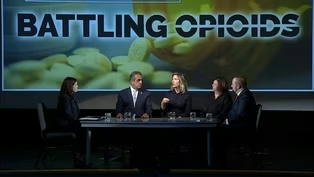
Wyoming County Voices - Battling the Opioid Crisis Together - Preview
Clip: S2025 Ep7 | 30s | Premieres Monday, November 17th at 7pm on WVIA TV (30s)
Providing Support for PBS.org
Learn Moreabout PBS online sponsorship















Support for PBS provided by:
WVIA Special Presentations is a local public television program presented by WVIA