
Zero Street & More
Season 17 Episode 1 | 26m 36sVideo has Closed Captions
A 1931 photo becomes a portal through time, an eerie barley circle ignites decades of speculation.
A 1931 photograph becomes a portal through time, an eerie circle in barley ignites decades of wild speculation, old-school western art through the eyes of a modern cowboy, and a DeWitty descendent shares a poem written by her father in 1912.
Problems playing video? | Closed Captioning Feedback
Problems playing video? | Closed Captioning Feedback
Nebraska Stories is a local public television program presented by Nebraska Public Media
Zero Street & More
Season 17 Episode 1 | 26m 36sVideo has Closed Captions
A 1931 photograph becomes a portal through time, an eerie circle in barley ignites decades of wild speculation, old-school western art through the eyes of a modern cowboy, and a DeWitty descendent shares a poem written by her father in 1912.
Problems playing video? | Closed Captioning Feedback
How to Watch Nebraska Stories
Nebraska Stories is available to stream on pbs.org and the free PBS App, available on iPhone, Apple TV, Android TV, Android smartphones, Amazon Fire TV, Amazon Fire Tablet, Roku, Samsung Smart TV, and Vizio.
Do you have a Nebraska Story?
Do you have a story that you think should be told on Nebraska Stories? Send an email with your story idea, your name, your city and an email address and/or phone number to nebraskastories@nebraskapublicmedia.org. Or, click the link below and submit your information on nebraskastories.org.Providing Support for PBS.org
Learn Moreabout PBS online sponsorship(gentle music) -[Narrator] Coming up on Nebraska Stories.
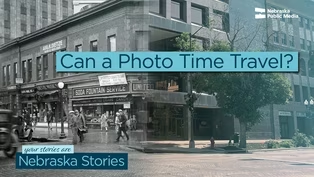
A 1931 photograph becomes a portal through time.
(gentle music) An eerie circle in barley ignites decades of wild speculation.
(gentle music) Old school Western art through the eyes of a modern cowboy (gentle music) and a DeWitty desendent shares a poem written by her father in 1912.
(upbeat music) (upbeat music) (upbeat music) -[Narrator] 5 billion.
That's how many photographs we humans take each and every day.
In the second decade of the 21st century.
(upbeat music) Anything that common lacks mystery.
(upbeat music) It was different in the last century.
(upbeat music) I was walking into a restaurant in Lincoln, Nebraska, when I looked up and saw a photograph on the wall.
(dishes clanging) As I got closer, it came to life.
(jazz music) May 31st, 1931, 13th and O Street in downtown Lincoln.
(jazz music) It gave me an uncanny feeling, as if I could step into it.
Kind of like a time machine.
(jazz music) A drugstore with soda fountain service.
(jazz music) Aunt Betty's Bread.
Wonderful flavor.
(jazz music) The Strand Theater.
Chesterfield Cigarette day: "They satisfy.
That's why!"
Men and women were rushing across the street with umbrellas drawn against the rain.
(jazz music) They don't know it.
But this rainy day is a blessing.
(people chatting) In a little more than two years, A major dust storm will hit out west with winds over 50 miles an hour, (wind blowing) and so will begin what nobody in this photo can imagine.
The dust bowl.
(wind blowing) Odd thoughts to have as you sit down to a bowl of tortilla soup.
(somber music) Can a photo take you into the past?
I once read a novel called Time and Again by a writer named Jack Finney.
(somber music) It's 1970.
A man is taking part in a time travel experiment.
(somber music) From his window in New York City, He can see the Dakota building looming over Central Park.
For days, He stares at a photo of that identical location (somber music) 90 years in the past, and the experiment works.
He travels back in time to January 21st, 1882, until he's actually there.
(somber music) What he can't imagine is the future.
(whistle blowing) In 1980, John Lennon, who lived in the Dakota, was assassinated right outside.
(somber music) And there's the movie called Somewhere in Time.
Christopher Reeve plays a young man who sees a photo of a beautiful woman on the wall of his hotel.
(somber music) Through self-hypnosis, he travels back in time to 1912 and meets the woman, played by Jane Seymour.
(somber music) Of course, they fall in love.
(somber music) So can you use a photo for time travel?
Do the ghosts of the past live in the present?
(people chatting) Let's go to the same location as the one in the photo.
Exactly 94 years later.
(wind blowing) -[Christine] It's May 31st, across from the northeast corner of 13th and O Street.
I'm here with architect Bob Ripley, who grew up in Lincoln.
So, Bob, looking at this photo from 90 years ago, (soft rumbling) what do you see?
(soft rumbling) -[Bob] Downtown Lincoln at the time this photograph was taken was the spot in the city.
(soft rumbling) If there was business, if there was entertainment, (loud rumbling) if there was banking, if there was anything you wish to do in the city of Lincoln.
Downtown was where it would happen.
There were no suburbs, so to speak, in terms of major shopping or business areas.
It was all concentrated in downtown Lincoln.
And bear in mind, when this photograph was taken, Lincoln was one quarter, 25% the size that it is today.
(construction pounding) -[Narrator] It was poet Alan Ginsberg who named O Street Zero Street.
(loud rumbling) Some say it's the longest main street in America.
(loud rumbling) It's definitely one of the noisiest!
But what did it sound like back then?
-[Bob] This was largely a pedestrian zone with a few cars.
Now it is largely an automotive zone with just a few pedestrians.
So it has kind of turned 180 degrees from what it was (loud rumbling) when this photograph was taken.
-[Christine] Where did all the people go?
(loud rumbling) Where do they walk now?
-[Bob] No kidding.
No kidding.
-[Narrator] There's one building in the photo that hasn't changed, at least on the outside.
(soft rumbling) The Stuart building.
-[Bob] Very beautiful neoclassical kind of neo-Gothic building in the background designed by Ellery Davis.
This building is one of.
It's one of downtown's true architectural landmarks.
(train horn blaring) -[Narrator] And the granite office building that dominates what we see today still retains the shape of the old JCPenney store.
(loud people talking) Which had its grand opening in 1950.
(whistle blowing) (soft piano music) In fact, from the 1930s into the 80s and beyond, places like downtown Lincoln were all about walking, talking, eating and shopping.
(soft piano music) Bob Ripley remembers it well.
(soft piano music) -[Bob] And my mom would bring us down because she didn't have a sitter to leave us with, and she'd bring us down, and we were wandering around behind her from one location to the other as she did her shopping.
(soft piano music) -[Narrator] Across the street from 13th and O is Miller and Paine, the department store once famous for its tea room and cinnamon rolls.
(soft piano music) It's an office building now, but back in the day, Miller and Paine rivaled Amazon.
-[Bob] If I lived in Dallas and wanted to shop for my family that all lived in Lincoln, I could call Miller and Paine.
They would shop for me and deliver all the packages (soft piano music) and take care of everything.
That's one.
That's just one of hundreds of services they provided.
(soft piano music) Plus it had location, location, location.
Bingo.
Right at the prime intersection of downtown Lincoln 13th and O.
(soft piano music) -[ChristineÑ What do you think these people would think if they could be suddenly transported here onto this corner?
-[Bob] I think they'd be astonished.
I think they look around as if they were on another planet, and they they would see some familiarity there, some things they might remember from their life, but I think they would walk around and see people walking down the sidewalk with a phone in their hand and texting someone.
I think they just think they were on another planet.
(soft piano music) -[Narrator] Time to take a picture of my own with my new iPhone.
(gentle music) Now... And then.
(gentle music) I have to confess.
Time travel has eluded me.
(gentle music) But someday, 90 years from now, someone might look at the photo I just took and wonder what life was really like back in the 21st century.
When they see the cars, the trucks, the SUVs driving by on Zero Street.
(gentle music) Will they wish they could tell the people inside those vehicles (gentle music) what happened next.
(gentle music) (static sizzling) - [Man] And that is so strange.
You see what I mean in the center there.
-[OfficerÑ All counterclockwise isn't it.
-[Man] Not saying I disbelieve you, but someone else might.
(intense music) -[Kelly] Do you believe in UFOs?
(intense music) - Yes, I do.
Without a doubt.
I believe in UFOs.
The interesting thing is that the government is now having a number of committees that are being set up to really study it openly.
It's no longer necessary to try to prove it.
They're real, and they're here and they're for somewhere else.
And that's about all there is.
(intense music) -[Duane] I got into the office a little bit early.
I was doing some paperwork, and all of a sudden Kelly Reiser came into the office and he was all excited.
(intense music) He said, I gotta show you something.
It's hard to describe.
(intense music) - I guess I'd got up earlier in the morning.
It was hot, and I went to windrow, this field of barley before it got so hot in the afternoon.
Probably ten acres in the field, and that I could.
I came upon it and I could see it like several, probably 100ft away.
No.
(intense music) No footprints, nothing.
No disturbance of any sort.
I was above it.
It was an open station machine with no cab.
So I was able to get right close to it, stand up and get an aerial more or less view of the circle.
That's when I went and got Thad.
- I couldn't figure out what he was talking about.
But then when we got out there, I was like, I was.
I said, well, you need it.
We need to get somebody here to look at this besides us, because they're not going to believe what they're seeing.
(static) -[Duane] I looked out there and there was two circles.
One was a inner circle.
One was an outer circle.
And I says, did you go inside it to check what was happening?
He says, I have not been out there.
He says, that's barley.
If you go through there, we'll leave tracks.
And first thing I did, I call Offutt Air Force Base.
He laughed at me.
He says he just call the FBI.
I called World-Herald, KFAB, KMTV.
I called the White House at noon.
(intense music) The news came out about a crop circle up at Boyd County.
(gentle music) And then the phone call started coming.
(gentle music) And that's what the morning was on the on the 21st.
I got a lot of ideas from the town people and who came out.
(gentle music) I got a call from a newspaper man from New York saying that he heard about it.
And it's phony.
-[Kelly] Yeah, that's what I count.
-[Duane] And I said, well, how do you know you're in New York.
-[Kelly] They basically set up a crime scene and research if they could find any human activity in the ditch or anywhere around there.
(gentle music) -[Officer] 42ft from the outside to the outside.
(gentle music) -[Kelly] They looked it over, well.
-[Duane] There was no entry into the field.
None at all.
(gentle music) -[Officer] Nobody would.
Well, there's a path going out there now.
I couldn't keep anyone away.
-[Duane] Yeah I know.
Well, that's.
But there wasn't this morning when you and I were out here.
-[Kelly] No, I know.
-[Officer] When you windrowed, there were no tracks?
-[Kelly] There wasn't anything.
I was the first set.
(wind blowing) -[Kelly] The beard is about three inches long.
They were all gone.
They were clipped back to approximately, maybe an eighth of an inch.
There was no trace of them.
They were just gone.
(tractor engine rumbling) -[Kelly]The most peculiar thing I noticed is in the center of there.
(tractor engine rumbling) It's just like bent and spiraled.
Yeah.
-[Duane] It's like somebody took a drag and laid it down there and then just spun it right around.
-[Kelly] Do you see what I mean in the center there.
-[Officer] This is the center right here?
-[Kelly] Yeah.
-[Duane] Yeah, you can tell it right there.
-[Officer] It's all just starts laying the same direction.
-[Kelly] That's what I. That is so strange.
It's just.
And that grain is good and tall, and it just kind of wraps it around there.
(tractor engine rumbling) And that's something wind absolutely will not do to grain.
-[Duane] That's what they said.
There was no wind thing made that.
(tractor engine rumbling) I don't know what the hell it would be.
(tractor engine rumbling) -[Kelly] The barley itself was bent over approximately three inches up and just at a complete 90 degree angle.
Then the grain was in the weave.
- I started investigating what was taking place that night before.
It was, a big (gentle music) lightning display up at Boyd County on that night from about 9:00 to about 11:00.
It was phenomenal.
(gentle music) - You know, some people thought it was hoaxers.
Some people thought it was Kelly and I that did it.
It was too clean a job and there was no tracks.
(gentle music) People had all kinds of opinions.
- But whatever it was, was created not by a hoax, but by some, I think some non-human intelligence.
(gentle music) And the way it is laid out with apparently no human touches, whether that's extraterrestrial or some non-human intelligence on this earth (gentle music) spirits or something like that, but not humans.
(gentle music) - I was not getting no results until I got a call from a professor in Michigan.
So I took samples of the barley it was standing, and then the barley that was all laid down.
He said to take soil samples and he says, hey, we're going to test it out.
And they would get back to me.
I got a letter from that professor saying that he believed there was pressure from the atmospheric is the thing that caused there to crop circle.
But he could not come to no conclusion how it happened.
So I took the advice and I said there is had to be something that had to be all related to the lightning strikes and what took place the night before.
- Doctor Levengood has is tried his analysis to say there's some kind of a plasma vortex, and he would like to make it some kind of a natural phenomenon, but there's nothing natural about it.
- I'm not thinking it was aliens, and I'm not really buying that it was a natural event, but it could have been.
(gentle music) I just thought it was pretty neat that it happened here and and everybody that showed up to see it, I (gentle music) it was it was quite a stir for a month.
- There ended up being thousands of people came in looking at it and just stand there for hours and just be fascinated like they didn't know what they made of it.
I don't think it was made by a person.
I feel that it was some sort of natural phenomena.
That's my personal feeling with it.
But what it was, I don't know.
-[Jack] Kelly Reiser, the farmer, was running the combine going on in the field, and he saw this thing in the circle and saw it and stopped.
We have no explanation.
He didn't do it.
It's not a hoax.
And we don't know how it was done and what intelligence did it, but it's there and we still don't know why.
All these years later.
(gentle music) -[Kelly] One last question.
Do you believe in UFOs?
(gentle music) - Yes and no.
Well, there was no proof back then to, you know, if there was any kind of flying saucers or other people from other planets coming down.
I just left it at the imaginations of people, of what they think, of what it was.
Things could happen, and you could either believe it or not believe it.
(gentle music) (gentle music) -[Narrator] Brandon Bailey credits fate with bringing him to the western edge of Nebraska's panhandle.
(gentle music) He and wife, Priscilla, and a host of critters live on a ranch nestled in the rolling hills and canyons near the Wildcat Hills.
(gentle music) The Wyoming native came to Nebraska to study art education and ended up dropping out to pursue art instead.
(gentle music) -[Brandon] Self-taught is an interesting concept because I would say more self-motivated than anything.
Trying to find artists that you admire and look up to, and that's where I started.
Some of those artists that took me under their wing and kind of showed me the ropes, someone would give me a pointer, "Hey, why don't you try this?"
And I would just start doing those little things, and then that just kept expanding upon the language of art for me.
(brush scraping) -[Narrator] Bailey began drawing at an early age as a way to document experiences.
(brush scratching) And now, before he spends time in the studio, Bailey takes his brushes into the field.
(brush scratching) -[Brandon] Seeing old buffalo wallows, you know, and walking in the same footsteps that the Kiowa, the Lakota, and even the Stone Age prehistoric peoples would have walked.
You're seeing all that history written in the land.
I consider the hiking aspect of it is just as much a part of my painting as it is the actual painting itself.
Going out and seeing how the grasses are at two in the afternoon on a sunny day, it's almost like you're painting in your head as you're walking along.
I can capture different times of day and sometimes it doesn't translate the same way in my photography.
So like a shadow will be kind of darkened, whereas in plain air, if you really observe something, you'll see the colors that are in that shadow.
And so these are color studies, so you're getting the colors of that environment and then you take that into the studio.
(brush scratching) -[Narrator] His latest piece depicts native wolf scouts.
His process is meticulous.
He researches key details for historical accuracy, from tribal beating patterns to the feathers that might have been worn.
He uses photographs, either historical or modern recreations as a reference.
The weather, time of day, the interplay of light and shadows are all used to recreate the moment as it might have unfolded.
(gentle music) In the early part of his career, Bailey found success painting wildlife, landscapes and cowboys.
But as a member of the Ottawa and Chippewa nations, he was hesitant to explore his heritage in his work.
-[BrandonÑ I didn't wanna paint my tribe because I didn't grow up around it.
So growing up around the West, I was more interested in the Plains Indians and the tribes of this area.
I kicked it down the road, I didn't want to paint it because I knew the respect and the reverence that it took to portray that correctly.
(gentle music) -[Narrator] A few years ago, that all changed.
-[Brandon] I kind of went on a photo shoot for the first time and started getting the reference of Native Americans dressed in different tribal outfits and you know, whether it was Blackfeet, tribal war shirts, or headdresses to Lakota and I just kind of started painting it, and then from there it became an obsession of how much can I learn about cultures of the plains.
(gentle music) I don't speak for all native people either, that this is just my experience with painting what I'm painting, and this is the contribution I can give, but it's not everybody's story.
(gentle music) My experience as someone that's half white and half native, you know, that's what I'm bringing to it.
But I've been finding my native roots through the painting and trying to discover that side of me.
(gentle music) -[Narrator] In 2019, the Cowboy Artists of America invited Bailey to join their exclusive ranks.
-[Brandon] We're portraying the truth of the West, I guess that's the main mission behind the CA.
(gentle music) I'm still speechless about the whole thing.
I mean, I was in tears when I got invited in.
It's one of those deals where I know there's nothing more prestigious I can do in my career.
(gentle music) -[Narrator] A few years ago, Bailey began sculpting as well.
[Brandon] And it just came natural to me.
With sculpting, I actually have more fun doing sculpting than I do painting because it's like you have something 3D to work with.
And so I did the bison, you know this big, and now it's in downtown Cheyenne.
And so the same as with this pronghorn antelope, I did the Marquette, somebody saw it and now wants to do a half life size.
(gentle music) -[Narrator] Still, even as Bailey's sculptures gain recognition, painting remains his true passion.
(gentle music) -[Brandon] There's no such thing as making it in this business.
You just get up every day and try to get better.
It's one of those pursuits that, you know, when I still have a painting on my easel at the end of the road in my life, I'll probably still be trying to learn how to paint.
And I think that's what makes it fun, is you're never gonna figure it out but you know, you'll keep trying.
(gentle music) (gentle music) (gentle music) (gentle music) (gentle music) ♪ ♪ ♪ ♪ ♪ ♪ >> "NEBRASKA."
>> FROM THE MIGHTY OLD MISSOURI TO THE DRY PLAINS OF THE WEST, FROM DAKOTA'S LAND TO KANSAS IS THE STATE THAT I LOVE BEST.
'TIS THE PLACE WHERE FIRST THE HOUSES WERE OF RICH PRAIRIE SOD.
IT IS BEAUTIFUL NEBRASKA, THE HOME OF THE GOLDEN ROD.
'TIS THE HOME OF MAMMOTH RANCHES AND OF MIGHTY FIELDS OF CORN.
'TIS THE LAND OF PEACE AND PLENTY.
IT'S THE STATE WHERE I WAS BORN.
ITS STREAMS ARE SWIFT AND MIGHTY AND THE PLATTE HERE MAKES ITS HOME.
'TIS THE LAND OF COZY FIRESIDES FROM WHICH WE NEVER CARE TO ROAM.
IT HAS TOWNS AND ALSO CITIES OF WHICH WE NEED NOT BE ASHAMED.
THE CAPITAL IS LINCOLN, FOR OUR GREATEST PRESIDENT NAMED.
THE HILLS ARE NATURE'S TEMPLES.
THE VALLEYS ARE OUR PRIDE.
'TIS KNOW AS A TREELESS STATE, BUT WE HAVE TREES BESIDE.
THE PEOPLE ARE PROGRESSIVE AND CO-OPERATION RULES.
AND WHEN IT COMES TO TRAINING, WE'VE THE VERY BEST OF SCHOOLS.
WHAT NEBRASKA IS AND WILL BE, I HAVE NOT THE WORDS TO SAY, BUT IT'S THE WORTHY PRIDE OF A COMMONWEALTH AND THE GEM OF THE U.S.A.
WRITTEN BY MY DAD, WILLIAM H. MEEHAN, AT 19 YEARS OF AGE, APPROXIMATELY 1916.
(upbeat music) (upbeat music) - [Narrator] Watch more Nebraska stories on our website, Facebook and YouTube.
Nebraska Stories is funded in part by the Margaret and Martha Thomas Foundation, and the Bill Harris and Mary Sue Hormel Harris Fund for the presentation of cultural programming.
(upbeat music) (upbeat music) (upbeat music) (upbeat music)
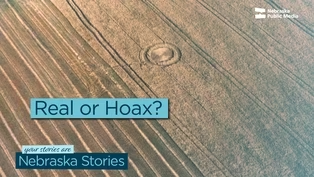
Why This Nebraska Crop Circle Still Has No Answers
Video has Audio Description
Clip: S17 Ep1 | 8m 42s | An eerie circle in barley ignites decades of wild speculation. (8m 42s)
Video has Closed Captions
Clip: S17 Ep1 | 8m 28s | A 1931 photograph becomes a portal through time. (8m 28s)
Providing Support for PBS.org
Learn Moreabout PBS online sponsorship














Support for PBS provided by:
Nebraska Stories is a local public television program presented by Nebraska Public Media