
Zero Street
Clip: Season 17 Episode 1 | 8m 28sVideo has Closed Captions
A 1931 photograph becomes a portal through time.
Have you ever seen a photograph so real you feel as if you can step right into it? When Christine Lesiak saw a photo on the wall of a restaurant, taken on a rainy day in Lincoln in 1931, she wondered if she could use it to travel into the past. She meets architect Bob Ripley on that same corner exactly 94 years later to see what has changed over time. Does their attempt to time travel work?
Problems playing video? | Closed Captioning Feedback
Problems playing video? | Closed Captioning Feedback
Nebraska Stories is a local public television program presented by Nebraska Public Media
Zero Street
Clip: Season 17 Episode 1 | 8m 28sVideo has Closed Captions
Have you ever seen a photograph so real you feel as if you can step right into it? When Christine Lesiak saw a photo on the wall of a restaurant, taken on a rainy day in Lincoln in 1931, she wondered if she could use it to travel into the past. She meets architect Bob Ripley on that same corner exactly 94 years later to see what has changed over time. Does their attempt to time travel work?
Problems playing video? | Closed Captioning Feedback
How to Watch Nebraska Stories
Nebraska Stories is available to stream on pbs.org and the free PBS App, available on iPhone, Apple TV, Android TV, Android smartphones, Amazon Fire TV, Amazon Fire Tablet, Roku, Samsung Smart TV, and Vizio.
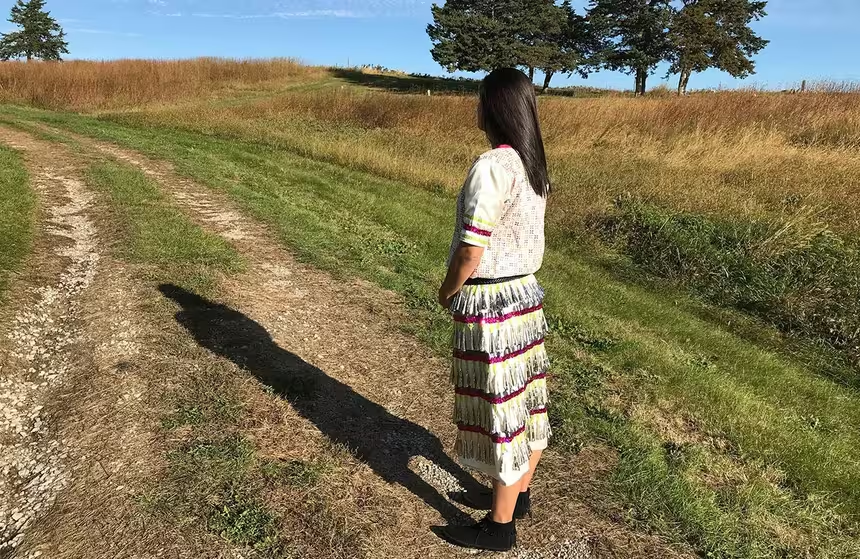
Do you have a Nebraska Story?
Do you have a story that you think should be told on Nebraska Stories? Send an email with your story idea, your name, your city and an email address and/or phone number to nebraskastories@nebraskapublicmedia.org. Or, click the link below and submit your information on nebraskastories.org.Providing Support for PBS.org
Learn Moreabout PBS online sponsorship(upbeat music) -[Narrator] 5 billion.
That's how many photographs we humans take each and every day.
In the second decade of the 21st century.
(upbeat music) Anything that common lacks mystery.
(upbeat music) It was different in the last century.
(upbeat music) I was walking into a restaurant in Lincoln, Nebraska, when I looked up and saw a photograph on the wall.
(dishes clanging) As I got closer, it came to life.
(jazz music) May 31st, 1931, 13th and O Street in downtown Lincoln.
(jazz music) It gave me an uncanny feeling, as if I could step into it.
Kind of like a time machine.
(jazz music) A drugstore with soda fountain service.
(jazz music) Aunt Betty's Bread.
Wonderful flavor.
(jazz music) The Strand Theater.
Chesterfield Cigarette day: "They satisfy.
That's why!"
Men and women were rushing across the street with umbrellas drawn against the rain.
(jazz music) They don't know it.
But this rainy day is a blessing.
(people chatting) In a little more than two years, A major dust storm will hit out west with winds over 50 miles an hour, (wind blowing) and so will begin what nobody in this photo can imagine.
The dust bowl.
(wind blowing) Odd thoughts to have as you sit down to a bowl of tortilla soup.
(somber music) Can a photo take you into the past?
I once read a novel called Time and Again by a writer named Jack Finney.
(somber music) It's 1970.
A man is taking part in a time travel experiment.
(somber music) From his window in New York City, He can see the Dakota building looming over Central Park.
For days, He stares at a photo of that identical location (somber music) 90 years in the past, and the experiment works.
He travels back in time to January 21st, 1882, until he's actually there.
(somber music) What he can't imagine is the future.
(whistle blowing) In 1980, John Lennon, who lived in the Dakota, was assassinated right outside.
(somber music) And there's the movie called Somewhere in Time.
Christopher Reeve plays a young man who sees a photo of a beautiful woman on the wall of his hotel.
(somber music) Through self-hypnosis, he travels back in time to 1912 and meets the woman, played by Jane Seymour.
(somber music) Of course, they fall in love.
(somber music) So can you use a photo for time travel?
Do the ghosts of the past live in the present?
(people chatting) Let's go to the same location as the one in the photo.
Exactly 94 years later.
(wind blowing) -[Christine] It's May 31st, across from the northeast corner of 13th and O Street.
I'm here with architect Bob Ripley, who grew up in Lincoln.
So, Bob, looking at this photo from 90 years ago, (soft rumbling) what do you see?
(soft rumbling) -[Bob] Downtown Lincoln at the time this photograph was taken was the spot in the city.
(soft rumbling) If there was business, if there was entertainment, (loud rumbling) if there was banking, if there was anything you wish to do in the city of Lincoln.
Downtown was where it would happen.
There were no suburbs, so to speak, in terms of major shopping or business areas.
It was all concentrated in downtown Lincoln.
And bear in mind, when this photograph was taken, Lincoln was one quarter, 25% the size that it is today.
(construction pounding) -[Narrator] It was poet Alan Ginsberg who named O Street Zero Street.
(loud rumbling) Some say it's the longest main street in America.
(loud rumbling) It's definitely one of the noisiest!
But what did it sound like back then?
-[Bob] This was largely a pedestrian zone with a few cars.
Now it is largely an automotive zone with just a few pedestrians.
So it has kind of turned 180 degrees from what it was (loud rumbling) when this photograph was taken.
-[Christine] Where did all the people go?
(loud rumbling) Where do they walk now?
-[Bob] No kidding.
No kidding.
-[Narrator] There's one building in the photo that hasn't changed, at least on the outside.
(soft rumbling) The Stuart building.
-[Bob] Very beautiful neoclassical kind of neo-Gothic building in the background designed by Ellery Davis.
This building is one of.
It's one of downtown's true architectural landmarks.
(train horn blaring) -[Narrator] And the granite office building that dominates what we see today still retains the shape of the old JCPenney store.
(loud people talking) Which had its grand opening in 1950.
(whistle blowing) (soft piano music) In fact, from the 1930s into the 80s and beyond, places like downtown Lincoln were all about walking, talking, eating and shopping.
(soft piano music) Bob Ripley remembers it well.
(soft piano music) -[Bob] And my mom would bring us down because she didn't have a sitter to leave us with, and she'd bring us down, and we were wandering around behind her from one location to the other as she did her shopping.
(soft piano music) -[Narrator] Across the street from 13th and O is Miller and Paine, the department store once famous for its tea room and cinnamon rolls.
(soft piano music) It's an office building now, but back in the day, Miller and Paine rivaled Amazon.
-[Bob] If I lived in Dallas and wanted to shop for my family that all lived in Lincoln, I could call Miller and Paine.
They would shop for me and deliver all the packages (soft piano music) and take care of everything.
That's one.
That's just one of hundreds of services they provided.
(soft piano music) Plus it had location, location, location.
Bingo.
Right at the prime intersection of downtown Lincoln 13th and O.
(soft piano music) -[ChristineÑ What do you think these people would think if they could be suddenly transported here onto this corner?
-[Bob] I think they'd be astonished.
I think they look around as if they were on another planet, and they they would see some familiarity there, some things they might remember from their life, but I think they would walk around and see people walking down the sidewalk with a phone in their hand and texting someone.
I think they just think they were on another planet.
(soft piano music) -[Narrator] Time to take a picture of my own with my new iPhone.
(gentle music) Now... And then.
(gentle music) I have to confess.
Time travel has eluded me.
(gentle music) But someday, 90 years from now, someone might look at the photo I just took and wonder what life was really like back in the 21st century.
When they see the cars, the trucks, the SUVs driving by on Zero Street.
(gentle music) Will they wish they could tell the people inside those vehicles (gentle music) what happened next.
(gentle music)
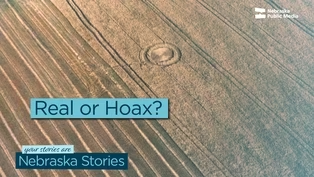
Why This Nebraska Crop Circle Still Has No Answers
Video has Audio Description
Clip: S17 Ep1 | 8m 42s | An eerie circle in barley ignites decades of wild speculation. (8m 42s)
Providing Support for PBS.org
Learn Moreabout PBS online sponsorship














Support for PBS provided by:
Nebraska Stories is a local public television program presented by Nebraska Public Media