Reference story:
Original air date:
11.14.07
Astronaut Franklin Chang-Diaz has been in orbit more times than most people have been in airplanes. Since 1986, he's logged over 1,600 hours on board the Space Shuttle. Now, retired from NASA, he's President and CEO of the Ad Astra Rocket Company. At facilities in Houston and in his native Costa Rica, Franklin Chang-Diaz is developing some revolutionary rocket engine technology. He's here to talk to Adam.
Adam Rogers: Franklin Chang-Diaz, welcome to WIRED SCIENCE. Delighted to have you here. Uh, now, you’re a, you’re working on a spacecraft propulsion system that, that you invented, um, that I want to talk about but, but you're also a veteran of, of 7 space shuttle missions.
Franklin Chang-Diaz: Correct, that's right.
Adam: So that actually makes you the coolest person in the studio. Um, forgive me for being a space nerd but can you talk to me about what that was like and do you have a favorite mission that you were on? What was kind of your favorite moment?
Franklin: The first flight is definitely the most interesting one because it’s the first time you experience this leaving Earth and being able to, you know unbuckle your, your seatbelts and float out into the cabin and look out the window and see that spectacle of the planet in front of your eyes.
Adam: A lot of astronauts do describe that as being really profound.
Franklin: It really is. It's, it's a tremendous feeling. Um, you have arrived you are there. That is very transforming in fact.
Adam: You know, 7 missions is a lot. Did anything ever go wrong? Were you ever scared?
Franklin: Well, yeah. We had one fairly major problem on the second flight. We had a failure of a cooling system. And what was even more interesting is that on board, we had the Galileo spacecraft bound for Jupiter...
Adam: Right.
Franklin: Who had been waiting six years to get its launch...
Adam: And went on to do all those great pictures of Europa and just was a tremendous mission.
Franklin: Exactly, it was a beautiful mission in the end but Galileo had to be deployed.
Adam: Right.
Franklin: So, it was a, extremely high-pressure moment for us to get that thing out of the cargo bay.
Adam: Did you fix it?
Franklin: We fixed the, the problem but in the course of fixing it, the shuttle cabin became extremely hot and humid, like a summer day in Houston except that of course, we had these very bulky suits and you can't imagine how uncomfortable it is to sweat in zero gravity.
Adam: Oh, it was…
Franklin: And that is because all the, all the sweat just covers your face and it doesn’t drip.
Adam: Right, of course.
Franklin: And of course, if somebody all of a sudden turns, their head and all that sweat goes flying off.
Adam: That’s horrible.
Franklin: And ends up in your face. And it’s very ugly, very uncomfortable. We were able to get the Galileo off on time and of course there’s, some beautiful pictures of the movement of this majestic thing coming out of the cargo bay and people behind the camera were, there was absolute pandemonium going on. Absolute chaos.
Adam: We, don’t know anything about that kind of thing here, that's...
Franklin: No, everything was nice and cool supposedly.
Adam: That’s right.
Franklin: But it’s not the case. But in a way, it relates to how astronauts work. I mean, you, you get the job done.
Adam: Now that you’re out of the Core and now you run a company Ad Astra, that is building a spacecraft propulsion system, new design that's your invention, right?
Franklin: That’s right.
Adam: I know it’s called VASIMR,
Franklin: Right.
Adam: Can you tell me what that means and explain how it works?
Franklin: Yeah, well it's an acronym Variable Specific Impulse Magneto-plasma Rocket. So, VASIMR is a very different type of propulsion system unlike the chemical rockets that we have today, which use hydrogen and oxygen or some other chemical compounds that burn, produce a lot of heat and what we do is sort of the same thing except that we, we go to much higher levels of temperature of this reaction and there’s actually no burning going on. We are heating a fluid, which happens to be a gas, to such an extent, that it becomes plasma.

Adam: So, charged particles
Franklin: A soup of charged particles not unlike the sun and the stars, the hotter the exhaust, the better the rocket.
Adam: Could you still use this to launch from Earth?
Franklin: Uh, no actually no, not in this case, because the plasma is a, a medium that doesn't really live very well in the atmosphere. It kind of needs a vacuum, to be, a plasma we, we would use it for the transportation from one planet to another.
Adam: So do you use a, a traditional chemical rocket to get to orbit, let’s say and then it would be waiting when you got there, to, to move to the moon, to Mars.
Franklin: Exactly. Exactly. That's what we would need, some sort of a transporter that would get us over to orbit and then from orbit, we would move on with plasma drive, just like the Starship Enterprise….


Adam: I was going to say, you use the word transporter and all of a sudden the Star Trek geek lights go off…
Franklin: All of a sudden came out.
Adam: But so, why is that better than just using a traditional chemical rocket?
Franklin: In reality it all boils down to fuel efficiency, if you want to supply the moon, for example. The moon is going to be sustaining, um, a human presence for many, many years and that needs to be affordable. And the chemical approach will not allow you to do that. You would have to have some other means of getting stuff to the moon cheaply and the plasma drive will do that for you.
Adam: Well I just want to geek out a little bit more about this because it's also a lot more faster, the plasma drive is much faster than a, than a chemical rocket.
Franklin: It is faster if you give it range. It's kind of like a sports car. You need to be on the freeway to really realize the capability of this vehicle and it turns out that going to the moon is like going to the neighborhood store. You really don’t want to, don’t want to go all the way into the fifth or sixth gear…
Adam: Only someone who’s been to space could be so casual about going to the moon, but all right.
Franklin: You could only realize that speed capability in a, on a mission to Mars or beyond. And that is, um, because the, the engine is on all the time. You can think of it as on continuously halfway and then when you get to the midway, the mid-point of your journey, you flip around and you start decelerating because otherwise of course, you miss the planet and then you miss your exit, you can't just turn around.
Adam: People get embarrassed, when you… So the, so that’s as distinct from like, um, you know an Apollo rocket, where you sort of burn for a few seconds and then you're just on trajectory…
Franklin: Exactly.
Adam: …basically, right?
Franklin: And then you know they say in the chemical Apollo-type of rocket, you know you travel on a cannon ball in, in essence. You get a push and then you free-fall all the way. That's why, um, they had to go to the moon all, all the way to the moon before they could turn around to come back on the Apollo 13. If you're, if you're familiar with Apollo 13 flight, um, the abort had to, um, required them to use the moon's gravity to turn them around...
Adam: To swing around.
Franklin: …and come back to Earth.
Adam: So, but you also, it's magneto-plasma so what, what does a magnet have to do with that?
Franklin: Right. Well plasmas, um, are very hot. So temperatures of the order of a, a million degrees cannot be sustained by any known material, no matter what material it is. Fortunately plasmas respond very well to the presence of magnetic forces, magnetic and electric forces and we use those to advantage by creating essentially an invisible flux tube, an invisible sleeve that has the shape of a nozzle.
Adam: It's a force field and so instead of a cone, like on the bottom of a standard rocket, that's just a magnetic field.
Franklin: A magnetic nozzle is what we call it.
Adam: Then this is, your original research was in fusion, so that confining plasma with a magnetic field comes out that, right?
Franklin: Exactly and the origin of this whole technology comes from research in magnetic fusion...
Adam: All right.
Franklin: …where you have to do the same thing. You have to confine the plasma and you have to hold it away from any material walls in order to heat it and compress it to temperatures that are thermonuclear, where the ignition of the plasma will take place.
Adam: Now, not all astronauts have this kind of scientific background. When you were in the Astronaut Core, you were actually pretty instrumental in trying to bring some of this science to some of your colleagues, right? The Astronaut Science Club, talk a little bit about what that was like.
Franklin: Correct that was an interesting facet of, of time. The Astronaut Core over time evolved into something more scientific. See, if you remember in the early days of, of space flight, the task was not science. The task was stay alive you know, and find a way to survive. And that required people who were very well versed in, in following procedures strictly.
Adam: Aviators.
Franklin: Exactly. As we get more sophisticated at what we do in space, then we start expanding our horizons into scientific research and it turns out that you would like to have more access to what's going on right there in the real, in real time. You don’t really want to have w an experiment that has only an off/on switch and so that at some point in time on, you turn it on and then you don’t know what happened.
And we found in the early days of the shuttle program that astronauts were very instrumental in fixing, uh, experiments that didn't quite work, because perhaps the investigator didn't quite know how to do this experiment. Because you know, if you, if you know exactly how to do it or then you shouldn't be doing this experiment, you should be doing some other experiment, so.
Adam: But were the, were the astronauts in the Core responsive to hearing about the science? I mean did you have to sort of drag them to class or did they want to be, did they want to be along?
Franklin: Well, I guess Adam as you might imagine, there was a little bit of difficulty achieving that plan between the, the scientists and the, the pilot type you know those, those 2 types of persons don’t quite mix so easily. So, you have to kind of bring them together. It’s, it's important for the scientist to learn to achieve a goal and, and not get lost in the, in the research and in the, the, the spaceship will you know, crash and burn.
Adam: Do you think that your experiences as an astronaut being on orbit affected how you’re designing the engine now?
Franklin: Very much so the engine that we're designing is, is designed from the ground up as to be human serviced. We would like to be able to replace components as they fail. We expect certain failures but others we don't know. So, we would like to make this, this device as suitable for repair as possible.
Adam: What phase of development is the VASIMR at now?
Franklin: We’re about to test a flight-like prototype, which will be tested in the laboratory in Houston. Given the results of that test, we will then embark in the construction of two flight engines.
Adam: Real…
Franklin: And real…
Adam: Type engines that you can actually put on a spacecraft.
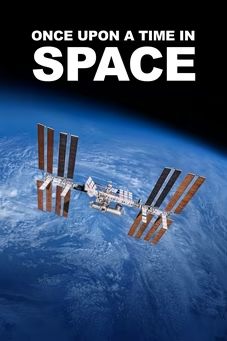
Franklin: Real engines, yes we hope to put the first one on the International Space Station.
Adam: Really?
Franklin: And we would use it of course, to demonstrate the technology but there's another purpose to it, which is, that by firing this engine continuously, we would maintain the space station in a stable orbit.
Adam: You can use it for station keeping. Use it for station keeping.
Franklin: Right. I, actually what happens on the space station is this. The station is low enough that parts of the atmosphere are still affecting it and so, there’s a drag on the space station, which requires that every 3, 4, 5 months, some rocket has to go and dock with it and give it a shove. You know, give it a push, so that it goes up to a higher orbit, then it keeps on falling again, and there, another push.
Adam: But you could replace it with a, with a VASIMR and, and keep it on…
Franklin: Right. So our…
Adam: …a low level.
Franklin: That’s right. It, we call it drag compensation of orbiting large structures.
Adam: All right. Franklin thanks for being here. I appreciate it.
Franklin: Thank you it’s a pleasure.
Adam: I know that you call it the VASMIR but I’m looking forward to hearing a Starship Captain say: “Activate the Chang Diaz Drive”.
Franklin: All right.
Adam: I think that will be great.
Franklin: You know we’ll do that someday.
Adam: Thanks a lot.


Features RSS Feed


0 Comments
0 Posts
+ Add Comment
Post your comment