| |  |
Interview with Richard Cheney, Secretary of Defense |
|
|
How does a cruise missile work? What's a laser guided munition all about? What's the secret of the F117 Stealths? Which are global positioning systems and the Abram tanks? All the other things that went into it. There was an awful lot of the operational art that as a civilian I didn't know. And so I'd scheduled a whole series of briefings for myself with the joint staff in the run up to Desert Storm and by the time we started the operation I had great confidence that the guys would be able to do what they said they could do and I never had any doubt about the military outcome, could we achieve our objective?
The question was, the thing no one could answer was the question of casualties and we assumed with respect to the air war that our worst night would be the first night. That you had the Iraqi forces, the air force basically full up, the air defence system in place -- that we would suffer our largest number of casualties that first night of the air war. And in fact when it was all over with I spent the night in my office at the Pentagon and I got the word when all the aircraft came back we'd only lost one airplane and it was just a phenomenal result. I could not believe that we'd done that well. Obviously we'd been enormously successful and all the training and planning that had went into it had paid off.
Q: How important was the meeting with the Saudis?
Cheney: It was a very important assignment. From a military standpoint if we could not get into Saudi Arabia it was going to be very hard for us to do anything militarily other than mount a naval blockade for example.
Q: And what did you say to King Fahd?
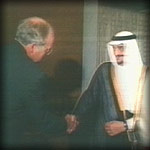
Cheney: I told King Fahd that the Iraqis were amassed on his border and we briefed him on the intelligence in terms of the size of the force that the Iraqis had already used in Kuwait. Pointed out that it was very hard for us to be able to help them unless we could get plenty of advance time 'cos it takes a long time to move heavy forces half way around the world and that timing was of the essence. That they did not have the luxury of waiting until Saddam began an invasion of Saudi Arabia and then ask for help because then it would be too late. We could not get there in time to help them if that were the case. That if he wanted help and assistance and we thought they needed it then it was important to start immediately. King Fahd had listened attentively throughout the meeting They knew exactly why we were there. There was very little small talk, we went right straight to the issue. We had about a two-hour session, at the end of which there was a short conversation between King Fahd and his associates, the Crown Prince, the Foreign Minister, and then he turned back to me after about five minutes of discussions in Arabic and said through the interpreter, through Prince Bandar, that they were prepared to go ahead to accept the U.S. forces in the Kingdom.
Q: What was your sense of the moment?
Cheney: When King Fahd said that he was prepared to accept our proposition, I was pleased, obviously. That was something that was very important to achieve but, secondly, I also had a sense that this particular decision then triggered a whole sequence of pretty momentous events. Hundreds of thousands of troops going to the desert--US deploying major force half way round the world was obviously a significant event.
Q: Was there a moment when he [Bush] said, "OK, sanctions aren't going to work...?"
Cheney: Well, I always thought that the commitment to use force if necessary -- clearly the hope was that we wouldn't have to, that there'd be other ways to resolve it diplomatically or through the application of sanctions -- but that the commitment to use force to expel Saddam Hussein from Kuwait was there when the President came down from Camp David that first week into the crisis and said that this aggression will not stand. I mean, I took that to mean that we were prepared to do whatever we had to do in the end to expel him from Kuwait. Now it did not make sense for us to talk about offensive options in August; we didn't have any forces there yet and if there was a lot of banter and loose talk about offensive operations, it would simply possibly provoke Saddam Hussein into moving them to pre-empt us so that we couldn't get into Saudi Arabia.
But again remember, if he'd gone another 200-250 miles he would have been able to capture the bases and the air fields and the port facilities we needed for our forces. And in August all we had over there initially was the ready brigade of the 82nd airborne and wing of F15's from Langley in Virginia and relatively small forces at the outset, so it wasn't really until the end of August that we began to feel fairly comfortable with the size forces we were getting there. That we could respond aggressively if he were to launch an attack. In September, as you move through the month of September and US forces have arrived, the 24th from Fort Jackson the other kinds of heavy forces began to flow into the region, elements of the 101st, the Marines and so forth and then you begin to feel that you've achieved your first stage objective which is to be able to defend Saudi Arabia. Then you move into the second phase which is OK -- now what are we going to do to get this guy out of Kuwait?
Q: October the 11th, there was a briefing in the White House. What do you remember of that briefing?
Cheney: Basically this was the first look by the senior civilian leadership what we might do by way of offensive action to kick Saddam out of Kuwait. And in effect what I had said and General Powell had said and General Schwarzkopf, was to bring us a briefing on how they would use their forces offensively once this first phase deployment was complete. There were two parts. The first part was really the use of our air capabilities, the air war. That went fairly well, the basic plan that was laid out for us in late September; early October was the one that we ultimately used and was splashed out with a lot more detail, but the overall strategic concept remained the same. The second part of it--how they would use ground forces then to follow through on the air campaign to actually expel Saddam Hussein from Kuwait--most of us felt that was unacceptable. Because of the size of the force, General Schwarzkopf really was limited in the sense that he didn't have enough forces there to do a large flanking attack, which we ultimately undertook. Rather, if he was going to cover Saudi Arabia and defend it against an Iraqi force, and at the same time use it offensively, he really felt he had no option but to go straight up into Kuwait. General Schwarzkopf did not like this option. It was not something he was recommending to us, but it was all they felt they could do, given the forces that were available to them at the time.
Q: Brent Scowcroft thought this was the military saying, 'Hey, you don't want to do this, it's going to be difficult.' Did you feel that?
Cheney: I understand why General Schwarzkopf felt that this was the best they could do at that point. But then it's also important to point out that the slide in the briefing that they showed us that day and General Johnston did the briefing, General Schwarzkopf's chief of staff, the last line in the briefing said this is what we would do if you told us today we had to move offensively but we don't like it, we don't think it's the right way to go and subsequent to that briefing I then sent General Powell out to the Gulf on a mission to meet with General Schwarzkopf which he reported on later in the month. Which basically said 'All right if you don't like that, tell us what you would need in order to be able to undertake an offensive operation to defeat Saddam Hussein and kick him out of Kuwait?'
Q: Did you find that initial plan unimaginative, did you think something Machiavellian was going...
Cheney: Machiavellian is a phrase I would disagree with. I found the plan unimaginative in terms of the ground war because I felt it did risk the possibility that we would not be successful, that we would get bogged down trying to attack the Iraqi fortifications head on, that we'd suffer a lot of casualties, but there weren't many options given the size force we had. 'Cos what had happened as we deployed forces in early August when we were starting out in August, we had nothing then and the Iraqis had about 140,000 troops in Kuwait. As we deployed forces in August and on into September they were building up their forces in Kuwait so that by the time we were finishing our first phase deployment and this briefing was taking place---we were talking about maybe 200,000 US troops in the theatre but they were up to 500-plus thousand troops on the Iraqi side so I would not describe it as Machiavellian.
I think that there was this stated understanding on the part of General Schwarzkopf that this was not something he wanted to do in terms of using that small a force to try to liberate Kuwait. I think also the other thing that runs through here and I think there's some justification for it is, is that some of our senior military commanders still had doubts about whether or not the same thing would happen to them here that had happened in Vietnam. Now in Vietnam we had a President who refused to deploy reserves. He would never call up the reserves and the National Guard. He didn't want to offend the American people and create a political problem for himself. So the active duty force was forced to fight the war all by themselves without the kind of support that they'd planned on. They had a gradual escalation in the air war in Vietnam, they were, all of these senior military commanders had had the experience of a political leadership that was not full square behind the effort and not prepared to make the tough decisions to give them what they needed to do the job.
Now that wasn't true of George Bush, we did it very differently in the Bush administration. I think we had it right, but in these early stages when you're deploying forces and planning the operation I think there was a legitimate reluctance there from some to say you know, are these guys really for real? Now, of course, what they found out was that we were, and when we said "What do you need to do the job?"-- they said "Well, we want VII Corps out of Germany, that's two additional divisions, we want the 1st Infantry division out of Kansas, give us another Marine division and six aircraft carrier battle groups." We said "You got it, now what do you need?" I think we came together and agreed upon the strategy and executed it beautifully. But in those early, early weeks I think there were different points of view within the administration between the military and the civilians in terms of how we were going to proceed. I would agree with Brent on the notion that the President and Brent and I were probably the most aggressive in terms of wanting to develop a military option. Probably less convinced than others that diplomacy was going to work, and leaned hardest on the military to produce an adequate plan with adequate forces to achieve our objective.
Q: After that meeting Brent Scowcroft called you and said he was outraged, what did you say to him?
Cheney: Well, I shared Brent's concern. And it was clear to me that we didn't want to do sort of ground war plan one. That that was unacceptable and that we had to find a way to be more creative in the application of those forces and so we were, we looked at other options. I had work done within the Department by the joint staff to look at something we called the Western Excursion. I mean we experimented with various possibles, some of which we eventually briefed to the President, that looked at the possibility for examples of taking the small force and going out into Western Iraq and occupying the Oman-Baghdad highway cutting that road and occupying some airfields out there for several reasons.
Q: I read about this in some detail and talked to people about Western Excursion...I get the impression of a man trying to put a rocket up the command's backside.
Cheney: I did that very deliberately because it wasn't enough for me just to give instructions. Give me options. I also wanted to have alternatives being debated and I wanted to send a message through the organization that said 'Guys we mean business, now one way or another we're going to get an option put together that allows us to launch offensive action to go after the Iraqis'. In this particular case I had some work done in the policy shop, separate and apart from the joint staff by a retired three star who was a very capable officer in his own right but who was no longer on active duty. He came up with some fascinating ideas and Harry Rowan was involved in it. He worked for Bob ...we took that then and had the joint staff staff it out, but by virtue of having them staff it out it was useful in terms of our planning exercise, that it let us think about some problems we were going to have to deal with down the road but it also sent the signal to everybody, the joint staff, out in the field and central command 'Guys get your act together and produce a plan because if you don't produce one that I'm comfortable with, I'll impose one'.
Q: You achieved that. October 30th everyone gathers in the White House and Colin Powell comes with his shopping list.
Cheney: Yeah, and in the meantime what I'd done was taken Admiral Jeremiah over and we'd briefed the President while General Powell was out in the Gulf and they knew what I was doing but I took the Vice Chairman, Joint Chiefs over and we briefed the President on this Western Excursion option, various ways that we might in fact move there. So I think everybody had the message by the end of October that we were serious and we really wanted to move on.
Q: Could you describe what Powell asked for in that meeting and the President's reaction?
Cheney: Well, I had a pretty good idea what he was going to ask for really. Because we had conversations before he actually did the brief obviously but, I wanted to make certain that they had everything they requested. I did not want to be in a position where the civilians had denied our military leaders the resources they said they needed to do the job. I didn't want there to be any excuse there that "we can't do this because you won't let us have the reserves and haven't given us enough divisions" or whatever. So they came in with a fairly long shopping list and instead of debating it, I just said 'Yes'. And the President had bought off on that. He never questioned once the size of the force we wanted to commit, and he was quick when we said we wanted a quarter of a million reserves. He immediately agreed to a quarter of a million reserves. We said we wanted the VII Corps out of Germany, no problem, he immediately agreed to all of that so that I think the that there was no excuse possible for anybody in the military to say that the civilian side of the house had not supported them. We gave them absolutely everything they asked for and then said, 'Now you must get on with the job.'
Q: As Christmas comes what was the President's mood?
Cheney: I think it's difficult to overstate the pressures that the President was under through this period of time. I mean you've got to remember, we've got not only the military option that we're developing and deploying the troops and so forth and of course he spent Thanksgiving in the desert with the troops. I think that was tremendously morale boosting event for him, not just for the troops but for him. Plus, we'd been through this cycle where in the fall there was a lot of doubt. The public was not united behind this matter when we started, the Democrats and the Congress were opposed to it. Sam Nunn, the Chairman of the Armed Services Committee held hearings after we'd announced at the beginning of November that we were going to double the size of the force we'd sent out there. There was consternation in many quarters.
The former Chairman of the Joint Chiefs went up and testified against us on Capital Hill--yeah, a whole body of opinion in the West that raised questions about whether or not we were doing the right thing. And I think what happened as we got the forces deployed in November and December as we called up the reserves, as people saw that we meant business. --By the time we get close to the holidays the country starts to come together in support of what the President wants to do. And of course as you get later and later in the year it's increasingly clear that Saddam Hussein's not going to withdraw from Kuwait, he's not responding to the sanctions, he's not responding to the diplomacy and it looks increasingly as though we will in fact have to use force to expel him. And General Powell and I went out there on a joint trip as I recall shortly before Christmas and came back and met with the President at Camp David over the holidays. And I think it would be fair to say that we were increasingly confident that if it did in fact come to combat we were increasingly confident we were going to be able to do it and do it right.
Q: And in headline terms your message for the President when you went up to see him at Camp David?
Cheney: Very positive. We were talking then in terms of the date when we would kick off the operation air war. And of course by then we'd been through this diplomatic sequence. What Jim Baker and the President were doing diplomatically was very important.
Q: The Congressional vote. Do you recall discussing with the President what he would have done if he'd lost the votes.
Cheney: It was my view at the time [that] we were absolutely committed to getting Saddam Hussein out of Kuwait one way or the other, no matter what we had to do. We had to have the Saudis as allies in that venture, but if no-one else had been with us if it had just been the United States and Saudi Arabia, without the United Nations, without the authorisation of the Congress, we were prepared to go ahead. I argued in public session before the Congress that we did not need Congressional authorisation. That in fact we had the Truman precedent from the Korean crisis of 1950 that the Senate and all ratified the United Nations charter. By this time the UN Security Council had authorised the use of force back in November saying that we could do it by January 15th if he wasn't out by then and that legally and from a constitutional stand point we had all the authority we needed.
I was not enthusiastic about going to Congress to ask for an additional grant of authority. I was concerned that they might well vote NO and that would make life more difficult for us, or that even if they voted YES and then we had a disaster on our hands and it didn't work they'd still be against us. The President to his great credit felt very strongly that he wanted the Congress on board and he felt we could get them on board and he was correct. We went to work on them and had that vote and in fact prevailed. I think having had the Congress vote ultimately was a major plus.
Q: But if you'd lost the vote ...?
Cheney: If we'd lost the vote in Congress, I would certainly have recommended to the President we go forward anyway. Again, as I say, you don't go back having deployed forces over there and decided it was of strategically vital interest. The worst thing you could do in terms of the situation in that part of the world once you've got 500,000 troops out there in the desert is you can't leave them there indefinitely, you cannot sustain that kind of deployment over time. Then you're in real trouble if you decide you're gonna bring them home...
Q: The President would have accepted that recommendation do you think?
Cheney: It's my conviction, that he would in fact have gone forward whether Congress had supported the effort or not.
Q: How did you feel about the last-minute Geneva meeting with Tariq Aziz? Should it have taken place?
Cheney: Well, you had a problem throughout the crisis, in that you had different audiences you had to play to. We had the American public here at home to worry about. Then you had the Iraqis. So if you got tough and sort of belligerent really hammering the Iraqis then people would get nervous sometimes here at home. Public opinion would say, 'Well gee you guys are you know, too warlike, too eager to go to war.' If on the other hand you did something like schedule a meeting with the Iraqis to give them one last chance to get out, then the allies would get nervous. So we were always working sort of a three cornered billiard shot throughout this operation. But also, from very early on in the crisis I operated on the assumption that we were going to have to use force. That this guy would not get out and it was my job as Secretary of Defence to make certain that that was a live option.
I had been concerned at those times as some others had I think that we'd end up with half a loaf of some kind. That he would withdraw half way or something like that. The President was very, very good at showing everybody up on that and while the Geneva meeting was controversial in some circles, I think especially with the allies, in fact it was very helpful here at home in the US because it demonstrated conclusively to the public and to the Congress that we in fact were deadly serious about trying every last option to get him out and we would only use force as a last resort. The meeting in Geneva as I recall took place on about the 9th of January and the vote in Congress about the 12th of January. And being able to say to the American people and to the press and the Congress, 'Look guys we tried everything and now we've got no option left but to use military force' really set the stage for the kind of unified mission we had behind the effort when we finally had the round up.
Q: The first part of the air war..... Were you having nightmares about casualties?
Cheney: I never tried to penetrate a mine field, how do you do that? How do you run air control traffic pattern when you've to get 4,000 airplanes all trying to get over Baghdad at the same time? How does a cruise missile work? What's a laser guided munition all about? What's the secret of the F1 17 Stealths? Which are global positioning systems and the Abram tanks? All the other things that went into it. There was an awful lot of the operational art that as a civilian I didn't know. And so I'd scheduled a whole series of briefings for myself with the joint staff in the run up to Desert Storm and by the time we started the operation I had great confidence that the guys would be able to do what they said they could do and I never had any doubt about the military outcome, could we achieve our objective?
The question was, the thing no one could answer was the question of casualties and we assumed with respect to the air war that our worst night would be the first night. That you had the Iraqi forces, the air force basically full up, the air defence system in place -- that we would suffer our largest number of casualties that first night of the air war. And in fact when it was all over with I spent the night in my office at the Pentagon and I got the word when all the aircraft came back we'd only lost one airplane and it was just a phenomenal result. I could not believe that we'd done that well. Obviously we'd been enormously successful and all the training and planning that had went into it had paid off.
Q: And then, the next evening, Scud Thursday I've heard it called... Can you recall Moshe Arens calling you that night?
Cheney: Well, he and I had had a long running conversation in effect--back in the fall when we were first deploying forces I had offered Patriots to the Israelis because they didn't have any yet. They'd bought some, but their crews weren't trained yet and they turned them down and their attitudes changed obviously when the scuds started flying...I had called Moshe Arens the day the air war started and I gave the Israelis notice that that evening we were actually going to launch the attack so he was my contact in that regard. And then when the scuds started to fly the next night the Israelis came up on this radar screen and really wanted to retaliate, which was normal.
I mean you imagine an American President sitting quietly as missiles land on the United States saying 'No we're not going to do anything?' I mean that's an unacceptable political position for any government but what the Israelis wanted was for us to not only clear our aircraft out, or to give them the codes identification for interflow codes, so that they could operate there and not have any accidental conflicts with our aircraft, but they also wanted us to negotiate access for them because the only way the Israelis can get at the Iraqis except to overfly Saudi Arabia, Jordan or Syria and they wanted us to negotiate access routes through one of those locales. Which of course, we refused to do.
Q: Did it seem to you inevitable or likely that you were going to have to acquiesce to the Israelis' request?
Cheney: Not necessarily that we were going to have to acquiesce but there were two schools of thought here within our Government in terms of how to respond. One was sort of stiff the Israelis and I didn't think that was the right way to go. I was more an advocate that we need to work with them. We needed to let them know that we were doing absolutely everything we could to head off this scud missile threat to Israel, that we were sympathetic to it, that we didn't want them to respond because that would obviously do damage to the coalition and respond in a way that would let Saddam Hussein break the coalition apart possibly. That was his strategic gamble. But we wanted to co-operate with them in terms of the Patriot deployments for example and in terms of setting up the joint intelligence cell which we finally did, in terms of reallocating some of our assets. I had directed General Schwarzkopf eventually to put more aircraft into the scud hunt in Western Iraq, not because it necessarily was the right military target but because it was very important in terms of being able to persuade the Israelis that we were doing everything that they could do to deal with this crisis and there was no need for them to get involved.
Q: A couple of days later, a lot of people remember this you were having your morning briefing and, unusual for you, you exploded when you discovered there were only 30 sorties against the scuds and you said 'Come on we've got to get this together'. You told Schwarzkopf to get on with it.
Cheney: Well I think the difference between myself and General Schwarzkopf - perfectly understandable we have different perspectives - his job was to execute the war plan and he wanted to put aircraft on targets that would allow him to achieve his objective. Also Israel was not part of his command. Israel has always been covered by the European command not the central command and so in a sense this wasn't his problem. I think it's also fair to say that militarily the scud attacks were not doing very much damage. A few casualties, some property damage but in the relative standard of things the scuds are a very crude instrument, conventional warhead on it weren't likely to seriously jeopardise or threaten our forces or the military outcome of the conflict. So when I directed him to reallocate resources and put them on the scud hunts he didn't like it because it was taking aircraft off targets that he wanted to work on in Iraq. From my perspective, from the strategic perspective and the President's perspective, I was doing this with the President's approval-- it was vital to keep the Israelis out of the conflict and the way we did that was to make certain that they knew we were doing everything humanly possible to deal with that scud threat. I talked to Mr Arens every day and I needed to be able to say 'Look last night we flew 50 sorties over Western Iraq dealing with this and here are the results we got' That's the one place where I intervened really in the conduct of the war..
Q: The final Soviet initiative, what did you think the attitude should have been to Gorbachev, what advice were you giving the President?
Cheney: Well this was late, shortly before we started the ground war. And we all got together late in the evening upstairs in his office. Gorbachev from time to time weighed in and while their overall posture was one of co-operation, they went along with the votes in the UN Security Council and so forth, they stopped the flow of arms to Iraq. Nonetheless, diplomatically they frequently were difficult and they kept trying to sort of intervene to negotiate some kind of a settlement and generally I was not happy with the Soviet intervention. Often at times very difficult. The easy thing to do by this stage would have been to say 'Look you don't have any forces deployed, the lives of no Soviet troops are at risk here and sort of put a sock in it, get out of our way and let us go on about our business' And that was not the President's response. Obviously the President makes those decisions and so he felt very strongly that he wanted to keep the Soviets on board. That Gorbachev had stuck his neck out to sort of support us domestically within this venture and that it was important to keep stroking him and keep him on board. And he sort of accepted that responsibility personally himself and did a beautiful job of it. He spent a lot of time on the phone with Gorbachev explaining why we were doing what we were doing. Listening to him, politely but firmly saying 'No we're not going to do it that way, this is the way we're going to do it' and so he handled that account personally himself.
Q: The land war started and there was this scene where you slip into church and pass the President a note. Can you tell me that story?
Cheney: Well, the ground attack had begun on what was it, a Saturday night Washington time, and on Sunday morning the President invited a few of us to go to church--St John's across Lafayette Park. And I got briefed just before I went into the church, I talked to General Powell and had gotten the latest on the ground war. And it was all very positive and in effect it said that the marines had gotten into Kuwait. Things were going so well. That VII Corp that was scheduled to start 24 hours after the Marines launched their attack and 18th airborne had launched their attack, they wanted to go early, they wanted to accelerate by 12 hours and I'd signed off on that so they were going to go forward 12 hours sooner. But as we said in church, the President was right ahead of me in the next pew up I passed him a note and said Mr President things are going very well and he sent it back and said, you know, come up for coffee after the service.
So we all went back to the White House and went upstairs in the residence and sat around the coffee table in the West End living room. As I recall there was a map, I got out a map from Time magazine to sort show him exactly what was happening. And there was family there and there were some classified things I needed to talk to him about so I took him in the back bedroom and I was able to tell him there that the Marines had gotten through the wire and the barricades and the minefield and we only had four killed in action in that operation and that things were going extraordinarily well and again this was sort of the second feeling of great relief because again we had assumed that this toughest part of the ground war in terms of casualties would have been the early hours of that conflict and, and in fact what we were finding was that the air war had been enormously effective and decimated the Iraqi forces and that they in effect were collapsing in front of us.
Q: What would you have done if the Iraqis had used chemicals and caused heavy casualties.
Cheney: Well we had not made that decision yet. What we had done is to convey the message to Saddam Hussein and I did this repeatedly in public statements when I was asked about it all the time and said 'well we reserve the right to decide how to respond and the President will consider use of any of the means at his disposal.' It was deliberately left that vague but obviously somewhat threatening to convey the message to Saddam Hussein that he was much better off if he never, never crossed over that line of actually using chemical weapons against us.
Q: February 27th-- How did the war end?
Cheney: Well as I recall, there was a morning meeting in the Oval Office and the usual suspects present and I sent off General Powell, Secretary Baker, General Scowcroft, probably the Vice President, Mr Gates ----and by this time, what we had on our hands was a collapse of the Iraqi forces and the question that was put to us really was whether or not we had achieved our military objectives and the answer was 'Yes we had...
Our assessment was, for example, that we had rendered combat ineffective-- 41 out of 65 divisions. We had a pretty good fix on what we had done to their air force that part they had fled to Iran. We shut down a power grid, air communication, air defence network, their communications system, a lot of their transportation system. We had the highway of death going north out of Kuwait City where we'd decimated what was left of the Iraqis as they tried to escape Kuwait.
Plus we had vast numbers of prisoners as the Iraqis surrendered we had all this footage of our troops switching from being warriors to being angels of mercy, taking care of the surrendering Iraqis. And there was a feeling, I think it was especially pronounced on the part of General Powell, that we'd asked the troops to do about all we could do by way of continuing the slaughter. I mean in fact the Iraqi resistance was collapsing fairly rapidly and it was pretty clear that we'd had a tremendous victory. That in fact we had liberated Kuwait and done enormous damage to the Iraqi armed forces.
Q: The President suggested that a call be put in to Norman Schwarzkopf...
Cheney: We called Norm, and General Powell and I both talked to him I think the President probably did too.
Q: And what was his message?
Cheney: Well the question for him was whether or not he had achieved what he'd set out to achieve and/or were there significant additional things yet to be done. And I think that's where the notion came from that there was a general consensus that we had in fact achieved our objectives we'd done what we said we were going to do.
Q: And that's what General Schwarzkopf was saying to you? When I talked to the commanders on the ground, they were all amazed that the war stopped, putting aside Schwarzkopf......None of them were consulted. [T]hey all reckoned on the evening of the 27th they'd finally got themselves into position to encircle the Republican Guard and go out. Was the decision to stop the war a political one or, was it one taken in consultation with the military?
Chemey: The military was very much a part of it. General Powell was present in the room, was a strong advocate of the course that we ultimately adopted and Norm was contacted on the telephone from Riyadh. So there was no sense, I don't believe on the part of any of us who were there that day that there was any disagreement with this approach. There might have been some different views down further in the ranks -- General McCaffrey and the guys in the 24th fought a major engagement the day after the cease-fire obviously against a brigade of Iraqi Republican Guard. But there was no sense at that time that there was any different point of view that we ought to keep the conflict going much longer. There was a feeling too, there was an important consideration, call it political if you want, but there's only so much you can ask young Americans to do. I mean we really went from this position where they were literally fighting for their lives, conducting military operations against a formidable foe to the point where you've got something like 70 or 80,000 Iraqi troops on your hands. They're surrendering in droves and the biggest problem is figuring out what to do with all the surrendering Iraqis. And General Powell as I recall was a strong proponent as well of this view that there was a limit to how long you could continue the bloodshed without having it look as though we were asking our troops to do something we probably shouldn't ask them to do.
Q: You were comfortable personally with this?
Cheney: I was.
Q: What was the mood as the war ended? What was your mood?
Cheney: Well I mean it was obviously a great sense of relief. A sense that we'd been enormously successful that we'd done what we set out to do . The American military had performed magnificently, the American people were behind the effort in ways we hadn't seen in this country in fifty years. I mean there was this tremendous outpouring of public support, goodwill, restoration of confidence in the military. This sort of a healing process that needed to take place.
Q: The President was surprisingly downbeat.......worried that Saddam Hussein was still there? ... Did he seem downbeat to you?
Cheney: No, I don't recall him particularly being downbeat. I think he was as pleased as the rest of us were. The assumption from the experts was that Saddam would never survive the defeat -- that you could not impose this sort of uh battering on Iraq and Iraqi armed forces and have Saddam Hussein stay in power.
Q: Had you expected the uprisings to occur?
Cheney: The uprisings --you're talking about the Shi'a in the South and the Kurds in the North? I don't recall any specific forecast that that would happen. No. You'd been dealing with Saddam Hussein--he did totally unpredictable things day after day, month after month after month, I mean you could have told me anything might happen in Iraq and I'd say 'OK maybe it will, maybe it won't' but there wasn't anybody who had a very good track record at forecasting those kinds of things anyway. But I don't recall a specific forecast that there would be uprisings.
Q: What was your advice to the President about those uprisings?
Cheney: I was not an enthusiast about getting US forces and going into Iraq. We were there in the southern part of Iraq to the extent we needed to be there to defeat his forces and to get him out of Kuwait but the idea of going into Baghdad for example or trying to topple the regime wasn't anything I was enthusiastic about. I felt there was a real danger here that you would get bogged down in a long drawn out conflict, that this was a dangerous difficult part of the world, if you recall we were all worried about the possibility of Iraq coming apart, the Iranians restarting the conflict that they'd had in the eight year bloody war with the Iranians and the Iraqis over eastern Iraq. We had concerns about the Kurds in the north, the Turks get very nervous every time we start to talk about an independent Kurdistan.
Plus there was the notion that you were going to set yourself a new war aim that we hadn't talked to anybody about. That you hadn't gotten Congress to approve, hadn't talked to the American people about. You're going to find yourself in a situation where you've redefined your war aims and now set up a new war aim that in effect would detract from the enormous success you just had. What we set out to do was to liberate Kuwait and to destroy his offensive capability, that's what I said repeatedly in my public statements. That was the mission I was given by the President. That's what we did. Now you can say well you should have gone to Baghdad and gotten Saddam, I don't think so I think if we had done that we would have been bogged down there for a very long period of time with the real possibility we might not have succeeded.
Q: Did you feel you'd betrayed the Shi'a? The President had asked people to rise up.
Cheney: No I didn't have that feeling.
Q: What was different about the Kurds? What turned it in terms of helping the Kurds?
Cheney: From my perspective in terms of the mission we were assigned with when we sent troops and set up camps and so forth -- a lot of my concern was driven by Turkey. Turkey's a NATO ally, Turkey had just given us access to their bases to use in the war against Saddam Hussein. The Turks had signed on earlier on and shut down the oil pipeline that went from Iraq across Turkey to the cost of millions and millions of dollars. They had been great allies, they were NATO allies, with a solemn treaty obligation to come to the defence of Turkey if they were attacked. And this surge of Kurds north out of Iraq into Turkey was a major, major concern to them and we had Turkey's troops on the border up their trying to seal the border and contain the problem and so I looked at what we did in terms of helping the Kurdish population out, partly it's a humanitarian mission, partly also it helped stabilize the situation so that we didn't make things much worse for the Turks than they now already were.
Q: You would have liked to have seen Saddam Hussein go. Why didn't he?
Cheney: We deemed him a legitimate target as the commander of the Iraqi armed forces and the first night of the air war we took down his presidential palace with cruise missiles. We hit a lot of command centers where he might have been expected to be and if he had been in any of those centers he would have been a casualty. That would have been a perfectly acceptable outcome. I don't think he went near a military facility during the Gulf War. I think he probably hung out in the civilian sections of Baghdad, he knew we'd never attack a civilian area and he was safe. I think in terms of the expectation of the time, as I say there was the view.. belief on the part of many of the experts and others in the region that if you administer a decisive defeat to his military forces that he will not be able to survive politically. There have since the war been a number of occasions on which there have been serious attempts to throw him out but he's always defeated them because he has a very tight security service. He's got a security service watching his security service. He's a brutal, very harsh, tough, individual and so far he's been able to survive.
Q: You find that personally frustrating?
Cheney: No. I don't. There's this line that people use-- well, George Bush is out of power and Saddam Hussein is still there-- well, we have a democracy in this country, we elect Presidents, we unelect Presidents, people serve for four years or eight years, it's not a dictatorship. It's not like Iraq, it's goofy even to make a comparison. I think if Saddam wasn't there that his successor probably wouldn't be notably friendlier to the United States than he is. I also look at that part of the world as of vital interest to the United States for the next hundred years it's going to be the world's supply of oil. We've got a lot of friends in the region. We're always going to have to be involved there. Maybe it's part of our national character, you know we like to have these problems nice and neatly wrapped up, put a ribbon around it. You deploy a force, you win the war and the problem goes away and it doesn't work that way in the Middle East it never has and isn't likely to in my lifetime.
We are always going to have to be involved there and Saddam is just one more irritant but there's a long list of irritants in that part of the world and for us to have done what would have been necessary to get rid of him--certainly a very large force for a long time into Iraq to run him to ground and then you've got to worry about what comes after. And you then have to accept the responsibility for what happens in Iraq, accept more responsibility for what happens in the region. It would have been an all US operation, I don't think any of our allies would have been with us, maybe Britain, but nobody else. And you're going to take a lot more American casualties if you're gonna go muck around in Iraq for weeks on end trying to run Saddam Hussein to ground and capture Baghdad and so forth and I don't think it would have been worth it. I think the, the decision the President made in effect to stop when we did was the right one.
Q: What did the war achieve?
Cheney: Well I guess it achieved a great deal. It reversed a blatant act of naked aggression by Saddam Hussein against a UN member. That was an important principle to establish. Yet denied control of the world oil supplies to a guy who obviously is hostile to the United States and most of our friends around the world. I think it dramatically changed the situation in the Middle East and made possible for example the peace process now that's underway in Israel. It was sort of the capstone, the end of Soviet involvement in the Middle East and an awful lot of our problems over the years had been that they were there as support for Syria or for others who wanted to fish in troubled waters. Hostile to US interests. Brought an end to the hostage crisis in Lebanon. It had the effect I think of showing all of our friends, not only in the Middle East but around the world that the United States meant business, that when we make commitments we keep them, that we have the capacity to send force to defend our interests to wherever they're threatened, and that we are prepared to do that. It was all in all, I think a very good solid performance primarily by the United States but also with a lot of help from our allies.
Q: When the land war started there was a 48 hour black-out of press coverage. Why?
Cheney: My first obligation was to achieve the objective, win the war. Secondly, to do it in the lowest possible cost in terms of American lives and after that worry about the needs and the care and feeding of the press corps. Now I think this was the best-covered war in history. We provided more information in near, real time than ever before in history in any conflict. The press was not happy with the way we did it because a lot of it we did direct to the American people. Our daily briefings for example that were covered live on television and they didn't get to cover the war they wanted to cover but in fact the nature of modern combat, the fact you fight at dark at very high speeds across desert terrain means the old romantic notions of a reporter going out sort of travelling with the troops are a thing of the past and you have to, in fact, make arrangements for the press to cover that kind of an operation. It has to be done in conjunction with military and as I say I was interested in seeing that they got a chance to do their job but not at the risk of accomplishing the mission or at the risk of casualties to American troops.
Those considerations came first and black-outs specifically was designed to deny information to the Iraqis that might prove valuable in trying to counter our ground attack. And with CNN being received in Baghdad and a lot of the press coverage going on around the world I didn't want any stories going out that would somehow undermine or put at risk the situation of the operations. So I issued the orders for the black-out, then the operation went very fast, more rapidly than we thought and so it didn't last very long and we were able to lift it.
Q: And were you concerned also that the press, through its looking for, you know, tanks getting bogged down in the mud and chinks in the armor as it were...inconsistencies... were to undermine public support?
Cheney: Well the press were going to do that anyway. I mean the fact is that there were some reporters who were very good and some who weren't very good. Some who take their jobs very seriously and do a good job of reporting, understand the military and how it works and others who were referred to derisively as food editors. Last week they were food editors; this week they're covering the war. Again, what we did was we felt we had to maintain credibility and credibility meant we never said anything we couldn't deliver on, we didn't make promises we couldn't keep. We never set out to mislead anybody and at the heart of that was to say to the American people, this is what we're going to do and this is why we are going to do it. And that's exactly what we did, and I think the Government and the Defence Department and the administration, me personally, General Powell had more credibility because of the way we explained what we were doing and then delivered on it than any recent administration. But we didn't do it through the press, we did it direct to the American people, we did it on television, we did it live at our press briefings and I think the press per se was unhappy that they didn't control the flow of information, but in fact they didn't because we went over their heads for a lot of it and I felt that was essential in terms of my getting the honest straight message through to the American people. So that's why we did it.
Q: February 11th, Moshe Arens again visited the White House, in a very bad temper. He turned up and said 'Heh, the Patriots aren't working it's time for us to go in.' How did you feel?
Cheney: Well, I disagreed with his assessment on Patriot and I always felt to some extent that Moshe Arens was never a big Patriot fan. He didn't like Patriot, he'd rejected them early when they'd been offered he finally accepted them somewhat reluctantly later on. And he was a big supporter of Arrow and some of the other projects. But he'd always been a critic of Patriot. From my perspective Patriot was an air defence system designed to shoot down aircraft, not missiles, we'd been able to upgrade it and improve it and it was a miracle that we had anything at all to use against missiles, it wasn't perfect but in fact it did its job. It did its job in the sense that it helped us justify to the Israelis why they had to stay out of the war--that we were doing everything that could be done.
The other thing too that's important to understand about Patriot is that in the air defence business, it's designed to defend a point target, if you get an incoming warhead headed for an air field and you launch Patriot at it and you knock the war head off course so it misses the air field, that's a success, that's a kill. If, on the other hand you're trying to defend a city which is what we were doing in Israel, Haifa and Tel Aviv and so forth. If you knock the war head off course and it falls in another suburb, well that's not a success so whether you'd consider it an area defence weapon or point target defence weapon makes a big difference. Obviously the Israelis were much more interested in a broad area coverage but there is no such system, it just doesn't exist and so there was something of a dispute there. But I think that on balance Patriot was a success, that it was strategically an important part of the equation.
Q: But was the importance of [the] Patriot not whether it hit scuds but whether politically it sustained Israeli people?
Cheney: I think that was probably a significant part of it. It was like allocating F15's, taking them off their missions to Baghdad and putting them out over the desert flying scud patrol. Didn't kill many scuds, it turns out we didn't apparently, hadn't been able to confirm that we knocked out any mobile launchers. But it was very important that we tried, we were perceived as doing everything we could. And you would not have wanted to operate any other way. Same for Patriot, we were able to get them there in a hurry put American troops in Israel, helping defend Israel against the Iraqis was strategically important.
Q: And at the time you thought they were working.
Cheney: Well I think they did have some success but, you know, there's an ongoing debate about how much.
Q: I can remember the numbers 41 out of 42 or something......at the time you thought that was good?
Cheney: We've learnt a lot from the process but again what I remind everybody. All my friends in the United States who think we've got defences against missiles we don't. All we've got is Patriot and we're working on upgrades but the idea of defending against missiles, incoming missiles was something that Ronald Reagan was big on the three-year-old strategic defence initiative, but the Democrats and this administration basically shut down on a big part of that.
Q: The meeting at the end of the war -- the conversation you had with Norman Schwarzkopf...
Cheney: Well, remember what's happened by this time. We've run six weeks of air war. Enormously successful, devastated the Iraqi armed forces. We then have launched the ground war. I think we planned for it for months, deployed thousands of troops for all kinds of logistical machinations to get the forces out there for the flanking attack and the thing has gone unbelievably well. And so the outcome's no longer in doubt I mean the Iraqis are done, they're finished in Kuwait, they have been stripped of a lot of their offensive capability. Their air force is basically not operational, their communications network is shut down. 41 out of 65 divisions are rendered ineffective so there's a tremendous sense of victory and then this question of when the war ends is a relatively small matter of fine tuning in a sense relative to what we'd already accomplished.
An important decision, I don't deny that at all but I must say I still have the feeling that there's been a lot of nit-picking afterwards that if I sat back long enough and some folks let them go on long enough - the Patriots didn't work, the guys stopped too soon etc. etc. etc. - if you spin that tale out long enough you'd be convinced that we lost the war. And of course we didn't. It was a tremendous success and I think the mood in the office that day when we made that decision about how much longer will we continue combat operations was very much one of we've had a tremendous success. We did what we set out to do and now we've got to decide when we're going to tell the guys to stop shooting.
Q: To what extent was there a constant debate between you and Powell with you saying 'Heh you know we're achieving very clear political aims here let's go do it...' and Colin Powell saying 'Woah, I remember Vietnam. Don't go too fast, we'll lose the American public.'
Cheney: I think it's been overdone. At the outset we had slightly different views about the strategic significance of the Iraqi invasion of Kuwait. I was more concerned about it than he was and then as we went through the build-up, I think it would be fair to say that he was more prepared to sit tight and let sanctions work and I was not as prepared to let sanctions work, didn't have as much confidence in sanctions as he did. He made his case to the President, I was with him at the time. Perfectly legitimate for him to make that case, he also was very good at giving us military advice on the potential consequences and cost of the various courses, course of action. He was also instrumental in devising the ultimate strategy and executing the strategy. But overall impression of that whole crisis from the day Saddam invaded Kuwait until the Spring of '91 when it was all over with is much more one of cooperation and moving in sync and agreeing 90% of the time.
Q: Did your confidence in Schwarzkopf ever waiver?
Cheney: I basically made the decision to have him serve in that capacity. I mean I inherited him as head of Central Command when I became secretary, he already had the job but I took it upon myself to make the conscious decision about whether or not I wanted General Schwarzkopf to be the commander or whether we should get somebody else. The Panama operation that we'd done in December of '89 was an example of where I went in and relieved the Four Star who was in command and replaced him. I figured that was my obligation to make certain I had somebody there that I had confidence in and who I trusted. And this is a subject that I discussed at some length with General Powell it was not related just to General Schwarzkopf -- if Joe Blow had been the Central Commander at that time I would have gone through exactly the same kind of evaluation process with him. After I looked at it and thought about it and watched Norm operate for a while and spent time talking to General Powell about it. I was persuaded that he was in fact the right man for the job and I think he was, I think he did a superb job.
Now all of us have our flaws. I've got mine and Norm's got his. You will find people who will say you should have done this or you should have done that. The fact is the results speak for themselves. And in the final analysis what we had was a team that did a superb a job as any team has done in, in recent memory in terms of managing this kind of problem. I thought we had superb military leadership, I thought we had superb civilian leadership. We had our differences, we discussed those differences but we didn't let them out in public and uh we came to conclusions. The President got to make the decisions that a President ought to make and we executed and it's one of the most successful military operations in history so people might not like Norm's personality and he can be difficult at times. May not like my personality, people might not like the way I did my particular job, but I think on balance that's all Monday morning quarter back and a lot of nit-picking. You've got to look at the results and the results were phenomenal.
Q: George Bush ...?
Cheney: He felt I think very, very deeply that what Saddam had done was an outrage. That what he had done to Kuwait the terms of aggression against a harmless neighbour, a small country, was really despicable and I think he harped back to some extent to his World War II experience. I know there were a couple of times where he drew on analogies from the 1940's but certainly triggered for me the memory that he was a guy who's formative years had been spent in World War II as a Navy pilot in the Pacific, shot down in combat and all of that had had a big impact on his thinking and when he watched and saw what happened out here on his watch it was clear that there had to be an aggressive response and he was prepared to lead it and to put his entire administration on the line to do it and did a superb job of it.
Q: The POW's-- Is there anything you want to comment on the POW's or about the emotions of that reunion or, just about the Iraqis treated the POW's in general?
Cheney: It was one of the more emotional moments. There were a lot of moments of high emotion and celebrations and parades and so forth. There were two that were far more sombre that stick in my mind. One was the memorial service up in Arlington, the morning we had the parade here in Washington where we had a service for the families of the guys who didn't make it back and the other then was the return of the POW's. On the one hand -- I was deeply distressed at the very difficult situation they found themselves in, 'cos some of them were very badly treated. On the other hand there was this great sense of relief that they were coming home and also some satisfaction that we'd been able to account for everybody and as we did not, when we finished the war in the Gulf we didn't have the kind of problem we had after Vietnam where we had thousands of people unaccounted for.
Q: At the memorial service you were the guy who with the President sent those abroad...a difficult experience?
Cheney: Well it was, it was. You know in the midst of all of the joy and celebration of the victory and the outpouring support for the troops afterwards, you always had to remember the cost and for the 140-some men killed in action and for their families it wasn't a cheap war and the reminder of that was that memorial service up at Arlington that morning and the President spoke, I didn't have to speak, I'm not sure I could have. It was it was a very emotional service. We had the families gathered there. I always remember a young woman, obviously the wife of a pilot standing right down in the front of the service with a very young girl, 5-6 years of age, on her hand and at the end of the service we had the missing man formation fly over. A formation of aircraft with one slot vacant to commemorate those who didn't return and I'll always remember the look on their faces, as that missing man formation came over.
home · oral history · war stories · weapons · maps · chronology
tapes & transcripts
FRONTLINE · wgbh · pbs online
web site copyright 1995-2014
WGBH educational foundation
|