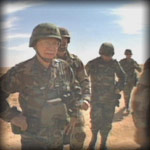
| |  |
Interview with General Frederick Franks, Commander of VII Corps |
|
|
Third Army essentially making a 90-degree turn and going to the relief of the forces in Bastogne, I believe that whole unit that went to the relief there was about the size of maybe one and a fraction of another one of our divisions, so we were .. VII Corps was a World War II army, probably about the size of George Patton's Third Army in World War II terms .. considerable combat power and the capability of the equipment, Apache helicopters, M1/A1 tanks, 120 millimeter tanks the British .. certainly a British equivalent tank, and infantry fighting vehicles, so considerable combat power to fight day and night, fight day and night, fight in bad weather, capability to reach out and hit the Iraqi forces before they even knew we were coming. As a matter of fact some of their prisoners said to us afterwards, one of them said, hey, the tank to the right of me blew up, the tank to the left of me blew up, I couldn't even see what was firing at us, and that was because we were able to hit them in some cases at extended ranges, so a considerable amount of combat power, but the combat power is only realised by superbly trained and motivated soldiers and that's really what made the corps, British and American soldiers, superbly trained, motivated, tough, took the fight to the enemy, well led.
Q: Can you tell the story of that first briefing with General Schwarzkopf....
Franks: We met with General Schwarzkopf, I believe it was Tuesday, we had gone to Saudi Arabia on a leaders reconnaissance, we got notified Thursday, late Thursday evening, we flew down there on Sunday and we met Tuesday. The setting was a dining facility, essentially a mess hall, with flat tables, a small room, and we were all in there, all the senior commanders from all the services were in there, in our case, in 7 Corps, these were all fellow soldiers and members of .. the other services that I knew, we were all combat veterans of Vietnam, of another generation of US soldiers, we had all been products of our own military schooling system, so we all knew each other, so there was a very calm professional atmosphere in the room. On the walls were maps, it turned out they were aerial photographs with covers over the top, and in the front of the room was essentially a podium and General Schwarzkopf came in and delivered the whole briefing himself as the Commander, laid out the whole enemy situation, friendly situation and the four phases of the scheme of manoeuvre, and there was no particular excitement among those of us there in the room, people were calmly taking notes, looking around at each other, a couple of small chit-chats passed back and forth as General Schwarzkopf gave the briefing. He was very clear, very precise in the description - we didn't know at the time if we would execute this or not but certainly if you're going to get called on to execute an offensive operation, you need to start to prepare for it well in advance, so that's what the purpose of the briefing was and it was very clear and at the end of it he asked if there were any questions, as I recall there weren't any, and then he invited us.. all to get up and take a look at the maps which showed the Iraqi positions and then showed roughly the sector of operations that we would get to operate in. So I recall, we got up, those of us that would comprise 7 Corps, the US commanders, and walked up to the map - at that point I didn't know that we would have the 1st British Armored Division as part of the US 7 Corps, went up and looked at the map, quickly internalised what I had heard General Schwarzkopf say, I'd never been to Saudi Arabia before and so this was all relatively new to all the commanders, the geography, the names, the Iraqi positions and so forth, so this was rapid internalisation of what had just been said and I was looking at the map and rapidly making up in my own mind schemes of manoeuvre for the Corps, I'd been in command of the Corps well over a year at that point so we had had some operations, and General Schwarzkopf walked up and he said what do you think, Fred, and I .. looking at the map, I said, this'll work, we can do it, and that was it.
Q: You took these guys seriously, they were the fourth largest army in the world ....
Franks: Oh, we were very serious professional soldiers there taking a look at the conditions of the mission, the enemy forces, the terrain, the troops we had available to us and the amount of time that we had to get to the theatre, to essentially make a Cold War Central European Corps into a contingency Corps tailored for that particular mission, which was a considerable undertaking, so all of those things were going through my mind at the time and, no, we did not underestimate the enemy - I don't think we overestimated the enemy either, I believe we were .. we had reasonable information about what their capabilities were, how they fought against the Iranians, so we were ..
very sober-minded about Iraqi capabilities.
Q : How did it come about that the Big Red One were the guys who made the breach?
Franks: I went to see General Tom ........ who commanded the 1st Infantry Division, the Big Red One, and I really wanted the Big Red One to do the breach so I knew that they had done a lot of work at our national training centre at Fort Owen in California, practising a breach, and I said to Tom, look, I need the division to conduct a breach operation, you've done a lot of that, he said, we'll do it, we know how to do that, we'll do it and we'll do it right and we'd like the mission, and I said, okay Tom, you got it, that was early December.
Q: It was a tough mission.
Franks: It was a tough mission, it was a tough mission on two counts, one the actual breach operation, clearing 24 lanes for the passage then --it turns out the first British armored division to pass through them--and secondly the logistics of the Corps to pass through, and then third it turns out the 1st Cavalry Division to pass through the breach as well, so yes, it was a tough, complex mission, required a lot of rehearsal, required some new techniques developed there in the desert and developed a lot of co-ordination with the 1st British armoured division, so a tough mission but Tom and the Big Red One did it superbly, the soldiers and leaders, they thoroughly rehearsed it and I was very proud of them.
Q : And they were the obvious division, they've got a history.
Franks: Well, they've got great tradition in breach operations, the division was awarded an Arrowhead device for the heroic actions at Omaha Beach, D-Day in Normandy, June 6th 1944, and so it was in that tradition that they carried off this breach superbly and I was proud of them, soldiers and leaders of the Big Red One.
Q: At that stage, you were aware that the life expectancy of the first guys through that breach was not necessarily great and you were going to do everything you could to increase it.
Franks: I knew that I was giving the Big Red One a very tough mission, I knew that the soldiers, especially in the lead vehicles, were going
into--they were out on the tip of the spear so to speak, particularly the Arrowhead as it turned out, and that it was a tough mission, and so what I wanted to do was to do everything that I could to provide them the kind of support to minimise our own casualties in the accomplishment of that mission and to be very aggressive in the accomplishment of that breach, and so we did that.
Q: Could you sum up for me, as you prepared for the war, what was your plan?
Franks: As I looked at the disposition of the Iraqi forces, the mission we were given, the troops I had available to me and the time that we had, we had three fights, we had to fight against the front line Iraqi infantry, in essence the Iraqi 7th Corps, as it turns out, then it was a fight against the tactical reverse which was positioned right behind the front line infantry divisions, then it was a fight against the Republican Guards. So those three fights had to be sequenced in a way that would allow us to have our point of main effort initially at the breach and when the success of the breach was assured then to shift that point of main effort to mass against the Republican Guard, so essentially we had three fights, those three.
Q: And you wanted to mass?
Franks: I wanted to mass, I knew that again in the breach mass of fires and rapidly push through the breach, and then secondly to ensure that when we hit the Republican Guards we would go in at full speed, full speed, and that we were massed into a fist - I didn't want to poke at the Republican Guards with some extended fingers or hit them piecemeal, I wanted to hit the Republican Guards with a left hook, with a fist, with a three division fist, and when we hit 'em we'd hit them hard and be through them in a minimum amount of time.
Q: What happens to people who attack in fingers rather than fists?
Franks: What you get is, you get piecemeal commitment, you get lack of coherence in the attack or lack of synchronisation of fires with manoeuvre forces, with ground and air co-ordination, and what you get is you get a chance, a probability of increased casualties, you get the probability of an attack that starts and stops and starts and stops, loses momentum, and you get all those things that you really don't want - what you want to do is you want to hit .. you want to hit at max. speed, you want to hit massed and you want to hit the enemy from an unexpected direction and at a speed that they just can't handle, and that's what we were after.
Q: What sort of forces did you have, I mean I don't know if there's a Second World War analogy or something, but what is a corps, what did you have in Corps?
Franks: We had in 7 Corps, we had 146,000 American and British soldiers, we had 5 divisions, essentially 5 armoured divisions, although one was a mechanised infantry division and one was a cavalry division, essentially 5 armoured divisions. We had close to 1600 tanks, American and British, a sizeable force, a lot of moving parts, we consumed well over 2 million gallons of fuel a day, we had a support command, vital logistics support command of over 26,000 soldiers, we had 15 hospitals, we had over 800 helicopters, a sizeable force, a lot of moving parts.
Q: Is there a sort of Second World War analogy--how big a force was this you were commanding, how destructive?
Franks: Well you can go back to the battle in the Ardennes and General Patton's Third Army, essentially making a 90-degree turn and going to the relief of the forces in Bastogne, I believe that whole unit that went to the relief there was about the size of maybe one and a fraction of another one of our divisions, so we were .. 7th Corps was a World War II army, was about .. probably about the size of George Patton's Third Army in World War Two terms .. considerable combat power and the capability of the equipment, Apache helicopters, M1 .. M1/A1 tanks, 120 millimetre tanks the British .. certainly a British equivalent tank, and infantry fighting vehicles, so considerable combat power to fight day and night, fight day and night, fight in bad weather, capability to reach out and hit the Iraqi forces before they even knew we were coming - as a matter of fact some of their prisoners said to us afterwards, one of them said, hey, the tank to the right of me blew up, the tank to the left of me blew up, I couldn't even see what was firing at us, and that was because we were able to hit them at .. in some cases at extended ranges, so a considerable amount of combat power, but the combat power is only realised by superbly trained and motivated soldiers and that's really what made the corps, British and American soldiers, superbly trained, motivated, tough, took the fight to the enemy, well led.
Q: How serious a force was yours?
Franks: This was a force designed, trained and equipped to defeat the best the Soviets had in Central Europe. It was a powerful maneuvre force, mounted maneuvre force, five armored divisions, 146,000 American and British soldiers, superbly trained, motivated, tough, well led, and a force that could take the fight to the Iraqis day and night, in sandstorms and in the rain, 24 hour capability on the ground and in the air, a considerable combat capability.
Q: You did all that superbly well, but if you hadn't done it ..
Franks: Actually if we hadn't done it, if we'd have committed ourselves piecemeal, if we'd have gotten lack of coherence, you're talking 20,000 plus vehicles in the Corps, if we had done it in a way that would have caused units to attack the Iraqis piecemeal, certainly the probability of casualties would have gone up.
Q: What was the nightmare scenario, why didn't it happen?
Franks: The thing we were most concerned about was getting stalled in the breach and then getting hit by enemy artillery fire that could have included chemicals if the Iraqis had chosen to use a chemical, and to take casualties from artillery, from chemical and also from getting stalled in the breach and getting hung up on mines, so we didn't let that happen, we prepared an exact replica of the Iraqi defensive position and the Big Red One rehearsed it time and time and time again, so that every soldier knew their particular duty, knew their assignment and knew their mission. We also rehearsed the first British armored division passing through the US 1st Infantry Division, so it was thoroughness, it was preparation, it was synchronisation of all of the capabilities available to the Corps -
air, attack helicopters, artillery, and seeing to it that we did not put ourselves at that kind of disadvantage and so we worked hard at it, we worked hard at it, that's why I wanted to tell General Tom R...... early on that, okay Tom, you've got the mission, that would allow him the time to talk it over and to rehearse it and to go over it and make very thorough battle plans. We said in the intent of the Corps that the breach operation would be very detailed planning and very detailed in its preparation and a very closely synchronised, co-ordinated operation, and once that was completed then the rest of the operation would be much more free-falling and much more adept and be force oriented, but the breach had to be very carefully rehearsed and orchestrated in order to accomplish the mission at least cost to the attacking force.
Q: Could you describe the February 8th briefing with Dick Cheney, what was the message you wanted to get across to them?
Franks: The message that I wanted to get across at the 8th of February briefing to both Secretary of Defence, Dick Cheney, and General Powell, Chairman of the Joint Chiefs of Staff,
that VII Corps was prepared to fight, VII Corps would accomplish its mission with the plan that I was about to brief. I also wanted to be candid and say this was the 8th of February, all our forces had still not completely closed into the theatre, I wanted to be candid and up front and say there were a few concerns that we still had, but that they were all soluble within the theatre and that the Corps was committed to fight. I also wanted to communicate the message that the support and continuing support of the American people back home, which we felt there in the theatre of operations, that was coming through in cards and letters and the news that we did get, that that was very important, that that was combat power, that that mattered to our soldiers on the battlefield, so those were the messages I wanted to get across, the bottom line being the Corps was ready to fight and the Corps would accomplish its mission.
Q: Cal Waller afterwards grabbed you in the corridor, can you tell me that story?
Franks: We took a break afterwards and Cal thought I had used more than the time that had been allotted to me, I guess I did run over time a little bit but I was talking about a five-division operation here, I was talking about the main attack, and I felt as if this needed to be communicated very clearly, that we would accomplish the mission at least cost, how we envisioned the plan unfolding, and so I felt that those points needed to be made.
Q: Schwarzkopf believed that VII Corps kept treating the Iraqis like they were Soviet army, what do you say to that?
Franks: We treated the Iraqi forces as the Iraqi forces. There was no particular comparison with potential opposing forces in Central Europe with the Soviet forces, we knew they were well equipped, we knew they had recently fought and we also knew that they were essentially two different forces, their front line infantry and their mounted forces, so I don't believe for a minute that we overestimated the capabilities of the Iraqi forces - we didn't want to underestimate them either and certainly numbers do count, there were 11 plus divisions squared up in our zone of attack. To begin our attack, 4 attacking 11, and so our goal was to make sure that the fewer who were massed at places where our speed and our combat power and our training of our soldiers would be to best advantage against those numbers.
Q: But the idea you could have a mad cavalry charge going up to Baghdad, that just wasn't on.....
Franks: No. First of all in the VII Corps sector we were in a very tight restricted piece of real estate for a five division Corps and so it required some intense co-ordination and synchronisation
and co-ordination of the forces, you're talking about tank cannons that fire a projectile at a mile a second at ranges in excess of 2500 metres, 3,000 metres, and whatever they hit at that range they're going to destroy in a flat piece of terrain, so you're talking about maneuvering five divisions in a relatively confined piece of real estate that isn't rolling but is flat and where the possibilities of units running into each other, of fratricide, is very probable if you don't maintain a coherent direction of attack, so we knew thatin our enveloping force I had two Army divisions on a 40-kilometre front. One of the divisions was on a 15-kilometre front, he was in a column of brigades, if you stretch a US armor division in a column of brigades on a 15-kilometre front, it'll stretch for about 120 kilometres, there is a lot of vehicles, a lot of moving parts. So based on the mission we had and the numbers of Iraqi units in our sector, we felt as if our attack needed to be massed and in coherent combat formations rather than in pursuit or exploitation, which we certainly were not in, at least for the first two days of the war.
Q: When you got this news there was going to be a ground war... the head of this great force, what did you as a person feel?
Franks: It came over the telephone, I think I was in
my .. I had a trailer built up on a back of a truck is really what I was living in there at the time, at the Corps main C.T., and I remember talking on the phone and I got the word that, yes, the attack would .. G-Day would be the 24th of February, now originally we were going to attack at G plus one, that's essentially on the 25th, and I thought to myself, this is it now, all questions are removed, we're going to get .. we're going to attack on the 24th and I said to myself then, we've got to use the time we've got remaining to ensure we've done everything we need to do to give our soldiers the best possible advantage to accomplish the mission at least cost to them.
I said to myself .. first I wanted to get the word out to my subordinate commanders and so I did, then what I wanted to do since there weren't many more preparations I could do as the Corps commander, what I wanted to do was go out and visit some of the units and I particularly wanted to visit the units who were going to conduct the breach, so I went to visit General Bert Maggert, then Colonel Bert Maggert, 1st Brigade of the Big Red One, to talk to him, his soldiers, talk to his subordinate commanders, and I came away from there sensing an air of confidence, not over confidence, certainly a sense of awareness of the toughness of the mission they were about to go on, but a sense of confidence in their own capabilities, in the plan, in their knowledge of the plan, that they had rehearsed it, so they were confident, they were ready to go, and I came away from that feeling as if the Corps was ready to attack, and what I had told the Secretary of Defence certainly was confirmed for me by those soldiers that afternoon in that visit.
Q: You knew all about combat, what did you feel as you were talking to Bert Maggert's guys there, looking around all those young faces?
Franks: Well I had seen battle, of course, in Vietnam, many of us had, I had been wounded in Vietnam twice, so what I wanted to do was to make sure we had done everything in terms of preparation, in terms of seeing to it that the soldiers understood the mission, they were well trained, to give them the best possible chance to accomplish the mission at least cost, get them at the right place at the right time in the right combination and they'd do the rest, I was confident in that, they were confident in themselves, but as I looked around .. and I had visited hospitals before the ground attack started, we had had some casualties in the 1st Cavalry Division in their great actions in the R.... pocket, so I was well aware that it was the young soldiers in the front line vehicles, the Bradleys and the tanks and the Challengers and the Warriors in the case of the British who would be at the tip of the spear and so I wanted to go out and talk to them, see how they felt, they felt confident, I visited the 1st Armored Division, one of the platoons called themselves the Raiders, they wanted to get a picture taken, this was the day before the attack, I still have it .. I told them good luck, I knew what they were about to go through, I maybe knew better than some of them. I told 'em good luck, shook their hands, you know, pat on the back, just wanted to talk to them soldier to soldier, see how they felt. I happened to run into that platoon on the way home, I'd wished 'em good luck, the 1st Battalion of the 7th Infantry, they were originally part of the 3rd Infantry Division but fighting with the 1st Armoured Division - I saw them on the way home, the day before they went home and went back, I said how did you do, they said, hey sir, we did great, we accomplished our mission and there was not a single soldier killed or wounded in our platoon.
Q: The air war had been going on for over a month, did it give you what you wanted?
Franks: Yes, what the air war did for our scheme of maneuvre, it essentially froze the Iraqis in the configuration they were in at the start of the air war, now they could move around and make some minor adjustments but in terms of extending the barrier further to the west, in terms of repositioning large units, they couldn't do that, so essentially they were fixed in position so the scheme of manoeuvre . that I had issued to the Corps in early January at a war game we had in King Khalid military city, essentially was a scheme of manoeuvre that would work, because the Iraqis were essentially fixed in position. Now we had some disagreements in the air as to the air that was made available in the VII Corps sector, what targets they would attack. Now we had some intense discussions over those targets, which ones would be attacked in what priority and that's just in the nature of air/ground operations, sometimes I got what I wanted, sometimes I didn't.
Q: The strategic guys who played an important part in this, they were into bombing residential palaces and buildings in Baghdad.
Meanwhile you're worried about artillery pieces that are going to land chemical weapons on a lot of young soldiers, did the Air Force understand that?
Franks: My goal was to see to it that the air that was flown in the VII Corps assigned sector was flown against targets whose priority would contribute to the success of our scheme of manoeuvre to accomplish our mission, in other words I was given a mission by the theatre commander to destroy the Republican Guards forces command forces in our sector - we knew how to do that. Air was in support of that, so whatever numbers of air would be flown in our sector, I wanted to be the commander who would determine the priority of what they would attack. Now whether it was two sorties or attacks or a hundred, that wasn't my decision, that's the theatre commander's decision, but if the two flew then I wanted them to fly against the target priorities that would contribute to the success of the ground manoeuvre, so my priorities were first artillery within range of the breach, back to the success of the breach operation, and because the Iraqis had chemically .. chemical capable artillery systems. Secondly I wanted to go after their .. essentially their command control of the Iraqi VII Corps which was in front of us, so they couldn't notify the Republican Guards the speed and direction of the main attack, this fist that was coming after them. And third, I wanted to go after the tactical reserve, I didn't want the 1st British Armored Division to get stuck in the breach by an Iraqi tactical reserve that was right up against where they were breaking out of the breach, so there was a brigade sitting right there of tactical reserves so I remember pounding the map, saying make this brigade go away, some of the staff picked up on it as the 'go away brigade', but essentially that was to emphasise that that brigade was prioritised .. a priority of attack, so those were our priorities. Now sometimes we got that and sometimes we didn't.
Q: What did you want the Air Force to hit and did they hit it?
Franks: I wanted the priority of air to go after artillery in range of the breach, second to go after the command control of the Iraqi VII Corps which was directly in front of us, to prevent them from telling the Republican Guards the direction and the speed of our attack, and then third I wanted the air to go after the tactical reserve positioned close to the exit to the breach so they would not interfere initially with the 1st British Armoured Division. I had some amount of difficulty getting those priorities struck because of other theatre priorities in terms of number of air available to the Corps and then even which wasn't my decision, but even that air that was made available in the Corps sector, to get it to attack in accordance with those priorities, sometimes other priorities would override those particular priorities. In the end we got it all done, now we got a lot of it done through the use of our own MLRS rocket system and the use of unmanned aerial vehicle to locate the targets and then fire MLRS, the bomblets, after Iraqi artillery.
Q: So you never managed to get air to hit artillery in the way you wanted?
Franks: No, we went after Iraqi artillery mainly with artillery raids by the Corps.
Q: That must have been pretty frustrating.
Franks: Well, there was some intense discussions about priorities of air and the targetry and correlation between targets requested to be hit and those that were actually hit, so that's in the nature of things in a theatre of operation.
Q: You've got a whole bunch of troops who are going to die if they have chemical weapons landed on them and there's long range artillery sitting nearby and you're telling me you can't get the Air Force to hit them...
Franks: Of all the things that got me heated up prior to the attack or the ground campaign, as a matter of fact I went down to Riyadh
in person to talk about it, was my lack of success in getting the air that was forming in the VII Corps sector to attack artillery within range of the breach, because we were concerned about artillery as artillery and also chemical capable artillery firing into the Big Red One as they conducted the breach .. so I appealed to the Third Army commander, the G-3, General Steve ......., who carried, you know, that argument in the targeting council that went on and then finally appealed to General Cal Waller who finally General Schwarzkopf put General Waller in charge of essentially target prioritisation and when Cal got into it then the correlation between the priorities of targets that I had requested in VII Corps and what actually got much better.
Q: What were you saying to Cal Waller?
Franks: What I said to Cal Waller was, Cal, how much air flies and attacks targets in the VII Corps zone is not my decision, that's a theatre decision, but what does fly in there needs to attack targets in the priority that I as the ground commander set in order to support the ground scheme of maneuvre to accomplish a mission that I've been given by the C-in-C.
Q: What were you saying to Cal Waller about artillery?
Franks: I was saying to Cal Waller, Cal, the air has got to go after artillery, especially artillery in range of the breach, this will assure success of the breach and if the Iraqis choose to use chemicals it'll also prevent the Iraqis from firing chemicals on to our troops in the breach, Cal understood that and so did John Yeosock and so between the two of them and especially after Cal Waller was given the mission to see to it that the correlation between the ground commander targets request and what was flown was better, it got better.
Q: So after Cal Waller intervened, all the artillery was bombed by the Air Force?
Franks: No, that's not true either, no, because there were other priorities for air in the theatre, they were going after Scuds and other strategic targets and that was not my decision so that was certainly none of my concern, but what I wanted to do was destroy the artillery in range of the breach, that was our top priority, so because of disagreements over priorities of air and then the lack of air to go after those targets, we began a series of artillery raids using all the artillery in the Corps in combination with our own targeting apparatus in the corps, unmanned aerial vehicles and also other platforms that could detect these targets, to go after these artillery in range of the breach, and so I wanted to .. first of all I wanted every unit in the Corps to have some combat action prior to the attack and so we used artillery raids
to go after the artillery, the Iraqi artillery.
Q: You did it yourself in the end.
Franks: Yes, it was a team effort, it was a team effort, but what I couldn't get the air to go after we went after with our own capabilities.
Q: The day the war started, you spoke about going to see the troops .. you were asked if you could go earlier and you flew up to see Tom R......., what did you say to him?
Franks: I got a call about 9.30 in the morning of the first day, the 24th of February, from General John Yeosock saying could we attack early and I didn't know the reasons why, all I knew was could we attack early and John told me that the answer he got from 18th Corps was with two hours notice they could go. I said that sounds okay with me, let me go check with my subordinate commanders but that's .. it's a go with VII Corps, so then I left the corps tactical C.P. which is a small collection of vehicles and flew on up to visit General Tom R...... and talked to Tom and he said yes, he was ready to go right at that moment, he and the 2nd Cavalry, but it required some considerable adjustment, we had a two hour artillery preparation plan for the breach, we reduced that to half an hour, it required considerable adjustment on the part of General Rupert Smith and the 1st British Armored Division, who had to move from there 80 kilometres or so, they were south of the breach, they had to move early, so considerable adjustment on their part, and then to get the word out to all the troops. But Tom told me he was ready to go, as a matter of fact he probably would have requested to go early even if we had not gotten the call, since he had done some initial probes in the Iraqi security zone and was encouraged by the initial success that he was having and so he was going to ask to push forward at least through the security zone on that first day, as had Colonel Don Holder who was commanding the 2nd Cavalry.
Q: There's a picture of the two of you looking at some maps, Tom R....... and yourself, just before the breach--what was the last thing you said to him as you headed off?
Franks: Well, what I said to Tom was, good luck, you've got a tough mission but you're up to it, the division's well trained, you've rehearsed it, good luck, but also you're not done when you're finished with the breach, be prepared for future missions because I'm not going to leave you behind, because I knew I needed three divisions in this fist and I didn't know where I was going to get the third division from. At that point I didn't know whether I would be given command of the 1st Cavalry Division, who at that time were CENTCOM reserve, so I told Tom, good luck, you know what to do, go for it and to .. well, I'm not going to leave you behind, be prepared for a follow-on mission, because I wanted him thinking ahead, you always try to think 24, 48, 72 hours ahead.
Q: Where were you when the breaching operation took place?
Franks: I went out to visit Tom late that afternoon, heard the operation going on, firing going on, went out and met with him and General Rupert Smith, the 1st British Armored Division commander, right out there in the middle of the breach.
Q: Describe what was going on around you, what was the scene?
Franks: Well, the scene was of a lot of vehicles moving, of completing the lanes so to speak, you could hear artillery, you'd got aircraft flying, you could hear the sharp crack of tank cannons and the pop of 25-millimetre Bradley cannons, so a lot of fighting still going on but there was also the prisoners who had been captured by the Big Red One, and a sense of early success .. a feeling of success and confidence on the part of the Big Red One.
Q: When did you first realise that it was beginning to work?
Franks: The first indication I had was when the artillery was able to take what was going to be a two hour preparation and position themselves to fire a 30-minute prep. and for that to go off like clockwork and to have then followed up by the co-ordinated attack of two brigades of the Big Red One who attacked at 1500 on Sunday afternoon as opposed to first light the following morning. I said to myself, if the Corps is able to adjust that quickly, then we're going to build on success here and then I got some of the radio reports that the breach was going well.
Q: Do you remember any particular conversation or report from Bert Maggert or Tom R...... that made you think we're okay - once the fighting had started?
Franks: No, I had gotten radio reports, I was monitoring that at the corps tactical C.P., then I got in a helicopter and went on out to the breach and talked to Tom and I could see it in his face and I could see the sense of confidence in the Big Red One that what they had done to this point had been very successful, they were very confident, they were very pleased that the plan had gone very well, so I could sense it, I could feel it, I could see it, I could see it in their conversations and I also could talking to the 2nd Cavalry and also the 1st and 3rd Armored Divisions, they were moving well, so the whole thing was beginning on a .. on a note of great success and the Corps was gaining confidence rapidly and quickly.
Q: All the time you've been talking about speed, why didn't you pause the guys in the breach that night?
Franks: We had a decision to make, because we attacked early, what we were going to do the first night. I was thinking 48 hours ahead, I wanted to be in a posture that when we hit the Republican Guards, that we would hit 'em with a fist massed from an unexpected direction at full speed, and so what I needed to do was get the Corps in a posture that would allow that to happen over the next 48 hours. In addition to that I wanted to talk to both commanders involved, General Tom R...... commanding the Big Red One and Colonel Don Holder who was commanding the 2nd Cavalry out in front of the two armored divisions. I asked both of them, Colonel Holder was concerned about getting too far out in front of the two armoured divisions and attacking the Republican Guards piecemeal, as was I.
And General R...... was concerned about being able to complete the breach during the hours of darkness with the thoroughness required to allow rapid passage of the 1st UK Armored Division and also to allow passage of the logistics vehicles that we needed to position on the other side of the breach in order to support the enveloping two armoured divisions, 1st and 3rd Armoured Divisions, so I determined from the sensing of the commanders, from the need to synchronise the British passing through and attacking and destroying the tactical reserve, which could have gotten into the logistics tail of the attacking armoured divisions, and the need to be at full speed when we hit the Republican Guards - taking all those things into consideration, I told the units to conduct local reconnaissance, continue the artillery fights, continue to pressure up and to resume full scale operations at first light the next morning.
Q: Because otherwise there was going to be a horrible night-time traffic jam with the possibility of friendly fire incidents....
Franks: Correct. It seemed to me the it was more of a gamble to continue the breach that evening. Now I briefed my immediate commander in Third Army, I told him what we were doing, and he said okay and I presume he had told General Schwarzkopf and that everybody at Central Command knew what we were doing.
Q: If they'd continued that night, what could have happened?
Franks: Well, . there was a lot of possibilities of things, you could have had difficulties in navigation which could have led you to some fratricide incidents, you could have had Iraqi stay behind units that could have gotten in behind .. it's easy enough to by-pass dug-in infantry during the day, it's of course much easier at night when you can't see them, they can come up and shoulder fired anti-tank weapons can get .. interfere with following logistics vehicles and we figured we needed all 24 lanes cleared, so if for example you had two or three or four or five lanes that would have damaged vehicles in them, burning vehicles, our own, in those, that would in a sense lengthen the time it would take the 1st British armored division to pass through.
Q: More haste, less speed.
Franks: So speed was necessary to get them through to attack the tactical reserve, so the tactical reserve of the Iraqis could not interfere with the enveloping force, so it was all tied together, it was all tied together, so it seemed to us .. there's an old German saying that says, 'go slow now and go fast later' and so the scheme of maneuver based on my own assessment and my discussions with the tactical commanders, I informed my headquarters that it would be actually faster, we would conduct the mission faster if we did not continue during hours of darkness but we continued it at first light, in fact the 1st British Amoured Division began passing through....
Q: And Schwarzkopf, as you have heard, was absolutely furious about the slowness of the Corps advance......
Franks: I had heard later, about the next day, through my chief of staff, that was there was some concern about the pace of the Corps operation and I had talked this over then with General Yeosock and he understood, I talked to him on almost on a continuing basis about the pace of the Corps, what we were doing, the manever of the Corps, and assumed that all of that was well known. So it was hard for me to understand why there was a lack of understanding about what the Corps was up to, especially correlating it to the intelligence we had about what the Republican Guards were doing at that point in time.
Q: But Schwarzkopf throwing the tantrum, is that the way he should do business?
Franks: Well, I think every commander does things their own way, I felt as the commander of the main attack, if there was some problem with either direction or the pace of the attack, then someone would tell me that and I got no such communication during the four days of the ground war. As a matter of fact, I talked to General Schwarzkopf on Tuesday, the 26th, and told him that we had made our right turn, that was a call we made in the Corps, and that we were about to conduct .. it turns out a four-division night attack against the Republican Guards. He seemed pleased with that, he told us to press the attack, he gave me a piece of intelligence about the H....... division had been seen loading on to hit vehicles so he said he wanted us to continue to press the attack and I told him that we would. I also told him I was not happy with a mission I had gotten to attack, the 1st British Armored Division south and clear essentially Wadi al Batin, which we had gone around to avoid, and eventually we did not do that.
Q: But Schwarzkopf was going around saying that you and the VII Corps, these 146,000 men you had, were stuck into European mode, it was NATO, they didn't have any fire, any dash. What do you say to that? ..
Franks: The pace of the attack depends on first of all the scale of the map you're looking at, as to time and distance. The movement of actually four divisions at that point in time, since the 1st Cavalry Division did not .. was not part of the Corps, we were moving and attacking continually, from the time we got the word on 1500 on Sunday afternoon, either ground or air, until cessation of offensive operations at 8 o'clock on Thursday morning. Now .. I did halt the large unit movement the evening of the 24th and we've discussed that ..
Q: I'll come on to that later.
Franks: Correct, we've discussed it. But the pace of the Corps attack and synchronising and co-ordinating large unit movement on flat terrain in very confined maneuver space and turning a Corps, two Armoured Divisions, 90 degrees and attacking 90 degrees to the east while on the move, with no pause, and doing essentially a four-division night attack, I was enormously proud of the soldiers and the leaders of VII Corps then and I'm even more proud of them now, I think it was an enormously powerful achievement by the soldiers and leaders of the VII Corps British and American soldiers.
Q: If you could have been transported that morning to that room and sat next to General Schwarzkopf, what would you have said to him?
Franks: What I was trying to do was to describe what I was seeing, the battle as I was seeing it, on the ground, up front, with my own commanders, seeing with my own eyes, ....having been in battle before in Vietnam, sensing the battle, sensing the pressure, seeing what the soldiers and the leaders were doing, going around visiting commanders, I would have .. and I tried on a continuing basis with General Yeosock, who was back in Riyadh, to describe the situation as I was seeing it and the pace of operations, and I felt the pace was swift, that the soldiers were moving, the soldiers units were changing, in major formations going from a column of brigades to brigades, making a night passage of lines, a division through a cavalry regiment, under fire, very difficult operations - all of this was done with enemy resistance, we had 11 plus divisions in the Corps sector of operations, there were some gaps in where enemy forces were but most of our units were in contact almost on a continuing basis, there were a lot of prisoners, contacts, units that were by-passed, there was a considerable amount of Iraqi forces, so I felt .. I was proud of the pace of the Corps and of the soldiers and their willingness and drive and toughness to take the fight to the enemy, day and night, sandstorms and in the rain, and I think that'll be forever etched in the desert sands of Iraq and Kuwait.
Q: It's one thing to sit in a war room in Riyadh, it's another to be in a tank.
Franks: You get different perspectives, looking at different scale maps, you get perhaps an incomplete view of the battlefield, you get different perspectives, I had a perspective and I was conducting the pace and the synchronisation of the combat power of VII Corps in accordance with the mission that I was given. T accomplish that mission at least cost to the soldiers, and if that pace needed to be increased and I felt as if one of my commanders would call me and tell me that and none of them did.
Q: What was the significance of 73 Easting?
Franks: 73 Easting was really the first large scale fight that we got in, .....the breach of course was a separate operation, the 1st British Armored Division, as soon as they broke out of the breach, began a series of tough fights against the Iraqi reserve. The 73 Eastingwas the first indication we had of the Republican Guard's positioning and the role that they would fight, and so it was significant in setting up the battle that followed.
Q: Were you out there at the time of 73 Easting- did you see the battle?
Franks: I heard it, it went on late. No, I did not, the particular battle, I'm not sure they named it 73 ....... until later, but that particular battle that discovered .. the initial success against the Republican Guards, where their main battle positions were and the fact that we had caught them by surprise, I knew then that our armored divisions would be successful as the British 1st Armored Division was being very successful against the Iraqi tactical reserve.
Q: So the Iraqis by now, the J-STARS were showing that they were beginning to peel off, they're beginning to retreat, they'd left a defensive screen, what was your perception of how the battle was at that stage, as we go into Tuesday night/Wednesday morning?
Franks: My instructions to the Corps were we had to keep up the intensity of attack for the next 24 or 36 hours, a straight message to the Corps. My perception was we would have .. the 3rd Armoured Division, General Butch ........, 3rd Armored Division, hit the Tawakalna right in the centre, the 1st Armoured Division to the north and the Big Red One came out of the breach after the 1st British Armoured Division had attacked through, so we essentially had 4 divisions from north to south, the 1st US Armoured Division, 3rd US Armoured Division, 1st US Infantry Division and the 1st UK Armoured Division, 4 divisions on line as it were, about 8 to 9 brigades, depending on what the units were doing, each one of these considerable, sizeable formations, I think the calculations were if you would line up vehicle to vehicle, end to end, in the 1st UK Armoured Division, you'd stretch about 350 kilometres, so we're talking sizeable numbers of units packed into a frontage of maybe 120 kilometres.
Q: You've got a wall of tanks ..
Franks: That's about correct, a massed fist, smashing into the Republican Guards and destroying them, as was our mission. All throughout the night of Tuesday, into Wednesday morning, Wednesday morning then I wanted to go and do a quick assessment, because my initial calculation was that we could entrap the remaining units in our sector if we could do a double envelopment.
Q: Tell me about the Medina Ridge, what was the significance about that?
Franks: There it was that we ran into the Medina Division of the Republican Guards. I actually went out to visit General Ron Griffith and the 1st US Armoured Division, to talk about moving the 1st Cavalry around to the north, it was at that point that the battle of the Medina Ridge was going on. Again it was an indication of the great skill and toughness and capability of our soldiers and our equipment in that the 1st Armoured Division was able to essentially reduce a brigade of Iraqi vehicles, render them totally combat ineffective and destroyed in lessthan an hour, at great ranges, at ranges in excess of 2 kilometres where you couldn't even see the target with a naked eye, so a tremendous combat victory there by the 1st Armoured Division but also an indication that the line of defence of the Republican Guards had stretched further to the north and what they were trying to do was rapidly get vehicles and units in our way as we were attacking and driving to the east.
Q: As this was going on, General Schwarzkopf was standing up saying that the gates are closed.
Franks: I believe that's correct, I didn't know at the time that there was a briefing going on, I found out later that there was a briefing going on, this fight went on mid-afternoon of Wednesday, the 27th of February.
Q: Had General Schwarzkopf consulted you, did General Schwarzkopf say to you, are the gates closed?
Franks: No, .. most of my communication, except for that one phone call, was through my immediate commander there, General John Yeosock, who was commanding the Third Army.
Q: I suppose what I'm getting at is that here you have the Commander in Chief standing up saying the gates are closed and you're on the ground and you're the guy who knows that they're not closed because you've just had a major engagement and you're doing damned well but the gates aren't closed yet, what do you make of all that?
Franks: I knew we were in the middle of a continuous intensive armoured fight, our troops were doing terrific, we had extended the battlefield so it was not just a fight of tank against tank, our scheme of manoeuvre was to extend to simultaneously attack the Iraqi forces throughout the depth of what are now called battle space, so we were using attack helicopters, we were using Air Force air, rocket and cannon artillery, so we had an extended attack zone and that was moving, that was very lethal and deadly and that was moving due east towards the Gulf.
Q: I accept all that was going on, but General Schwarzkopf said the gates were closed, were they?
Franks: I knew that--actually Wednesday morning-- that the 1st Infantry Division and the 1st UK Armoured Division had essentially achieved a breakthrough and they were in essentially pursuit and exploitation, which the Big Red One was. I also wanted to attempt to encircle the remaining Iraqi forces that were in front of 7 Corps and so we came up with a double envelopment scheme of manoeuvre to do that, using 2 divisions.
Q: In very simple terms, what was going to happen the following day, the Thursday, what were you going to do?
Franks: Our scheme of manoeuvre in 7 Corps was to bring the 1st Cavalry Division around to the north of the 1st Armoured Division and around from the south we would bring the 1st Infantry Division and they would link up in front of .. actually just to the south of Basra and encircle any remaining Iraqi forces in our sector.
Q: So the following day, what would have happened to the Iraqis?
Franks: Any forces that were still in the 7 Corps sector would have been caught in this encirclement and then in addition we had the 18th Corps attack in the east with the 101st Airborne, with the 24th Division and then the 3rd Cavalry attacking due east and one of the .. the ARCENT plan was that they would be the hammer on top of the 7 Corps anvil, right on the Iraqi/Kuwaiti border.
Q: How were you told that the war was going to end and what did you feel?
Franks: We had .. all day on Wednesday I had gone around personally visiting units and assembling commanders out on the battlefield to put into motion this double envelopment scheme which would utilise all the assets, all the combat assets of the Corps. Early in the evening then I got the word from my main command post, which was back in Saudi Arabia, that there would be a possible ceasefire the following day so I called my commander, the Army commander, General Yeosock, and asked what was this all about and he told me, yes, there was a possibility, a very real possibility of a ceasefire, he would confirm it later, and so that meant that the scheme of manoeuvre that we had put into effect certainly would not happen so we had to make some adjustments, plus put a warning order out to cease all offensive operations at that point, at 5 o'clock in the morning.
Q: You travelled across all this desert, hundreds of miles to get to grips with the Republican Guard and destroy them and the following day that would have happened, you would have encircled them--and now someone's ringing up saying, hey, you are never going to really get to grips with them, what did you feel?
Franks: We felt that the purpose of destroying the Republican Guard's forces, in our sector anyway, was the means to achieve the strategic objective and the strategic objective was the liberation of Kuwait and so what we had done to that point had achieved the strategic objective.
Q: Should the war have gone on for a little longer, just military considerations?
Franks: We essentially had achieved our objectives, strategic objectives in the theatre, there was some resistance but not very strong organised resistance in the 7 Corps sector.
Q: So you felt no feeling of frustration that just as you were ..
Franks: Not at that point, no, did not, I felt that we had achieved a great victory, I was very proud of the soldiers, as a matter of fact I assembled the commanders of the corps, all the division commanders at the Corps Tactical CP that morning at .. I believe it was about 10 o'clock and I told them I wanted to be the first one to tell them that they and their soldiers, I was enormously proud of them then and I am even more proud of them today for their extraordinary achievement .. extraordinary achievement, toughness and willingness to take the fight to the enemy day and night in some tough weather, sand storms and then the rain.
Q: It undoubtedly was a great .. it achieved everything you wanted to but there were two divisions worth of Republican Guards, according to the D.I.A. who went over and counted them with some of their funny stuff in the next couple of days, two divisions worth of armour stacked up in that Basra pocket that was allowed to drive out eventually into Iraq, with all this fire power, with you chasing across the desert, with all the air, how could it be there was still two divisions worth of armour left at the end of the war?
Franks: I don't know the exact count, what was there, what left the theatre, I'm not aware of the exact figures on that, there've been a variety of pieces of information on that - I do know we were attacking the Iraqi forces in our sector throughout the depth with attack helicopters, with air, and with ground combat vehicles, and within the attack scenario destroyed almost 4,000 then and after, going around the battlefield, destroyed almost 4,000 essentially armoured vehicles and other pieces of equipment.
So I believe that the sensing was in the Corps that the strategic objectives had been achieved, that we were enormously proud of the soldiers and the leaders of the Corps. Could we have gone on had we been asked? Of course, but that certainly wasn't the decision of the Tactical Commander at the time.
Q: Safwan ..how did you become aware that Schwarzkopf was irate, what happened?
Franks: There was a call I got said we need a place to conduct the ceasefire discussions, one proposal was the village of Safwan, another proposal was let's do it at the captured headquarters of the Medina division which lst Armoured Division had overrun, which was not very accessible, it was out in the middle of the desert, no roads to it or anything, so the site was Safwan which then I informed my commander that we don't own Safwan, we had not been there, I think what happened was that, as I learned later, that a map got erroneously posted at CENTCOM and if you talk about the scale of maps, on a large scale map distances show up as a very small space on a map, so I don't know how it happened but apparently as the C-in-C was looking at the map he was under the impression that we had captured Safwan when in fact we had not, none of our maps showed that, I had no information, I knew we were not in Safwan, everybody in the Corps knew we were not in Safwan - the Big Red One knew they were not in Safwan and so then there was a phone call that asked for an official explanation of this, which I provided in writing--I sat down and wrote out a handwritten explanation to the C-in-C as to what happened and why we were not in Safwan. We eventually got there after the cessation of hostilities, the Big Red One did.
Q: Can you describe, as you took off in that helicopter to Safwan, can you just take us through that helicopter ride, what you did, what you felt, what he said, what you could see.
Franks: From Kuwait City to Safwan is about a 20 minute helicopter, in a B....... helicopter. We had arranged for a company of Apaches to accompany us on the way up there - we wanted a show of force to Iraqis who could see all of this that there was plenty of combat power still available if they wouldn't agree to the ceasefire terms, but I wanted to show General Schwarzkopf what I had seen, the destruction, we flew over the 1st British Armoured Division, how far they'd come, the Big Red One, the lst US Infantry Division, so I wanted him to see what I had been able to see on the battlefield and the destruction of the Iraqi military, at least close to Highway 8, so as we took off I instructed the pilots to fly so we could see a lot of that on the way to Safwan and I told General Schwarzkopf as we were flying along, I didn't want to talk too much, except to point out the units, the lst UK Armoured Division and the lst Infantry Division, because I wanted him to be able to look out and see what the forces under his command, in this case 7 Corps, had done and the magnificent achievement, victory that they had achieved.
Q: Describe to me what you could see from the helicopter and what Schwarzkopf said to you.
Franks: I instructed the pilots to see as much of the destruction parallel to Highway 8 that we could see on the way to Safwan, so what we saw north of Kuwait City, we saw the destruction there of mainly civilian vehicles that the Iraqis were attempting to escape with, buses, trucks, cars, in addition to some combat vehicles, an enormous destruction scene there, burning vehicles. North of that then it was mainly military vehicles, mainly military vehicles, military vehicles hit by air, also destroyed by the attack of the coalition forces, then north of that the 1st UK Armoured Division who had successfully attacked all the way east, got Highway 8, and also the lst US Infantry Division. There were smoking, burning tanks, other types of vehicles, infantry fighting vehicles, artillery pieces, damaged and bombed out buildings, vehicles at all sorts of angles destroyed, the Highway 8 was not even .. you could not even drive down Highway 8 for the vehicles destroyed on Highway 8, so there was a tremendous amount of armoured vehicle destruction visible from the air, even with the oil fires burning and all the smoke burning, and I wanted .. General Schwarzkopf had not been able to see that as I had seen that for almost four days on a continuing basis out on the battlefield so I wanted him to see what the coalition forces, ground, air and sea had done to achieve a great victory in the Kuwaiti theatre of operations, so I didn't want to occupy him with a lot of small talk and told him such and instructed the pilots to fly so that he could see all of this, so we didn't .. we didn't talk a lot, I didn't initiate a lot of conversation, he remarked about the damage, he remarked about what a terrible decision it was for the Iraqis to set fire to all the oil fields, all of the oil, .. the tremendous waste, tremendous damage that that would do to the environment and how completely .. how difficult that was to understand how the Iraqis could do that.
Q: And then what did General Schwarzkopf remark?
Franks: Then General Schwarzkopf remarked, as we were flying along, he said hey Fred, just as we planned it, just as we planned it, which to me was just as he had envisioned this whole thing unfolding back at that early briefing in early November and this was the culmination of that operation, as we could witness on the ground.
Q: What do you remember of the Iraqi officers arriving and the look on their faces, what was said at the ceasefire?
Franks: We had arranged a show of force there, we picked up the Iraqis in US vehicles, drove them down a line of combat vehicles that were lined up along the route. I recall the Iraqis being very stone-faced, not much emotion, a lack of emotion in their faces, pretty much agreeing to everything that was said, not having a whole lot to I think they could .. perhaps there was some surprise on their part as to the amount of destruction that they could even see there in the vicinity of Safwan as to their army in the field.
Q: The Iraqis were stony-faced but I remember you saying to me that there was one time when they showed some emotion... What happened when they discovered there was 60,000 Iraqi prisoners?
Franks: I think there was genuine surprise on their part as to the number of Iraqi prisoners that the coalition forces held, that probably surprised them more than anything during the discussions there, that plus the combat power available to the coalition forces and plus the destruction that they could see even there around Safwan that had happened to their army in the field.
Q: Was there ever a day you didn't think about Vietnam when you were out there?
Franks: No .. constantly in my mind. Memories of Vietnam are very sharp, clear to me, I mean with every other step I take I'm reminded of Vietnam and I remember the great soldiers that I was privileged to serve with there, those that I was in the hospital with at Valley Forge General Hospital, I remember those whose names are on the Vietnam memorial here in Washington .. no, never .. never far from my mind and especially during the Gulf War, we didn't say it to each other but I think we all felt that we're going to do it right this time.
Q: Did you feel when you'd won this great victory that you'd re-established the American military in the eyes of the American public?
Franks: I felt that what our soldiers had done certainly was proof of the sustained commitment to excellence that we had seen done in the US military following the Vietnam war, the training in leader development, in equipment, training at our national training centre, that it was a vindication of the wisdom of those decisions and that sustainment to tough, hard, realistic training and that was evident on the battlefield.
Q: You've got a photograph there I want to ask you about, how many of those guys helping you in that picture, and I think you know the picture very well, how many of them came back?
Franks: All except one.
Q: And when you were in the hospital, there were people around you who were pretending they'd been in car crashes and things.
Franks: Well, what happened of course for the Vietnam era, generation, was that for a while .. we couldn't separate the war from the warriors and so the soldiers - and the members of the other services - but soldiers in our case, got caught up in a lot of the anti-war business that was going on in the United States at the time and so there was not a sense of thanks, you went and did what your country asked you to do, and even if one questions the wisdom of the commitment, nonetheless young American men and women went and did what their country asked them to do, at great personal sacrifice, families, friends, and at great personal risk, pain, soldiers I was with in the hospital got so tired of going on convalescent leave back to their home town or out of the hospital and having to explain that they were wounded in Vietnam and people saying to them, oh what a shame, all that for nothing, that they stopped talking about it, they made up stories about they were hurt in a paint factory explosion or an automobile accident so they wouldn't have to talk about service in Vietnam. All of those memories were sharp and clear to me, as they were to many others during the Gulf War.
Q: Did you ever think you'd be able to achieve such a big victory with so few casualties?
Franks: I felt confident in our soldiers .. the soldier who said, don't worry, General, we trust you. They were tough British and American soldiers, I had seen .. I had been out and around them, I felt certainly it was within our grasp to achieve a great victory at least cost, and I felt as if I and the leaders, and we had a great team, division commanders, if we could get the soldiers to the right place at the right time in the right combination, then they would take it from there.
Q: And what do you say to the revisionists now,that if only these soldiers, these 146,000 guys, had moved a bit faster, been a bit more aggressive, we'd have got the Republican Guard?
Franks: I said to the soldiers then that a lot would be written and said and shown about what happened or didn't happen over here, but their willingness to take the fight to the enemy day and night, in sand storms and in the rain, with a sense of toughness and courage, will be forever etched in the desert sands of Iraq and Kuwait - what happened happened and the facts are the facts and so I'm enormously proud of the soldiers and leaders of 7 Corps, US and British, who fought side by side and achieved a great victory.
home · oral history · war stories · weapons · maps · chronology
tapes & transcripts
FRONTLINE · wgbh · pbs online
web site copyright 1995-2014
WGBH educational foundation
| |