 |
Sherry,
Over all, it seems to me that the most interesting questions to cover,
which no one has yet covered in much detail, are:
a. the role of the oligarchs in all this
b. the White House & US Treasury
c. the IMF
These are the chief parties who exerted muscle in encouraging ex-prime minister
Sergei Kiriyenko to pull the trigger. One idea for us might be to fill in the
trans-Atlantic dialogue that transpired from the spring of last year to August
17, 1998.


Make it easy. Begin by taking a look at the graph of the
life of the Russian Trading System (the RTS) on their web page.
It looks like a child's drawing of a fairy-tale mountain. It goes perfectly steep up one side and just as steep
down the other.
The stock market here didn't last long. But while it did, boy did it boom.
In its first post-Soviet experiment with the markets, the Russian government
raised about $45 billion from 1994-98 by selling securities (GKOs, Eurobonds,
MinFins), Russian commercial banks and companies ran up debts of an estimated
$20 billion more. Anywhere from $60 - $100 billion left Russia over the same
period. In short: contrary to conventional wisdom, Russia didn't crash for lack
of money.
Russia's brief experiment with the free market began with pain.
There was price liberalization, hyperinflation, massive un/underemployment.
Here you may wish to remind Strobe Talbott of his own words--to
paraphrase--"There was too much shock, not enough therapy." A brief refresher
of the elemental phases:
- 1992: On Jan 2, Yegor Gaidar ends price controls - arguably the most
important decision of the post-Soviet era. Gorbachev's talk of the coming of
'market socialism' ends. Foreign exchange controls are abolished, too. The
market would come, all right. (Western governments, by April, gave the first
big cash infusion--$24 b. aid package)
- June 15: Yeltsin names Gaidar acting pm (he is never approved)
- August 15: Yeltsin announces the voucher program. But there was a problem:
the economy had no competitive levers - no invisible hand to control supply and
demand. What resulted? Hyperinflation--some 2,600 percent in 1992. Life
savings and pensions were inflated away--by the day. The masses were not so
irate last August about the banks' folding because many had lost their savings
in '92.
- Gaidar then set about dismantling the Soviet command
economy--stripping the state of its immense property holdings. This phase is
best seen through the history of one "organization"--the GKI, the State
Property Committee. From Chubais through Boyko to Kokh. What began as an
inspired, Thatcheresque ideology of de-politicizing the state's assets ended up
with Kokh--as a sales quota. ($1 billion per annum, is what Kokh told me
bluntly). Just like in the Soviet days--a plan to fulfill.

Thanks to a scheme planned and paid for in large part by U.S. taxpayers--145
million Russians received vouchers for shares in some 15,000 large state
enterprises. But before long, it all started to go bad--really bad.
Privatization began with the vouchers--but who would get the factories and
mines was more often than not understood long beforehand. In many regions, the
so-called Red Directors would retain the controlling stakes in their old
enterprises. No one bothered to explain the need for direct foreign investment
and transparency and efficiency and so forth. Taxes started to go uncollected,
regional budgets broke down, profits flowed off-shore and barter began to
spread like a cancer.
- Only in 1994 did the then-prime minister, Viktor Chernomyrdin, understand
that printing money was not the right answer. This brought Gaidar's infamous
quip on the end of "the most expensive education in history."

1995 and 1996: The reign of Chubais-shchina. Chubais in short order became the
darling of D.C. The WH, Treasury, State Dept seemed to back him from the
get-go. Why? A number of good reasons. But in short: Chubais got things done.
By 1995, everyone knew that if you had to get something done, some document
signed etc--see Chubais. Moreover, he looked like a Westerner--tall, wore good
European suits, carried his own laptop, etc. Russians may not have trusted
him, but Western diplomats and businessmen sure did.
- Under Chubais, two dark currents ran strong and deep: the sell-off of state
industries and the development of "authorized banks"--banks, or rather
financial vehicles, that were given carte blanche with budgetary funds--for
financing state enterprises, arms production, taxes, you name it--they got
it.

The auctions, simply put, were imperfect. (We can do detail on this, if need
be.) A series of privatization "auctions"--whose results were determined
beforehandówere held by the GKI. (There are books out on this phase, but
in essence, they held the firesale of the century. ) The engines of Soviet
industry --oil companies, metals plants, utilities-- were sold for a song. Russia is among
the world's richest countries in terms of natural resources--(The Natural
Resources Minister, Viktor Orlov, can run down the list of gold, nickel,
silver, timber, oil and of course natural gas--one-third of the world's
reserves--for you.). And in short order, the riches were exported by the
shipload east and west.

Ever wonder how Estonia, a country that produces no aluminum,
became one of the world's top aluminum exporters? This was the market's main
cancer: theft. The greed that motivated it (and still does) was impressive.
But the theft will go down in history. Economists now talk about state
corruption, and of course graft was a contributing cause of the market's
death, but pure and simple robbery played the leading role. The rape of
Russia's riches in its first decade of "independence" will doubtless be
remembered in a century's time as unprecedented.

The gold-diggers flew in from Wall Street and Washington, London and Tokyo.
By 1995, much of Wall Street was sold on Russia. "Bullish on the Bear," was the
title of one Salomon Brothers'
breathless report on the new market. In 1996, an economist from LSE joined a
former Moscow correspondent from The Economist to write a book
(unfortunately) entitled The Coming Russian Boom. The Western bankers
played eager pilgrims. The auditors too. One US accountant--from a Big 8
firm--once told me: "We don't practice creative accounting in Moscow, but we
often have to create new ways of accounting." Go figure.

You can never leave out Yeltsin's easily offended ego when it comes to Russia's
market experiment. Think of it this way: Before the '96 election, Boris was
weak. He was, if you remember, all but ruled out. He needed the cash. He
needed the new financial elite on his side. Now it has become fashionable to
downplay the role of the oligarchs in reelecting Yeltsin. I do not agree.
Those who attended the financial "strategy" sessions say that it was never a
question of whether or not to give to Yeltsin's campaign; it was a question of
How Much. And give they did.

Russia, we are told ad nauseam, had at one point as many as 5,000 banks. But
most were flimsy shells. Ever wonder why there were so many armored cars
circling Moscow? Most companies could never get more than, say, ten thousand
dollars in cash from a bank.
The reason: there was never a real, functioning banking sector. No credits, no
small-biz loans, no credit cards. And certainly no multiplier effect. The
banks were parasites, not catalysts for growth. The financial sector grew fast
in the early 1990s--some 45 percent from 1992 to 1995, even as GDP plummeted.
But why did Russia need so many banks? (New ones appeared by the week, on every
corner) The biggest banks speculated against the ruble using the state funds
entrusted to them. (In large part the fault for this lies with the government
itself, for it never developed a treasury system.)

The biggest banks--Unexim, Menatep, Inkombank, Rossiisky Kredit, SBS-Agro, Nationalny Reservny (Gazprom), MOST--grew into
"powerhouses." By 1995, however, the government faced a new problem. (Rather,
an old problem that everyone had quietly ignored.) The state debt. To cover
yawning gaps in the budget, the govt. was forced to find a new way to come up
with the cash. As the unpaid masses began to protest, demanding their months
--for some, years--of back wages, the masters of the state's finances realized
they had to do something. Russia had already borrowed billions in the first
post-Soviet years--from the West, mostly through the IMF (I have the stats, if
needed.) But now they tried a new trick--they created a cash channel. They
would sell short-term, ruble-denominated treasury bills, known as GKOs (not
pronounced GECKOS, as some would have you believe, but GAYKAYOOS). At first,
the idea, blessed by the US advisors, seemed swell. Western and Asian
investors had liquidity. Emerging markets were hot. And Russia needed cash.
Moreover, Russia had 30,000 nukes and some 147 million consumers. "It can't
crash" was the refrain. The GKOs, moreover, as anyone who went big in them will
now tell you, were to be guaranteed by the Central Bank.
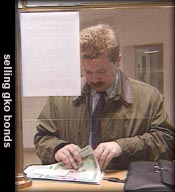 Was it a pyramid scheme, an international ponzi scam? To a good degree, yes.
But at first, the bonds made great sense. And they worked--they delivered
billions to the Central Bank. Did that money go to the budget? To pay pensions,
the army, social services etc? Some of it did--the finance minister Mikhail
Zadornov and others insist. But most of it went right back out--to pay off the
debt that they couldn't roll over. Obviously, the process had momentum--the
higher the yields soared, the more people bought the GKOs. Up to a point. At
triple-digits returns, even the deep-deep-pockets started to worry about the
state's ability to pay off the bonds. Was it a pyramid scheme, an international ponzi scam? To a good degree, yes.
But at first, the bonds made great sense. And they worked--they delivered
billions to the Central Bank. Did that money go to the budget? To pay pensions,
the army, social services etc? Some of it did--the finance minister Mikhail
Zadornov and others insist. But most of it went right back out--to pay off the
debt that they couldn't roll over. Obviously, the process had momentum--the
higher the yields soared, the more people bought the GKOs. Up to a point. At
triple-digits returns, even the deep-deep-pockets started to worry about the
state's ability to pay off the bonds.
The state started to have a new trouble: moving the paper at its weekly
auctions. Then during the spring and summer, it started canceling the auctions
altogether. This was not, to put it mildly, a good sign. The debt, all the while, compounded.
Sirens should have sounded. It was not just the bond market. (We can't forget
MinFins, Eurobonds too.) It was also the stock market, an experiment that soon
grew into a cash cow for Russian and foreigner high-risk investors alike. The
stock market looked like good value, even with its high risk. (Hedge
funds--the monsters that helped eat up the promise of
globalization---mushroomed in the Russian market). But market cap was never
high. Even at its peak, the stock market never held more than $127
billion--about four times Amazon.com.'s stock value (as of this writing).

The market's big year. It grew beyond anyone's dreams. As
returns on some of the top stocks hit 1,500 percent, the market became the
world's hottest emerging market. The fault-lines were obvious. The blue chips
were 90 percent oil and gas. Moreover, with their brazen dealings, the leaders
of the Russian market put Boesky and Milken to shame. Insider trading was not
the exception - it is said to have been the coin of the realm. An American
corps of advisors and consultants tried to bring financial law and order to the
market. They even helped to establish a Russian-style Securities and Exchanges
Commission. But enforcement was rare.
So was real, direct investment. Very few foreigners put a dollar or a DM in the
decaying Russian factories and mines. At the same time, they had good reason
not to. Tax men, hit men and old-guard industrial captains (the infamous "Red
Directors") conspired to discourage foreign investors from trying more than a
brief fling with "the new Russia." It was a dance, a flirtation--but never a
long-term relationship. Investors went bullish, but never committed.
In the weeks before Yeltsin's '96 reelection, annualized yields on GKOs climbed
over 150 percent. The triple-digit yields should have caused the IMF to
reconsider its policy. But by then, the big boys of the emerging market
sandlot had gone long on Russia-- Mark Mobius and George Soros. Inflation
(which had bloomed famously under Gaidar) had flattened off into single digits
and stocks boomed. Traders from Texas and London and Omsk squared off in the
fight to discover the best finds on the RTS - the stock market.

Even though the tight ruble corridor was holding and inflation had come dramatically down, given the history of hyperinflation, the
Western houses that went big into GKOs all started to sign
dollar-forward-contracts. (We can do detail on this, should you desire.) In
essence, the foreign banks were smart; they wanted to hedge themselves against
a fall in the ruble. These deals were signed in quiet--as the Russian banks
didn't really have the cash to cover the contracts (a point that has now become
painfully obvious.) I remember well the day last spring as the ruble came
under attack and the devaluation rumors gained weight, when I asked one of the
top bankers, Vladimir Potanin, about the dollar-forwards--news of which had
only just spread. (Reports had surfaced suggesting that the forwards could
amount to as much as several billion dollars worth of contracts.) Potanin
simply replied that "I don't think anyone bought GKOs without signing forwards
on them." (The Russian banks, in turn, had hedged their contracts, naturally,
to guard their own positions.) And so the GKO market was not only soaring, the
higher it went the more weight it put on the hollow banking system. The bomb
went off in my mind: a devaluation would destroy the banks.

First: Svyazinvest. Soros and Potanin broke the "gentlemen's agreement" on the
privatization auctions. They paid a competitive price--at the time--for the
goods. Second: At the same time, the 'bankers' war" broke out. In part
because of Svyazinvest. But more because the oligarchs had let their egos get
the better of them. They began to believe that Chubais & Company were in
their employ, that they should do their bidding, and if they failed to--they
should be fired.
Soon enough, in the fall of 1997 the first waves of the Asian contagion hit.
The world price for crude--Russia's primary hard currency export--had already
begun its fall. Indonesia went. Japan foundered. The Asians dumped their GKOs.
Those ministering to Russia's finances yet again doubled GKOs yields. As 1998
opened, the sharks swarmed. The ruble came under attack--again and again. With
the GKO market soaring, the stock market--by the inverse nature of their
relation--tanked.
Still, Chubais, who had shuffled so often between the cabinet and Kremlin in
recent years, repeated his mantra that Russia would soon see growth. The Asian
flu, Chubais insisted, was good news for Russia. "It proves that at last we've
joined the global economy." As the ruble fell prey to attacks, the Central Bank
mounted a costly defense. "A stable ruble," Chubais chanted, "is our pride,
proof that the reforms are working."
The Central Bank, however, soon burned billions in hard currency reserves
propping up the ruble. During a June visit, World Bank head James Wolfensohn,
ever the affable Australian, was saturnine: "A bump in the road to be sure," he
told Russian reporters. "But you've been through crises before."
A note on George Bush's cameo: You may wish to get footage of Bush's speech at
the Goldman Sachs' gala in early June. It was a classic. Ranks up there with
his famous Chicken Kiev speech. Goldman flew him in to open up their Moscow
office. As the signs of impending doom swirled and the dire diagnosis of
Mobius ("This is meltdown time folks") lingered in the Moscow air, Bush
declared his faith in "the power of freedom and free markets." "I am
optimistic," he told the gathering in the elegant House of Columns (where
Stalin had lain in state). "I believe Russia is going to thrive." Coming as
Russia's stock market hit a new low and GKO yields soared, his speech sounded
more like a half-time pep talk to the Christians in the Coliseum.
In July, after long weeks of suspense, The Bailout arrived.
Chubais joined IMF and World Bank officials in the Russian White House to
unveil a complex package of $22.6 billion in credits. (Japan also pledged a
small slice of that--to feed hungry coal miners in the far eastern regions that
have critical exports for the Japanese market.) But no one knew how much
Russia really had received. Previous credits were thrown in to pad the total.
Billions more depended on the Duma approving liberalizing economic measures,
while the World Bank tagged its credits to vague "structural reforms."
And so, the headlines around the world the next day gave varying figures for
the total credits. The Bailout, we were assured, would return confidence to
the market. The IMF team left town. Chubais went on holiday. Potanin went to
Europe, to enjoy his yacht. The IMF delivered the bailout's first tranche, $4.8
billion. But John Odling-Smee--the IMF's top man for Russia who helped Chubais
announce the Bailout--is said to have told fellow passengers on the flight from
Moscow that "there's no way they'll ever get all the cash." Within days, no one
believed in the package. The markets, meanwhile, kept staggering--down one day,
up a bit the next. But the confidence in Russia's ability to steady itself
never came.
By late July the rumors of a devaluation, first floated before May Day, hit
fever pitch. The Central Banker, Sergei Dubinin, instructed his compatriots "to
spit in the eye" of anyone who dared to call devaluation inevitable. (He had
in mind the liberal, provocative, economist Andrei Illarionov--who had been
making daily press statements that the devaluation was inevitable.) Pressure on
the ruble mounted, as investors ran for shelter in dollars. The Central Bank
had just $12 billion in its coffers, with some $4 billion of that in
demonetized gold bouillon. The GKOs were coming due with accelerated
regularity. Several of Russia's biggest banks, the plush lairs of the
once-flush oligarchs, failed to meet margin calls on loans from Western banks.
The state faced darkness: it could not cover its debts.

- On August 13, 1998, after blue chips fell more than 20 percent in the first
hour of trading, the Moscow stock exchange shut down as the RTS fell 6.5
percent overall and yields on GKOs soared above 200 percent. The cause this
time is not just the sinking Yen: Soros also did his part. One of the biggest
players on the Russian market, in an August 13 letter to the
Financial Times, Soros called for devaluing the ruble, tagging it to the
dollar or euro and establishing a G-7 backed, $50 billion currency board. (Had
such a board been created, Russia's Central Bank would have had to guarantee
all rubles in circulation with dollars or euros at the established peg level.
Soros in his FT letter kindly added that Russia's meltdown had reached "a
terminal phase."
- Friday, Aug. 14, the rulers of Russia's finances convened in the White
House. It was late in the night when they ran down the figuresótrying
to tally CB reserves versus debt coming due. Zadornov and Dubinin were in
charge. Kiriyenko listened. The Soros FT letter was discussed at length.
Yeltsin's "no devaluation" promise still resounded on the TV news--he'd said
it only hours earlier on a visit to a sausage factory in Novgorod. There was a
sense of panic. In large part because the IMF top advisors were out of town.
And because Chubais, the mastermind of the post-Soviet political economy, whom
millions of Russians consider an agent of Washington, World Zionism and
Deutsche Bank, was still on holiday in Ireland. But all agreed that if they
were going to devalue it had to be done immediately--on the weekend moreover,
so as to limit the hemorrhaging. (Or so they thought).
- Early on Saturday, Aug. 15, Kiriyenko called a conclave at his government
dacha outside Moscow. Kiriyenko and Gaidar ran the meeting, which lasted for
hours. Chubais--according to my interviews--had made it back by then. He and
Dubinin and Gaidar assured Kiriyenko the IMF would back them up, and they were
right--in part. Over the weekend there would be more meetings.
The IMF's top Russia hand, Odling-Smee, would also fly back that Saturday
morning. Handmaidens from Washington would sit in on the meetings in the
Russian White House, compounding the hand wringing.
At least two participants of those White House deliberations say the decision
to devalue was made by a small circle: Kiriyenko, Chubais, Dubinin, Zadornov,
Vyugin and Gaidar. Boris Fyodorov, the former finance minister and erstwhile
tax czar, says that after the dacha gathering, when he first learned of the
planned default on GKOs, he rushed to the Metropol Hotel near the Kremlin to
tell the IMF delegation. "I warned them of the coming suicide," Fyodorov would
later say. "I tried to get them to stop Kiriyenko. But I realized right
away--they knew, they were in on it and they decided to keep quiet about
it."
Later on Saturday, the usually restrained, unflappable Kiriyenko was on the
verge of panic. During the night, as people came and went through the White
House, it was Chubais who held court. He had not had his best year. Embroiled
in a scandal over an unseemly book advance from a Swiss company tied to
Potanin, Chubais had spent much of 1998 in political exile. In delivering The
Bailout, however, he had returned to savor the limelight. It was late at night
when he laid out the state's emergency exit plan to the assembled ministers and
bankers, uttering almost in passing, the fateful words, "controlled
devaluation." "I knew right then," said one of those present, "we were
fucked."
Chubais standing at the window in the White House that night in mid-August,
almost 7 years to the day after the 1991 coup against Gorbachev, uttering, for
the first time, the words "controlled devaluation." The moment may well
deserve a special place in Russian history--alongside the passing of a General
Secretary, the beginning of a purge, the end of an era. The pain, Chubais
said blithely, would be minimized. By Sunday, however, the oligarchs had camped
out at the White House.
- Sunday afternoon the cabinet took a straw vote in the White House. All were
in favor. Sunday evening, Kiriyenko decided the time had come to tell Yeltsin.
The PM and Chubais and Kremlin chief of staff Yumashev choppered out to
Yeltsin's country residence in Zavidovo--known as Rus. "Grandpa," as Nemtsov
calls Yeltsin, gave his blessing. (All the subsequent talk that Yeltsin knew
nothing about the coming devaluation was shameless spin).
While Kiriyenko and Co. were at Rus, the oligarchs agitated for a total debt
freeze--both domestic and foreign. They'd get most of what they demanded.
They'd get a 3-month freeze. NB: In the wake of The Deval, some would say the
barons of Russia's nascent financial- industrial empires had little to gain
from a devalued ruble, and everything to lose. Others would note that when your
debts are big, and getting bigger all the time, devaluation never hurts.
(Especially when your chief commodity is oil.) A debt moratorium, however,
would give all players a precious time-out--time enough to channel equity
abroad.
Late Sunday night, the PM broke the good news: there would be the "controlled"
devaluation and a debt freeze--but only temporary while the debt restructuring
was worked out. Early Monday morning, just a few hours before the world would
find out the news, the IMF gave Chubais and Gaidar its OK. "They were in on
the discussions all along," insists Gaidar. "The IMF knew what our idea was and
they supported it. All attempts to say otherwise
now are simply cowardice."
- Monday, Aug. 17: And so the deed was done. "It's over," came the calls--one
after another, from the distraught bankers and brokers. Russia defaulted on $40
billion in GKOs and cut its umbilical cord to the capital markets. Many of
Russia's fattest banks would cave in. Hardest hit, of course, was the infant
middle class. The stock market tanked. By October 6, 1998, one year after
hitting a high of 571, the RTS hit a new low, at 37.

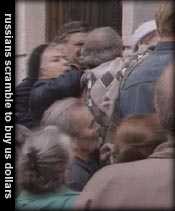 The political witchhunt--"Kto vinovat?" being the first instinctive question on
many Russian minds--began right away. The Communists cried for arrests, the
Central Bank came under attack. The IMF hid. Soon Dubinin resigned (and went
back to Gazprom). By now all the contenders for Yeltsin's throne have cried for
the guilty, those behind the GKO "pyramid" and the "criminal privatization," to
be tried. In Strasbourg not long ago, Interior Minister Sergei Stepashin told
the Council of Europe that $1 to $2 billion was smuggled out of Russia each
month. The prosecutor general's men seized the databases of the Moscow
Interbank Currency Exchange, investigating money laundering by state officials.
The data, prosecutor general Yuri Skuratov promised, would reveal the activity
of the accounts of those who had been deepest in GKOs. In November, the
business daily Kommersant reported, citing "operational information" from the
Interior Ministry, that in the days before August 17, "high officials of the
government and the Central Bank warned certain participants in the GKO market
about a default." Those fortunate few, of course, could then dump their GKOs.
By now, the oligarchs have taken a big hit--for some, the fall has been fatal.
(Sidanko this week will go into bankruptcy). Boris Nemtsov, the former deputy
prime minister, was blunt, telling me, "Now there's only one oligarch
left--[Moscow Mayor Yuri] Luzhkov." The political witchhunt--"Kto vinovat?" being the first instinctive question on
many Russian minds--began right away. The Communists cried for arrests, the
Central Bank came under attack. The IMF hid. Soon Dubinin resigned (and went
back to Gazprom). By now all the contenders for Yeltsin's throne have cried for
the guilty, those behind the GKO "pyramid" and the "criminal privatization," to
be tried. In Strasbourg not long ago, Interior Minister Sergei Stepashin told
the Council of Europe that $1 to $2 billion was smuggled out of Russia each
month. The prosecutor general's men seized the databases of the Moscow
Interbank Currency Exchange, investigating money laundering by state officials.
The data, prosecutor general Yuri Skuratov promised, would reveal the activity
of the accounts of those who had been deepest in GKOs. In November, the
business daily Kommersant reported, citing "operational information" from the
Interior Ministry, that in the days before August 17, "high officials of the
government and the Central Bank warned certain participants in the GKO market
about a default." Those fortunate few, of course, could then dump their GKOs.
By now, the oligarchs have taken a big hit--for some, the fall has been fatal.
(Sidanko this week will go into bankruptcy). Boris Nemtsov, the former deputy
prime minister, was blunt, telling me, "Now there's only one oligarch
left--[Moscow Mayor Yuri] Luzhkov."

Nearly a decade after the fall of The Wall, life in Lenin's old
land was supposed to be better than this. 1998, as Chubais had promised every
journalist who would listen, would be the year that Russia turned the corner,
that the Motherland enjoyed real economic growth at long last. Instead, the
crash came and Chubais was history.
Yeltsin had decreed 1997 the "Year of Reconciliation and Accord." There was
little evidence of either, however. And in 1998, political crises became the
norm, as Yeltsin fired two prime ministers and as many governments. And
brought in a third--Primakov--only after the toughest political standoff since
October 1993. By the fall, the reformers were out in the cold. One day in
October, Nemtsov was summoned to the Kremlin to meet with Yeltsin--(when
Yeltsin named him to his present volunteer job on some little-known Kremlin
committee). After a long lunch in the Kremlin, Yeltsin invited Nemtsov out to
Gorky-9 for tea and a stroll. As they walked in the woods --in Nemtsov's
telling--Yeltsin turned to him and asked after "the boys" (i.e. the young
reformers he had so praised only months before.) Nemtsov demurely explained
that they'd known better days. (He didn't have the nerve to ask why the
president had fired them all) In response, Yeltsin simply shook his head, and
sighed: "So the old guys have come back?"
As the year closed, Russia faced its darkest winter in years. The bankers and
brokers, traders and importer/exporters were all badly wounded. So too were the
political "liberals"--the Molodiye Reformatory who had sullied words like
Democracy and the Free Market. Now they would have to bear the blame for the
so-called "reforms." And then before long, came the murder of one of their
own--the Duma deputy Galina Starovoitova, who had long demanded genuine reform
that developed genuinely democratic institutions.
Just before New Year's, Russia failed to make a $362 million payment on Soviet
debt. By then the point had grown obvious to all: Russia will soon have to
default on its external debt as well. As one top banker put it to me in early
January of 1999 : "We are now living on the good will and patience of the
Western bankers."
| |







