|


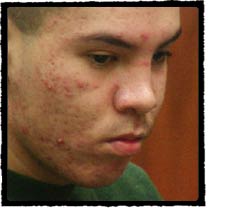
In the fall of 1999, when he was 17, Manny and two other gang members attacked
a family in his neighborhood. One of the victims was six months pregnant. The prosecution says she was hit repeatedly in the stomach with a baseball bat. Four men were assaulted, two of them stabbed. Manny was arrested and brought to court on four counts of
attempted murder.
Manny comes from one of San Jose's roughest neighborhoods, and is a member of
the Hispanic Norteño gang. His childhood was difficult; he grew up without his
father and started running the streets and fighting in fourth grade. He has
adopted the ethos of the streets, and believes that violence is sometimes
necessary to achieve the respect of his peers. He says, "If someone hits you,
you got to defend yourself . . . By just sitting there and turning the other
cheek , you don't stick up for yourself, you just get rolled on, you don't have
no self pride for yourself."
The 1999 attack was his second violent felony; at 14 he pled guilty to rape in
juvenile court. Given this history, the District Attorney believed that he had
all the hallmarks of a kid who belongs in the adult system, and petitioned the
court to try him as an adult. In criminal court, Manny could receive more than
20 years in prison if convicted as charged.
Under California law, there are five criteria the juvenile court must consider
when determining whether to certify a child up to the adult system: the level
of the offender's criminal sophistication, whether he can be rehabilitated within the time the juvenile court has to work with the minor, previous delinquent history, the success of prior attempts
at rehabilitation, and, finally, the seriousness and gravity of the crime.
A Santa Clara County probation officer, working independently of the
prosecution and defense, prepared a fitness report for the court based on the
five criteria. He found Manny to be fit for the juvenile system on the first
four counts. He believed that the system could have done a better job of rehabilitating Manny after the rape
incident. He served only 56 days at the Juvenile Ranch because of good behavior, and did not receive any sexual offender counseling while serving his sentence or when he returned home. Given
this, the probation officer found Manny fit under the criteria of previous attempts to rehabilitate him. He did find him unfit on the criterion regarding
the seriousness of the crime, however.
 Ultimately, the court agreed. Despite evidence that Manny had not been the one
to hit the pregnant woman, Judge LaDoris Cordell found him unfit on the
final criterion, the seriousness of the crime. In her ruling, she said, "There is no evidence of any circumstances that would tend to mitigate the gravity of the offense. It was clearly under any kind of reading a vicious attack." Under California law, since Manny was 17, he must
be sent to adult court if found unfit on any of the five criteria. His one
reprieve was being allowed to stay in Juvenile Hall pending the outcome of his
adult trial.
Ultimately, the court agreed. Despite evidence that Manny had not been the one
to hit the pregnant woman, Judge LaDoris Cordell found him unfit on the
final criterion, the seriousness of the crime. In her ruling, she said, "There is no evidence of any circumstances that would tend to mitigate the gravity of the offense. It was clearly under any kind of reading a vicious attack." Under California law, since Manny was 17, he must
be sent to adult court if found unfit on any of the five criteria. His one
reprieve was being allowed to stay in Juvenile Hall pending the outcome of his
adult trial.
In the summer of 2000, Manny pled guilty to seven counts of assault with a
deadly weapon. He now has two adult violent felony convictions or "strikes."
If he commits another felony--violent or nonviolent -- he could be sentenced to
life in prison under California's "three strikes" law. He is not hopeful about
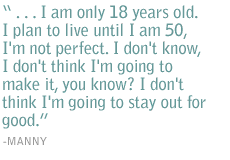
his chances of remaining out of prison for life. He says, "It might as well be
a done deal. Two strikes. . . . I am only 18 years old. I plan to live until I
am 50, I'm not perfect. I don't know, I don't think I'm going to make it, you
know? I don't think I'm going to stay out for good." On January 22, 2001, Manny was sentenced to nine years at state prison.
manny · shawn · marquese · jose
from both sides of the bench · facts & stats · related report: little criminals
discussion · synopsis · press · tapes & transcripts · credits
FRONTLINE · wgbh · pbs
web site copyright 1995-2014
WGBH educational foundation
| |