UPDATE
Fall 2013: Associated Press: Feds to Protect Red Knot Shorebirds
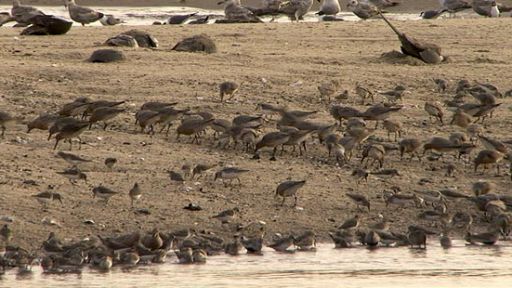
The Obama administration is moving to protect the red knot, a robin-sized shorebird known for its 10,000-mile migration from South America to the Arctic.
The Fish and Wildlife Service said Friday it is proposing the bird be listed as threatened under the Endangered Species Act. Officials say rising sea levels and disappearing habitat along the East Coast are taking a toll on the rosy-breasted bird, which makes refueling stops in Cape Cod and Delaware Bay. [read more…]
WEB SITES
Horseshoe Crabs
HorseshoeCrab.org
http://horseshoecrab.org/
Comprehensive Web site exploring the anatomy, evolution, conservation, and research on the horseshoe crab. Also visit http://horseshoecrab.org/act/act.html for information on how to get involved in helping the horseshoe crab.
Green Eggs & Sand Educational Program
http://www.dnr.state.md.us/education/are/ges.html
A Tri-State Horseshoe Crab/Shorebird Education Program for middle and high schools students.
University of Delaware Sea Grant College Program
http://www.ocean.udel.edu/horseshoecrab/
Web site designed to provide the public with research-based information about the horseshoe crab. Plus, information on artificial bait to replace horseshoe crab meat: http://www.ocean.udel.edu/horseshoecrab/Research/bait.html
Horseshoe Crab Research Center
http://www.nmfs.vt.edu/HSCwebsite/index.htm
The goal of the Horseshoe Crab Research Center (HCRC) is to provide information required to sustainable manage the horseshoe crab resource for the benefit of all resource users.
Dupont Nature Center – Red Knot & Horseshoe Crab
http://www.dupontnaturecenter.org/explore.html
Owned and operated by the Delaware Division of Fish and Wildlife, this center offers one of the best viewing areas for spawning horseshoe crabs and migratory shorebirds during the peak season.
Red Knots
The Shorebird Project
http://shorebirdproject.blogspot.com/
Larry Niles, featured in “Crash: A Tale of Two Species, and an international team of biologists who monitor red knots and other shorebirds blog about the ongoing news surrounding red knots and other shorebirds.
Friends of the Red Knot
http://mysite.verizon.net/vzeu3rwf/
Friends of the Red Knot is a club whose members are working to have the Red Knot bird placed on the Endangered Species List.
Shorebirdworld.org
http://www.shorebirdworld.org/index.php
Organization dedicated to promoting understanding and awareness of the natural history of shorebirds.
New Jersey Division of Fish and Wildlife
http://www.nj.gov/dep/fgw/ensp/redknot.htm
NJ Division of Fish and Wildlife’s page on Red Knot Population and Conservation.
American Bird Conservancy
http://www.abcbirds.org/abcprograms/science/watchlist/red_knot.html
ABC’s mission is to conserve native wild birds and their habitats throughout the Americas.
Birding and Conservation
All About Birds
http://www.birds.cornell.edu/AllAboutBirds/
All About Birds is Cornell Lab of Ornithilogy’s Web site for bird basics. Includes info on identifying birds and birding hotspots.
Audubon
http://audubon.org/
Audubon’s mission is to conserve and restore natural ecosystems, focusing on birds, other wildlife, and their habitats for the benefit of humanity and the earth’s biological diversity.
eBird
http://ebird.org/content/ebird/
A real-time, online checklist program for bird sightings.
Manomet
http://www.manomet.org/
one of the nation’s oldest independent environmental research organizations, Manomet conducts original research on natural systems and wildlife.
Defenders of Wildlife
http://www.defenders.org/index.php
One of the country’s leaders in science-based, results-oriented wildlife conservation.
Wildlife Conservation Society
http://www.wcs.org
Search the WCS Web site for a wealth of information about horseshoe crabs and red knots — as well as about how their fates are intertwined.
BOOKS
Harrington, Brian. The Flight of the Red Knot: A Natural History Account of a Small Bird’s Annual Migration from the Arctic Circle to the Tip of South America and Back. W. W. Norton & Company, 1996.
Crensen, Victoria. Horseshoe Crabs and Shorebirds: The Story of a Food Web. Marshall Cavendish Corporation, 2003.