TRANSCRIPT
[melancholy music] - [Narrator] Some stories have small beginnings.
No one knows just how this one started, but what evolved is remarkable.
[melancholy music] Beneath the full moon, an ancient creature was stirring at the water's edge.
While half a world away, a small bird set off on an epic journey.
Somehow, their lives began to touch and an amazing synchronicity grew.
This is the story of a fragile connection between two specie and the forces that threaten to tear it apart.
[melancholy music] [upbeat music] - [Announcer] This program was made possible by the Corporation for Public Broadcasting and by contributions to your PBS station from viewers like you.
Thank you.
[suspenseful music] - [Narrator] For 350 million years they've answered to the call of the moon.
[somber music] They've survived ice ages, asteroids, and cataclysmic forces even the dinosaurs couldn't withstand.
While thousands of species came and went this humble creature endured.
It's a time traveler, a living fossil, the horseshoe crab.
[melancholy music] Their simple design has weathered the eons.
Only sharks or sea turtles can penetrate their shells.
[melancholy music] Their home is on the ocean floor.
They only leave the water to spawn.
[calm music] After millions of years of evolution, most of the world's horseshoe crabs are found smack in the middle of the eastern seaboard.
[calm music] When they're overturned it seems a miracle they've survived at all, but they have an important tool.
Their tail might look like a weapon, but it's harmless.
They use it to steer and to flip themselves right side up.
They're more closely related to spiders and scorpions than they are to crabs.
[calm music] And like their relatives, they shed their shells in order to grow, casting off as many as 17 in a lifetime.
[calm music] 10 eyes key them to the light and the cycles of the moon.
They even have receptors on their tails.
[calm music] Their ancient design has changed the course of modern science.
Studies of their vision have led to Nobel Prizes and their blue blood plays a vital role in human health.
There's hardly a person alive who doesn't owe thanks to the horseshoe crab.
Humans have also discovered that crabs can be useful as bait.
While no one was counting, millions were harvested in the '90s.
Oddly enough, it was a small bird that sounded the alarm.
The bird is rather remarkable in its own right.
Each year it makes one of the longest migrations on earth.
But without the horseshoe crab, its incredible journey might soon come to an end.
Theirs is a story of connected lives and a fragile synchronicity that's coming undone.
It's a tale that reaches all the way from the Arctic to the tip of South America.
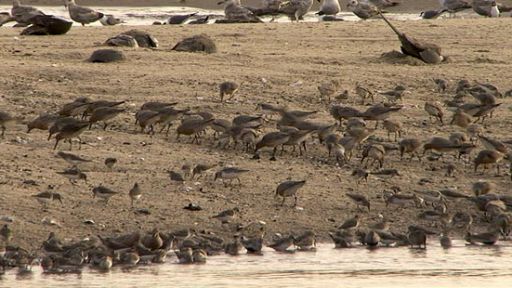
These are the wintering grounds for the little red knot.
[somber music] Tierra de Fuego is a land of extremes.
The wind can scour the landscape at 80 miles an hour.
For three months each year, a special population of red knot called Rufa makes this their home.
[somber music] They're about the size of a robin and they weigh less than an apple.
[calm music] Here in Chile, they survive on tiny mussels which they eat whole.
They spend much of their days feeding.
They need the calories, because they're in the process of molting new flight feathers for their extraordinary migration.
[calm music] The process takes about three months and a tremendous amount of energy.
[calm music] On this exposed landscape small birds are easy prey.
The red knots flock with other species, there's safety in numbers.
With one eye almost always open, someone's bound to spot the falcon or the fox.
[hopeful music] Even in flight they stick together to confuse the predators.
It's as if the flock has a single mind.
[hopeful music] But recently the red knot has fallen prey to something far more menacing than a fox.
The population has started to crash.
For over two decades, Guy Morrison has been conducting aerial counts.
He's witnessed one of the most rapid declines of birds ever recorded.
In the last five years, red knot numbers have dropped by nearly 70%.
It happened quickly, catching biologists off guard.
Today the aerial counts are coordinated with ground surveys below.
But searching for small birds in this landscape is like looking for a needle in a haystack.
Biologist Larry Niles has led the ground surveys for the past seven years.
The scientists time their expeditions with the moon, when the tides are highest is when they return to this spot each year because that's when the birds are easiest to catch.
Larry and his wife Amanda Dey from New Jersey Fish & Wildlife are part of a six member team here to collect data on red knots.
Based on the aerial survey, they've decided to set up a mist net on the flats.
- [Larry Niles] We have great difficulty catching birds in Bahia Lomas.
That long inter tidal flat makes the tide unpredictable.
- [Amanda Dey] The water just rushes in incredibly fast.
- The tide here is scary.
[hammer hitting a stick] If you make a bad choice you could end up getting stuck and this is so remote, I don't know what would happen to you.
- [Amanda Dey] It kind of gives you a view into world of the red knot.
Constant wind blowing at 30, 40 knots, cold at night and rain, and this is summer.
- [Narrator] The birds are becoming more vulnerable as their numbers drop.
One single disaster, a hurricane or an oil spill could wipe out the entire population.
Even here, the potential for extinction is a growing reality.
[melancholy music] Every bit of data is a critical piece of the puzzle.
But that means catching birds.
And so far on this trip, the teams' attempts have failed.
With only a week to go, they need to make a catch.
Mist nets only work when the birds can't spot them.
The team waits for the long Chilean sunset, to see what the darkness brings.
[birds chirping] The night's catch is excellent.
They net over a hundred red knots.
- [Humphrey Sitters] The weight is 125 grams.
125.
- [Amanda Dey] We weigh and measure them, measure wing, bill length, and those biometrics give us an idea about how well they're doing, the condition of the birds.
Our banding work involves individually marking these birds with a little tab of plastic that sticks off the upper leg and it has letters on it.
From that, we can re-sight those individuals and get an understanding of their survival.
- [Narrator] Colors correspond to the country where they've been tagged, red for Chile, white for the Arctic, green for the US.
- [Humphrey Sitters] This is an old Delaware Bay bird.
- [Narrator] Armed with data, the team hopes to strengthen international protection.
Without it, experts fear this little bird could be extinct in less than five years.
[somber music] It's late in the season, and the knots will set off for the Arctic soon.
Their long migration is crucial, because the Arctic is where they mate and hatch their young.
They'll be flying nearly 20,000 miles round trip.
It's an astonishing journey.
- Hold the bird in your hand and you what [indistinct] everyday for your survival means.
I can't even imagine the flights these birds have to take, taking off for a trip across the Atlantic, flying for three or four days straight.
Battling off bad weather and then not knowing when you get to a stop over, if there's going to be any food.
It's extraordinary.
[melancholy music] - [Narrator] It's now February and the knots have a last chance to fatten up.
They've molted new flight feathers, which need to be carefully preened for their long migration.
And then, one day when the wind is right, a flock lifts off as if by magic and begins the first leg of its long journey north.
[melancholy music] They'll spend the next three months hopping up the coast of South America, fattening up as they go.
Once they reach Brazil, they'll rest and prepare for the longest leg of their epic migration.
[calm music] 4,000 miles North, the spring moons are calling an ancient creature from its wintering grounds.
As the waters warm and tides grow high, horseshoe crabs leave the ocean floor and make their way to the shores and estuaries of the Atlantic Coast.
Here in the sheltered waters of South Carolina, they suddenly emerge by the thousands in a spawning ritual they've performed for hundreds of millions of years.
On the highest tides, they drag themselves to shore to lay their eggs.
Crabs don't mature until they're nine or ten.
By then they've molted for the last time and their permanent shells can host an ecosystem of hitchhikers.
Horseshoe crabs are safest on the ocean floor.
But the only way to carry on the species is to take a risk.
- [Jerry Gault] We say the ones that see us coming and turn and take off to the water, we caught him before.
He knows us.
[Jerry chuckles] - [Narrator] Jerry Gault and his father Bob have worked these waters for decades.
- [Jerry Gault] We work the moons.
The horseshoe crabs come up and spawn on the moons in the springtime.
- If you actually get into the water, you can feel them swimming and sometimes you can't even catch them because they'll get to swimming so fast.
A lot of people seem to be scared when they first see them on the beaches, they do look a little scary, but what I do is put them right up against my face and as you can see, they do not hurt, their pincers are all very light.
These are harmless.
I just like 'em.
- Mine is bigger.
[chuckles] - Mine is younger.
[both laugh] - [Narrator] For 15 years, South Carolina has banned collecting horseshoe crabs for fishing bait.
Now only fishermen with special licenses are allowed to gather crabs for biomedical use and only if they return the crabs alive.
Few of us realize just how valuable the horseshoe crab is.
- When I first started 37 years ago, we were allowed to harvest them.
There was no recording, there was nothing and they became fair game and I was involved with selling them for bait and then a doctor came down and he said that if I didn't sell bait crabs anymore he would be interested in the laboratory.
- [Jerry Gault] Normal fishing is you catch it, you ice it, and you deliver it to the table and you eat it.
The horseshoe crab we actually catch them, take them to the lab, and they bleed them, and we bring them back and release them.
So we're borrowing the crabs is really what we're doing.
What do you say we go unload this?
- All right.
- [Narrator] Crabs that are borrowed end up a couple of hours away at the Endosafe Laboratories in Charleston.
Here in this alien world, they're given a rigorous cleaning to prep them for process ahead.
For the past thirty years, the biomedical industry has been mining the medical equivalent of gold.
Endosafe is one of only four labs in the world that produces a derivative of horseshoe crab blood.
Their blood has a clotting agent that's used to detect minute levels of bacteria.
But what's truly surprising is the color.
The crab's blue blood is an evolutionary gift that helped them survive the eons.
- [Lab Technician] Male or female?
- A small male would be good.
- Okay.
- [Narrator] Dr. Norman Wainwright has been working with horseshoe crabs for most of his career, studying the remarkable properties of their blood.
- The beautiful blue color is a result of its blood containing copper as an oxygen carrying pigment instead of hemoglobin, which contains iron.
I'm adding a suspension of e-coli bacteria.
At the first sign of bacteria, the crab's blood forms a protective clot.
Look at that.
This is perfect.
This is the horseshoe crab cells protecting the animal from infection.
Any type of leakage of seawater into their blood system would trigger this response, seal the wound and there actually are proteins in the clot itself that kill the bacteria.
They are almost primitive antibiotics.
- [Narrator] The phenomenon caught the attention of the biomedical companies in the '70s.
They've been putting it to work for us ever since.
Up to 1/3 of the crab's blood is removed during the process, yet most of them survive.
One quart of horseshoe crab blood is worth about $15,000.
It's a multi-million dollar industry.
The clotting agent, called Lysate, is used to test intravenous drugs for bacteria.
No IV drug reaches the market without being tested on horseshoe crab blood.
It's an FDA regulation.
Years ago, the only way to screen for toxins dangerous to humans was to use live rabbits.
Feverish bunnies revealed contamination and the test was slow.
Horseshoe crab blood takes an hour tops, and most of the crabs survive the process.
Scientists are exploring alternatives that would make bleeding crabs unnecessary.
But each day we're finding more ways the horseshoe crab can help us with everything from sutures to contact lenses.
[indistinct chatters] Over 300,000 crabs were bled last year.
Of course the goal is to return them unharmed, but studies have shown that up to 13% may not survive.
Every one of us has probably benefited from the horseshoe crab and yet this odd looking creature has been largely taken for granted.
- [Bob Gault] In my lifetime, I've had the choice of taking and taking and taking.
And with the horseshoe crab, I have the privilege of returning it.
I get a chance to return something that has benefited so many people.
[calm music] - [Larry Niles] We are not the only species that's come to depend on the horseshoe crab.
They're critical to others too like the red knot.
It's now May in Brazil.
The red knots have built up their fat reserves and they're now in their breeding plumage.
They're ready to begin the longest leg of their epic journey.
They'll fly for as many as four days and nights, without stopping, mostly over open ocean.
With no landmarks to guide them, they'll use the moon, the stars and the sun.
Their departure is mysteriously synchronized with an annual event four thousand miles north.
Here on the Delaware Bay, the waters have warmed and the worlds largest population of horseshoe crabs is beginning to spawn.
[calm music] It's here that the red knot has always found the fuel for their journey to the Arctic.
And the horseshoe crab has always provided that fuel in the form of eggs.
The spawning season is an annual feast.
It's a windfall for shorebirds and a great opportunity for biologists.
Migrating flocks have just begun to arrive.
If the red knots are on schedule, they should be here soon.
[calm music] Horseshoe crabs prefer spawning in the cover of night, but this is the height of their short season.
It only lasts a few weeks.
[calm music] They come to shore when the tides are highest to lay their eggs deep in the sand.
Swarmed by hopeful males, the female digs down to bury her clutch.
The males are smaller than the females, but they have a special claw that hooks onto her shell.
Since fertilization is external, even unattached males will father some of the eggs.
When her clutch is finally laid, the female breaks through the sand.
[melancholy music] In all the commotion eggs from prior spawns get unearthed.
What the crabs accidentally dig up is what the red knots depend on.
[melancholy music] [birds chirping] As the tide recedes and the crabs retreat, a flock of red knots appears in the sky.
[hopeful music] They've traveled for 4 days and nights without stopping.
They're exhausted and emaciated.
The flock will find a safe place to roost for the night and rest.
[calm music] [aircraft engine revving] From all over the world, biologists have come to count shorebirds on the Delaware Bay.
The spring migration offers a rare opportunity to assess populations.
Many species of shorebirds are in decline, but the red knots that winter in South America are by far the most serious.
No one knows how many will make it to the Bay this year.
[melancholy music] For the next week, more flocks of red knots trickle in.
Once they're here, they need to eat.
They only have about two weeks to refuel and set off again.
Their breeding is tightly synchronized with the brief Arctic summer.
Their digestive systems have shut down for the long journey.
It's here that the horseshoe crab makes all the difference in the world.
Their soft eggs are packed with protein and easy to digest.
Some knots will double their weight in two weeks.
While it's an important food for other species, for the red knot, it's essential.
This was a revelation to scientists and a key piece of the puzzle.
As red knot numbers dropped, evidence began pointing to the Delaware Bay and to horseshoe crab eggs.
Ongoing studies began to confirm the connection, there's been a steady decline in eggs on the Bay.
Figuring out how many eggs there are is a tedious job, but it's become a critical piece in the puzzle.
- It's a lot of work.
We work about 40 hours a week.
We take a sample roughly per one meter.
We do this for about 4 hours every couple of days then we sort through egg, then we count the eggs.
And that takes 6 or 7 hours.
And then we count the birds.
From last year, it looks like the egg densities have dropped from the same beaches and it's not a good sign.
It does worry me.
It's just a beautiful animal.
I mean it's...
I hate to see something go extinct.
[somber music] - [Narrator] Oddly enough, it was the red knot's decline that made us pay attention to another species in decline.
In the past decade, it's been estimated that horseshoe crabs in the Delaware Bay have dropped by 75%.
It all began in the nineties when a growing fishery discovered that horseshoe crabs made good bait.
They were easy to collect and free.
With no regulations, anyone could scoop crabs right off the beach.
At the height of the rush, 2 million crabs were harvested in one year.
No one seemed concerned until red knot numbers began to drop.
By the time we saw the connection, the red knot was in serious trouble.
Getting a handle on horseshoe crab populations has been tricky.
One method is to tag crabs and ask the public to report sightings.
- 15- - [Narrator] Dave Smith from the US Geological Survey has been a key player in tracking crab numbers.
- [Speaker] Point four centimeters.
- There's a lot of demands on this animal and right now it's up to us to find out if there's room for all of those demands.
If there's room for using horseshoe crabs for bait, as well as biomedical and still meet the needs of the red knots.
- [Narrator] Today, efforts are underway to restore a balance that's been lost.
To build up crab numbers, there's now a two-year moratorium on harvesting horseshoe crabs in the Delaware Bay.
- Female horseshoe crab.
- The regulations that have been put in place for horseshoe crab seem to be working.
There's gonna be a lag, and whether this success has occurred in time for the red knots, we just don't know.
[somber music] - [Narrator] A recovery of crabs in the Bay will take time.
[melancholy music] Horseshoe crabs don't mature till they're 9 or 10.
That's nearly a decade before the next generation is ready to spawn.
In the short season, females lay over 80,000 eggs.
Out of 80,000, only 10 might survive to adulthood.
The odds might seem low, but it's been a successful breeding strategy for eons.
[melancholy music] Protected beneath the sand, the eggs are nurtured by the warmth of the sun and the moisture from the tides.
[melancholy music] By the fifth day, tiny legs become visible inside their watery nurseries.
[melancholy music] The next day, they'll molt for the first time.
They'll shed their little shells four times while still inside the egg.
But their tails won't grow until after they've hatched.
[calm music] It's a remarkable process the horseshoe crab has carried out for 350 million years.
But will the population recover in time for the red knot?
No one knows.
[thunder storm sounds] A few days after the first red knots arrive, a storm moves in.
The crabs won't risk coming to shore in this kind of weather, the waters are too rough.
This means fewer eggs for the birds that are here.
And for the red knots still in transit, it means a serious delay.
[birds crying] Once the storm has cleared, the birds need to make up for lost time.
Same goes for the scientists.
- Now there's birds coming in.
- [Narrator] With the knots here for only three weeks, they've got a brief window in which to collect data.
[Speaker speaks indistinctly] Cannon netting can be dangerous.
- [Larry Niles] Still gotta go down a bit.
- [Narrator] Larry Niles is one of only a handful of trained professionals.
- [Amanda Dey] Nobody in front of the net.
- [Narrator] If it's not done carefully, birds can be killed in the process.
- See all the eggs in there?
See this is loaded with eggs so I'm just stirring them up so that the birds will come in quicker.
We've lost many of the birds, see them taking off right there?
So we're gonna have to get them back here.
Try to get off this beach right away.
Go.
[birds crying] See we've got birds going back there, that's good.
There's knots coming in.
I think we're above 50.
[Larry growls] It's alright.
I think we've got a catch.
Get ready, Get ready, Get ready.
Three, two, one, fire!
[net shoots up] Okay, good.
[footsteps sounds] We got a good catch.
- We've got a big- - Whoa there's a hole in the net.
Hold that net up.
Hold it up like this.
Okay, we're good.
- [Amanda Dey] Everybody, no stepping on this net or the covering material.
[indistinct chatters] - [Narrator] The team will work quickly so the knots can get back to feeding.
The birds can't afford another setback, they have a long trip ahead.
[indistinct chatters] - When you catch a sixteen year-old bird which we have a couple of times, they've flown enough miles to have gone to the moon, they're called the moon bird.
[indistinct chatters] - [Narrator] The plight of the red knot has drawn experts from as far away as Australia, England, and South America.
Not one of them has seen such a rapid decline in shorebirds.
The red knots from Chile pass through at least 6 countries during their journey.
Only an international effort will give them the protection they need.
- Larry Niles] Okay, it's 1172.
- [Speaker] 354.
- Wow 112, this one is 112.
- [Speaker] Wow.
- Look.
See how he's sleeping.
You can just see he's real tired.
They're the whole group of birds that we caught that just came in from probably South America.
Yeah, and he's real thin.
Poor guy.
This adverse wind stopped birds from getting here until the 24th.
The 24th is not enough time.
If they don't have a lot of eggs in a bunch of places where they can quickly build up weight, then those late arrivals are gonna be in trouble.
And that could be the case this year.
[birds chirping] Look at the difference?
Can you see the difference between these birds?
This bird is 184, this bird is 114?
- [Speaker] 112.
- 112.
So this bird is ready to go to the Arctic, He's already reached his critical weight.
He's got fat on every part of his body, on his back, on his behind, in his chest, and he's very likely to have changed his system so now he's ready for flight.
So he's built up his pectoral muscles, he's built up his heart, and he's reduced the size of his intestine and his liver and what organs you need for digestion.
This bird, he just arrived from South America somewhere.
And to get here, he didn't have enough fat, so he burned off muscle.
You can feel his breastbone is real bare, and you can see how he's real weak.
This bird needs to start fattening up fast.
This bird is fully ready to go.
Beautiful bird.
[Amanda Dey] Wow, that is a fat bird.
When I see a bird like this, it gives me hope that things are improving on the Bay.
[somber music] - [Narrator] The knots have about a week left before they'll set off for the Arctic.
While they feed on the eggs that have been unearthed, the next generation of crabs is taking shape.
[somber music] They've spent two weeks beneath the sand, locked inside their little pools.
As the moisture from the high tide seeps down from above, the crabs begin to free themselves from their nurseries.
[calm music] They're not much bigger than a grain of sand and their tails are hardly visible.
[calm music] They'll claw their way to the surface.
Here the waves will carry them to open water.
[calm music] Using their gills like paddles, they'll practice swimming for the first time.
[melancholy music] They've survived the first phase of life, but now many will fall prey to fish that depend on them for their own survival.
The hatchlings that reach adulthood are now more important than ever.
[calm music] All around the Bay, there's growing concern for the horseshoe crab.
During each spawning season, a squadron of volunteers walks the shoreline counting crabs.
- [Speaker] One female and five males.
- We're just out here 7 o'clock, midnight, bugs, rain, shine.
We're one of a lot of volunteers that are up and down the coast of New Jersey, Delaware, Maryland.
- One, two, three- - [Narrator] Dropping a grid every 20 meters keeps the counts consistent.
- Two, like three?
- [Speaker] Two, three?
- [Dan] Jeez.
- [Speaker] Wow.
- [Dan] Wow, that guy took a hit from a dredge.
It's incredible that an animal like this can take such a vicious hit going right through its carapace.
Its brain is right there, there are nerves coming all around here.
- [Narrator] It's a testament to the crab's remarkable power to heal.
But horseshoe crabs have been no match for the fishing industry.
- Wow, she's really old.
That's amazing.
This is really exciting to see a female this big because the fishermen prefer larger females because they're better for bait.
But now since the moratorium it's great to see a big female because they're allowed to breed.
- [Narrator] Fishermen have found that eel and conch have a taste for female horseshoe crab.
The moratorium has been deeply contentious.
Because of the uncontrolled harvest in the 90's, Delaware Bay fishermen like Buck Farrall are now in a tight spot.
- [Ed Buck Farrall] I'm a waterman, that's what I do for a living, I work on the water catching eels, and it's probably been over ten years now that I've been doing it.
There's just something in a female crab that turns these eels on.
- [Narrator] Farrall will sell of some of his eels as bait for fishing.
The rest will go to the international market for foods like sushi.
- That's female crab, yeah.
All them eggs and stuff.
Everything in there will be just completely cleaned out when they're in there thick like that.
You don't have that, you're not catching eels.
I'm not anyway.
Horseshoe crabs, can't pick these up now.
Two year moratorium on 'em for the red knots 'cause we're protecting the red knots.
I've got bird feeders and stuff, I feed the birds and stuff, yeah.
Yeah.
I don't see nothing against the red knots or any of the other ones, you know what I mean?
If it's a species that's in trouble, you gotta do what you can to help it, but I still think the way they went about doing it was just not fair to the watermen.
Just a lot of things against you trying to make living that's for sure.
- [Narrator] With the moratorium in place, fishermen on the Bay have had to get their crabs from somewhere else.
Now there's concern about crab populations in other States.
- Bought some crabs off a guy out of New York and they were $2.50 a crab.
To try and save some, we took these crabs and we started quartering them to see.
But your catch falls off somewhere too.
- [Narrator] It looks like a problem that's not going away unless someone can find an alternative, that tastes like horseshoe crab.
I thought it would be a lot easier to make an artificial bait for the birds and put that on the beach if they need protein.
I'd be easier than making artificial bait for this.
It'd be great if they do, but we'll see what happens.
[somber music] - [Narrator] At the University of Delaware, trials are underway for a horseshoe crab substitute.
The eels have shown a liking for the artificial bait but the conch fishery is even bigger and they like horseshoe crab too.
- Our trials have shown that the conch have slightly different taste buds than the eel, and so it would be a slightly different formulation probably for the fishermen in this industry.
- [Narrator] Nancy Targett and her students have been working with eel & conch for the past seven years.
They hope to take some pressure off of fishermen and horseshoe crabs.
They've recently teamed up with the DuPont Company.
They're getting closer on the formula.
- [Nancy Targett] The matrix that we're using can be thought of like cubes of Jell-O, and just like you have different flavors in the Jell-O, you have raspberry or strawberry, we're putting different flavors into the gelatin matrix.
- [Narrator] This will be the first field trial for artificial bait.
They're still using horseshoe crab to flavor the matrix, but it's a big step.
- [Speaker] Nice.
- [Speaker] All right, good [indistinct] - Let's see what's left out of the bait.
- Oh, does not appear that there's a whole lot left.
[both laugh] - All we had left was the cheesecloth wrapper.
- [Narrator] Giving fisherman an alternative will certainly take pressure off of the horseshoe crab, but throughout their range, crabs face other threats.
Hundreds get caught in the trappings of human development.
Sea walls and pilings create impossible barriers.
Sometimes there's no beach left at high tide and without the beach, it's impossible to spawn.
By the end of the season, civilization has taken a toll.
Coastal development is a threat for any species that depends on the shoreline.
On the Delware Bay, there are efforts to ease the pressure.
A sanctuary for horseshoe crabs now protects 1500 square miles of water.
And for migrating birds, beach access is restricted in the spring.
It's the end of May, and the spawning season's winding down.
The public will soon have the beach again.
[somber music] Migrating birds are starting to leave the Bay.
The remaining knots have a last chance to fatten up.
If they linger much longer, they'll be too late to breed in the Arctic.
- [Larry Niles] That little one, he's in trouble.
- [Narrator] Some of the knots haven't managed to put on the weight they need.
- He doesn't have that much more time to gain weight.
If this was back ten years ago, he'd have no problem, he could build up that weight, but now the eggs are so spotty and there are so many birds on the bay, he's sort of at the back of the line 'cause he's so small.
The problem is if he tries to leave.
If he encounters any harsh weather, he's gonna have to drop out.
And once you get above, the beginning of Canada, most of it's frozen.
So if he drops out, he'd be out of luck 'cause he can't come back, can't go forward, so I think that's how we're losing a lot of birds.
[somber music] - [Narrator] It's now the 2nd of June and the knots are nervous.
They've been flocking and swarming all day.
[somber music] Finally it appears a decision has been made.
The winds are favorable and a full moon will light their way.
[hopeful music] They'll journey for more than two days to reach their breeding grounds.
[hopeful music] If the winds are good, they'll travel day and night without stopping.
[somber music] Since breeding knots don't flock, they begin to disperse as they approach the Arctic.
[suspenseful music] The red knots time their arrival for the cusp of the season.
In Cambridge Bay, temperatures hover at 36 degrees in June.
The landscape is still frozen, slowly coming back to life.
For the first week or so, the birds will survive on what's left of their fat reserves, a gift of life from the horseshoe crab.
The scientists base their arrival on past years.
The knots should be paired up by now, carefully guarding their nests.
They set up camp in an area where knots have nested in the past.
With no time to waste, the search begins.
[somber music] The knots' breeding plumage is wonderfully camouflaged in the Arctic.
The only way to spot them is to listen closely for their calls and comb the ground on foot.
Red knots time their breeding precisely.
The chicks hatch at the very moment the insects do, guaranteeing plenty of food.
[melancholy music] By day four the last of the ice is melting.
But no knots have been seen.
[walkie buzzing] - We think there wasn't much snow here.
Maybe they are down in that lower area where the [indistinc] - [Narrator] The ice has thawed and the insects have hatched.
Day six passes with no knots.
The team decides to move camp to another area where knots were observed in recent years.
[somber music] Still no knots.
- Maybe there are only a couple of pairs if that.
But there's been no red knots singing, there's been no territorial display, no courtship flight, absolutely nothing.
We haven't heard a peep out of one red knot anywhere we've searched.
[somber music] - [Narrator] No one knows yet how global warming might affect the red knot.
With precise timing so critical to their survival, climate change could be lethal.
- [Larry Niles] We're getting in touch with what this decline really means.
You lose 80,000 birds out of a population of 90,000, it just sounds like a bunch of numbers, but you come up here and you can see what that feels like.
- At what point when the numbers start to drop do birds get here and they can't find other other birds.
A male comes back to a territory and there's no female and he's doing his territorial song and trying to figure things out and there's just no other birds here.
[somber music] - We didn't see anything, so I don't think it was that we missed them.
I think it's because these knots have been lost here.
[somber music] - [Narrator] Red knots are harder to find in the Arctic since their numbers have dropped.
Some nested this year in other areas, but here in Cambridge Bay they could be gone for good.
In the months to come, experts will scan the skies and shorelines for knots headed south.
They'll have to wait for winter to see how many make it back to Tierra del Fuego.
[somber music] - If you've ever held a bird or a small animal in your hand and you realize how really vulnerable they are, how could you not want them to continue to exist?
[birds chirping] The fate of the animals like the re knots really are in our hands and it would be extraordinarily selfish to allow that species to disappear along with the horseshoe crab.
[somber music] - [Narrator] It's September now.
In the Bay, the hatchlings who've survived their first three months have miniature tails.
They're still no bigger than a dime.
They'll spend most of their time hiding from predators, burrowed beneath the ocean floor.
In nine years, the few that survive will fuel the red knot's long migration if the red knot makes it.
It's only a little bird and a strange looking creature called a horseshoe crab, but the implications might be profound.
Their story will play out in the years to come.
It may be too late for the red knot, but the next time a story like theirs begins to unfold, perhaps we'll write a different ending.
In the meantime, if you look up some evening and the moon is full, think about an ancient creature stirring on the ocean floor or a small bird flying through the night.
[melancholy music] [upbeat music] - [Announcer] This program was made possible by the Corporation for Public Broadcasting and by contributions to your BPS station from viewer like you.
Thank you.
[calm music]