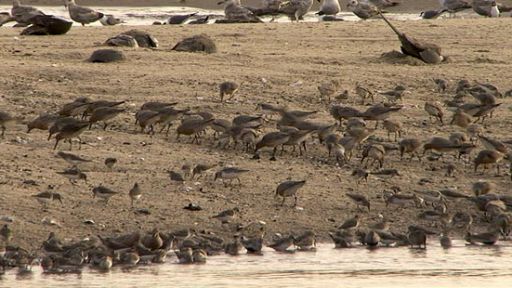
It fuels the journeys of shorebirds along the Eastern Seaboard and feeds some loggerhead sea turtles and sharks. The horseshoe crab is intricately woven into the web of life. Yet this harmless and primitive sea creature not only plays a key role in nature, it occupies a crucial place in the human world as well.
Over three decades ago, medicine claimed this ancient animal as a new life-saving tool. In 1971 researchers discovered that when they exposed the horseshoe crab to E. coli bacteria, the crab’s blood clotted. The clotting indicated the presence of endotoxins, toxic substances released by E. coli and other gram-negative bacteria that could produce severe symptoms in exposed humans such as fever or hemorrhagic stroke.
The simplicity of its immune system is actually what makes the crab’s blood useful to our biomedical industry. Horseshoe crabs live under the constant threat of infection in a habitat that can easily contain billions of bacteria per milliliter. To fight off infection, the horseshoe crab has a compound in its blood — LAL, or Limulus Amebocyte Lysate — which immediately binds and clots around fungi, viruses, and bacterial endotoxins.
LAL’s endotoxin binding and clotting ability is what makes it so invaluable to our own pharmaceutical industry. Once the LAL test was recognized by the Food and Drug Administration (FDA) as an alternative to then current methods of testing for endotoxins, the pharmaceutical industry tapped in. Horseshoe crabs were abundant, their blood easy to harvest and the test took only one hour.
Today, LAL has become the worldwide standard screening test for bacterial contamination. Every drug certified by the FDA must be tested using LAL, as do surgical implants such as pacemakers and prosthetic devices.
Horseshoe crab blood has not only become a key weapon in our medical arsenal, it has also become big business. On the world market, a quart of horseshoe crab blood has a price tag of an estimated $15,000, leading to overall revenues from the LAL industry estimated at U.S. $50 million per year. But that pales in comparison to its value to the pharmaceutical industry.
Of course, to obtain LAL you need horseshoe crabs — and lots of them. According to the Atlantic States Marine Fisheries Commission, that $50 million dollar industry requires the blood of approximately 250,000 horseshoe crabs.
While the blood of a horseshoe crab can be extracted without killing the animal, there is some question of how harmful bleeding is to the animals. The LAL industry says the bleeding causes no long-term injury.
Adult horseshoe crabs are collected by trawlers and transported to the LAL lab, where they are washed to remove sand and other marine debris from their exoskeletons. Those crabs without visible injuries are placed on a rack and bled with a large-gauge needle. Up to 30% of the crab’s blood is removed. Within 72 hours, the bled horseshoe crabs are returned to the water, where their blood volume rebounds in about a week.
LAL manufacturers have measured mortality rates of less then 3%. Yet two recent studies estimate that between 10% and 15% of crabs do not survive the bleeding procedure, which accounts for the mortality of 20,000 to 37,500 horseshoe crabs per year. Another concern is that it takes the crab a few months to rebuild its blood cell count level back up after a bleeding. Horseshoe crabs could be bled up to three or four times a year, which would take a toll on the health of the animals. But LAL manufacturers claim they only bleed them once a year.
Whether we can or will protect the health of horseshoe crabs for their own benefit, for the good of other creatures, or for our own use remains to be seen. Despite supporting the fishing industry for over 100 years, the condition of horseshoe crab populations has largely been ignored by fishery managers until recently. With growing concern over declining populations, regulations on the harvest of Horseshoe Crabs have just recently been imposed, though some states are already loosening restrictions.
Perhaps science can step in and “give back” to the animal for all of the good it has done us. Researchers are focusing their attention on producing LAL without the horseshoe crab, exploring the potential to cultivate and produce LAL from other sources.



(8 votes)

im doing a research project on horseshoe crabs.i found them to be very important.i plan on taking my studies to the next level. Thank you PBS!!!
I like this site, it is very informative.
we are joint this business horseshoe crab blood
so many in my island in sabah malaysia please i joint
to become suplyer this blood. i no comment.
this crab you can get too many!in east coast of asia,if you really need the blue blood for supply, why not you make another partner here,don’t say $15,000..per quart, if you want it,you just give us your technologies and we do the works here and supply it for you..!$10,000per quart enough for us..! how about that? if this thing real,is it good offer.?
It would be good to get a crab blood supply from elsewhere, but that is not the most important point. We are destroying global ecological networks. The horseshoe, with its valuable blue blood, is also depended upon for its eggs — as food for migrating birds and other species. Sure, Malaysia should sell the blood, but that won’t help the migrating bird species in this hemisphere.
I get out of scientist, researchers and profiteers that say it doesn’t hurt the animal, as if they can ask the animal that question. While it holds true that scientist and researchers are making huge progress in the conservation of life, how many species must die or be eradicated before realizing that the human race cannot survive without them.
When is this show going to be aired again?
To find out when “Crash” will air again in your local area, click the “schedule” link at the top of the site.
Why don’t they rehab the crabs while they build their blood back up so they can sell the crabs that die to the eel fishers. Love PBS and thanks to all who make it possible.
Perhaps the blood harvesting companies should consider feeding the horseshoe crabs before releasing them back into the wild(to help replenish their strength). At $15,000 a quart you would think a bit of feed isn’t too much to ask. Think of it like the courtesy snacks we get for donating blood. Free cookie anyone?
I was appalled at the harsh, indifferent handling of the crabs and at the cost charged for their blood. Typical of big pharmaceutical companies … It is unfortunate that the video mentioned the cost since now every yahoo will be catching and trying to bleed the creatures. As for their decline, perhaps it has something to do with bleeding them … It would be nice to have a link to info re: how the process was developed and how much and how often blood can be drawn. Also, on research to create a synthetic replacement. The ban on catching them for bait should be permanent. So few fisherman destroy so many crabs just to catch eels that they should be helped to segue into a different means of making a living …
singapore has success fully find out the enzymes that use to detect medicine . if this can be use for the replacement, horse shoe crabs will be saved.
All the comments about not hurting the crabs are awesome but how do you suppose we continue to test all of these medical devices and drugs for endotoxin without the crabs blood. Until we find another way to make the lysate without crab blood those crabs are saving human lives! If these devices were released before they were tested for endotoxin and they were dirty it would cause a horrible fever and possibly shock or death to the patient. Not to mention that if the patient is having a medical device used on them or they are taking a drug their immune is probably already compromised and they do not need any more stress from the endotoxin being introduced into their bodies. SOOO until an alternative is found I say GO Crabs!
Actually, there IS an in-vitro pyrogen test that has proven to match (and even surpass) the LAL in accuracy, precision, cost, and speed. Five methods of endotoxin testing have already been validated in Europe, and if pharmaceutical and medical device testing companies would just contribute to helping validate the methods in the US as well, we would have more human-relevant information that could TRULY save human lives. There are alternatives. We just need to get the industry to support in-vitro testing instead of the outdated and less-accurate animal tests that are easier for them to continue doing.
I think that it is interesting that the crabs have blue blood in the first place lol! But truthfuly it was kind of boring.
I agree that blue blood is pretty cool but there really is no sure way on how to track how many die which could help the population.
I THINK THAT THE WAY THAT THEY FERTILIZE THE BLUE BLOOD AND MAKE IT INTO IV DRUGS AND SELLING IT FOR 15000
Itss weird how the crabs blood is worth so much $ .. !