
 Club-winged manakinClub-winged manakinThis is the club-winged manakin, a rainforest bird the size of a sparrow. If a male manakin hopes to breed, he has to make a sound that is totally unique.
 How manakins make musicHow manakins make musicKim Bostwick of Cornell University observed these birds 'singing' in "What Males Will Do." She filmed male manakins using high-speed video in order to study how they produce musical sounds. She discovered something astounding.
 Wings as a musical instrumentWings as a musical instrumentRather than using his voice, the male manakin uses his wings as a musical instrument. He leans forward and flicks his wings together over 100 times a second -- faster than a hummingbird beats its wings.
 Good vibrationsGood vibrationsWhen she looked closely at the manakin's feathers, Kim noticed that one wing feather (6) has ridges, while another feather (5) has a curved tip. When the male manakin knocks his wings together, these neighboring feathers act as a spoon and washboard, generating vibrations at just the right frequency. But Kim suspected that wing movement at such a high speed must require extra support, so she ordered a CT scan.
 Super-sized bonesSuper-sized bonesKim found that the manakin's wing bones were super-sized. In the right half of this image, the large bone with raised bumps is the ulna. If you've ever eaten a chicken wing, you know that this bone should be smooth and narrow. Instead, the manakin has an ulna that is four times wider than it should be. Its large bumps and grooves provide support for the wings, allowing them to move at high speed. But there's more.
 A solid wing bone?A solid wing bone?When Kim examined the bone's density, she found something unique. "Every ornithologist knows that birds have hollow bones," Bostwick said. "They're hollow because they need to fly." However, the male manakin's wing bone is solid, and the inside is even more dense than the outside. The wings evolved so that he can create the perfect pitch -- precisely the sound the female is looking for in a prospective mate.
 WhatFemalesWant-ManakinAnatomy
Features

What Females Want
Airs Wednesday, March 7, 2012 at 8:00 p.m. ET/PT. Check your local listings.

Meet the Mate Munchers
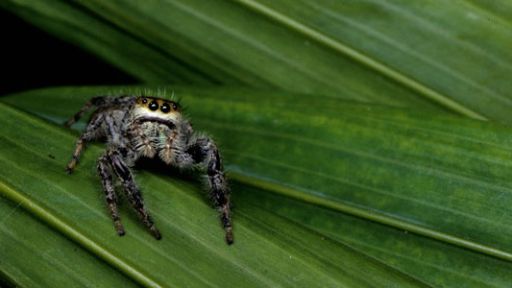
Learn more about the praying mantis, black widow spider, and jumping spiders; just three among...

Quiz: Animal Mating Antics
It's your turn to play a hand in the mating game: Try decoding the language...
Real Swingers of the Animal Kingdom
While gossip columnists may have full reign over the sex lives of Hollywood stars, scientists...

Jumping Spiders Photo Caption Challenge
Submit a caption about the male and female jumping spiders in this photo.
Animal Antics Quiz Answers
Find out the answers to the Animal Mating Antics Quiz.

Additional Web and Print Resources
Find additional Web and print resources about animal courtship and mating.

To Have, to Hold, and to Cheat
Of the 4,000 or so species of mammals, only a handful of animals have ever...
Additional Web and Print Resources
Find additional resources related to animal mating and courtship.
You May Also Like

Yosemite | Preview
As climates change and temperatures rise, Yosemite Valley is a wilderness at risk.

White Falcon, White Wolf - Preview
Airs Wednesday, April 2, 2014 a 8:00 p.m. ET/PT. Check your local listings.

A Sloth Named Velcro | Preview
Airs Wednesday, November 5, 2014 at 8:00 p.m. ET/PT. Check your local listings.

Bears of the Last Frontier
A 3,000 mile journey across five ecosystems to encounter three species of bear.

Animal Odd Couples
Love apparently knows no boundaries in the animal kingdom.

The Cheetah Orphans - Preview
Airs Sunday, July 24, 2011 at 8:00 p.m. ET/PT. Check your local listings.