
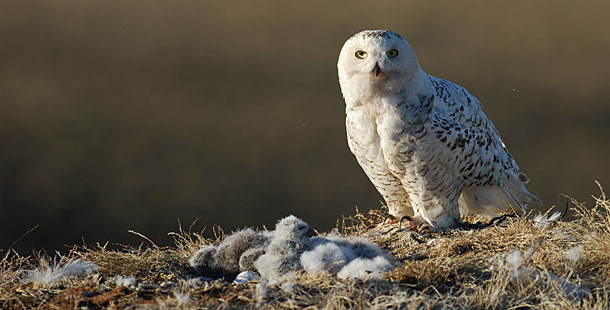
Snowy owl with chicks during the summer. In wintertime, survival on Ellesmere becomes even more difficult. |
Winter on Ellesmere Island is a far cry from the tranquil summer seen in White Falcon, White Wolf. As the most Northern part of Canada and extending into the Arctic Circle, Ellesmere Island experiences extreme winters. Shrouded in continual darkness, temperatures reach beyond “cold” to a bitter -20 or -30 degrees Fahrenheit. To survive in these harsh conditions, animals must develop special adaptations to stay warm, conserve energy, and find food in a barren, frozen world.
To stay warm, most animals rely on their thick winter coats. Some of these coats can be quite “high tech.” Polar bears have a watertight layer of insulating hairs, protected by a layer of longer guard hairs on top. Other Arctic animals rely on a similar layered coat where guard hairs act as a protective shield against the elements. Arctic foxes, for example, have furry feet. The hairs on the soles of their feet help them retain heat as they trot across the tundra.
The ultimate goal of all arctic animals is to lose as little body heat as possible. In comparison to their cousins, the red foxes, arctic foxes have several morphological differences. The first, of course, is their coat color. Their coats change to all white as the winter begins, then turn brown again the next summer to allow for seasonal camouflage. Arctic foxes also have a rounder body, shorter legs, shorter tails, shorter muzzles, and shorter ears. These are adaptations common to Arctic animals. The more compact the body, the less heat is lost.
Besides physical features like fur and body proportions, Arctic animals have highly specialized thermoregulatory systems. The metabolisms of Arctic animals can adjust seasonally so that animals conserve energy during the winter. Arctic animals have to be able to adjust their systems to cope with lower caloric intakes, or even to go without food for long periods of time. To do so, animals must make the most out of what they can find during the winter. The musk ox, like most Arctic animals, does what it can to fatten up during the summer when food is abundant. During the winter when food is less accessible and less nutritious, musk ox rely on these fat reserves to help them avoid starvation. It can be difficult to find food during the winter. Plants exist in a dormant state between the frozen ground and the blanket of snow. The air trapped between these two layers acts as insulation, and the plants and lichen living under the snow mostly avoid freezing temperatures. But any creature that eats this winter vegetation must first be able to get at it. Musk ox and caribou dig through the snow with their hooves and horns, or graze in windswept areas where food is exposed.
What it takes to survive on Ellesmere Island today may be vastly different in the years to come. Climate change and global warming are already altering the landscape. Massive ice shelves larger than the island of Manhattan, and thousands of years old, are breaking off from the northern edge of Arctic Canada. Glaciers are retreating, and the average winter temperature is increasing. Most animals on Ellesmere Island are so well adapted to life in the Arctic that any change in climate could be catastrophic. Only time can tell what will happen to the handful of specialized animals that call Ellesmere home during winter.
For further information on climate change and the Arctic, visit our list of additional web and print resources.
Photo © Mark Smith 2007


