Vermont Public Specials
2026 General Election Debate - U.S. House
Season 2026 Episode 18 | 55m 30sVideo has Closed Captions
General election debate for the U.S. House of Representatives
Democratic Rep. Becca Balint, Republican Gerald Malloy and Independent Adam Ortiz compete for Vermont's only seat in the U.S. House of Representatives. Moderated by Mikaela Lefrak.
Problems playing video? | Closed Captioning Feedback
Problems playing video? | Closed Captioning Feedback
Vermont Public Specials is a local public television program presented by Vermont Public
Vermont Public Specials
2026 General Election Debate - U.S. House
Season 2026 Episode 18 | 55m 30sVideo has Closed Captions
Democratic Rep. Becca Balint, Republican Gerald Malloy and Independent Adam Ortiz compete for Vermont's only seat in the U.S. House of Representatives. Moderated by Mikaela Lefrak.
Problems playing video? | Closed Captioning Feedback
Where to Watch Vermont Public Specials
Vermont Public Specials is available to stream on pbs.org and the PBS app.
Providing Support for PBS.org
Learn Moreabout PBS online sponsorshipMore from This Collection
Videos related to the 2026 Election season in Vermont
 New
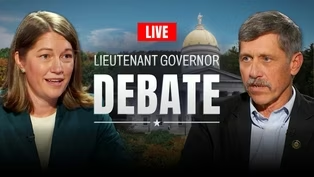
New2026 General Election Debate - Lieutenant Governor
Video has Closed Captions
Lt. Gov. John Rodgers, a Republican faces a challenge from former Lt. Gov. Molly Gray, a Democrat. (55m 45s)
Providing Support for PBS.org
Learn Moreabout PBS online sponsorship>> Welcome to the Vermont Public 2026 general election debates.
I'm Mikaela Lefrak, the host of Vermont edition.
This show is part of a series of candidate interviews and debates ahead of Election Day on November 3rd.
Now, if you're listening on the radio or streaming the audio right now, there's also the option to watch the live stream on Vermont Public's YouTube channel.
Today, the candidates for Vermont's seat in the U.S.
House of Representatives.
Here with me in the Vermont Public Studio are Representative Becca Balint of Brattleboro, a Democrat.
She's running for a third term in the House.
She was a member of the Vermont Senate from 2015 to 2023.
Before entering government.
She was a teacher.
We also have the Republican candidate, Gerald Malloy of Wethersfield with us today.
He's a U.S.
Army veteran and a former defense contractor.
He ran for the U.S.
Senate in 2022 and 2024, and Adam Ortiz of Newport City, an independent.
He served in the Army National Guard, and he ran for the U.S.
House in 2022 and 2024.
Throughout today's debate, you're going to see hear are some questions submitted by you, our audience.
And if you want to submit a question for our October 21st gubernatorial debate, you can email it to Vermont Edition at Vermont Public dot org with the subject line debate question.
All right, let's run through the format for today's debate before we begin in the first segment, I'll ask questions to all of the candidates.
They'll each have 60s to answer.
I'll also likely ask short follow up questions.
In the second segment, the candidates will ask one another questions.
They'll have 30s to ask a question and 60s to answer.
We'll start our third segment with more questions for each of the candidates.
Then there's a lightning round, and we'll conclude with one minute closing statements from each candidate.
And we will start with questions for all of you.
Again, please limit your answers to 60s and the order in which your answer.
The order in which you will answer today was randomly selected before the program.
Becca Balint.
You will go first, followed by Adam Ortiz and Gerald Malloy will rotate.
It'll all be fair.
All right, let's begin with the economy in Vermont.
Diesel is at 638 a gallon.
Last year at this time, it was under $4.
Mortgage rates are at a nearly three year high.
And in a recent poll from Vermont, Public Affordability was the leading answer to a question we asked about the main problem facing the state.
What would your primary target in Congress be to address affordability for Vermonters?
>> Becca Balint thank you for the question.
This is absolutely the thing I hear most about from Vermonters as I travel around the state.
Look, first and foremost, we have to end this war in Iran that is most directly driving up the cost of fuel.
As I talked to farmers, as I talk to small businesses.
That's coupled with this tariff regime around the globe.
And it is critically important that the the laws that we have on the books that delineate what what is the role of Congress and what is the role of the president are enforced.
And so Congress has the power to declare war.
Congress has the power over many aspects of tariffs.
And I know from speaking with consumers and speaking with small businesses that these two things are making it unaffordable for Vermonters.
So those are two of the things that I would focus on.
I brought forward a War Powers Resolution in April and was part of a bipartisan resolution in June.
But that's what I hear directly from Vermonters.
We have to end the war in Iran.
>> And we're going to talk more about the war in Iran in just a moment.
So I want to follow up on one other element of this affordability issue with you first, which is the one big, beautiful Bill act, which was signed by President Trump.
Of course, it is often maligned by Democrats as a net negative for working Americans.
There are tax deductions, though, that could potentially be helping Vermonters, including a $6,000 tax deduction for seniors.
So I wonder if you would agree that there are certain elements of this bill that positively impact Vermonters when it comes to affordability, particularly seniors?
>> Yeah.
And I was in the budget committee when we were debating those provisions.
And certainly the support for seniors, the no tax on tips, the no tax on overtime.
Absolutely.
The problem is that the bulk of that bill was directed at folks at the very top.
And trickle down economics doesn't work.
It hasn't worked.
And it also took $1 trillion out of our health care system.
You can't remove $1 trillion from the health care system without driving up costs for everyone.
And so it is important that we work across the aisle, that we figure out that we're focused on the people that most need the assistance.
And that was not true in that bill.
And I also had to sit in budget hearing after budget hearing, being lectured by folks on the other side about the deficit.
And that bill increased the deficit by almost $5 trillion.
And again, that is a cost that we all have to pay.
>> Thank you.
You're welcome.
Adam Ortiz, it's your turn.
What would you do if elected to Congress to address affordability for Vermonters?
>> Specifically?
Apply for everything.
There's billions and billions of dollars for different programs.
There are 16 different >> FAA recognizes airports that have $500 million allocated to upgrade rural Vermont airports.
So 16.
$8 billion available in funding for construction projects, local construction workers in 16 different locations to upgrade Vermont airports.
There's funding for every single friggin thing there is.
Apply for all of it.
Whatever we get, we do the feasibility study and moving that direction.
Federal recognition for all Native American tribes.
It's long overdue, and we mix with prison reform that we teach culinary classes and botany classes and whatever forgotten recipes and ingredients put the Vermont Abenaki name on it and generate taxable revenue that will not have resentment the same way we have Vermont Maple Sirup, Vermont, Abenaki, whatever product.
>> And do you think that those types of reforms could address affordability at a large systems wide scale?
>> $8 billion worth of money being pumped into the Vermont economy, plus, we have.
Prison reform.
Where are these these things?
Department of war has a $961 billion budget.
There is no justification for any actively serving National Guardsmen.
Anybody actively serving in the military should not be homeless.
Homeless with a $961 billion budget.
USDA 20 billion.
Ice 39 billion.
Border protection 26 billion.
DOT 106 billion.
NASA 24 billion.
Department of Homeland Security 641 billion.
Department of prisons 8.63 billion.
Feelings don't pay bills.
The moral high ground.
All the feelings.
Moral high ground.
Think of it like a streaming service.
You pay all your streaming service, but you don't pay your electric bill good.
You have the moral high ground and nothing else.
Apply for every single frigging thing that we can get.
Due to feasibility study.
Moving that direction, you have living wages and more money.
>> Thank you.
Adam Ortiz and Gerald Malloy.
If elected to Congress, what would you target?
What would you focus on to address affordability for Vermonters, specifically?
>> Well, thank you Mikaela.
Good to see you.
Good to see everybody.
So many things.
It's actually many tiered approach.
I would start off, as congresswoman mentioned, to actually have an impact on bad policies that are going on right now, including the war on Iran.
I would look to impact that.
We obviously didn't think through the strategic results of impact in the Strait of Hormuz and the gas impact on energy prices.
I will say that there are many state issues impacting Vermont affordability right now.
And I would ask Vermonters to look at the track record of my opponent, Miss Balint, and her eight years in the Senate actually implementing property state tax increases, new payroll payroll tax, and the programs underneath that, adding additional burden to Vermonters blocking act 250 reform, adding all sorts of different bureaucracy, bureaucratic regulatory requirements on Vermont businesses.
One of the things I'm definitely going to do is bring business and jobs to Vermont.
That's my background.
Excuse me.
You mentioned defense contractors, more business, senior business development positions.
I've been in of partnered with hundreds of businesses.
I know I can bring business to Vermont.
The big answer actually, is legislation at the congressional level to lower costs.
And you see my website, I've got ideas in there for many different programs to lower costs.
>> Ask a follow up real quick.
You said bring business to Vermont.
What does that mean?
How do you do that?
>> Sure.
You're a congressman.
You've got relationships with businesses across the United States, innovation, technology businesses.
You pick up the phone and you say, would you consider bringing part of your business to the state of Vermont?
It's the best state place to live in the whole world.
Actually, it's also involves working with the governor, whoever that is, and seeing what kind of businesses the Vermonters would like to come here.
We need to stop.
Stop the bleeding, frankly, of young people leaving because there is no career path.
Jobs here in Vermont.
There's not there's very little.
And what's left is leaving in a hurry because of all the burdens that have been placed on small businesses here.
So I know that I know literally hundreds of companies, and I've already started talking to many to bring part of their innovation, technology business to Vermont, not data centers, because I know Vermonters don't want that.
But other business sectors create jobs, keep people here so you can raise a family, have a job, and in the end, afford to retire here in Vermont.
>> Well, two of you brought up the war in Iran.
Adam Ortiz you brought up defense spending.
So let's talk about that aspect of this equation.
The US war with Iran is now in its eighth month.
Congress has held 20 war powers votes since the conflict began in February, most recently at the end of September, four Senate Republicans joined Democrats in an effort to direct President Trump to end the war.
The vote still failed narrowly, 50 to 49.
Do you think that the U.S.
should continue its military campaign in Iran?
And if not, what specifically can and should Congress do to stop it?
And Adam Ortiz, you're first up this time.
>> I support President.
>> Trump's decision.
I will support the president and help him win the war faster.
I know how to fight a fight I deployed to Baghdad, Iraq, Kabul, Afghanistan.
You can't have people that you don't want next to you in a bar fight, in charge of anything related to aggression.
If somebody pays for someone you know to be harmed, what should you do about it?
How many times should you let these people pay to harm America's interests before you put an put a stop to it.
Don't poke the bear.
And this is what happens.
You pick a fight with somebody you shouldn't have picked a fight with.
Then you lose the fight.
Bad.
And the person that won the fight that you started the fight with, that person's the bad guy.
Don't start nothing.
Won't be nothing.
Pretty much.
I support the president.
>> What, in your view, would constitute a successful end to this war?
>> I need the Intel reports.
And once their leadership is out and they're not a threat to America's interest, that's a success.
Because the Iranian government is killing Iranian citizens.
So anybody trying to say that this is what happens.
You pick a fight with somebody you shouldn't have picked a fight with.
Now you're getting beat up and now you want to cry victim.
I'm going to go tell the teacher.
Don't pick a fight with people you can't beat.
You started this.
This started way before we were born.
Well, here you go.
I have faith in Donald Trump's judgment.
I'm going to be the next apprentice.
>> Thank you.
Gerald Malloy.
>> I thank you.
So I guess I'd like to start off, you know, I graduated from West Point.
I have 22 years of active duty service.
Adam, thank you for your service.
I am a decorated combat veteran.
I've served in Europe, Asia, the Persian Gulf, Middle East, been in combat.
When I look at what has happened here, one of the things I look to do as a congressman is actually have an impact on proper military decision making processes.
It's clear that the current administration did not go through that process to actually have a clearly defined objective and an end state and an exit plan, and they really didn't clearly didn't do the wargaming to consider an important strategic place like the Strait of Hormuz and the impact on energy prices.
So what I look for is an immediate cease fire and a negotiation as like your follow on question to a peace agreement, I do want that peace agreement as soon as possible, but I would like it to have parts to it to can ensure that the United States can ensure that Iran does not have nuclear weapons.
We do not want that.
They do harbor and support terrorists like Hamas, and we'll do something terrible with a nuclear weapon.
>> In the most recent U.S.
House vote on the War Powers Resolution, seven Republicans joined Democrats in backing it.
And I'm curious to hear if you had been in the House at that time, would you have voted yes or no on the War Powers Resolution?
>> I would have to look at I don't know exactly what that War Powers Resolution.
>> Says, yes or no to to effectively take away President Trump's ability to continue military action without congressional approval.
>> Well, I what I would like to see with that said, like I said, I would push and try to impact an immediate cease fire agreement.
We almost had one a week ago around talked about opening up the Strait of Hormuz in a week.
So I would like us to get to that point, negotiate in earnest.
I will say the president does have authority in the Constitution to conduct actions, but he is required to notify Congress at a certain point.
So if that's what the law said, I would support the law.
>> Thank you.
And Becca Balint.
>> So before I get to the heart of your question, I just want to acknowledge that the 158th Fighter Wing of our National Guard that was deployed to the region is now home again, and that is incredibly important to me as a member of Congress.
I take the the lives of those young men and women who have signed up to serve Vermont in the country incredibly seriously.
This was an illegal war.
This was an unwarranted war.
Yes, it is true.
Iran is no friend to the United States.
Absolutely not.
To your point, it wasn't as if they didn't have the Intel.
They had people telling them the first thing that's going to happen is they're going to close the Strait of Hormuz, and you're going to disrupt the entire region.
They ignored that.
I have sat in congressional briefings with Pete Hegseth, with the secretary of state, who cannot give us any clear reason why it was an imminent threat.
And in 2025, the president said they had obliterated, excuse me, obliterated nuclear capabilities.
So why are we currently at war with Iran?
>> So you've said that you want to see an end to this war as soon as possible, say, there is a cease fire deal on the table in which Iran does not agree to any sort of nuclear weapons inspections.
Would you still support that deal?>> So, look, I want to bring us back.
We had a nuclear deal in place.
We had a nuclear deal that Obama had negotiated, and we are in a worse position now than we were before then.
We have lost our partners in the region.
We have lost our partners globally because of this reckless act.
And so, of course, I have to see the details of what would be in that agreement.
But I just want to remind everybody there was a deal in place.
If we had stuck with the agreement that was in place, we would be in a much safer position and the world would be in a much safer position than we are right now.
>> Thank you.
I'm sorry we have to move on to our next topic, and I want to bring things a bit closer to home here and talk about health care for a moment.
Vermonters have some of the most expensive health insurance premiums in the country, as I'm sure you all know, Medicare enrollment starts next week, October 15th, and premiums and out-of-pocket spending are expected to rise, in part because of general inflation and spiking medical expenses.
What specific legislation would each of you support at the federal level to bring down these costs for Vermonters?
As we enter the New Year and Gerald Malloy, it's your turn to go first.
>> Sure.
So I meet folks all over across Vermont, and it's disheartening to me, particularly senior citizen who's paying $2,400 a month for health care.
That's crazy.
The health care costs in this state and across the country are way too high.
So I'm not in favor of universal health care.
We tried it here in Vermont.
Democrat Governor Shulman canceled it.
It's going to bankrupt.
The state would drive taxes through the roof for all Vermonters.
So but there's a lot to be done into in terms in terms at the federal level.
Finally actually enacting legislation and policy to like the governor is trying to do here to increase competition, to increase transparency.
I've actually been to a generic drug manufacturing facility.
I think there's ways to actually impact patents and bring them down from ten years to five years to get much less expensive generic drugs on the table much quicker.
I'd also say one of the issues going on, and I think this is where myself and Miss Balint really diverge, is to get government out of intervention in health care and in private industry.
It's not working.
It increases costs and.
>> Gerald Malloy in our interview that we conducted during the primaries, you pinned the high cost of health care in Vermont on progressives who you said, I'm quoting here, add burdens and regulations and oversight costs that have driven up costs.
Vermont also has no economies of scale.
We're a very small state with a very rural hospital system.
And I know you've brought up a couple of times in this debate, a lot of state level policies and the work of the governor.
Do you stand by that statement pinning Vermont's high cost of health care on state level policies?
>> Well, yeah.
So I think at the state level, there is much too much bureaucracy in the health care system from the state.
And I would add, that's the same kind of if you look at the education costs, which, you know, 30,000 a year for to educate a student is among among the very highest in the country.
But going back to to the federal level, what I you know, I debated Bernie Sanders, who talked about reducing health care and his 40 year career, and it's done nothing but go up.
So what I look to do is not just talk about, you know, cuts and things, but actually develop legislation that actually impact competition, which is the main problem.
I just met a small business owner, talked about the health care costs that she has with her husband running a family business here in Vermont, and they have to make a choice every year, but it's a choice between two health care systems to provide health care insurance for, for their for their employees.
We need much more competition that will lower costs.
>> Thank you.
Becca Balint.
>> So look, as you said, Mikaela Vermonters pay some of the highest costs for for health care in the nation.
And you going back to what you were asking me before about the one big, beautiful bill, the $1 trillion cut to Medicaid last summer has made things worse in Vermont.
When I travel around the country, excuse me, around the state and talk to our rural hospitals, they tell me it's Medicaid that keeps the doors open and tens of thousands of Vermonters are facing loss of their health care because of that bill.
There are also 100 million Americans right now that are suffering with medical debt.
I am a Medicare for all person.
The time has come for us to finally have a single payer system nationally that is similar to Medicare, and whether it's phasing in people, you know, from from the bottom up, as my colleague Senator Kim has in the Senate, adding, it has people are growing older.
Or if we are adding a tier previous to becoming 65, there are lots of ways to implement it and phase it in over time.
But I think what Americans are saying right now is it's not working and they want something else, and they want something bold.
>> Okay, yes.
In our candidate questionnaire, I think you said that you are a loud and proud supporter of Medicare for all.
The first version of that bill, I believe, was introduced in 2003, still hasn't passed.
What makes you think it's a politically viable plan worth rallying behind?
>> Yeah, I appreciate the question.
Look, our we have to be aspirational.
What Americans are telling us is they don't want us nibbling around the edges.
But here are some low hanging fruit that we can go after right out of the gate, the U.S.
government should be allowed to negotiate prices on pharmaceuticals like lots of governments do across the world.
We pay some of the highest prices for our drugs in this country.
The other thing is we need to get pharmacy benefit managers out of the picture.
I serve on the antitrustsubcommittee on the Judiciary Committee, going after these monopolies and the way in which they've cornered many areas of the market in health care.
So I will always be pushing us to have a a version, whether you call it Medicare for all or some other, in which Americans are paying in and they're getting high quality health care, regardless of where they live.
But we also have to have our eyes on some short term gains that will give people relief right out of the gate.
>> Thank you.
And Adam Ortiz.
>> Feelings don't pay bills.
And having the moral high ground doesn't matter if you don't have the money to fund your idea.
Vermont can promote physical therapy tourism.
We could have the best of the best physical therapy places.
The amount of money that was pumped into me to put my pieces back together.
Times.
How many other soldiers.
So bring physical therapy, tourism in mental health retreats.
We have 16 different airports, medical transport.
How much money are you going to make on that?
We have 90 to 120 mini helicopter pads, medical transport.
How much money are you going to make on that?
This is I'm not plugging anybody.
But there's $1.50 hot dog that a company loses money on.
You lose money on $1.50 hot dog.
But if you don't have that dollar 50 hot dog, you don't have all the rest of that stuff.
So because we're bringing in money from the physical therapy, tourism, the mental health retreats and the medical transport, we can fund these programs with money, not grants, not charity.
>> I wanted to give you the chance to to weigh in on the federal level programs, Medicare and Medicaid that your opponents in this debate brought up as well.
>> We have to have the money to fund these programs.
How are we going to generate the money to do it?
Should everybody have.
Absolutely.
This is what some people aren't going to understand.
You're going to lose your medical privacy because as soon as everybody has medical, you're going to be required to take a a blood test.
And that's the end of.
People are going to know, okay, give me one computer system that has not been hacked in the federal government.
So what makes you think the medical system is going to be any different?
Just like that?
Is it going to happen?
Yes, absolutely.
Is it going to be like a light switch?
Absolutely not.
But for Vermont, you asked me for Vermont physical therapy.
Tourism will make money.
Mental health retreats will make money, medical transport will make money.
Then we can subsidize because we have the carrot on the stick.
You want this money?
Give our people better prices or this goes away.
Being nice doesn't work.
What leverage do you have over these people?
Feelings don't pay bills.
>> Thank you.
Let's turn to immigration enforcement here.
Since President Trump took office in 2025, immigration arrests have increased fourfold.
There have been protests in some cities over ICE's enforcement tactics, from Minneapolis in January to South Burlington in March.
I'd like to know what your views are on ICE's current tactics under the Trump administration, and specifically, current Department of Homeland Security Secretary Markwayne Mullin, because we have seen a shift in tactics over this past calendar year.
Becca Balint.
>> So I do not support the tactics of Ice.
I was on the ground in Chicago during their surge and then again in Minneapolis and Saint Paul.
And what I want Vermonters to understand is that we were told repeatedly by this administration that they were going to go after violent felons, that they were going to use the money that Congress appropriated to make us safer in Vermont, make us safer across the country.
We have seen Americans, peaceful protesters getting killed.
We have seen Americans getting locked up, both in Chicago and in Minneapolis.
We've seen our neighbors being carried away, people who are just trying to earn a living.
And we warned our Republican colleagues that if you supersize the Ice budget, you're going to have people who are untrained and unqualified, wearing masks, using unmarked cars, terrorizing American citizens.
And that's exactly what's happened.
And so it is critically important that we hold this administration accountable for the ways in which they have violated our constitutional rights.
>> In your response to Vermont Public's candidate questionnaire, you said you want to dismantle Ice.
So if that were to happen, how would you propose the country move forward with immigration enforcement?
>> So this is something that a lot of Americans don't understand.
We have not always had ice, okay?
Ice was an entity that was created after nine over 11.
Of course, we were feeling obviously very unsafe and terrorized and afraid about the world and making sure that we had things in place to protect the homeland.
But that's not the situation that we're in right now.
This is about mass incarceration of, in many instances, and the majority of people who have been arrested by Ice have no criminal record whatsoever.
And so it is it was under the auspices of the Immigration Naturalization Service, where that work had been done before.
But what has been happening is we've created a paramilitary organization that seems to have no accountability.
It's not as if before Ice was created, we didn't have a system for checking to make sure that people who were eligible to be here were here, and we also have to make sure that we're giving money to immigration courts so we can actually process people also who are here legally.
>> Thank you.
>> Adam Ortiz.
>> I just saw your interview the other day, but I forgot your name.
Holmes.
I think his name is the guy in charge of ice.
Anyway, you made a good point.
Come to the jail, pick him up from the jail.
No problem.
I will work in a professional manner with all federal agencies.
Now.
Deescalation of force.
I worked as an MP.
I worked as a prison guard.
If you see a whole crowd.
Yo, dude, come on.
Really?
I get elected, I'm in charge here and don't think anything.
Don't have a better idea than me.
Let the bosses work each other out.
Come talk to me.
Let me know who you're looking for.
If this person is a threat, I will help you.
If this person is contributing to Vermont again, you're absolutely right.
It is the responsibility of Congress to make it easier to streamline, to get a work visa.
They're here legally.
>> You focus on the.
>> Question, which is about ISIS current tactics.
>> I just said so if you see the whole street, yo de-escalate is it really don't have a D measuring contest, then you're running over little old ladies back.
Yo de-escalate.
>> Thank you.
There have been calls as I was just saying to Becca Balint about dismantling ice.
What do you think of those ideas.
>> You need people that know what they're doing to be in charge.
And if you don't play nice, then if this if nobody's compromising, then you get the situations that you get.
How many situations could have been avoided?
If you have somebody that's a threat to themselves and others that's already in a detainment center, just get turned over to Ice.
All these things that you're seeing on TV could have been avoided.
This person doesn't play nice with that person.
He then total strangers of being affected by it, release them from the prison.
>> Thank you.
Gerald Malloy.
>> I thank you.
So I'm not in support of the current immigration policy.
I've actually stated that for a couple of years now.
I don't think that the government should be trying to track down every single person who's not fully documented here in the United States.
Every hotel maid, every farm worker.
So I never supported that.
What I would like to do, I've met Secretary Mullen.
I had a nice conversation with him.
I met many members of Congress actually try to impact that policy.
And I think actually a little while ago, some talk about going what it was going to be worse first, which I agreed with criminals, drug dealers.
Yes.
Let's deport them immediately.
But trying to track down every person.
I don't agree with that.
What I what I do plan to do is propose Barbara Jordan, Democrat Barbara Jordan's representatives, immigration framework.
Both sides have been kind of kicking that can.
Down the road for for decades in terms of immigration reform with, you know, part of that being pathways to citizenship, citizenship, I will say, you know, folks who are here illegally, but I also like you talking about I've done operations myself.
They can go bad quickly.
And I don't like seeing that.
>> And, well, I asked Representative Ballin earlier about why now for Medicare for all if it hasn't passed in the last 2025 years.
Same question to you about Barbara Jordan's immigration plan, which, as you said, was was introduced many years ago at this point, what exactly about it do you think you could pull out of that larger plan to, to get it passed?
>> It's a framework.
And one of the things that I don't like about Congress, I think we all don't like is inaction.
So I, you know, having worked, I mentioned business development through led through major, major projects, hundreds and hundreds of pages, proposals to win business for companies and grow business.
But that same effort to push through immigration reform, which which is needed, we need immigration reform in both sides are guilty.
They haven't done that over many, many years.
I will.
The candidates now have an opportunity to ask each other questions.
Now, these questions should be no longer than 30s responses are limited to 60s, and there could be space for some brief follow ups afterwards.
Gerald Malloy.
You've got the floor.
>> I'd like to ask Miss Balint, as a member of Congress representing Vermont, you have made many, many vulgar and insightful public statements.
These have included, and I quote, mean mother Effers immigrants to wipe our, take to the streets, make some trouble, throw some punches.
You have offended every American with immigration in their history.
You have clearly demonstrated a lack of judgment and character.
Why would any Vermonter vote for you to represent them in from Vermont?
>> So, Gerald, it is true that I have at times used some plain spicy language, and I speak the way that a lot of Vermonters speak.
And, you know, you brought up an instance when I made a statement that did insult some people and I apologized.
I always own my mistakes, which is unlike the person who is at the head of our government right now, Mr.
Trump, who has some of the most vulgar speech that we have ever seen, and said that he would grab women by their genitals.
Who calls reporters piggies, who intimidates people, who bullies them online?
And so I take my cues from Vermonters.
Vermonters call my office.
They let me know in real time if they like the work that I'm doing, if I'm on the right track.
And again, when I make a mistake, I own it.
>> Yeah, I think you missed the accountability class there.
So the Vermonters did not.
I don't I don't appreciate what the president says, some of his language, but Vermonters didn't elect a president.
They elected you.
And you've used Inciteful language.
You know, follow up.
Do you really think you're angry, nonstop angry vitriol is actually helping to deliver results for Vermont.
>> So I would take issue with you calling it nonstop vitriol, because I work very hard on a bipartisan level in Congress and my committees, I have multiple bills that I've introduced that are bipartisan.
I serve on multiple bipartisan caucuses.
I save my vitriol for the people in the Trump administration who are being incredibly corrupt, and they are taking our taxpayer money, and they are violating our Constitution, and they are taking away our article one powers.
I save that vitriol for the people who are to blame.
>> Thank you.
We do have to move on.
Adam Ortiz you have time to ask a question.
>> To the both candidates simultaneously.
Whoever wins, I'd like to move in the direction.
If I win, come help me.
Female veterans have similar challenges.
When they come back, but there's a veterans place for men, but not for women.
It is.
It will be better received coming from you.
When I say things, it's mansplaining.
Halfway houses for females leaving, incarceration.
My city, the Newport, has three zero for women.
>> What's the question there?
>> Will you help provide more resources for female veterans, transitional housing and women getting out of incarceration halfway houses?
>> Yes.
I will help.
I'm trying to think.
I've been to the Vermont Veterans Home several times, but.
>> In Northfield, that's where I was.>> I'm talking down in Bennington.
All right.
I don't know.
>> Northfield.>> I've only visited men there.
I don't know if they.
>> That's my point, because whenever I try to bring this up.
Sorry.>> Well, I can't remember if there's men and women, that's.
But.
Okay.
Yeah, I would support that.
>> Absolutely anyone.
And I thank you both for your service.
Anyone who has served our country should come home to a place where they are being supported.
They should not be homeless.
They should have the supports they need.
They should get the health care that they need.
And I'm glad that you you flagged this particular issue for us because equity is incredibly important.
>> To me every time.
Sorry.
Every time I bring this up to the people that are able to do it, they say there's not that many of them.
Then it should be easy.
So if there's not that many of them, copy and paste what is for the men and children, because.
>> We have we have to take we absolutely have to take care of the people who have served this country.
And my dad is a veteran.
I was born on a US Army base.
It isn't just taking care of folks when they're being deployed.
It is all of the wraparound services we need for those families and for the the individuals.
>> The deployment is easy.
I want to make sure home is.
>> Harder to ask a question, but thank you for that one.
Representative ballot.
>> So there's a question for Mr.
Malloy.
The Save act is not a voter ID law.
It's a voter registration law.
If you don't have a passport or your name doesn't match your birth certificate, you will be unable to register.
This would impact tens of thousands of Vermonters who changed their names when they got married, or who don't have easy access to documentation.
You've been a vocal supporter of the Save Act.
Why do you support making it harder for eligible Vermonters to vote?
>> I don't support making it harder at all.
That's your words.
I do support the Save act because I think in meeting Vermonters and meeting Americans, many Americans have lost faith in their election system.
And that that hurts because that's the foundation of our Constitution.
I want to restore that confidence.
And I think to save act the idea behind the Save act would help support that.
With a voter ID, get rid of the machines.
Let's.
And and part of that is what we've seen.
Like you got places in California where it takes weeks to determine an election that's not the United States of America.
You know what, actually, you know, a passport and other requirements.
You're actually in Congress.
What I would look to do is, you know, work with the other side to get that bill to some middle piece where it is agreeable.
Maybe it's just a maybe it's just a license, a driver's license, maybe it's just your Social Security number you punch in to reduce the requirements, if that was your concern.
But overall, the idea of restoring confidence to Americans in our voting system is something I support.
>> Representative.
>> So there is a reason why people have lost faith in our elections.
And part of that is because we have a president and many members of his party who continue to insist that he did not win the 2020 election.
I just want to remind everybody, elections are not run by the federal government.
Elections are run by the states and its town clerks across Vermont that make sure the people who are eligible to vote are voting.
You also just said voter ID.
I just said to you, it is not a voter ID bill.
That's not what the Save act is.
It is a registration bill.
And it will take thousands of people off the rolls in order to vote.
They will be removed if their names do not match, and thousands of Vermonters do not have passports.
>> Could you respond to that last piece?>> I think it's about showing an ID and making sure you are who you are, and a U.S.
citizen to vote.
I think that's the idea behind the act.
I will say, you know what?
I'm sick of the election integrity stuff myself.
Let's move on.
I would certify President Biden.
It was the president publicly, and it is time to move on with that.
That whole piece.
>> Adam Ortiz I'd like to weigh.>> In the concept of verifying who you are.
You hit the nail on the head during when you get your photo ID, proof of citizenship.
We have the little heart that lets us go into Canada, upgrade it.
The same level of a passport, one stop shop, take your passport, take your photo ID and citizen of saves money.
All you do is print citizen of on green card done.
You don't have to spend so much more if you have another ID, that's just more money being spent.
But you could just print registered to vote.
>> Briefly.
Each of the three of you.
We've done a lot of candidate interviews during this election cycle.
And one thing that a number, particularly Republican candidates, have brought up is the fact that some Vermonters have lost faith in the election system, whether that is valid or not, it is a fact that people are feeling that way.
I want to give each of you 30s to address Vermonters who feel that way.
What should they know?
Becca Balint we'll start with you.>> So I did an event with Peter Welch and town clerks a couple months ago ahead of the election, to explain to Vermonters the process.
And remember, it's your local town clerk and it is volunteers from within your community that are making sure that election law is being followed.
They have a chain of custody for ballots.
Our our voting system in Vermont is incredibly safe and secure.
I have a lot of confidence in the Secretary of State.
What I don't want people to do is not have faith and then not show up and exercise their right to vote or to vote early, because many of you have your ballots now.>> Gerald Malloy.
>> So I would encourage all Vermonters to get out and vote.
And I believe in our election system.
Like I said, it is the foundation of our Constitution.
Every vote does matter.
I actually just spoke about Senator Sanders way back when becoming mayor of Burlington, by about 9 or 10 votes.
So your vote does matter.
And I think we are looking to restore confidence through the Safe act and and other actions.
But please do just get out and vote.
I do believe in our election system.
>> Thank you.
And Adam Ortiz.
>> Remember to vote even if it's not for me.
Community engagement is important.
Whenever anybody is looking to put something that they know most people don't want, they look for the town with the lowest voter engagement because when it's put to a vote, those people don't vote.
So it's more than just picking who's running that election.
It's showing other people, look, this area has a lot of community engagement.
You're not just going to do whatever you want without any consequence because people are paying attention.
If it has a low voter turnout, you see more stuff in your neighborhood.
You don't want.
We're now going to return to questions for all the candidates.
Limit your answers to 60s and if you would like to address one another directly.
I know we didn't have a lot of time for direct questions.
Please do.
Let's talk about the impact of the trade war with Canada.
The full economic impact on the U.S.
is still unknown, but you can certainly feel it here in Vermont, which has a very tight socio economic and cultural connection with our neighbors to the north.
As a member of Congress, how would you work to repair that relationship?
And Adam Ortiz, you're up first.
>> I, JP creates taxable revenue and the border crossing that their customers want to use isn't 24 hours.
Canada is not looking to do us any favors right now.
To calm things down, invite the SEMARNAT from Mexico, the e c c from Canada and the EPA from America to discuss all environmental concerns to just cool things down.
Once we have common ground because the environment is is an easy one.
You don't have clean air, you don't have clean water, you don't have any other topic.
Then we move on to other topics of mommy and daddy aren't getting along, but the kids still love each other.
Like when parents fight and the cousins are still getting along.
You can't hang out with your cousin.
Canada and Newport are the same DNA biological relatives.
Those are their cousins.
So we are family.
We're one people, but mostly just have everybody in the room at the same time and just say the quiet part out loud.
>> Gerald Malloy, sure.
>> So it's one of the things I've spoken about that I'm not happy about current policy.
And I would have liked to have the administration stay at the administration, at the negotiation table, looked maybe a month or so ago where it was going to be an agreement was going to reach be reached.
And I would like to, you know, would try to impact that.
We stay at the negotiation table as opposed to getting into a trade war with Canada, particularly.
I think Canada is different for Vermont.
We do about $4 billion worth of business with Canada.
One third of Vermonters actually trace their ancestry to Canada, including my wife and we we we depend on tourism.
So I would have stayed at the negotiation table and tried to impact the administration state and the negotiation with our friends to the North Canada.
I will say the president is trying to lower, you know, level the playing field for American businesses.
But in my opinion, I would have thought to, you know, the candidates different actually, because they are a good neighbor.
>> Thank you.
Becca Balint.
>> So I agree with Mr.
Malloy on this.
I feel like this has created such a terrible situation for our friends, our families, our communities, that we feel like we have ties across the border.
I know from speaking with so many small businesses in Vermont, over 90% of our businesses here in Vermont are small businesses.
They're absolutely getting hammered by this trade war with Canada.
They say they want stability.
They want predictability.
This was what we call in sports, an unforced error.
This never should have happened.
They are one of our biggest trading partners and allies and friends.
And I just want to expand it just a little bit, because it isn't just the Canadian tariffs I hear from small businesses in Vermont all the time.
Tariffs across the country on again, off again, unpredictable.
This is not money that the other country is paying.
This is the money that we are paying as consumers and also as businesses who are trying to get those products into Vermont.
And so, yes, we got to get back at the negotiation table.
And I worry that this is going to erode our relationship with the Canadians long term.
That'sy that's my fear.
>> Thank you.
>> Let's talk data centers.
Back in March, Vermont Senator Bernie Sanders and New York Representative Alexandria Ocasio-Cortez introduced a bill to pause the construction of new large scale data centers.
Do you all think that there should be a federal moratorium on data centers?
Gerald Malloy.
>> No, I don't think there should be a federal moratorium.
I think that's a state decision.
And like I actually mentioned, you know, I look to bring businesses and jobs to Vermont.
It's loud and clear to me, meeting across Vermonters across the state.
The Vermonters are not interested in that.
I actually spoke with some folks down in Vernon, actually right next to Vermont Yankee, and we talked about some different things.
And one of them was data center.
No way.
I'm moving out the next day.
So, you know, I'm not going to, you know, in no way going to try to force that, you know, like I mentioned, working with the governor, bringing the businesses into Vermont and Vermonters and the governors, his administration want, I do think there need to be safety measures on AI.
And, you know, and, you know, there are some obviously some issues with data centers in terms of the environment and noise and water and power requirements.
But federal ban?
No, I don't support that.
>> Becca Balint.>> I do support a pause.
I think what we're hearing from communities across the country in both so-called red district purple districts, you know, blue districts, nobody likes these right next to their homes.
It is impacting the air, the water.
There are electric rates.
And the president had said recently, and I'm paraphrasing, but he said something like, any community that is not supporting data centers is, is poor and ignorant.
I take strong issue with that.
People want more local control over their lives and data centers and AI generally.
I feel like have been given a pass.
And what we're hearing from voters across the political spectrum is that they want guardrails, whether it's about where data centers are built or if it's about the kinds of consumer protections that we should have on AI itself.
>> Local control and a federal ban seem at odds.
>> Well, I take your point.
One of the things that is so challenging when you are in Congress is making sure that you are hearing that local voices are the ones informing the decision making, decision making that you're doing.
So if you have communities who are telling you, as a member of Congress, we want more local control over this.
What they mean is they want to have restrictions.
So that is a role that Congress can play.
>> Thank you.
And Adam Ortiz.
>> It's the same as any other gold rush, the same as like we're going to grow tulips and we're going to be rich and we're going to go, what is that the the gold rush?
You're going to make more money selling the tools to the people looking for gold.
Remember when I mentioned mental health retreats, the people who work at these things are going to burn out, and they're going to want to return to nature.
We have 11 ghost towns that can get a full gut renovation, put the best of the best infrastructure, make everything look old, keep light, discipline.
So people that work in these places have a place to retreat to.
Back to nature, look up and see the stars.
So we definitely need light discipline.
Do I see a data center?
Do I see Vermont making money off data centers without ever having a data center?
Yes, because RadioShack never went out of business.
It went out of business in Vermont or America, but not the whole rest of the world.>> So do you.
>> Support a federal moratorium on data centers?
You do not.
Okay.
Thank you.
I want to make sure we have some time for our lightning round.
Please keep your answers as short as possible here.
First question should there be term limits on members of Congress?
Representative Fallon absolutely.
Gerald Malloy.
>> Absolutely.
>> Adam Ortiz no, you vote who you vote for.
You don't like him.
You don't vote for him.
>> Is the U.S.
mail in voting system secure?
Gerald Malloy.
>> I'd like to see it more secure.
>> No.
>> I think it is secure.
But we have a president who is casting doubt on.
>> That.>> Yeah.
Should the federal government eliminate the death penalty?
Adam Ortiz no.
>> Think about.
>> No.
>> Thank you.
Should the federal government legalize recreational marijuana?
>> Think about.
>> Federal government.
>> Federal government?
>> No.
>> Yes.>> You have fist pump over here.
If you lose this race, what job are you going to try to get instead?
>> Gerald Malloy might become a farmer.
>> I actually did call Guantanamo Bay to see if I could do the EMT class.
So when we are in Cuba, I'm already there and I can be a civilian contractor as an EMT.
>> All right.
Becca Balint, if I lose this race.
>> I will commit myself to two of the issues that I care about literacy and food distribution to people who are hungry.
>> Thank you.
And lastly, who is a member of the of a different political party who you respect.
>> Adam Ortiz having a letter next to your name doesn't make you go to bed.
I respect you, I respect you, we're emotional attachment friends.
You're a great example for the next generation of politicians.
I'm helping the other independent candidates navigate the political system, and I'm trying to tell them copy and paste what works.
Attend to everybody's everything.
I respect both opponents.
>> Becca Balint.>> I have many folks in Congress on the other side that that I work with one in particular.
Her name is Laura Lee.
She serves on the Judiciary Committee with me, and we have met offline to talk about issues such as intellectual property rights, antitrust issues, and there are there are good people.
There are good people in Congress who are working for their communities, who do not have a D next to their name.
>> Thank you.
Gerald Malloy.
>> I'd go with John Fetterman, senator from Pennsylvania, Democrat, and he demonstrates that balanced representation in the state like they have in Pennsylvania, a few other states can work.
>> Thank you.
Well, it's time now for closing statements from each candidate.
Again, the order was randomly determined before the show.
Adam Ortiz you'll start us off.
>> Feelings do not pay bills.
I will apply for everything.
I will work professionally with every federal agency.
The president is the president.
And no tantrum is going to change that.
If you really believe that the president only allocates money to people that he likes, then be nice to him.
Mr.
president, you're right about everything you ever said in the exact same way you said it.
And my name is Adam Ortiz, and I'm ready to become the next apprentice.
Basically, the Vermont brand and the environment are one and the same.
So if you can't breathe and you can't drink the water, you don't have any other topic.
The order of operations for housing is you have to change out every single old thing and put the best of the best brand new, but keep the, the, the make brand new, old looking.
I want you to look up the tallest building in the world, and the quality of the solar system.
That's what happens when you're surrounded by yes men.
The amount of money that can be brought into the state just by applying for every single thing we can get.
Do a feasibility study, then move in that direction.
We'll provide living wages.
Same thing with health care.
If we're known for physical therapy, tourism, mental health retreats and medical transport, give us a discount or you're going to lose that money.
>> Thank you.
>> Gerald Malloy.
Thank you.
Vermonters.
You've got an opportunity right in front of you to change the course.
My opponent has had a chance to terms.
She's not showing up.
She's said some bad things.
She's not delivering results.
That's what I'm going to do.
I have done it for 40 years in leadership positions, delivering results, getting the job done, government, military, business, veteran, MBA, West Pointer.
I'm going to deliver results in Washington, such as actually creating and delivering legislation and policy to lower your costs to actually actually do the work to deliver federal funding that's being left on the table, actually work with our Republican governor, bring business in, and actually impact bad, bad current policies.
Like we talked about immigration, tariffs and Iran.
This election is not about one person.
It's about Vermonters, all Vermonters getting results from their representation in Washington, D.C.
I asked for two years to serve you.
I cannot stand.
Vermont has become a place to leave and unaffordable.
I'm going to change that.
I want to thank my wife, family, whole team for all the support.
My name is Gerald Malloy.
I ask for your support.
I ask for your vote.
Vermont Strong.
Thank you.
>> Representative ballot.
>> So Vermonters, you are my boss.
That is how I determine the work that happens in my office.
And my opponent just talked about accountability and showing up for Vermonters.
I have delivered in a divided Congress.
I've still delivered $25 million back to Vermont to build housing, to help with infrastructure and healthcare.
I've also, with the my team, who worked closely with me here in Vermont and in DC, we have been able to deliver $15 million back to the pockets of Vermonters.
A lot of people don't understand that the work that we do in Congress is not all about voting on bills.
It's about how the team shows up for Vermonters.
We don't ask Vermonters when they call the office.
Are you a Republican or a Democrat?
Did you did you support Becca Balint?
We say, what is your problem and how can we help you?
How can we connect you to state offices?
How can we connect you to grants that will help you?
It has been the honor of my life to get to represent Vermont in Congress, and I don't take any of that for granted.
And if I am lucky enough to be elected again, I will keep fighting for you.
>> Thank you so much to all three of our candidates today.
That concludes Vermont Public six general election debate for the U.S.
House of Representatives.
Thank you as well.
To our crew who worked on this show today.
I'm Mikaela Lefrak, thank you so much for listening.
We'll catch up again soon.
 New Episode
 New Episode
- Drama

Lesley Manville and Tim McMullan return in the final installment of the Susan Ryeland mysteries.

 New Episode

 New Episode
 New Episode





Support for PBS provided by:
Vermont Public Specials is a local public television program presented by Vermont Public