MARKED! - The Series
A Man Named Button
Clip | 14m 18sVideo has Closed Captions
The story of a founding father, his influence on early Georgia, and the duel that ended his life.
One of Georgia’s largest counties is named after him. But the legacy of Button Gwinnett is also tied to Georgia’s early colonial years, when he served as the eighth governor of Georgia and as a delegate to the Continental Congress, where he signed the Declaration of Independence before meeting his end in a duel with his political rival, Lachlan McIntosh.
Problems playing video? | Closed Captioning Feedback
Problems playing video? | Closed Captioning Feedback
MARKED! - The Series is a local public television program presented by GPB
MARKED! - The Series
A Man Named Button
Clip | 14m 18sVideo has Closed Captions
One of Georgia’s largest counties is named after him. But the legacy of Button Gwinnett is also tied to Georgia’s early colonial years, when he served as the eighth governor of Georgia and as a delegate to the Continental Congress, where he signed the Declaration of Independence before meeting his end in a duel with his political rival, Lachlan McIntosh.
Problems playing video? | Closed Captioning Feedback
Where to Watch MARKED! - The Series
MARKED! - The Series is available to stream on pbs.org and the PBS app.
Providing Support for PBS.org
Learn Moreabout PBS online sponsorshipHe was a Savannah shopkeeper who ran into money problems and went on to sign the Declaration of Independence and become the namesake for one of Georgia's largest counties.
His death was the end of a bitter political tug of war and where he was finally laid to rest, still more than 200 years later, is a mystery, kind of.
This is Marked, a show that zooms in on Georgia and its backstory one historical marker at a time.
I'm Maiya May and I'm here at Georgia Historical Marker 067-1 to tell you the story of a man named Button.
If you've ever been to Gwinnett County just north of Atlanta, you may have heard the phrase, Gwinnett is great.
Locals love to remind you, they've even put it on their water tower.
But if you've every wondered where the name Gwinnett actually comes from, well that story starts more than 260 years ago.
Gwinnett County's name for Button Gwinnett.
There's successes, there's failures, there is politics, and of course when you have politics, you will have.
If you're looking for someone with an interesting backstory, Button Gwinnett might be your guy.
His last name actually comes from the Kingdom of Gwinnett in Northern Wales.
Button is born in Gloucestershire, England in 1735, and in 1762, he is married with three daughters.
Gwinnett runs a shipping business in England, and in 1665, he decides to go across the ocean to America.
His first stop is Charleston.
But he doesn't stay long, and soon heads south to Savannah.
Button comes to America first, and then he sends for his family later.
And this is a full 10 years before the American Revolution.
And spoiler alert, we're doing a... Of foreshadowing here.
So while he's in Savannah, he sets up business as a merchant.
So he's literally setting up shop.
Does what he thinks he knows, but he clearly doesn't know it very well.
He always had a hard time keeping his finances in order, business and personal.
He even puts a huge ad in the Georgia Gazette, which at the time was Georgia's only newspaper.
His ad promises goods that are quote, just imported and sold on the most reasonable terms.
He brags of this massive influx of goods freshly imported from England, and he lists all of these things which would make him look like a Sears and Roebuck or a Walmart of today.
So while he's in Savannah, he's running his business, but he unfortunately realizes he's not able to make as much money in Savannah as he was in England because exporting things back to England is not as lucrative as importing and exporting things in England.
So the mercantile.
Business does not work out and Button Gwinnett wants to try something new.
He decides he wants to run a plantation.
So he buys a region of coastal land known as St.
Catharines Island.
Yes, he buys the entire island.
He bought it from, legally, Sarah Bosomworth, who was related to Thomas Bosomworth and Mary Musgrove, who were missionaries.
Gwinnett is extremely protective of this land, and he puts it out in the Georgia Gazette that anyone found fishing, hunting, or trespassing will be prosecuted.
He even offers a reward of 20 pounds of silver to anyone who catches trespassing.
But after a while, Button's payments on that land are late, and his island and his house repossessed.
Unfortunately, he has to file bankruptcy and his life on St.
Catherine's, his beautiful plantation that he loved so much, no longer his.
So with his business in Savannah folded and his island home repossessed, Button's next move Politics, of course.
And even with these financial issues, he had gotten enough support from the community to become justice of the peace.
It's really interesting to be chosen as a justice of the peace, which requires no training, per se, and it's just a trusted member of society.
And this is when Button Gwinnett's political aspirations really come into view.
Being in those circles where, on some level, everybody has to respect you.
I imagine that's probably pretty intoxicating to a guy who hasn't met with much success in the business world.
Georgia has become a royal colony and it is managed by the Commons House of Assembly.
Essentially, it's a group of white landowners, men who had 500 acres or more, and since Button was at one point a large landowner, he qualifies to be a part of that.
Okay, quick lesson.
Just in case you weren't paying attention in your history class, Revolutionary Georgia has two sides.
The first are the Whigs, and they're the home team.
Hooray!
These are the guys who strongly oppose royal influence, and they've declared their loyalty to the original 13 colonies.
And then there's the other side, the Tories.
They've sworn their allegiance to the king, their pro-monarchy, the royal cause.
And by royal cause, We mean King George III.
He's the man in charge.
King George III.
He had just become king in his early 20s.
You've seen the musical Hamilton.
There's great scenes with the king.
And within the Whigs, who are kind of like the rabble rousers of the day, Button is seen as kind of a radical.
Even within the Wigs, you've got two sides.
You've got the more rural Georgians who have their own way of believing things.
And you've the more urban people living in Savannah that have a completely different life.
So even though they want the same thing, they're also pretty different.
There's an internal split between these two groups.
Gwinnett is able to, unlike many radical leaders in America at the time, he is able to kind of bridge some gaps that allows for the Whig party to function more closely as one in a much more united fashion.
It's him uniting those two groups that leads him to be the leader of the Georgia Continental Army.
But there's some controversy around that selection, and instead, he takes an appointment to the Continental Congress.
So, when Button steps down as commander, the man who takes his place is Lachlan McIntosh.
Remember his name.
We'll circle back to him.
I promise.
The Continental Congress can get a little confusing because there's actually two of them, but it's the second Continental Congress that makes button guinet.
So in the spring of 1775, he goes to Philadelphia with Lyman Hall and George Walton, the other two representatives from Georgia.
As in Walton and Hall counties in Georgia, getting a county named after you is kind of a thing.
And while in Philadelphia, it's the Second Continental Congress that drafts the document that puts everything in motion, the Declaration of Independence.
And on July 4th, 1776, after a number of revisions, the Declaration Of Independence is officially adopted.
It takes nearly a month until August 2nd of that same year before guys like Button Gwinnett or John Hancock and the other 54 delegates officially sign the document.
Fun fact, Button Gwinnett and Pennsylvania's Robert Morris are the only two signers of the Declaration of Independence that were actually born in England.
Signing the Declaration of Independence makes Button a pretty big deal.
So he's now got political influence.
He's got sway.
Once he returns to Georgia later in 1776, early 1777, he becomes the speaker of the Georgia Provincial Congress, which is like the not officially official Georgia government.
Georgia's now operating its first democratic government.
And Button is leading the legislative part of that government.
One of the other leaders is 46-year-old Archibald Bulloch.
As in Bulloch County.
Statesboro, see?
Everyone gets a county.
Which, fun fact, is the great-great-grandfather of President Theodore Roosevelt.
He's the governor.
And it's his job to lead the state and protect it from a British invasion.
But Bulloch dies.
What it is that kills him is still a mystery.
For years, they said it could be poison.
There would be no way to prove that at the time, but certainly not now.
So Georgia needs a new leader.
And once again, Button Gwinnett finds himself in the middle of the fray.
He is the man picked for this.
So then the Georgia Council of Safety officially appoints Button the President and Commander in Chief of Georgia, which we would know as Governor.
And it's at this point that East Florida is under British control.
They are a royal colony with their own royal military.
They are kind of overlooked a great deal.
If you were going to mount a campaign to retake your colonies, might not be a bad place to start.
Situation becomes kind of like a pivot point for our man, Button Gwinnett.
As governor, he wants to send an army into the region to basically help protect the border, but this is ultimately what will start to become his downfall, because this is where the McIntosh-Gwinnett feud rears its ugly McIntosh.
You remember the name?
But let's avoid confusion because there are three McIntosh brothers.
There's Colonel William McIntish, who Button Gwinnett accuses of being a lousy leader.
There's George McIntash, who opposes Button as governor, and because of that, is accused of treason.
And then there's Lachlan, who in 1777 is the brigadier general of the Georgia Milit- forces.
Lachlan was originally chosen for that position over Button Gwinnett.
And Button, even though he's governor, is still a little bitter about it.
So he sends troops to East Florida to help secure Georgia's southern border.
Lachlan McIntosh, the man with military experience, disagrees with that decision, which further angers Gwinnett, further divides the two men in professional and personal terms.
Lachlan strongly disagrees with this strategy.
According to records, Button doesn't even let him go with his own brigade, and Lachlan says this is all politics.
Something.
Never change.
The resulting engagement between the forces in South Georgia and in East Florida is a disaster for the Georgians.
And it's probably a big reason why Button Gwinnett's term as governor only lasted two months.
In the spring of 1777, the new Georgia legislature convenes.
And when it comes time to elect a new governor, they choose fellow Whig John Treutlen.
He's the first elected governor of Georgia.
Treutlen defeats Gwinnett, and this is absolutely wonderful in Lachlan McIntosh's eyes.
This is where the feud reaches a boiling point.
After the election of Treutlen, McIntosh goes before the Georgia Assembly, the Commons Assembly, and puts Gwinnett on notice.
McIntosh calls Gwinnett a lying rascal and a scoundrel.
I mean, that is attached to his integrity and his honor as a man.
Today, you might call this putting someone on blast.
And Button Gwinnett is not one to just go away quietly.
So Button challenges McIntosh to a duel.
Two guys, two guns, and one doesn't come out alive kind of duel.
So on May 16th, 1777, just after he loses his second bid for governor, Gwinnett and McIntash meet at sunrise just outside of Savannah.
Gwinnett and McIntosh are facing each other, with about 25 feet between them.
They raise their pistols, and they fire.
McIntish takes a shot to the leg, and Button Gwinnett is injured, taking a shot just above the knee.
And just three days later, on May 19th, 1777, Button Gwinnett dies of an infection, a pretty common occurrence in those days.
But even in death, is still a man of mystery and intrigue.
Button Gwinnett is of a larger in life, yet also smaller in life character.
He is a failure in really most everything he does, but always fails forward.
Because we still honestly have no idea the exact location of his remains.
He then dies in something of a disgrace, being shot in a duel, and is purportedly buried in Savannah's Colonial Cemetery.
We don't know.
There is a memorial to him in the Colonial Cemetery in Savannah, but there's no definitive evidence that he was ever buried there.
And although Button Gwinnett's name isn't as well known as Thomas Jefferson or Benjamin Franklin, among the signers of the Declaration of Independence, his signature is one of the most valuable because it's so rare.
And it's rare because he died at 42 years old.
So he just wasn't around long enough.
He was this kind of enigma in his life, this failure turned success turned failure, but when we add up the sum of one's accomplishments or one's impact on the world they lived in, his is pretty substantial.
He was able to push Georgia into the revolutionary movement and lead Georgia into independence.
And that, above anything, I think has to be his lasting legacy.
You've probably realized by now, the story of Button Gwinnett has a little bit of everything.
There's a failed business, bouncing back to become a government leader, a duel at sunrise, and a signature on the document that makes America, America.
So Gwinnett County, when it comes to names, you picked an interesting one, one that's made a mark and left a lasting impact on Georgia's larger story.
I'm Maiya May, this is Marked, and we'll see you at our next stop.
Video has Closed Captions
The story of an early Georgia woman who stepped in to help the resistance and outrun King George. (10m 35s)
Video has Closed Captions
The story of a soldier who rallied an army and-according to legend-saved patriot prisoners of war. (10m 57s)
Video has Closed Captions
The story of a Georgia frontier leader, the legend of his death and the vengeance that came after. (13m)
Video has Closed Captions
The Georgians who signed the Declaration of Independence and their influence on the early republic. (12m 52s)
Video has Closed Captions
The story of an international coalition and the attempt to recapture Colonial Georgia's most importa (14m 6s)
Georgia's Fight Goes To The Water
Video has Closed Captions
The story of a small Georgia fleet that stands tall in the face of the powerful British Navy. (12m 8s)
Video has Closed Captions
The trials, tribulations and resilience of one of Georgia's earliest settlements. (13m 38s)
Video has Closed Captions
A Liberty County landmark that once protected the people and resources of Coastal Georgia. (12m 49s)
The First President Heads South
Video has Closed Captions
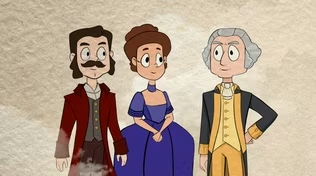
The story of George Washington's first and only visit to Georgia. (13m 32s)
The Soldier Who Arrested A Governor
Video has Closed Captions
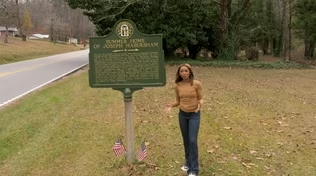
An early Georgia leader who was key to Patriot resistance and the early days of the postal service. (13m 31s)
The Frontier's Fierce Protector
Video has Closed Captions
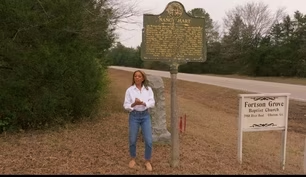
The story of a Colonial Georgia woman who was a fierce protector of home, family and liberty. (14m 9s)
 Now Playing
Video has Closed Captions
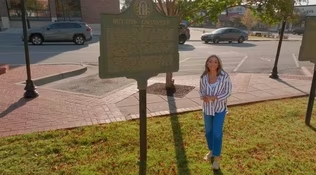
The story of a founding father, his influence on early Georgia, and the duel that ended his life. (14m 18s)
Providing Support for PBS.org
Learn Moreabout PBS online sponsorship










Support for PBS provided by:
MARKED! - The Series is a local public television program presented by GPB