Prairie Sportsman
A Park Ducks Remember
Clip: Season 17 Episode 8 | 8m 18sVideo has Closed Captions
Follow host Bret Amundson as he explores the history of waterfowl hunting and regulations.
Follow host Bret Amundson as he explores the history of waterfowl hunting and regulations while visiting Memorial Park Mill Pond in Shakopee, highlighting its unique wildlife viewing opportunities.
Problems playing video? | Closed Captioning Feedback
Problems playing video? | Closed Captioning Feedback
Prairie Sportsman is a local public television program presented by Pioneer PBS
Production sponsorship is provided by funding from the Environment and Natural Resources Trust Fund and Shalom Hill Farm. Additional funding provided by Big Stone County, Yellow Medicine County, Lac qui...
Support provided by:


Prairie Sportsman
A Park Ducks Remember
Clip: Season 17 Episode 8 | 8m 18sVideo has Closed Captions
Follow host Bret Amundson as he explores the history of waterfowl hunting and regulations while visiting Memorial Park Mill Pond in Shakopee, highlighting its unique wildlife viewing opportunities.
Problems playing video? | Closed Captioning Feedback
Where to Watch Prairie Sportsman
Prairie Sportsman is available to stream on pbs.org and the PBS app.
Providing Support for PBS.org
Learn Moreabout PBS online sponsorship- When it comes to the state of our wildlife, we often look to past.
Decisions regarding regulations, land use, and ethics have shaped our current outdoor landscape.
Now, while those decisions are always evolving, we can use history as a guideline for the path forward.
(gentle music) In the 1800s, there wasn't much to protect waterfowl and other migratory birds.
A market had grown where brightly colored feathers were sold to hat makers, and the meat from these birds would be loaded onto trains and shipped to big cities and fancy restaurants.
Soon, various species became extinct, including Labrador ducks, passenger pigeons, heath hens, and more.
Something needed to be done.
John F. Lacey, a Republican from Iowa, introduced the Lacey Act to Congress.
It aimed to prohibit trade in wildlife, fish, and plants that have been illegally taken, possessed, transported, or sold.
It was signed into law by President William McKinley on May 25, 1900.
Over the years, the Lacey Act was amended to include different species of birds, animals, and plants.
While this laid the groundwork for protection, the Migratory Bird Treaty Act in 1918 played a larger role in protecting waterfowl.
It ended the feather trade, made it illegal to pursue, hunt, take, capture, kill, sell, transport, or trade any migratory bird, including the feathers, eggs, and nests.
This put an end to market hunting and the most effective method for taking ducks and geese: the punt gun.
(gun firing) In the years that followed, defined seasons and limits were enacted.
Those have been refined over the years, and in 1995, the adaptive harvest management system was implemented.
This allowed for management strategies to fluctuate based on waterfowl population trends and ensure that no matter how many birds are legally killed by hunters, it won't have an effect on the overall population.
While these rules have protected waterfowl, other factors such as habitat and weather can play a larger role in migratory bird survival.
(gentle music) National wildlife refuges and waterfowl rest areas give ducks and geese places to escape pressure and restore fat reserves during the spring and fall migrations.
(gentle music) In recent years, it seems that large metro areas with protected agriculture and open water have also served as safe staging areas for these migratory birds.
(ducks quacking) While these metro areas have become havens for waterfowl, they also give us a chance to see them up close.
This park along a busy road in the Twin Cities has become a popular wildlife viewing destination, while also honoring both veterans and the Native Americans who settled here.
(gentle music) Memorial Park, it sits along the busy Highway 101 here in Shakopee.
Burial mounds rise up behind me on the east end of the park, and a Vietnam-era helicopter rests right here near the entrance.
While visitors come to pay their respects and dig into the region's history, others head toward the watery west end with cameras in tow.
(gentle music) Most visitors at the park come to see the waterfowl.
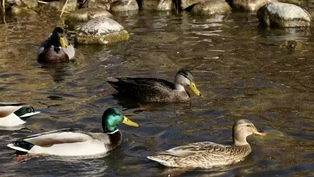
While mallards are the most common, you'll also see Canada geese, trumpeter swans, wood ducks, blue-winged teal, a few random farm ducks, some hybrids, various divers, and the somewhat rare black duck.
(gentle music) Black ducks are always fun to see.
While more common in the Atlantic Flyway along the eastern part of the United States, they're occasionally seen in northern Minnesota.
Memorial Park always seems to have one or two swimming around, however.
They're similar to mallards but feature darker colors.
While often mistaken for mallard hens, seeing them side by side gives you a better look at the differences.
One obvious way is to check the bill color.
Drake black ducks will have a yellow bill, similar to a drake mallard, despite the brown to black plumage.
The ducks also find similarities with each other and often interbreed.
Experts differ on the true extent of their differences and their histories.
In my years of hunting in Minnesota, I've only come across a few black ducks.
And despite this, the limit is two, since overall, the species is of least concern.
Now, if you hunted out east, shooting your two can be a bit easier depending on where you're at.
Visitors to the park can walk or bike the paths through the trees or get a little bit closer to the wildlife and come down even on a pier like this.
We can get up close and personal with the waterfowl.
(gentle music) The pond is part of a former mill.
Its location near the expanse of the Minnesota Valley National Wildlife Refuge makes this a perfect stopping ground for ducks, geese, and swans.
But you won't just see them during the warm summer months, because there's current that runs through here behind me.
The pond stays open year-round, and if ducks have open water and access to food, then they won't need to go anywhere else.
(gentle music) While this open water opportunity for wintering mallards has given them refuge and a place for wildlife photographers to get close to them in the metro, it raises other questions about human interaction, hybridizing with farm ducks, and migration patterns.
While myself and other photographers have honed our skills at this park, what does it mean for hunters down south?
Maybe the number of birds staying in the Twin Cities over winter isn't large enough to make an impact, but maybe these wintering areas should be considered when researchers study their flight paths.
Or is this just a great opportunity to educate people on ducks and geese?
Regardless, this 137-acre park, set aside to preserve habitat and serve as a memorial for notable residents of our past, has become a safe haven for these colorful birds.
Video has Closed Captions
Clip: S17 Ep8 | 4m 24s | Forager Nicole Zempel showscases plantain, including the green leafy plants medical purposes. (4m 24s)
Video has Closed Captions
Clip: S17 Ep8 | 12m 54s | Examine the effects of powerboats on lakes across the Upper Midwest. (12m 54s)
Memorial Park and Powerboat Impacts
Video has Closed Captions
Preview: S17 Ep8 | 30s | Shakopee’s Memorial Park Mill Pond's waterfowl viewing, and the impacts of powerboats on lakes. (30s)
Providing Support for PBS.org
Learn Moreabout PBS online sponsorship New Episode
- Science and Nature

Explore scientific discoveries on television's most acclaimed science documentary series.



 New Season







Support for PBS provided by:
Prairie Sportsman is a local public television program presented by Pioneer PBS
Production sponsorship is provided by funding from the Environment and Natural Resources Trust Fund and Shalom Hill Farm. Additional funding provided by Big Stone County, Yellow Medicine County, Lac qui...