Prairie Sportsman
Fast Forage: Plantain
Clip: Season 17 Episode 8 | 4m 24sVideo has Closed Captions
Forager Nicole Zempel showscases plantain, including the green leafy plants medical purposes.
Forager Nicole Zempel explores the uses of plantain, demonstrating how the green leafy plant can be utilized for practical purposes such as making cordage and creating a soothing balm.
Problems playing video? | Closed Captioning Feedback
Problems playing video? | Closed Captioning Feedback
Prairie Sportsman is a local public television program presented by Pioneer PBS
Production sponsorship is provided by funding from the Environment and Natural Resources Trust Fund and Shalom Hill Farm. Additional funding provided by Big Stone County, Yellow Medicine County, Lac qui...
Support provided by:


Prairie Sportsman
Fast Forage: Plantain
Clip: Season 17 Episode 8 | 4m 24sVideo has Closed Captions
Forager Nicole Zempel explores the uses of plantain, demonstrating how the green leafy plant can be utilized for practical purposes such as making cordage and creating a soothing balm.
Problems playing video? | Closed Captioning Feedback
Where to Watch Prairie Sportsman
Prairie Sportsman is available to stream on pbs.org and the PBS app.
Providing Support for PBS.org
Learn Moreabout PBS online sponsorship(bright music) - I am next to one of my all-time, I say that about every plant, but this is truly like an incredible plant.
It is a non-native plant.
It was brought over by Puritan colonizers.
Indigenous folks commonly called it "white man's footprint," and that is because not only did they bring over the plantain, but also it grows prolifically in very disturbed ecosystems, compacted soils.
And so really, when you see this plant, love it, because it's actually repairing your soil, creating a healthy ecosystem again wherever you're finding it growing.
And also, it can be used in places if you're trying to prevent erosion.
First, though, I want to talk about how to ID the plantain plant.
And most people think I'm talking about bananas, not that kind of plantain.
So it is in fact the green rosette plant that grows from the ground and eventually will grow to be large, and also its central spike here will continue to grow too.
And so mature plantain plants can get very large.
You can see the leaf here, and you can see it's got very distinct veins in the leaf.
And so that's another telltale sign that this is plantain.
Something cool about it too, utility-wise, let's just say you're just someplace like maybe in a survival situation, you can tear away very gently and peel kind of a string that has been used for emergency suturing stitches.
It's been used as fishing line.
Oh, and also you can make rope if you need to.
So utility-wise, it's also nutritional.
Medicinally, though, is the way I utilize it most.
I will harvest plantain when they're about like this, and then I dry them.
When they're completely dry, I'm gonna crush them up, and then I am going to place them in a carrier oil.
I like to use extra virgin olive oil.
I will soak those dried leaves anywhere from six months on up to two years, depending on how patient I am.
And then very easily, I'm gonna strain that, and then I'm going to put the liquid in a double boiler.
So all of the medicine has then been transferred from the dried leaf right into that carrier oil as it's soaked.
So again, strain it, dump it in a double boiler.
You're going to use, let's just say, you take it in a cup measurement.
So then you're going to pour that liquid in a cup, and then you're going to take beeswax.
And I incorporate probably two to three tablespoons of the beeswax crumbles into that solution, and then I melt the beeswax down.
As soon as it's melted, give everything a good stir, and then you can transfer that into a jar.
So I make a salve or a balm.
That salve or that balm is like a miracle in a jar.
I can have the worst sunburn.
After coming off of the river, I will apply plantain, and by morning, that sunburn is gone.
One of the coolest things, though, say you don't have the balm or salve handy.
Let's just say I'm sitting here right now, I get stung by a bee.
It kind of hurts, right?
And you get the little throbbing, stinging sensation.
Take a plantain leaf, chew it up, make like a poultice, and slap it right on that sting.
It will take care of that sting.
So plantain is one of my absolute go-to favorite plants.
(light music)
Video has Closed Captions
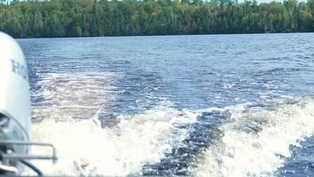
Clip: S17 Ep8 | 12m 54s | Examine the effects of powerboats on lakes across the Upper Midwest. (12m 54s)
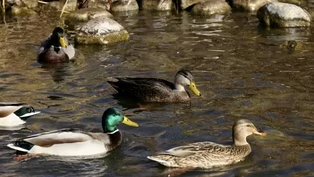
Memorial Park and Powerboat Impacts
Video has Closed Captions
Preview: S17 Ep8 | 30s | Shakopee’s Memorial Park Mill Pond's waterfowl viewing, and the impacts of powerboats on lakes. (30s)
Video has Closed Captions
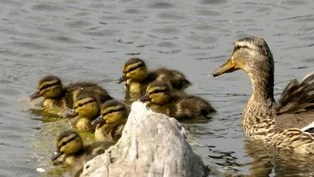
Clip: S17 Ep8 | 8m 18s | Follow host Bret Amundson as he explores the history of waterfowl hunting and regulations. (8m 18s)
Providing Support for PBS.org
Learn Moreabout PBS online sponsorship New Episode
- Science and Nature

Explore scientific discoveries on television's most acclaimed science documentary series.



 New Episode







Support for PBS provided by:
Prairie Sportsman is a local public television program presented by Pioneer PBS
Production sponsorship is provided by funding from the Environment and Natural Resources Trust Fund and Shalom Hill Farm. Additional funding provided by Big Stone County, Yellow Medicine County, Lac qui...