In the Arena
Alex Chequim: From Brazil to AgTech Innovation
Episode 3 | 26m 46sVideo has Closed Captions
Alex Chequim shares his journey from Brazil to building the agtech startup DigiFarmz.
Entrepreneur Alex Chequim joins Doug Cruitt to trace a journey that began with childhood businesses in Brazil and grew into DigiFarmz, an agricultural technology startup serving farmers and agribusinesses. Chequim shares lessons on resilience, innovation, risk and finding opportunity in problems while building a company across borders.
Problems playing video? | Closed Captioning Feedback
Problems playing video? | Closed Captioning Feedback
In the Arena is a local public television program presented by WTVP
In the Arena
Alex Chequim: From Brazil to AgTech Innovation
Episode 3 | 26m 46sVideo has Closed Captions
Entrepreneur Alex Chequim joins Doug Cruitt to trace a journey that began with childhood businesses in Brazil and grew into DigiFarmz, an agricultural technology startup serving farmers and agribusinesses. Chequim shares lessons on resilience, innovation, risk and finding opportunity in problems while building a company across borders.
Problems playing video? | Closed Captioning Feedback
Where to Watch In the Arena
In the Arena is available to stream on pbs.org and the PBS app.
Providing Support for PBS.org
Learn Moreabout PBS online sponsorship- There is an old saying that the longest journey a person will ever take is the 18 inches between their head and their heart.
And as I get older and as I spend more time around entrepreneurs, and founders, and builders, and dreamers, I think that there definitely is some truth to that.
Theodore Roosevelt famously spoke of the man in the arena, the one whose face is marred by dust, and sweat, and blood, one who strives valiantly, one who errs and comes up short again and again.
Now, what Roosevelt understood over 100 years ago is something every startup founder eventually discovers.
The arena is not a place.
It's a journey.
Today's guest understands that journey perhaps better than most, not only because he traveled the entrepreneurial road but because he (laughs) literally traveled thousands of miles across this planet in pursuit of a vision.
So today we'll talk about that journey, the miles traveled, the lessons learned, the sacrifices made, and what it really means to keep your eyes on the horizon while daring greatly in the arena.
I'm Doug Cruitt, and this is "In the Arena."
(upbeat music) (upbeat music continues) I'm happy to welcome our guest today, Alex Chequim.
Alex, welcome to "In the Arena."
- Thank you, Doug, it's a pleasure to be here.
Thank you for your invitation.
- Yes, as we talked about in the intro, you've not only traveled a lot of metaphorical entrepreneurial miles but literal miles to where you are today.
And we want to share with the audience some of that journey.
And so we'd like to go back into time, and one of the first questions we like to ask our guests are, who was Alex before he was an entrepreneur?
So we could reframe that question as, what would maybe your fifth grade teacher say about you?
Or what were you doing whenever you were a kid?
- Okay, so that's a great question because it's, I believe that I've been an entrepreneur since I was very, very young.
So I was very, you know, active.
So probably my old teachers would say that, "Okay, he's always chatting and doing things."
But the real thing is because my dad and my mom, they got divorced when I was four years old.
- Okay.
- And I realized at that time that things can change a lot.
And you need to be, you know, more focused, like, to not lose track.
- Right.
- So I started thinking in making things when I was very young.
So when I was seven years old, six or seven, we had, like, a garden, a place that some, you know, herbs and other things.
- Right.
- And people, "Okay, let's sell it."
And then I helped them, like, kids, you know, in the street, put those things to sell, to make tea.
And then I realized there's a problem because we are trying to sell.
And you know, the people, you know, passing and say, "Why I should buy it?
I can go there, and I grab it for free."
- Mm-hmm.
- It's, like, two steps from the stand that we were.
And it's, "Oh, that's something here.
We need to add value.
We need to do something that, you know, creates value."
Of course, now I can translate, now I can do that, but in that time it was, "Okay, there's no value here."
So I decided to sell orange juice and lemonade.
And so I, you know, created a stand and everything there.
And I remember that because my family, my grandpa, my great-grandpa and grandpa, they were from Italy.
So they immigrated from Italy.
They were farming.
They kept farming.
So my dad is agronomist and farmer as well.
So we had and we have a farm.
- And where is that?
Let the audience know.
Where did you come from?
- Yeah, where's this accent from?
- Yeah, yeah.
- Yeah.
So I'm originally from Brazil.
I was born and raised in Brazil, in south of Brazil, so a place that all the agriculture in Brazil started.
Then things moved and expanded to other regions, who is more, like, connected to agriculture, know all, you know, the places that now are well, you know, known.
But everything started the in south, close to Uruguay and Argentina, the last- - Right.
- the bottom of.
You know, Brazil is like a triangle, so it's in the bottom- - The bottom part.
- the tip of, yeah, yeah.
And then I remember that I was doing that, and my dad asked me, "Why are you buying oranges instead of getting the oranges that we have?
Like, because every weekend, you know, going to the farm, and there are a lot of oranges there.
Why not using?"
And I don't know, now it's clear, but I said, "Because I don't know the cost of, you know, the things that I have to make a profit."
So if I grab it, and I use, I'm not using, you know, something that can be repeatable.
- Mm-hmm.
- So that's when everything started, so I was seven.
I think it was seven to eight years old.
- And that's a very stereotypical first startup for a lot of entrepreneurs is quite literally that lemonade stand or orange stand.
- Yeah, yeah, I remember that I changed the place, moved close to a bus station 'cause I realized, "Oh, they're"- - [Doug] Location, location.
- Yeah, people are there waiting the bus, and they are thirsty, you know?
- Mm-hmm.
- So let's do something and creating some, like, if you buy two, you get an extra, you know, something like that.
Of course, it was during, you know, the vacation.
But it was very, very, you know, it was a spark for me.
- Yeah.
- And two years later, I really started, you know, the technology journey.
- Mm-hmm.
- So I started working with computers, so, like, having class.
That time before, PC was more, you know, like, a BASIC, COBOL, those old languages.
And then my dad is a baby boomer and the first generation to graduate.
So that's why when he graduated, he's agronomist.
And he decided to, you know, work in those big companies while my uncle and my grandpa stayed in the farm.
And then when he retired, he got back.
But during that period of time, we lived in different places in Brazil, big cities.
And so I had that one foot in the farm and one foot in the corporate side.
But at the same time, because the things were changing, and my dad was traveling a lot, he started asking me, asking me things in the computer.
"Oh, I need a spreadsheet.
I need this and that.
I need a presentation."
So then I started to do that for him and then, you know, for his colleagues.
- Mm-hmm.
- And they started paying me, so- - Ooh, here we go.
- Yeah, so things were in that, everything at the same time.
But then one of those guys, they used to travel a lot to America, and he bought a magazine.
Do you remember those magazines that used to come with floppy disks?
- Oh, yeah, yeah.
- So he gave me because I was, like, the son of the guy that works with computer, you know?
Like, all, you know, the colleagues looking for some help, "Oh, call Chequim's son."
So he gave me, and in one of those, three or four floppy disks, one of them, there was a BBS server software.
What is a BBS?
You know, people with more collagen doesn't know.
But it's a bulletin board system.
So it's kind of the grandma of the Internet.
- Okay.
- So it's a local server that used to connect using, you know, a terminal, all text.
And it's kind of a virtual, you know, a space.
So you connect.
You can send messages to someone.
The board is because you have boards of, you know, notes and messages.
- How old were you when this was kind of going on?
- I was 11, yeah, (Doug laughs) when I started, and then when we, when I do that for, 12, 12.
When I do that for really, really for as, it turns into a business with two other friends, probably I was 15 or something.
- Okay.
- Because I was, you know, looking to that, but the problem is having a landline so people could install, and when it happened because we had a second landline for the fax, you know?
- Mm-hmm.
- So that when you were not using, it's there, so I connected the server there.
And so that was the first business, I like to say.
- [Doug] Yeah, I mean, that's a pretty legit business- - Yeah.
- for being 12 years old and identifying yourself amongst your elders that, "Hey, this guy can do things."
- Yeah.
- "And we're gonna exchange money for those services."
As you went through challenges, and you've already identified as an older Alex now, you can look back and say, you know, "We were identifying, you know, a problem statement, solution, value," all those things.
At the time, do you recall, were you thinking through that?
And then a second part of that would be, when you faced a challenge, like, what did you do?
Like, if you had a product launch, or you're trying to get more revenues in, and you have a marketing strategy or whatever it was, and it didn't go as well, how are you handling that as a teenager?
- Okay, so I believe that, I'm an optimistic, so, like, a half-full glass, always.
- I often say entrepreneurs are unhinged optimists.
- Okay, yeah, I agree.
(Doug laughs) Definitely.
So I've been always thinking that the problem is the opportunity, okay?
So the thing is, if you don't think from different point of view, I like to say that it's a helicopter view, you know?
So we need to see it from, you know, a big point of view.
Because it's where you can find those different, you know, aspects and opportunities.
So any problem that I had or we had with business partners in other companies, I'm always thinking about how can we create a change, or implement, or make better processes, or change the product.
So I'm always trying to follow a framework.
Of course, as we are getting more seniors, (laughs) you are putting more tools in your box.
And you have more connections, and you have more experience, and things are getting, not easier but more clear.
- Mm-hmm.
- You know?
There's a sentence that a professor used to say that the obvious, it's obvious for the ready.
Trying to translate from Portuguese.
- Yeah.
(laughs) - But the obvious is only obvious for, like, the ready mind.
- [Doug] Like, you have an open mind, and you're- - Yeah.
- Yes.
- If you have, you know, the background, and if you know something about it, you can see the obvious there.
So since I was very young, I realized I must be better every day.
So I don't know why, because I was very nerd.
- [Doug] (laughs) Mm-hmm.
- I have a brother that is more a sport guy, you know, like, more popular at that time and playing basketball, and I was there assembling computers, you know, parts.
And then people started asking at the same time, "Oh, can you upgrade my computer?"
"Oh, yes," so I bought parts, and the old parts, I was creating older computers and using for all the other things.
So in any moment, any problem that I have, I try to see from the perspective of opportunity.
I'm very optimistic, so I'm not giving up.
But I learned that sometimes you need to change processes, or, you know, the pricing, or the go-to-market strategy, or things, but sometimes you need to change the business.
Sometimes you need to change, you know, the place.
And really, you know, it's hard to identify the level of change that you need, you know, to execute.
But it's in one level.
- Mm-hmm.
- Yeah.
- So let's jump to maybe the last few years, I would just say more scaled-up version of your- - Yep.
- lemonade stand, and your computer software, and all that.
So why don't we tell the audience, what are you doing now?
And then from there, we'll probably go back a little bit last five years 'cause there's been some transition, so if you wanna start with that.
- Okay, so now I'm the CEO and one of the founders of DigiFarmz.
It's a startup.
We still say that we are a startup because we are developing the market, developing the product.
It's in the ag space.
So, you know, it's the last industry to be digitized.
Everything is changing.
It's a risky operation.
I like to explain to people that are not from the ag.
Like, sometimes investors are, "Oh, I would like to invest in ag.
So let's have a meeting, and you can pitch."
And then you realize that they don't know about ag.
And I like to say that, "Imagine that you have an offer for a company."
Like, okay, I can hire you, and I'm gonna pay you 300, you know, thousand a year.
That's the offer, and some other benefits, and things.
Okay, but if something happens with weather or something, you lose a million.
Are you into that?
And they say, "No, it's not fair."
That's what a farmer does.
- Mm-hmm.
- You know?
So every year they are putting as a collateral, you know, their life and everything, their time.
And so that's why I believe that, you know, being pro-farmer, looking to the ag space and what DigiFarmz does, it's really thinking from we have three waves.
So from the first wave, decision making, providing, you know, guidance through actionable insights, farmers, agronomists, agritailers, so what to do, when to do, so what's the best seed, planting time, you know, herbicides, all the, you know, chemicals and biological products that must be used, when it must be used from the planting to the harvest 'cause things are changing every day- - [Doug] Mm-hmm.
- [Alex] a special product for agritailers and guys that are providing input to, you know, products to those farmers.
But it's very important because it's where everything started.
- [Doug] Mm-hmm.
- When you need to be active, and reliable, and need to be trusted to make things work well, more profitability, because otherwise we won't have those farmers there.
- Right.
- And you know what's gonna happen.
So the second wave is focused in all the, you know, traceability and scores for risk mitigation, so farm credit or credit, or insurance, crop insurance, but also the traceability for, you know, the food or sustainability.
It's kind of a bridge to the third wave.
That's where everything really changes.
And all the market, I like to say that now the pieces are more clear.
I believe that the ag space, and technology and ag, needs to change the way that it operates.
It must be more an ecosystem and less like individual companies.
In other industries, it worked, but in the ag space, we have so many challenges, technically speaking, agronomically speaking, but a lot of other challenges.
You know, the chain is very complex.
And we are in a moment that we need more but with more quality because, in the past, the challenge is to produce more.
- Right.
- But no problem with, you know, like, sustainability, financially, you know, environmentally, or all other things.
Now we need to produce more with less- - Right.
- or less, you know, problems.
So the third wave is where we connect the market demand to farmers.
So I'm talking about better-quality food, of course, but other demands.
Like plastic now is coming from soybeans.
- Right.
- And, you know, bio-fermentation is connected to that.
But it's not the commodity that we have.
So the quality is related, so different quality of oil, different, you know, quality or rates of protein, or things like that.
So the market is demanding that, but farmers are just, you know, doing the same and struggling to pay, you know, the bills and keep doing that.
So it's a very good opportunity to make things.
Of course, that's where the second, make the traceability.
And it's really connected to the guidance that must be provided the farmers, agronomists in that first moment, because all the quality is related, and the timing and everything is related to genetics, to products, when you do, where, you know?
But the thing is being more profitable, having a piece of that, you know, premium that those companies are also offering, but nobody knows who is producing, and here they don't know how to produce it.
- When did you officially start DigiFarmz, and do you remember who your first customer was?
- Yes, so we started, so the company, the idea, like, to put in market, like, to make things work as a first algorithms, first, you know, putting together data, it was 2015.
Okay?
- Okay.
- Because Ricardo was my professor.
- Oh.
- Yeah.
So after I finished the college, then I moved to other big cities, and we lost connection for a time.
But during, you know, the time that he was my professor, we had a lot of great projects together for companies.
He was at that time, and he's very connected to the market, so not only an academic guy but very connected to the market, so we had very interesting projects.
But we lost connection, and we reconnected.
When we reconnected, I was in a midlife crisis 'cause at that time I had five companies organized in a group 'cause DigiFarmz is my 10th company, so I had some failures, but at that time, I had five companies.
The idea was really providing what people used to say full service or 360.
- Right.
- But 80% of our clients in the ag space, but 20% in other industries as well, so providing all the marketing, technology-related services, sales, and things like that.
But I realized that there was a lack of purposeful, a lack of impact and scalability.
I was, okay, making money, providing good service.
People were, like, happy with what you were doing and demanding you, "Oh, no, you must be there, the strategy," but I was, you know, frustrated at that time, 31, 32 years old.
And then I focused mentoring, investing in startups, using, you know, because at that time, I had my MBA in marketing and other MBA in business.
So it was interesting to try to reconnect with the full tech-based, you know, initiatives.
- So now, today, so that was in Brazil.
- [Alex] Yeah.
- We are not in Brazil right now.
- Yeah.
- But yet you have a company presence up here, so when did that transition happen?
And then I'm curious how many acres you guys are currently helping to manage.
- Since the first day, it was clear that we should work in expansion, starting with the row crops, so soybeans, corn, winter cereals, and other, and then to specialty crops, and Brazil, some places around, and US, for sure.
We started all, you know, the study of the American market.
My business partner was living here, so he studied here.
So then he moved back to Brazil.
And after he retired, he was here, back but living in Florida, you know?
- [Doug] Yeah.
- But then we started in the West Coast, all, you know, the Bay Area thing, very good, you know opportunities for fundraising, but it's not the place where our market was.
- [Doug] Right, not a lot of your customers there that you- - And very expensive for the ag space, especially this row crop area that you must be very, you know, good in money management, the costs and everything.
It won't work.
- Yeah.
- It's not like a- - But today you're located in the Midwest- - Yeah.
- and a lot of your customers.
And how many total acreage across the world are you guys managing?
- Yeah, so the point is now we have three products, okay?
So one product is for farmers, agronomists, and one is for agritailers.
So the thing is, when we used to have only for farmers, it was easy to say.
Now, we have the agritailers managing farmers' areas, some really managing like farm managers.
Other, they are just, they have their area, and they are making the, they are the creating programs and using those programs, you know, management programs- - Right.
- plant health programs to them.
So if you sum it up, it almost two million.
- Wow.
- So, but the point is we have some in high touch, some in middle touch.
We like to be clear doing that because people, "Okay, you have, you know, two million guys following."
Yeah, but that's- - So from a seven-year-old picking a handful of oranges and turning that into a business and a profit to now today a global company managing, helping to manage over two million acres.
- Yeah, yep, yeah, and we are 23 people now.
- That is impressive.
- Yeah.
And the challenge is, you know, ag space is not that easy for fundraising.
So we realize since the first year that scalability would be very important, but at the same time be very efficient in money management, so bootstrapping, you know, because three waves, it takes time.
- Yeah.
- And just creating something simple and selling wasn't, you know, the purpose, yeah.
- Very good, well, Alex, thank you so much for sharing your journey with our audience today.
- Thank you very much.
- Best of luck with everything.
- Thank you very much.
It's a pleasure, and I'm very happy to be here.
I would like to say thank you also for the people from Greater Peoria Economic Development Council because we are here because of them.
- That's right.
- Great.
Thank you for having me.
- Thank you, Alex.
Pleasure.
- My pleasure.
Thank you for the invitation.
- Now, as I reflect on Alex's story, I'm reminded that entrepreneurship has never really been about companies.
The real journey is what happens to the person behind them.
And today we heard the story of a founder who traveled thousands of miles in pursuit of a vision from the farms of Brazil to the heartland of America, from comfort to courage.
But if we're honest, every one of us is on a journey of our own.
Whether you're launching a business, changing careers, raising a family, pursuing a dream, or simply trying to become a better version of yourself, I hope you'll have the courage to take the next step.
Thank you for joining us, and next time, we'll sit down with another founder whose journey has been marked by risk, resilience, sacrifice, and hope.
Until then, keep your eyes on the horizon, keep moving forward, and most importantly, keep stepping into the arena.
I'm Doug Cruitt, and we'll see you next time.
(gentle music) (gentle music continues) (bright music)
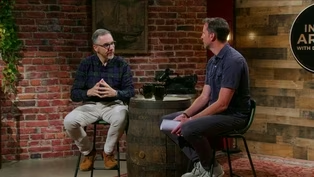
Alex Chequim on Turning Problems Into Opportunities
Video has Closed Captions
Clip: Ep3 | 1m 16s | Alex Chequim explains why entrepreneurs must see problems as opportunities to adapt. (1m 16s)
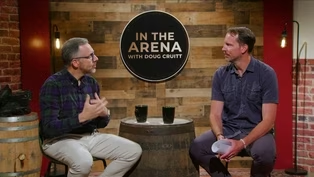
The Childhood Business That Sparked Alex Chequim’s Entrepreneurial Journey
Video has Closed Captions
Clip: Ep3 | 1m 37s | Alex Chequim recalls how a lemonade stand taught him an early lesson in creating value. (1m 37s)
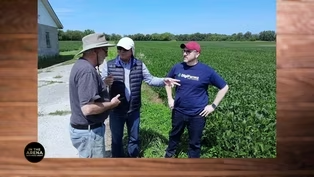
How DigiFarmz Is Using Technology to Help Farmers
Video has Closed Captions
Clip: Ep3 | 2m 29s | Alex Chequim explains how DigiFarmz helps farmers make smarter, less risky decisions. (2m 29s)
Providing Support for PBS.org
Learn Moreabout PBS online sponsorship New Episode
- Science and Nature

Explore scientific discoveries on television's most acclaimed science documentary series.
 New Episode








Support for PBS provided by:
In the Arena is a local public television program presented by WTVP