
All Too Clear: A Silver Lining (Ep. 3)
Special | 56m 15sVideo has Closed Captions
Fish adapt to mussels, cisco rebound in Great Lakes, and whitefish seek river refuge.
Fish adapt to mussels and the question emerges: is there an upside to the invasion? As overall fish numbers decline, cisco—the forgotten heart of the Great Lakes—begin an encouraging comeback. Witness an ambitious effort to restore river-run whitefish seeking refuge in tributary rivers. The journey ends 30 miles offshore at Lake Michigan’s Mid Lake Reef, where fish thrive despite the mussels.
Problems playing video? | Closed Captioning Feedback
Problems playing video? | Closed Captioning Feedback
All Too Clear is a local public television program presented by Detroit PBS
All Too Clear: A Silver Lining (Ep. 3)
Special | 56m 15sVideo has Closed Captions
Fish adapt to mussels and the question emerges: is there an upside to the invasion? As overall fish numbers decline, cisco—the forgotten heart of the Great Lakes—begin an encouraging comeback. Witness an ambitious effort to restore river-run whitefish seeking refuge in tributary rivers. The journey ends 30 miles offshore at Lake Michigan’s Mid Lake Reef, where fish thrive despite the mussels.
Problems playing video? | Closed Captioning Feedback
Where to Watch All Too Clear
All Too Clear is available to stream on pbs.org and the PBS app.
Providing Support for PBS.org
Learn Moreabout PBS online sponsorshipMore from This Collection
Underwater drones reveal how invasive quagga mussels are reshaping North America’s Great Lakes on a scale not seen since the glaciers. By trapping nutrients on the lake bottom, they cause widespread species loss and biological deserts—yet leave unusually transparent waters. Scientists race to control the invaders and discover clearer waters may offer an opportunity to restore an ancient ecosystem.
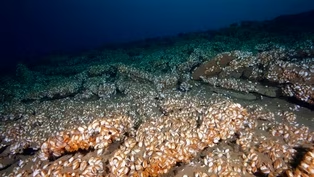
All Too Clear: Muddy The Waters (Ep. 2)
Video has Closed Captions
Fighting Back: The High-Stakes Quest to Control Quagga Mussels. (55m 16s)
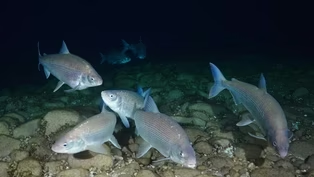
All Too Clear: The Last Whitefish? (Ep. 1)
Video has Closed Captions
When Mussels Invade: Whitefish and the Fight for Survival in the Great Lakes (55m 42s)
Providing Support for PBS.org
Learn Moreabout PBS online sponsorship(gentle music) (narrator): The Lake Trout was once the apex predator of the Great Lakes.
(tense music) But overfishing and the invasion of the sea lamprey nearly wiped them out by the 1950s.
In Lake Huron, scientists have been trying to bring this species back from the brink for decades, with little to show for it.
But now, the shark of the Great Lakes is making a comeback.
(mysterious music) Ironically, while the sea lamprey caused their decline, their recovery might not have been possible without the effects of another invasive species.
(Arunas Liskauskas): And all of a sudden, we were seeing signs of lake trout rehabilitation.
But how could you anticipate that that would be the outcome of a major ecological impact such as the quagga mussels?
(narrator): The invasion of quadrillions of quagga mussels has transformed the Great Lakes.
By trapping nutrients in the lake bottom, they've created vast biological deserts.
But all is not yet lost in the world's largest freshwater ecosystem.
There may even be a silver lining to these much clearer waters.
(tense music) (narrator): The Great Lakes of North America form the largest interconnected body of freshwater on Earth.
While images of the oceans fill our screens and live in our imaginations, the vast and magnificent freshwater world has long been hidden from our view.
Only now, using state-of-the-art underwater drone technology, are we finally able to explore the wonders hidden beneath the surface of the Great Lakes.
(serene music) (dramatic music) (narrator): When looking for life that's thriving in the age of the quagga mussel, a good place to start is Georgian Bay.
An offshoot of Lake Huron sometimes called, ‘The Sixth Great Lake,' the deep parts of the bay are covered in mussels just like everywhere else in the lower Great Lakes.
But the eastern shore is different.
This region, also known as the 30,000 Islands, is famous for its ancient granite bedrock, making the water low in calcium, a mineral the mussels need to build their shells.
(birds chirping) The area's many intact wetlands and rivers also provide a steady supply of nutrients, and create a huge diversity of wildlife habitats, making this area resilient to the mussels' effects.
All this makes eastern Georgian Bay a pretty special place.
At least, Professor Harvey Bootsma thinks so.
- Been coming to Georgian Bay since I was - could hardly walk.
(chuckles) (narrator): From his home base in Milwaukee, Harvey's spent years studying how the mussel have transformed Lake Michigan.
But every summer, his family finds refuge 640 km, or 400 miles away in Georgian Bay.
(Harvey Bootsma): Okay, we're gonna start turning left now... There's no place like this - just rocks, trees, and water.
It's just so beautiful.
(indistinct chattering) For kids, it was just magical.
(distant laughing) We spent almost as much time in the water as we did out.
(chuckling) Yeah, that's right.
I just fell in love with water and fortunately was able to get a job where I can work on lakes.
And we still come back to Georgian Bay as often as we can.
(gentle music) In some ways, at least so far, this place is protecting itself.
When we dive in Lake Michigan, the quagga mussels have completely flipped that system up on its head.
You know, we have quagga mussels here, but as far as I can see, they haven't dramatically changed the system.
So, it's a bit of a refuge for the biota that lives here, but a bit of a refuge for humans as well.
It's really reassuring to come back here and see that it's still very similar to the system that I came to, 50 years ago when I was a kid.
Hopefully, it stays that way.
(suspenseful music) (narrator): A key indicato of the health of this ecosystem is the state of the top predator in these waters, the muskellunge, or musky for short.
Musky have razor-sharp teeth, can grow to 1.5 metres, or 5 feet, and weigh over 27 kilograms, or 60 pounds.
But these particular musky are having a bad day.
They were coming to spawn in the shallows when they found themselves caught in the net of biologist, Arunas Liskauskas.
Lucky for them, thei incarceration is only temporary.
(Arunas Liskauskas): We are in beautiful McGregor Bay, the northernmost part of Georgian Bay.
And we're trying to get a handle on where the Muskie are, where they're spawning, how abundant they are and how large they are.
(narrator): It's been more than two decades since Arunas last checked on the musky here.
Because of the big changes that've occurred in the lake, he was unsure what he'd find.
- Wow!
One, two, three, four, five-- (woman): Oh!
- ...Six.
Oh, my goodness.
Nice!
Nine point four.
(narrator): The fish are tagged, weighed, measured and released as quickly as possible to reduce stress on the animals, many of whom are ‘ripe,' or ready to spawn.
- Four fifteen.
Ripe male.
Ten thirty.
- Okay, he's coming in.
(intriguing music) - Oh, boy.
Look at that... Ripe female.
Thirteen ten.
(Arunas): They're just a magnificent example of a apex predator that still resides in the Great Lakes.
And just to be in the presence of such a large, beautiful fish is a privilege.
(male deckhand): It's coming in.
- There you go.
(Arunas): She's exhausted.
Hang in there girl.
Twelve hundred.
Twelve seventy.
Okay, thank you.
Thank you, thank you.
Okay.
(chuckles) There you go.
Seven muskie in a single trap.
Wonderful to see.
(Arunas): It's a satisfying discovery to realise that this apex predator is still holding on in these relatively pristine waters of eastern Georgian Bay.
However, we can't be complacent because of the round goby.
(tense music) (narrator): The biggest threat to the monster muskies of Georgian Bay is the little invasive round goby.
(suspenseful music) Round goby go hand in hand with zebra and quagga mussels, two closely related species often referred to together as dreissenid mussels.
The round goby evolved to eat juvenile dreissenid mussels in eastern Europe, where all three species are from.
Like the mussels, gobies arrived in the ballast water of ocean-going vessels that travelled here from Eastern Europe.
(Arunas): The round goby was basically riding that wave of dreissenid mussels.
So, they just proliferated throughout the Great Lakes, including Lake Huron.
And unfortunately, it's also being found in coastal wetlands throughout eastern Georgian Bay.
(narrator): Round goby ca reproduce multiple times a year, quickly achieving very high densities.
It's at these densities that goby become a threat to many native species, because they're voracious predators of fish eggs.
(ominous music) They've a particular affinity for the eggs and newly hatched offspring of smallmouth bass.
Luckily, smallmouth bas have an evolutionary advantage.
They are experts at protecting their nests.
(Arunas): Smallmouth bass, their reproductive habitats include the male constructing a nest.
The female depositing her eggs in this nest.
The male after fertilising the eggs will protect them.
But when you have lots around goby, they can be effective predators on those bass nests.
(tense music) (somber music) (narrator): Unfortunately, the goby appear to have overwhelmed this bass, as no eggs or baby bass are visible in the nest.
Nearby, another bass dad has clearly been more successful.
(serene music) Overall smallmouth bass see to be winning the war with goby in the Great Lakes.
In fact, round goby have become a primary food source for the species.
(Arunas): Their growth rates have increased.
We're seeing much larger fish.
Their reproductive output seems to be enhanced, primarily because of their predation on round goby.
So, it's a push and pull and we don't know what the eventual outcome will be.
(narrator): When the quagga mussels invaded, they trapped the nutrients that used to feed the bottom of the food chain in the lakebed.
By eating young mussels, round goby are unlocking at least some of those nutrients, becoming a crucial food source for many fish species.
One of the species that now relies on round goby, is the mighty lake trout.
These lake trout spend most of their time in the deep waters of Lake Huron.
But because it's late October, they've ventured into the shallows to spawn.
The males have emerged first and they're mostly lazing about, saving their energy for a busy night ahead.
Lake Trout can affor to be lazy, because they evolved to be the apex predators of the Great Lakes.
Growing over 28 kilograms, or 60 pounds, and 1.3 metres, or 4 feet in length, nothing can eat them.
As the sun sets, they cruise along the rocky shoreline, looking for females.
But they're not alone.
This northern pike, a smaller cousin of the musky, comes by to check out the commotion.
These little whitefish are particularly brave, looking to make a snack of lake trout eggs deposited the night before.
But they quickly think the better of it.
Finally, a female joins the party and they begin their courtship ritual.
(gentle music) But she makes them work for it, as the males gently nudge and caress her to get her in the mood.
Then, when everyone is ready, they get close to the bottom and vibrate, releasing eggs and sperm simultaneously.
With any luck, the fertilised eggs will drop into cracks in the rock and stay safe until they hatch in the spring.
It's a remarkable even for a species that not long ago was extirpated, or locally extinct, from these waters.
But what's even more surprising, is that their triumphant return may not have been possible without the quagga mussel.
(seabirds squawking) (indistinct radio chatter) (narrator): Operated by the Ontario government, this research vesse is transporting baby lake trout, to be released into the offshore waters of Georgian Bay.
(trout deckhand): Gettin' ready.
Let me know when you're ready.
(narrator): Lake trout were gone throughout much of the Great Lakes by the 1950s, largely due to overfishing and predation by invasive sea lamprey.
(trout deckhand): Good?
All right - here we go!
(intriguing music) (narrator): Starting in the late 1960s, lake trout have been reared in hatcheries in an attempt to restore this keystone species to the ecosystem.
In Lake Huron alone, more than 100 million fish have been stocked into the lake.
It's one of the biggest restoration attempts ever for a freshwater fish.
But until the quagga mussel invasion, it wasn't working.
The little fish would grow into adults, but they weren't reproducing in the wild, a key measure of success i the restoration of any species.
(seagulls squawking) (Arunas): In the early 1990s, we had been stocking lake trout for decades.
But we had very little signs of success.
So, at that time, the prospects for lake trout recovery were pretty remote.
And then we had the introduction of quagga mussels.
And we really couldn't anticipate what the impacts would be, but they were dramatic.
(narrator): The primary reason for the failure of lake trout reproduction was a little invasive fish called the alewife.
Native to the Atlantic Ocean, alewife invaded as the lake trout disappeared, becoming the most abundant small fish in Lake Huron by 1960.
The trouble is that alewife ar like junk food for lake trout, because they contain a harmful enzyme called thiaminase.
When trout eat them, the babies of those fish are much less likely to survive.
But when the quagga mussels invaded, they reduced the food available to the alewife, resulting in a huge drop in their population.
(Arunas Liskauskas): With lake trout feeding less on alewife, their reproductive capacity improved.
So, we were finally seeing signs of natural reproduction, particularly in the main basin of Lake Huron, something that hadn't been seen at all in previous decades.
(gentle music) We kind of watch in a bit of amazement at what's happening, and also some concern, because we don't know what the eventual outcome will be.
But we're getting to the point where we're gonna have multiple generations of wildly produced lake trout, and over time, we hope that those naturally produced lake trout will acquire characteristics that make them fit for this new environment.
(narrator): It's not all good news for lake trout in the quagga mussel era.
The mussels may be having a negative impact on their reproductive habitat, the spawning reef.
(tense music) Here on Lake Michigan, a team of scientists is assessing the health of the reefs, with the hope of eventually restoring those that are degraded.
- Now, you guys try to do the habitat.
- All right.
That's my thought, 'cause then you'll see some of the vessel.
- Okay.
(Lindsay Chadderton): So, these are old reefs that we know historically were used by a number of fish species.
And then today we're coming out and essentially trying to get a handle on what's going on inside the reef.
They were, the sort of, quintessential part of the Great Lakes ecosystem.
(narrator): A freshwater reef is not the same thing as a coral reef in an ocean but they're critically important to life in these lakes.
(gentle music) A Great Lakes reef, is a pile of rocks that fish such as lake trout and lake whitefish are strongly attracted to to lay their eggs.
When the fish release their eggs and sperm onto the reef, the fertilised eggs fall down into the spaces between the rocks, where they will be safe until they hatch in the spring.
The spaces between the rocks are critical.
If the eggs don't have cracks to fall into, they can be washed away by currents, or easily consumed by egg predators like round goby.
(Lindsay): The point of the project is to get out and to find these reefs, to map them, and then to understand their status and condition.
And a key part of that is looking at how heavily colonised are they from a mussel perspective?
It was surprising today, on at least one of the reefs, there was next to no mussels on at all.
And I think probably because of the physical forces, those rocks are pretty clean.
And that's hopeful.
(narrator): Wave action and scraping from ice are keeping mussels off the top of the reef.
But that changes as we descend deeper.
(Lindsay): Once we got over a certain depth, probably 15 to 20 feet, the habitat was pretty poor.
Heavily encrusted with mussels.
And those rocks are what we would call ‘embedded.'
There's no real space in between them.
(narrator): The rocks here are covered in mussels, but they're hard to see.
Their feces is promoting the growth of thick mats of algae called ‘cladophora.'
The spaces between the rocks have also become clogged with dead mussel shells, known as ‘hash.'
(Lindsay): The other obvious organism on these reefs are round goby, and they are hugely abundant on all of these reefs.
So, the round goby are going to prey on whatever they can get their hands on.
And if they can find eggs or larvae, they'll certainly feed on them.
So, if eggs are dropped there, it's probably not a great environment for those eggs to survive.
(indistinct chatter) Yeah, not particularly good habitat.
So, you guys had plenty of mussels on yours?
- Anything that was large enough or buried enough, completely covered in quagga mussels.
(Lindsay): Okay, all right.
I think we do want to try and control mussels on the reef, but at the moment it's an idea.
And really the point of this project is to understand where are mussels a problem, and then to think about, well, can we go about changing that?
One of the questions is if we can control mussels and we can clean up this habitat, will the fish come?
(narrator): The effort to remove invasive mussels from Great Lakes spawning reefs is still in its infancy.
But there have been a handful of attempts to rebuild reefs for other reasons, that offer hope for these special habitats, and the species they support.
(Matt Herbert): Do you think you can focus initially right down the middle?
(radio operator): I can definitely try.
Let me try and get in position here and I'll see what we can do here.
(seagulls squawking) (narrator): In 2015, The Nature Conservancy partnered with government agencies to rebuild a reef near Elk Rapids, Michigan, that had been degraded by an iron ore operation more than a century before.
(Matt Herbert): What we were seeing before there, is that fish were using it.
But eggs were getting either blown out by wave action or eaten by predators.
'Cause it just wasn't enough of a rock layer there to protect them.
So, we brought in 450 tons of rock.
And we reconfigured that reef, with lots of interstitial spaces in the rocks for those eggs to hide and be protected from wave action and predators.
(tense music) (narrator): It didn't take long for lake trout to find their shiny new reef.
(Matt Herbert): When we first saw the video of the lake trout using the reef, that was super exciting.
Particularly that they were all kind of congregated on that restored reef, that was really neat to see.
(serene music) (narrator): Though their recovery is just beginning, lake trout are a bright spot in an ecosystem in turmoil.
Restoring their spawning habitat may help them regain their place as the apex predator of the Great Lakes.
But their future is by no means assured in the age of the quagga mussel.
(Arunas Liskauskas): We're still seeing the offshore ecosystem in flux, and it's difficult to predict what the eventual outcome will be.
And that's just the spectre of invasive species.
They are so disruptive and unpredictable.
We really don't know how these fish communities will respond and evolve.
(narrator): While Lake Huron lake trout are finally reproducing naturally, there aren't many small fish out there for them to eat.
But there are places where some of the lake trout's traditional prey fish are making a comeback, and the changes caused by the quagga mussels may be playing a part in their return.
(motor whirring) One of those places is deep in the offshore waters of Lake Ontario, where biologist Brian Weidel has been tracking the remarkable recovery of a unique little fish.
- We're out here as part of a collaborative prey fish survey, sampling the prey fish community, understanding what species are out here, and at what abundances.
Right now, we're sitting in about 130 metres.
And this is where we actually start to see a majority of the prey fish.
(narrator): Most of this catch is a native prey fish long thought extinct in these waters, the deepwater sculpin.
(Brian Weidel): The first one got caught in about 1996.
Ever since then, their abundance level has just shot up.
(narrator): As deepwater sculpin typically live in waters over 100 metres, or 330 feet deep, very little is known about them.
So we use the underwater drone to see what we can learn.
(gentle music) We descend to about 125 metres, or 410 feet, to find the lakebed, unsurprisingly, covered in mussels.
There are a handful of deepwater sculpin scattered amongst them.
But then, something looms in the distance.
(intriguing music) It's a huge industrial tire, which must have fallen off a large boat.
It's encrusted in mussels.
But upon closer inspection, we find it inhabited by many deepwater sculpin.
(Brian Weidel): This is a fish that most folks would never see.
In fact, most fisheries professionals don't know about it.
It only lives in the clearest, cleanest deep lakes.
(narrator): The deepwater sculpin disappeared in the 1960s, when Lake Ontario's pollution and nutrient levels were at their height.
(Brian): So, for decades, none were detected.
Then in 1996, one showed up.
And then, a few more are caught, and those fish came back.
(narrator): A short distance from the tire, we make an even more intriguing discovery.
(mysterious music) These holes are not natural.
They've been dug by deepwater sculpin to create nests to protect their eggs.
Previously, only a single active nest had ever been documented on camera.
Here, we find many.
In other sculpin species, the males protect the nests after the eggs are laid and fertilised, and that seems to be the case here as well.
Even at these depths, round goby lurk nearby, likely waiting for a moment to snatch some eggs.
A goby sneaks closer to a nest, but decides not to try it.
During the commotion, a sculpin tries to catch a freshwater shrimp called a ‘mysis,' but he misses.
These fish seem to be holding their own amongst the mussels.
(Brian Weidel): Here is a story where a native prey fish species came back on its own.
Folks talk about it healing itself, but really I think it had more to do with what people did to reduce the amount of nutrients and pollution in the lake, and maybe even the mussels lowering the nutrients, created an ecosystem where a native species came back on its own.
And in fact, they are one of the more abundant fishes in the lake.
(narrator): The return of the deepwater sculpin hints at an unexpected silver lining to the quagga mussel invasion.
When the Great Lakes formed by melting glaciers more than 10,000 years ago, they would have been very low in nutrients.
Some of the fish in them would have evolved to survive, and even thrive, in very clear waters.
(David Bo Bunnell): As the lakes have become less productive, accelerated by these mussels.
We assume they're a lot more like the lakes that existed hundreds of years ago.
And hundreds of years ago, these lakes were teeming with these native prey fishes called ‘ciscoes.'
(narrator): Also known as ‘lake herring,' cisco are a smaller relative of the lake whitefish, with one key difference.
Where whitefish have mouths designed to eat things off the lake bottom, cisco have a mouth shape that's evolved to eat critters swimming around in the water.
Here, they snack on midge flies that are hatching on the lake bottom and trying to make their way to the surface.
(gentle music) (Matt Herbert): Cisco were, from an ecological function perspective, they were extremely important.
They were, they were one of the most abundant fishes out there.
They were favourite prey for lake trout, and other top predators ate them as well.
(narrator): Great Lakes cisco evolved into multiple species to take advantage of the huge diversity of habitats in the world's largest freshwater lake system.
(Bo Bunnell): We had as many as eight species.
And these eight ciscoes really radiated everywhere.
And they were the ones that went out to the deepest parts of the lake, lived on the bottom and might migrate up near the surface of the water within a day, tremendous movements and migrations.
And then we had other species that mostly lived in the shallow waters.
It gets, biologists really geeked up and excited, sort of, describing that diversity.
(seagulls squawking) (narrator): Overfishing, combined with invasive species and high levels of nutrients and pollution, meant that by the 1960s, the great diversity and abundance of cisco had collapsed.
(somber music) Several species became extinct.
(gentle music) But recently, the cisco have been coming back in a few areas, most notably in Lake Michigan's Grand Traverse Bay.
(Matt Herbert): So, over the last 15 years or so, we've seen cisco numbers going up consistently in Grand Traverse Bay, and then we're also seeing cisco expanding to other parts of Lake Michigan as well.
Presumably, this is happening because of the changes in the food web.
It coincides with it, and they are thriving under those conditions.
Hopefully this will continue.
And we'll have this growing resurgence of cisco in Lake Michigan.
(serene music) (narrator): For millennia hundreds of millions of ciscoes filled every corner of the Great Lakes, fuelling the evolution of huge predators like burbot, walleye, and the queen of them all, lake trout.
This cisco-powered ecosystem likely had a total abundance many times greater than exists today.
When cisco collapsed, the invasive alewife took their place, but they were unhealthy food for Great Lakes predators.
Then the mussels invaded, sucking so many nutrients out of the lakes, that alewife declined in some areas, and disappeared in others.
Now, the lake trout are coming back, but the native species they evolved to thrive on are gone.
The unexpected resurgence of cisco in Lake Michigan is tantalising evidence that now may be the time to help cisco regain their place at the heart of the Great Lakes food web.
- Obviously, quagga mussels have done a lot of damage.
And they're - it's very concerning what they've done.
But it's ironic, because it is an opportunity to restore a lot of these fish that disappeared 60, 70 years ago.
(birds chirping) (narrator): Multiple initiatives are underway to restore cisco to the Great Lakes.
By far the bigges is an attempt to bring them back to Lake Huron.
For decades, the sprawling Jordan River Fish Hatchery raised lake trout for stocking into Lake Huron.
But with lake trout recovering, they've retooled their operations for cisco.
(water trickling) - We're currently producing about a million cisco for the Saginaw Bay region of Lake Huron.
And that's just about all I could raise.
Boy, look at the size of that pen.
(narrator): For about 200,000 of these young fish, today is their last day in the hatchery.
- Beautiful.
(narrator): They are being rounded up and transferred onto trucks for the first part of their journey.
(Roger Gordon): That's exactly how much we want going in there.
(narrator): After a few hours on the road, they arrive at Saginaw Bay and are transferred onto a vessel designed specially for stocking fish.
The last part of their journey is a 3-hour boat ride up the bay, to what was once the most productive cisco spawning reef in Lake Huron.
- I grew up in Saginaw Bay.
I grew up exactly where we're stocking these fish.
And I heard the stories.
These giant schools of cisco, coming back to these spawning grounds every fall.
The water would turn black there were so many of them.
(somber music) They were the cornerstone of the Great Lakes.
And they're gone.
(intriguing music) To watch those fish swim away from the boat is a very good feeling.
(narrator): By the time this 10-year project is complete, 10 million cisco will have been released into Saginaw Bay.
With any luck, enough will return as adults to create a self-sustaining population.
If their numbers grow to even a fraction of what they once were it will have tremendous benefits for the entire food web.
(narrator): Hopefully, the cisco of Saginaw Bay will one day be as numerou as their thriving relatives here in Grand Traverse Bay.
Cisco aren't the only ones who have come up from the depths of Lake Michigan to feast on midge flies.
A couple lake whitefish join them.
For a fish that evolved to eat critters off the lake bottom, they're doing a pretty good job catching midges.
But by their humped shape, you can tell they're elderly.
Research has revealed that most whitefish in this area are nearing the end of their lifespan.
It's a sad reminder that while cisco are starting to return, the whitefish a fish of tremendous importance to the environmen and culture of the Great Lakes, is in serious trouble.
But it may be premature to count the whitefish out just yet.
(motor whirring) The Sault Tribe has a plan to harness an ancient ability of the whitefish, to help them survive the age of the quagga mussel.
- The idea of whitefish being extirpated from treaty waters is really too sad to even contemplate.
So, could we start to restore some rivers, and get fish spawning in rivers again, like they did for 10,000 years?
(tense music) (narrator): Long ago, there were two groups of lake whitefish in the Great Lakes.
Those that spawned in lakes, and those that spawned in rivers.
The river fish all but vanished more than a century ago after logging practices destroyed their spawning habitat.
But the Sault Tribe and the Little Traverse Bay Ban of Odawa are out to change that.
These Lake Huron whitefish were caught on their spawning grounds just hours ago.
They gently remove the eggs from the females and the sperm from the males.
The females don't survive the procedure, becoming food for the community, but the males are released to spawn again.
Once the eggs and sperm are combined, they have only 24 hours to put the in the river before they become too delicate to handle.
130,000 fertilised eggs are carefully placed into special incubators, and prepared for travel to their new home.
Their destination is the Carp River, which flows into Lake Huron not far from where the parents of the whitefish eggs were caught.
(indistinct chatter) (Jason Smith): We have our egg incubators loaded.
So, we finally are going to put eggs back in the Carp River today.
(narrator): The Indigenous Communities are not alone in this bold experiment.
One of the world's largest conservation organisations, The Nature Conservancy, is a key partner.
Senior scientist, Matt Herbert, is the group's lead on the project.
(Matt Herbert): We've been talking about this for several years.
It also was kind of a dream, so to be - to be starting in on this, and be doing it, is very exciting.
So today is the very first attempt to try to help rebuild whitefish populations.
- And then you come down, yup.
(Matt): All right, here we go.
(gentle music) (narrator): With luck, the eggs will be safe until spring, and the larvae will hatch and escape through tiny holes in the incubators.
Free of quagga mussels and naturally high in nutrients, the river may be a far better place for larval whitefish to begin their lives than the open waters of Lake Huron.
- I'll be upstream of you, Ron, but I won't fall on you.
(Jason Smith): It is really challenging in the Great Lakes themselves to make a living if you're a brand new, hatched fish.
There's almost no food.
But there's still food in these tributaries, and there's food right at the mouth of these tributaries in the lakes.
(narrator): The ultimate goal is for the baby fish to imprint on the river, and return here to spawn as adults, creating a new, self-sustaining population.
While this may seem like a long shot, Jason and Matt are actually following nature's lead, because whitefish are already returning to the tributaries of Green Bay, Wisconsin, all on their own.
(gentle music) (Matt Herbert): About 20 years ago, whitefish were found to be running into one river, the Menominee River in Wisconsin.
And that was the first time that people had really known about whitefish running in rivers for around a hundred years.
And those populations have been increasing.
(narrator): No one knows precisely why lake whitefish returned to the Menominee River, but it's recently undergone a major environmental cleanup.
The return of the whitefish has benefited the whole river ecosystem, includin these endangered lake sturgeon, who are vacuuming up eggs laid by spawning whitefish.
(narrator): Lake whitefish have since spread to other nearby tributaries helping make southern Green Bay the only part of the Great Lakes south of Lake Superior where whitefish are truly thriving.
This is despite the area being heavily infested with quagga mussels.
(Matt Herbert): There's a huge drop off right here.
(Jason Smith): We see the one place in the Great Lakes where whitefish are doing great, and we're just going to try to help jumpstart that exact same thing over here.
This one right here.
All right, hold ‘er there for just a second.
This is something that is scale-up-able, to the size where we could really make a difference throughout the Great Lakes.
(upbeat music) (narrator): There is one final reason for hope for a Great Lakes ecosystem transformed by the quagga mussel.
Today, we're on a mission to use our underwater drone to help scientists studying the offshore ecosystem of the Great Lakes.
Our destination is the Mid-Lake Spawning Reefs, about 45 kilometres, or 28 miles, into the heart of Lake Michigan.
This is ground zero for the quagga mussel invasion, where the crystal-clear waters have been described as a biological desert.
(Zach Melnick): Yup.
Let's do it.
(burbling) Ok good.
I'm gonna start motors.
(alert chimes) Ok.
I am descending now.
(whirring) (Scientist 1): That is some blue water.
(Zach Melnick): That is blue water.
(narrator): The area is so remote, it's rarely visited by humans.
So, no one knows what we'll find.
- I would be amazed if there were whitefish out here.
(suspenseful music) (Zach Melnick): There is a fish there.
Yup, there's a few there.
Oh, this one's coming to say ‘hi.'
You're a lake trout.
Oh, that's cool.
(narrator): Not only is the area teeming with big, happy lake trout, we encounter something no one was expecting.
(dramatic music) (Zach Melnick): Oh, there are our friends.
Yup - a big school of whitefish.
- Oh, yeah.
Now I see them.
- There's a whole bunch there.
I'm just going nice and slow, I don't want to upset them.
(Scientist 1): Oh yeah, there's a ton of them.
Wow.
I mean those whitefish look pretty plump.
(Zach Melnick): That's good news, obviously.
And it's so crazy how they were nowhere else, but they really love this mound.
(narrator): Why they're here is a mystery, but it could be because the reefs, rising far off the lake bottom, cause currents that are concentrating nutrients, creating an oasis in the desert.
(Jason Smith): Fish are really resilient.
If you give them any opportunity to rebound, they will do so.
We just have to be the ones that help them start that rebound, and then get out of their way so that they can do it.
It won't be what it was ever before, but it could be magnificent.
(dramatic music) (narrator): With the incubators safely in the river, all that's left to do is wait.
- My 25-year vision of this is that we will stand right here in this spot, we will see whitefish, Atikameg, right here in this spot, and we will cook an amazing celebratory meal, right here, on this ground, watching those fish.
Mmm.
If we were standing maybe someplace just like this 200 years ago, what we would find is almost every species that lives in the Great Lakes would have had a life history that came up these tributaries and spawned.
So things like lake trout, lake whitefish, cisco - Otoonapii.
All of those species used these Great Lakes tributaries for spawning, for thousands of years, until things like logging stopped that.
(tearfully): I want these fish back in these rivers, for thousands of reasons.
I want our fishers to catch them, but really, I just want these fish back where they belong.
(serene music) (water trickling) (water bubbling) (♪♪) Subtitling: difuze
 New Episode
- Science and Nature

Explore scientific discoveries on television's most acclaimed science documentary series.
 New Episode
- Science and Nature

Capturing the splendor of the natural world, from the African plains to the Antarctic ice.


 New Episode








Support for PBS provided by:
All Too Clear is a local public television program presented by Detroit PBS