
All Too Clear: The Last Whitefish? (Ep. 1)
Special | 55m 42sVideo has Closed Captions
When Mussels Invade: Whitefish and the Fight for Survival in the Great Lakes
Follow the lifecycle of lake whitefish, from spawning and hatching to the struggle for survival in the Great Lakes transformed by invasive mussels. Scientists uncover how mussels have rewired food webs, clarified the water, and reshaped the ecosystem, with ripple effects devastating the Great Lakes communities that depend on these waters.
Problems playing video? | Closed Captioning Feedback
Problems playing video? | Closed Captioning Feedback
All Too Clear is a local public television program presented by Detroit PBS
All Too Clear: The Last Whitefish? (Ep. 1)
Special | 55m 42sVideo has Closed Captions
Follow the lifecycle of lake whitefish, from spawning and hatching to the struggle for survival in the Great Lakes transformed by invasive mussels. Scientists uncover how mussels have rewired food webs, clarified the water, and reshaped the ecosystem, with ripple effects devastating the Great Lakes communities that depend on these waters.
Problems playing video? | Closed Captioning Feedback
Where to Watch All Too Clear
All Too Clear is available to stream on pbs.org and the PBS app.
Providing Support for PBS.org
Learn Moreabout PBS online sponsorshipMore from This Collection
Underwater drones reveal how invasive quagga mussels are reshaping North America’s Great Lakes on a scale not seen since the glaciers. By trapping nutrients on the lake bottom, they cause widespread species loss and biological deserts—yet leave unusually transparent waters. Scientists race to control the invaders and discover clearer waters may offer an opportunity to restore an ancient ecosystem.
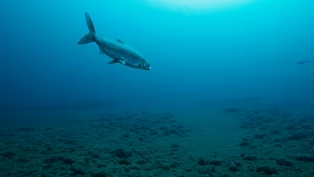
All Too Clear: A Silver Lining (Ep. 3)
Video has Closed Captions
Fish adapt to mussels, cisco rebound in Great Lakes, and whitefish seek river refuge. (56m 15s)
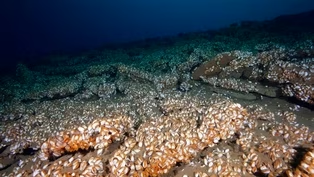
All Too Clear: Muddy The Waters (Ep. 2)
Video has Closed Captions
Fighting Back: The High-Stakes Quest to Control Quagga Mussels. (55m 16s)
Providing Support for PBS.org
Learn Moreabout PBS online sponsorship(waves crashing) (gentle music) (narrator): As winter descends on the Great Lakes of North America, lake whitefish return to the rocky reefs where they were born, to spawn under cover of darkness.
It's one of the largest freshwater fish migrations on our planet.
But it's rarely been witnessed by humans.
This female looks to be carefully choosing where to lay her eggs, pursued by a male eager to fertilize them.
It's a dance as old as the lakes themselves.
But every year, fewer fish are taking part.
Lake whitefish were once a key part of an incredible freshwater ecosystem that's nourished the people of the Great Lakes for millennia.
But now, life in these vast waters is struggling to survive in an environment utterly transformed by a tiny invasive species, the quagga mussel.
(Elgin): There's quadrillions of quagga mussels in the Great Lakes.
In a week's time, every gallon of water in Lake Michigan could have passed through a mussel.
(Weidel): Those mussels created a system that is really now much different than what we had seen before.
It's just incredible the clarity of the lake.
(Sweetnam): Clear water, from an aesthetic perspective, people kind of love that.
But from an ecosystem's perspective it really means nothing's there, nothing's growing.
The offshore waters have been described as a biological desert.
(Smith): It's my opinion that invasive quagga mussels have been the biggest change in the Great Lakes ecosystem, really going back since the glaciers.
(dramatic music) (narrator): The Great Lakes of North America form the largest interconnected body of freshwater on Earth.
While images of the oceans fill our screens and live in our imaginations, the vast and magnificent freshwater world has long been hidden from our view.
Only now, using state of the art, underwater drone technology, are we finally able to explore the wonders hidden beneath the surface of the Great Lakes.
(serene music) (bubbling) (cracking) (narrator): All winter, the lake whitefish eggs have been maturing, safely hidden in the cracks between rocks.
As the early spring sun thaws the ice, and starts to warm the water, the hatch begins.
(♪♪) At first, the larvae get nourishment from their egg sacs.
But that won't last long, and they soon head out in search of tiny aquatic animals called zooplankton.
Life is hard for a baby whitefish.
If they don't find food quickly, they will starve.
They must also contend with predators trying to eat them, and sometimes, the nets of scientists trying to save them.
(water sloshing) (clattering) - Now we wait.
So, we got some larval fish in here.
(squeaking) (splash) This is historically, really one of the most significant spawning shoals for whitefish in Lake Huron.
And it's one of our study sites, where we've seen declines in whitefish populations.
And what we're out here looking at is whether they, um, are getting enough food to eat.
I was interested in studying whitefish because of their importance in the commercial fishery and their importance to Indigenous communities.
I think they have a pretty unique role in the lake.
(bubbling) (narrator): Lake whitefish, also known as Atikameg, or Atikmeg , in many Indigenous communities, is a cold-water fish related to salmon and trout.
They can be found throughout northern North America.
In the Great Lakes, they can grow to more than 6 kilograms, or 13 pounds, and live for over 30 years.
Their mouths have evolved for digging into the lakebed, to feed on animals living in the soft sediment.
They often move in schools, grazing the lake bottom.
This feeding behaviour, akin to bison grazing grasslands, stirs up nutrients and leaves impressions on the lake floor.
Whitefish probably migrated into the Great Lakes shortly after the lakes formed from melting glaciers, about 12,000 years ago.
Their numbers likely once approached 100 million, playing a crucial role in shaping the lakes' ecosystems.
But now, their future hangs in the balance.
(Dunlop): Just to give you a sense of how much the population has declined, in southern Georgian Bay, um, we used to catch between about 10 and 15 lake whitefish in an individual monitoring net, whereas now we rarely catch a single individual.
It's a pretty dire situation for lake whitefish right now.
(water bubbling) (narrator): Whitefish began declining in the lower Great Lakes in the 1990s.
Recent years have seen them disappear throughout Georgian Bay, Lake Huron and Lake Michigan, with devastating consequences.
(birds chirping) Some of the steepest declines have occurred in Northern Lake Huron, where the Purvis family has fished for over 140 years.
(Denise): My family's been fishing on Lake Huron since 1882.
Whitefish has been our main fishery now for a long time.
It's the one that everybody wants to use for the fish and chips.
It seems to be the fish-- the best fish for that.
(George): We were getting about a million pounds a year in the, in the high years.
And they've got to the point now, here in Lake Huron, right here, in this part of Lake Huron, there are none at all.
Like, I mean, you'd be lucky if you saw one or two fish.
(Denise): Out here, we mainly just catch lake trout now.
So, that's all we can do is try to make a living out of that.
Yeah, it hasn't been easy.
(chuckles) Yeah, it's a lot harder than what it used to be, but we just hope that it changes again, right?
That's all we can hope for, is that it gets better again.
(water bubbling) (narrator): 350 kilometres, or 220 miles to the west, the story is the same for the Henriksen family, who've fished for decades in Northern Lake Michigan.
(Henriksen): There used to be six or eight boats here all the time.
We used to catch millions of pounds of fish.
It's all just disappeared.
(narrator): Indigenous communities have been hit hard by the whitefish decline.
This is especially true for the Sault Tribe, who have fished for centuries in Northern Lakes Huron and Michigan.
Each summer, Sault Tribe scientists undertake the grim task of estimating fish populations in their territory.
- We're just trying to get a sense of fish populations, all the species, all the age groups.
In this entire survey, we've happened upon maybe 20 or 30 whitefish this summer.
That's not really enough for the tribal commercial fishery to exist on.
No one is currently fishing throughout this whole area, and that's unheard of.
- It's kind of disheartening to see what's left of this fishery after being part of it for 30 years.
It's actually been devastated.
(gentle music) (Sheppard): I am worried about the future, 'cause I've seen how the fish has, has changed.
It will be really heartbreaking if we lose it.
Like, I want my kids to experience what I've experienced growing up here, and if we can't get this under control, then they won't be able to do that.
(seagull squawking) (narrator): When fish populations collapse, overfishing is often to blame.
That doesn't seem to be the case here.
(Smith): We do have a long history in North America of over-harvesting.
But the Great Lakes are actually managed really, pretty closely.
(wind gusting) We're, in almost every case, not harvesting anywhere near the number of fish that our best math says we could harvest safely, and yet the decline continues.
That tells us very clearly that it's not a harvest problem.
It's a recruitment problem.
Getting from being a baby to an adult, that's where the problem is.
And that's what makes it so challenging.
(water rushing) (narrator): Like, Erin Dunlop, Sault Tribe scientists are also trying to figure out if baby whitefish are getting enough to eat.
(bubbling) (Smith): What we're looking for is large-bodied zooplankton, the food that would really make these young fish grow well.
(dramatic music) (narrator): The zooplankton are so small that Sault Tribe staff use a microscope to count their tiny catch.
(Smith): If we go back to 1970s, we'd see something like 700 large-bodied zooplankton per litre of water.
What we're seeing here typically is one to three zooplankton per litre of water.
We know we're orders of magnitude lower than places where, where whitefish are doing great, and, and we're pretty confident that's part of the problem.
(water flowing) (narrator): Erin's work digs even deeper into why baby whitefish aren't growing up.
(Dunlop): We've got larval fish.
We actually take out their stomachs and have a look at what's inside.
(narrator): By closely examining their tiny bodies, Erin's team has discovered what the larvae are eating, and how fast they're growing.
(Dunlop): So, what we're finding is that the growth rates of larval fish are now just 50% of what they were, um, historically.
This is our indicator that perhaps these larval fish are not getting enough food to eat.
(Smith): If we were here a hundred years ago, every inch or two, they would have found a zooplankton to eat.
Now, they're literally swimming thousands of body lengths in order to get a single meal.
We believe it's directly due to invasive quagga mussels.
(narrator): Historically, whitefish would have hatched into what's known as the spring algae bloom.
As the strengthening sun penetrates into the water, it encourages the growth of algae, turning the water green.
Zooplankton then feed on the plentiful algae and multiply.
The result is an exponential increase in food for baby whitefish, right when they need it to survive.
But now, the algae are being consumed by mussels.
In some years, the spring bloom has been diminished.
In others, it has disappeared almost completely.
To make matters worse of the zooplankton that remain, many are baby mussels known as veligers.
(Lewandowski): In some areas they can be up to about a million per metre squared.
And on average, in the lakes, they can account for somewhere around 20 to 40 percent of the available zooplankton biomass.
(dramatic music) (narrator): Quagga mussels spawn by releasing eggs and sperm into the water, with each female producing up to 1 million eggs per year.
Fertilized eggs quickly become free-swimming veligers.
They move around for about a month, before settling onto the bottom, growing into adults, and starting to spawn themselves.
(birds chirping) At the Detroit River, PhD Candidate Katrina Lewandowski is trying to figure out what impact these veligers might be having on another important fish... (splashing) The yellow perch.
- I've always liked yellow perch.
I think because they're colourful and because they're charismatic, they swim around a lot, and they're usually what you see in the shallows.
(narrator): Compared to the lake whitefish, yellow perch are small, with the big ones only reaching about half a kilogram, or one pound.
But they play a mighty role in the ecosystem of the Great Lakes.
Like whitefish, yellow perch have mouths designed to dig animals out of the lake bottom.
Where whitefish prefer deeper waters, perch graze the shallows.
Their small size makes them a favourite food of many predators, such as their much bigger cousin, the walleye.
Yellow perch are also one of the most important fish economically in the Great Lakes, prized by both recreational and commercial fishers.
While their populations haven't collapsed like the whitefish, perch numbers have declined in many areas, likely due in part to the quagga mussel.
(water rushing) (splash) (Lewandowski): I was connected with researchers that study larval fish in the Great Lakes, and they have noticed that larval fish, such as yellow perch, were eating a lot of veligers, but they didn't understand how they were impacting their growth or their survival.
So, being so close to the Detroit River, we can collect veligers and bring them back to the lab to feed to the yellow perch to see how they grow and survive.
(pensive music) (narrator): Katrina fed one group of larval perch the mussel veligers she collected from the Detroit River.
She fed another group brine shrimp.
Brine shrimp are similar to the zooplankton baby perch would normally feed on in the wild, but they're easy to grow in a lab.
(Lewandowski): So, I did an experiment over two years measuring their survival and growth on a diet high in veligers and then 100% brine shrimp.
When I lined up fish that had been in brine shrimp only treatments, versus veliger only treatments, you could really see how small they were.
And just overall, had a poorer body condition.
And so, the fish didn't survive as well that lived in only veliger treatments.
It kind of suggests that veligers may have a broader impact on Great Lakes fisheries.
(narrator): The news gets even worse for larval fish in the age of the quagga mussel.
New research suggests the increased water transparency may also be very damaging to baby whitefish.
(Berry): Just like we can get sunburned if we're exposed to UV, or ultraviolet radiation, fish can also get sunburned.
They can even die if they have enough damage from UV.
Go ahead and bring it out, and then I'm gonna stop recording.
At this site, we said it was, what, 5.7 metres?
So, almost the entire water column is getting exposed to some level of UV radiation.
(Smith): Ready?
(Berry): Yup.
(Smith): Lowering (narrator): Working with partners like the Sault Tribe, PhD candidate, Nikki Berry has been collecting UV profiles around the Great Lakes, to learn how deep UV radiation is now penetrating into the water.
(Berry): We have found some of the deepest profiles reaching almost 10 metres deep, which is very deep.
(chuckles) Now to try to understand how much UV is actually gonna damage the fish, it gets a little trickier to do.
But at a site like this, where UV is almost reaching the bottom, there's not a lot of room for them to escape.
(boat rattling) (narrator): It's not yet known how much the Great Lakes' clearer waters are damaging baby whitefish.
But in a laboratory setting, Nikki has been able to measure how much ultraviolet radiation larval fish can withstand.
Her results don't bode well for the lake whitefish.
(Berry): They have such a low tolerance I've had issues sometimes even trying to expose them to low enough levels of UV that they can survive for even five days after the exposure.
Their bodies will literally start to turn on themselves, and kind of twist.
It's really, really unfortunate to watch it in the lab, and then to try to apply that to the natural system is, you know, it's kind of sad.
(gentle music) (Smith): Sault Tribe's creation story is based on a relationship with Atikameg.
The creator led the people here when they were hungry and explained that they'd have this relationship if they took care of it.
And the Anishinaabek took care of this relationship for thousands of years.
And now, the number of fishers is at an all-time low.
The number of fish harvested is at an all-time low.
And that relationship between the people and the fish is really in jeopardy.
We really are at a point where we have to do something.
Time to just talk about it is long gone.
It is time to do.
(♪♪) (narrator): The Indigenous communities of Northern Michigan are taking extraordinary measures to protect baby whitefish.
These eggs were collected last fall from one of the few spawning aggregations left in Northern Lake Huron.
After maturing for several months, they're starting to hatch.
(♪♪) (bubbling) (Aikens): The driving theory behind their decline in the Great Lakes is the lack of food.
There's just not enough food out there when they emerge from their eggs to get them off to a good start.
So, if we kind of help them through that stage here in hatcheries, maybe we can help them out.
(narrator): Instead of the dry pellets usually fed to fish in hatcheries, Rusty is using live brine shrimp.
The goal is to better prepare the whitefish for their future in the wild.
(Aiken): So, hopefully the brine shrimp will, will mimic nature more, right?
Because it's basically a zooplankton.
We're hoping it helps build that prey drive, and kind of teaches them how to get their own food when they do get in the wild.
The reason you find Sault Tribe in northern Michigan is because this is where the whitefish were.
There's members out there making a living off of fishing, and it's really been tough for them.
And also, people like having it on their tables.
So, the decline is a big hurt to our community.
If we can do what we can, hopefully we can make some difference here in the future.
(birds chirping) (narrator): To understand how things got so bad that the Sault Tribe is trying to raise whitefish in hatcheries, we must venture out into the vast offshore waters of the lakes.
(squeaking) (water bubbling) (crash) It's here, far beneath the surface, where quagga mussels have truly taken over.
(squeaking) (rattling) (boat deck hand): Surface!
(rattling) (narrator): Few have studied this invasion more deeply than Research Ecologist Ashley Elgin.
(Elgin): Today we are continuing our long-term monitoring of dreissenid mussels in Lake Michigan.
We are tracking dreissenid mussels because we have a survey that we've been conducting since before they even arrived.
(eerie music) (narrator): The quagga mussel is the slightly larger, and much tougher cousin of the infamous zebra mussel.
They're both native to Eastern Europe and are so closely related that scientists often refer to them together as dreissenid mussels.
(birds chirping) Both species hitched a ride to the Great Lakes in the ballast water of cargo vessels in the late 1980s.
(Boat deck hand): Surface.
(clattering) (Elgin): The invasion was first dominated by zebra mussels being seen in the nearshore.
But starting in the 2000s, the quagga mussels were more prominent, and their numbers really exploded.
And they expanded into deeper waters and colonized all the lower Great Lakes almost completely.
(clatter) (narrator): A dive into the offshore waters of much of the Great Lakes is now a descent into a world dominated by quagga mussels.
Out here, most hard surfaces are encrusted in mussels.
(eerie music) But what's truly extraordinary about quagga mussels, is their ability to continue spreading from rock to the mud and sand that make up the majority of the lake bottom.
(Elgin): Quagga mussels, they do like to have a surface to attach to, but they are capable of colonizing soft sediments, and that's what's unique about them, as opposed to zebra mussels.
(narrator): Starting at somewhere around 50 metres, or 160 feet, it's often difficult to see the lake bottom for the mussels.
(Elgin): What we see in those solid carpets, it's about 20,000 mussels you can get in a square metre.
In areas where they are attached and piled on top of each other, you can get 30,000 to 40,000 in a square metre.
Each mussel, as a conservative estimate, could filter one litre a day.
So, if you scale that up, it means that in Lakes Huron and Michigan, all the water could pass through and be filtered by a mussel in a week or two.
(narrator): Anything on the lake bottom out here, is a magnet for quagga mussels.
This is especially true of shipwrecks, like this one, which was discovered during the making of this documentary in Lake Huron.
Resting in over 80 metres, or 260 feet of water, it's believed to be the steamship "Africa."
Built in 1873, it was lost in a storm in 1895, along with all 11 crew members.
(♪♪) But many of its secrets remain hidden under millions of mussels.
(high-pitched squeaking) (Martin): There is just so many quagga mussels on this shipwreck.
Like there's hardly an inch of bare wood that I can even see.
All of these shipwrecks now are completely covered in quagga mussels.
So, I no longer see that bare deck, or the dishes on board, or the machinery.
Instead, I see a lump that I know, "Oh, hey, this is part of this machinery equipment," that I now recognize as a shape, not as the actual piece of equipment.
(narrator): Kayla Martin volunteers for an organization dedicated to the preservation of Ontario's shipwrecks.
(indistinct chatter) She's helping us document this newly discovered wreck, before it's destroyed by quagga mussels.
- Circle the wreck.
(Martin): Quagga mussels have byssal threads, which burrow into the wood.
And that's how they hold on, and so they don't fly away, off into the current.
But these threads are slowly destroying the wood as they burrow into it.
Also, the weight of the quagga mussels, as they slowly build on top of each other, will cause fragile pieces of wood to collapse.
So, overall, quagga mussels are very damaging to shipwrecks.
Yeah, there you go, that's looking good.
These shipwrecks are a critical part of our heritage, which is why we're in a quest right now to document all these shipwrecks before quagga mussels destroy them.
(eerie music) (narrator): In recent years, quagga mussels have spread to even the deepest, darkest, coldest depths of the Great Lakes.
(Elgin): In our annual survey a few years ago, we added more deep sites, so that we can say, "Well, we'll, we'll get these sites now, and then we can see when muscles reach these sites."
We get the before.
They were already at those sites, at the deepest sites.
So, confirmed they are at 200 metre depth.
(water rushing) (narrator): The mussels now cover the bottom of most of the lower Great Lakes.
Only Lake Superior remains mostly untouched, likely because the lake lacks the minerals the mussels need to build their shells.
To see what it was like before the mussels invaded, we must go to Lake Superior.
(gentle music) At first glance, this lakebed might appear lifeless.
(whooshing) But if you look closer, you'll see it's alive with a nearly limitless number of tiny freshwater shrimp, called diporeia.
(Elgin): Diporeia were historically the dominant organism that was on the bottom.
They're small, but curled up, kind of plump crustaceans.
They look very playful, I think.
(♪♪) They consume detritus on the bottom, and organic matter, and they're an important part of cycling at that lower part of the food web.
They themselves are a very high-quality food source.
They have high fat content.
And they were the preferred and prime prey for a lot of fish species.
(Smith): If we were studying whitefish diets in the 1940s, my best guess is that we would be like 95% diporeia.
But now we really have just a couple locations left in the Great Lakes where diporeia even live.
(♪♪) (narrator): As the mussels advanced, the diporeia disappeared.
Most native fish can't eat the mussels, compounding their profound ecosystem changes.
(Elgin): There's all this energy that was up in the water column that's now trapped in the mussels.
Then it starts with less food for zooplankton, and then the small fish that eat those zooplankton, and the larger fish that eat the smaller fish.
And it resonates throughout the food chain.
(boat deck hand): Surface.
(Elgin): It's hard to understand how something that is this small, and even much smaller than that rewired the food web.
(waves crashing) (indistinct boat chatter) (narrator): With most of the energy in the offshore waters now trapped in mussels, the biggest losers have been a group of species known as prey fish.
(man): Net going out.
(splash) (narrator): United States Geological Survey biologist, Bo Bunnel, is on Lake Michigan, tracking their decline.
- We are doing a long-term assessment the USGS has been doing since 1973.
We're trying to figure out how many prey fish, or forage fish, are in the lake that feed the salmon and the trout.
(bubbling) (narrator): To catch prey fish, the USGS uses a net that trawls the lakebed, which is where these fish are most likely to be during the day.
(Bunnell): We have this seven-billion-dollar fishery for the Great Lakes.
Ultimately the fisheries are supported by the larger fish.
But those big fish need some smaller fish to eat.
And so, we call those prey fish, it's kind of a weird word, but it just means they are prey for the larger, bigger fish.
(gentle music) (narrator): The most abundant prey fish in the lower Great Lakes has, for decades, been a non-native fish called the alewife.
(Bunnell): Not all prey fish are as important to the top predators.
And alewife, for whatever reason, is the most important.
If you look at the diets of almost all the salmon species, especially, alewife dominates 90% or more of what you see in their stomachs.
(water flowing) (electronic humming) I think my first survey was in 2005.
And we're getting all kinds of fish, buckets and boxes of fish.
We would often have to tell the captain to, "Slow down."
We needed more time to process these fish.
It's not like that today.
(narrator): Today, what the bottom trawling-net catches most is mussels.
(boat hand deck): Bring it close enough that I can choke it with the crane.
(electric humming) All right, stop there.
So, it caught too many mussels, we're unable to get it on board.
So, we're gonna have to redo this tow again, but we're gonna dum the caught end, full of mussels, uh, right now with the crane.
Yeah.
Keep doing that... (man): So, should I chop that clear?
- No.
Just leave it.
(metal scraping) (ding) (splashing) (indistinct chatter) I don't know, thousands of pounds of mussels in there.
- Six, six-hour day.
- Six-hour job.
(narrator): After their net breaks from the weight of the mussels, the crew of the Arcticus tries again.
This time, the crew reduces the length of the trawl from seven minutes, to two, in hopes of getting the net on board.
(whirring) (clattering) The short trawl works, and they are able to land the net.
(Fish Scientist): Here you go.
Here's a deepwater.
(narrator): But their catch contains only a single fish.
(Bunnel): We only did a two-minute tow, so, we wouldn't expect to catch a lot, but I would expect to catch more than this.
(whirring) (narrator): Their luck improves in subsequent catches, but not by much.
(indistinct chatter) - Ah, alewife!
(Fish Scientist): All right!
(Bunnell): Some of the catche we've seen today are reflective of those generally lower catches.
We're not getting anywhere close to multiple totes of fish.
(Crew Member): Oh, we got fish.
(Crew Member 2): Yeah, a few alewife in there.
Not much.
(Bunnel): Now we can sort of fill up the totes with mussels, or even catch so many mussels we can't even get them on board, as you saw earlier today.
(clatter) Yeah, it definitely is alarming.
(gentle music) There's been an 80 percent reduction in prey fish biomass over the past 30 or so years, to levels now that are lower than we've ever measured.
In Lake Huron in particular, alewife collapsed, for all intents and purposes.
And so, that had tremendous consequences for the salmon fishery in Lake Huron.
(eerie music) (indistinct boat chatter) (narrator): In concert with the decline of prey fish, came the huge increase in water clarity.
Fisheries biologist, Brian Weidel, remembers when the change happened in Lake Ontario.
(Weidel): We were out there working, and we drop a device into the water, it's called a Secchi disk.
And the deeper we can see that disk in the water, the clearer the water is.
And I'm letting the device down, and we're at 15 metres, it's small, but I see it clearly.
We're at 20 metres.
It's tiny, but I see it clearly.
It's at 24 metres and I don't have any more rope.
We quite frequently are able to see that disk 20 metres down or deeper.
And it's just incredible, the clarity of the lake.
It helps you think, "Wow, how much of this is what we've done and how much of this is due to those mussels?"
(suspenseful music) (narrator): As relentless as the mussels are, this huge change in the lakes cannot be blamed on them alone.
The other reason is because we've done such an excellent job cleaning up the Great Lakes.
It all comes down to nutrients, the real base of the food web.
(water babbling) (whoosh) When nutrients enter a lake, through a river, rainfall, or even a sewer system, they react with sunlight to grow algae.
The more nutrients, the more algae, and the murkier the water.
But it also means there's more algae for zooplankton to eat, and lots of zooplankton for fish to eat.
(bubbling) As a result, ecosystems high in nutrients can support more fish than ecosystems low in nutrients.
(Weidel): A clear lake with low nutrients has a lot of value, but it can't have as many fish in it.
And that's just a natural constraint of ecosystems.
(narrator): In the 1960s, there were far too many nutrients in the Great Lakes, largely the result of untreated wastewater from cities and industry.
This resulted in a massive overproduction of algae, which greatly reduced water quality and even created oxygen-starved dead zones where fish could not survive.
(narrator): Robert Hecky was part of a group of scientists who spent decades working on the issue of too many nutrients in lakes.
They discovered that the key to fixing this problem was controlling the nutrient phosphorus.
(narrator): Canada and the United States signed the Great Lakes Water Quality Agreement in 1972.
The agreement set targets for phosphorus in each lake, and both countries began aggressively reducing phosphorus pollution.
The resulting cleanup is considered one of the most successful pollution control programs in world history.
But, as the nutrient levels went down, so did the number of fish.
(Weidel): It's a little weird to think of reducing pollution actually causing a decline in fish.
(clanking) (man): Whoa!
(Weidel): But, as the minera nutrient inputs to Lake Ontario and the Great Lakes as a whole declined, the prey fish abundance declined.
And the steepest declines happened after the Clean Water Act.
(narrator): But then came something no one had foreseen.
(eerie music) (Weidel): They didn't count on the mussels, right?
The mussels created a system that is really now much different than what we had seen before.
And now nutrients are actually below the target originally set, and while the lake look incredibly clear and beautiful, it can't support as many fish.
(♪♪) (birds squawking) (narrator): Added together, this unlikely combination of the effects of humans and mussels is the reason the Sault Tribe is taking drastic measures to help starving whitefish.
- Is it going over by the bank?
- Yeah.
Pull the bags out.
(narrator): After a month in the hatchery, the whitefish are headed to a new temporary home.
(man): I would just float 'em where they still touch the bottom.
(Aikens): The fish look good.
So, this morning we're gonna stock the ponds with our larval whitefish.
It's always exciting.
Uh, you know, it's another step in the, in the process, and to get to here is a minor victory in itself.
(man): Freakin' out.
(Aikens chuckling) (bubbling) (narrator): The whitefish babies will spend several months here, hopefully growing strong enough to survive in the Great Lakes.
(Smith): Our pond has lots of zooplankton, unlike the Great Lakes, and these fish grow great there all on their own.
We basically ignore them, we get to the late fall, and we can catch them and release them once they've gotten past that reliance on zooplankton.
(suspenseful music) (narrator): After spending the summer in the pond, it's time to see if the whitefish are ready for the Great Lakes.
(man): Great.
- Big, beautiful fish, really nice.
- They're nice size.
They look healthy.
They look good.
(splashing) (tense whimsical music) (Smith): Those fish hit the water and immediately started feeding, hiding.
These were fish that in my mind had a bona fide shot of going out and becoming adult fish and doing fishy stuff.
(narrator): With a little help, these 2,500 young whitefish now have a fighting chance of growing up.
But, for a species that once numbered about 100 million, this is a drop in the bucket, unless something changes in the Great Lakes.
(♪♪) - When I am talking about this story, I usually use whitefish because it's the easiest to show the link.
Quagga mussels reduce the food, decrease whitefish abundance.
It's super clear.
But if the invasion continues to increase, I'm not at all confident tha there will be food for walleye, smallmouth bass, and many of the other fishes in the Great Lakes.
(gentle music) We're going to have to think far outside of the norm if we're going to save this relationship between the people and the fish.
(outro music) Subtitling: difuze
 New Episode
- Science and Nature

Explore scientific discoveries on television's most acclaimed science documentary series.
 New Episode
- Science and Nature

Capturing the splendor of the natural world, from the African plains to the Antarctic ice.


 New Episode








Support for PBS provided by:
All Too Clear is a local public television program presented by Detroit PBS