Chicago Stories
Chicago Stories: Skyscrapers
10/16/2026 | 55m 57sVideo has Audio Description
Explore Chicago’s iconic skyline and the visionaries, rivalries, and dreams that shaped it.
Chicago has been a leader in architectural innovation since the 19th century. Its ever-evolving skyline reflects the imagination and ingenuity of architects who dreamed big. Explore the visionaries, rivalries, and ambitions behind the city’s towering landmarks. Audio-narrated descriptions are available.
See all videos with Audio DescriptionADProblems playing video? | Closed Captioning Feedback
Problems playing video? | Closed Captioning Feedback
Chicago Stories is a local public television program presented by WTTW
Lead support for CHICAGO STORIES is provided by The Negaunee Foundation. Major support is provided by the Abra Prentice Foundation, Inc. and the TAWANI Foundation.
Chicago Stories
Chicago Stories: Skyscrapers
10/16/2026 | 55m 57sVideo has Audio Description
Chicago has been a leader in architectural innovation since the 19th century. Its ever-evolving skyline reflects the imagination and ingenuity of architects who dreamed big. Explore the visionaries, rivalries, and ambitions behind the city’s towering landmarks. Audio-narrated descriptions are available.
See all videos with Audio DescriptionADProblems playing video? | Closed Captioning Feedback
Where to Watch Chicago Stories
Chicago Stories is available to stream on pbs.org and the PBS app.
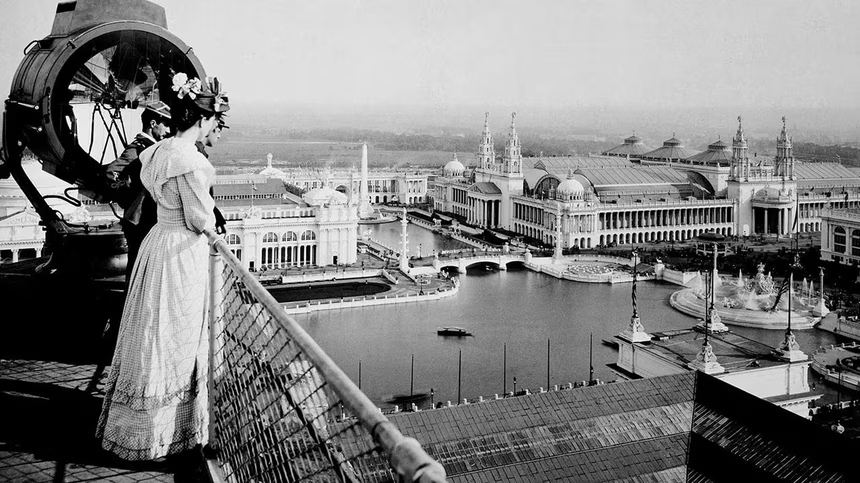
Chicago Stories - New Season!
Season 6 includes: The World’s Fair of 1893, Toy Town, Skyscrapers, and Home of the Irish.Providing Support for PBS.org
Learn Moreabout PBS online sponsorship- [Narrator] Coming up and up and up.
- Big, strong, up to the street, unapologetic temples to mercantilism.
- [Narrator] Chicago builds a new kind of city, a city of skyscrapers.
- Remember, we've got this compact downtown.
There's no place to go but up.
- This is kind of like Godzilla coming out of Lake Michigan.
- This was really hot stuff.
- [Narrator] The bold invention amazes.
- They stand there and they immediately do this.
- [Narrator] And terrifies.
- How do you know that is going to hold up?
- [Narrator] Builders defy gravity.
- Your tower is going to sink into the ground.
They went ahead and built it.
- [Narrator] Architects think big and dream even bigger.
- What can we do with this building type?
How do you come up with something creative and beautiful?
- [Narrator] Behind every tower looms a larger story of visionaries, rivalries, and the eternal quest to soar higher.
- This building says, "Man, we've arrived!"
- [Narrator] And when it comes to building tall, there is no place like Chicago.
- Oh my god, it's exciting!
- [Narrator] "Skyscrapers."
Next on Chicago Stories.
(bright music) (bright music fades) - Chicago is flat.
We didn't have mountains or cliffs or canyons, so we built them.
- [Narrator] The dazzling Chicago skyline is a sight to behold.
Towers so tall as to seem otherworldly.
- I got that thrill.
Like when you see the mountain range when you're going out to Colorado, you see the first time.
- [Narrator] Chicagoans dreamed big and broke boundaries over and over again with magnificent innovations in architecture.
- They express the desire to achieve, to do something bigger or taller than the last person, to reach up.
Who lives up in the sky?
God lives up in the sky, right?
So if you can reach up, you've shown that you've accomplished something.
As a human, you've done something great.
- [Narrator] And Chicago was on its way to something great in 1966, as the John Hancock Center rose on the shores of Lake Michigan.
At a towering 100 stories tall, the Hancock would be nearly double the height of any other building in town and the second tallest in the world.
- And it's like nothing that anybody has seen before.
- [Narrator] But disaster struck when one corner of the structure sank, triggering panic.
- When the steel is up to about the second or third floor, the foreman comes on site one day and sees that one of the columns has dropped.
- The whole column slowly slipped out.
It gave way.
- And they want to go up a hundred stories.
So the project comes to a complete dead stop.
- [Narrator] If the glass and steel giant failed, so too would the hopes and dreams of architects, engineers, and city leaders.
Could Chicago meet the challenge?
- This is not a business for the faint of heart.
- [Narrator] The Hancock wasn't the first Chicago landmark to come close to failure.
- It's interesting how our best laid plans can sometimes not always settle correctly, pun intended.
And the Auditorium Theater is a great example of that.
- [Narrator] 80 years earlier in 1889, when the Auditorium Building first opened its doors, it was the largest building in the country.
- The Auditorium was the great monument of Chicago of this era.
- [Narrator] It was the dream of a young Chicago-born opera lover and philanthropist, Ferdinand Peck.
- He was the son of an old Chicago family and he had these high ideals and ideas for the city.
- [Narrator] Peck believed a grand music hall could help heal the city in a time of violent labor struggles.
If he kept ticket prices low, the working class could sit next to the elite and find common ground in their shared appreciation of high art.
- There was this sort of cheeky article that was written for "The New York Times" saying, what does Chicago need a beautiful theater like this for?
It is of wolves and bears out there.
- [Narrator] To support his opera house, Peck proposed something unheard of: a block long multi-use complex that included a hotel and rentable office space.
But when Peck chose the upstart architectural firm of Adler & Sullivan for a project of this scale, eyebrows were raised.
- This relatively small and inexperienced firm.
What had they built up to that time?
Loft buildings, small residences.
- [Narrator] German-born Dankmar Adler was a successful engineer and theater designer.
His much younger partner, Boston-born architect Louis Sullivan, however, was another matter.
Though he was considered a visionary, Sullivan could be temperamental and erratic.
- He really needed Adler, the engineering partner in the firm, to kind of balance him and to turn those ideas into practical realities.
- [Narrator] Adler's biggest challenge: Chicago's bedrock sits so deep, 80 to 200 feet down, that digging to it was financially out of the question.
- Chicago is probably one of the worst places in the world to try to build a tall building.
We are on the shore of a very big lake, and for the last 10,000 years or so, the soil here has just gotten saturated.
- Engineers have a drive, thankfully, to make the most effective and efficient structure that you can to hold up anything.
- And they actually figured out a way that's almost like a raft floating on the ocean to do it and it actually worked.
- [Narrator] The innovative foundation was a concrete and steel slab that spread the building's enormous weight evenly, and sat just 14 feet down in Chicago's soft clay.
- And the raft foundation included a pyramid.
And that essentially floated on that sea of mud.
Just imagine you're the contractor, you're building the Auditorium Building and you have to account for the fact that it is going to sink a little bit.
And so you build it a certain level, two feet above the sidewalk, let's say, and then you're hoping that it's gonna gently settle down to sidewalk level by the time it's done.
- [Narrator] Peck was obsessed with owning the tallest building in the country, and demanded a 17th story be added to the tower.
- Dankmar Adler told the client, "Your tower is gonna sink into the ground."
They went ahead and built it.
- [Narrator] After three painstaking years of construction, Adler held his breath as the overloaded building finally settled, unevenly.
- You walk into their lobby and put a marble and you know, kind of watch it roll as the building has started to settle.
- When you walk into the Auditorium today, you walk down two or three steps instead of up.
- [Narrator] Despite these failings, the Auditorium Building put Chicago on the map as more than a place of stock markets and stockyards.
It was now a place of high culture.
- [Robert Bruegmann] It was the building in Chicago that probably made New Yorkers jealous in a way that almost nothing else would have.
- [Narrator] Its crown jewel?
A dazzling 4,237 seat theater where Sullivan's talent for ornamentation inspired by nature was on full display.
- This wonderful space just opens up before you with the lights agleam.
The acoustics were perfection.
- Here we are just a decade after the Great Fire and this wonder has appeared.
- [Narrator] With his reputation secured, Sullivan wanted to show Chicago, and the nation, the skyscraper's true artistic potential.
He argued, "It must be tall, every inch of it tall.
It must be every inch a proud and soaring thing."
- When you said Louis Sullivan, I just smiled because he is a soul that is behind tall buildings, but really tried to theorize how they should be done, how they could be humane.
- It's accurate to call Sullivan one of the fathers of the skyscraper because he actually is one of the first people to think about it as an object, not just as a pile of floors.
Sullivan sat there and asked, "What should this look like?
How should this feel?"
- He is bringing nature into architecture in order to soften and civilize the expression of its structural frame.
So if you look at his buildings, they sort of rise upward almost like trees that explode into leaves and berries and other decoration at the top.
- And I think you can look at almost any skyscraper anyway, and there's a bit of Louis Sullivan's DNA in 'em.
- [Narrator] Over the years, Sullivan's influence faded in the city he helped to define.
- [Blair Kamin] Chicago is often said to be great at building great skyscrapers and equally good at tearing them down.
And Sullivan's buildings are the prime example of that.
It was a great tragedy.
- [Narrator] His final days were spent alone and broke as his buildings fell out of fashion.
- And yet, over time we've come to recognize his brilliance and the enormous influence he had.
- [Narrator] Sullivan had shown that tall buildings could be proud, soaring things.
They also made good business sense in Chicago's downtown district, a roughly 1.5 square mile area contained by the lake, the Chicago River, and the railroads.
- We've got this compact downtown, so there's no place to go but up.
- A skyscraper is a machine that makes the land pay.
- [Narrator] Soon, more than 100 new skyscrapers appeared in Chicago, thanks to another innovation in construction, a fireproof metal skeleton frame that supported each floor.
- An internal cage to support the weight of the skyscraper.
- And then sort of the exterior of the building kind of becomes like a suit that hangs over it.
- [Narrator] This radical development eliminated thick load-bearing outer walls.
- With that, you could make a stronger, taller building, and then theoretically the sky was the limit.
You could build until you run out of steel.
- So the elevator was essentially what made possible the tall building.
You couldn't imagine the portly Chicago businessman walking up six flights of stairs.
It just wasn't gonna happen.
- [Narrator] For the first time, large windows appeared, a luxury in a time of limited electricity.
- These early buildings were really concentrated on large windows that let in a lot of light.
Also, they needed it to provide ventilation.
- The amazing thing about the early skyscrapers was the speed in which they were constructed.
It's like putting together almost like toys, like tinker toys.
(soft lilting music) - [Narrator] Many Chicagoans were worried.
To some, skyscrapers were risky experiments.
- People thought they'd fall over.
Keep in mind that people had never been this high before.
- If there were a fire to break out on the 20th floor of a building, would there be so many people rushing on the street that people would be trampled?
- [Narrator] All this anxiety took its toll.
By the early 20th century, city officials imposed height limits on new construction.
Chicago's first skyscraper boom was over.
Shorter buildings with a bigger footprint became the norm.
But after World War I, Chicago was primed to explode upward once again.
- [Lee Bey] There's a lot of money coming through the city at that time and coming through the nation.
- Incredible economic growth, the electrification of America.
It was a great time for skyscrapers.
- [Narrator] Under pressure from cash rich developers, the city lifted the height limit, and the race to the sky was back on.
Though buildings were capped at 264 feet, they could go higher if they narrowed as they rose.
- One of the things that the city is concerned about is they're wanting to make sure that sunlight and fresh air can get to the street level.
- You have to build in within what's called a setback.
And then there are a variety of ways that architects fill the space above that to not only make their clients money, but to also try to make aesthetic sense of these new zoning codes.
- [Narrator] The skyscraper began to take on a new shape.
Chewing gum magnate William Wrigley's 1921 building showed off the look, rising to an impressive 438 feet thanks to its famous clock tower.
- The Wrigley Tower does become this symbol of capitalistic achievement, and of course the symbol that Chicago north of the river had arrived.
- And they see the buildings basically as large billboards that can not only house their workers, but that can also essentially be part of their marketing scheme, that the skyline can become part of their advertising.
- The city's skyline becomes not a skyline of church towers, right, devoted to God, but rather skyscrapers devoted to money.
- [Narrator] The Wrigley Tower stood proudly north of the river where land was cheaper and poised for growth due to the newly opened Michigan Avenue Bridge.
Soon, others would follow.
- Colonel Robert McCormick was the editor and publisher of the "Chicago Tribune" and a man of great ambition and foresight.
- [Narrator] Colonel Robert McCormick returned from serving in World War I to take over the family newspaper.
- He was looking at the skyscraper as a corporate marketing tool, an icon that represented his business.
- [Narrator] Eager to make his mark, McCormick launched an international competition to design new headquarters for his newspaper, a monument to The Free Press and the Tribune itself.
He offered a $100,000 prize for "the most beautiful office building in the world."
- Ah, the Chicago Tribune competition.
What an amazing thing for the city of Chicago and for the history of architecture.
- More than 263 entries poured in from 23 countries around the world.
A brilliant range of designs.
- You had really strict modernist designs coming from Bauhaus architects in Europe, and then you had pretty conservative classical designs done largely by American architects.
- [Blair Kamin] The winning entry by John Mead Howells and Raymond Hood is a neo-gothic spectacular with flying buttresses that don't really hold anything up, but create a tremendous crown, a distinctive presence for the city.
- Why does it look like a gothic castle from centuries past when it's in the middle of a new city right by the lake?
- I think that they wanted something flamboyant, something that really would go on every postcard that would come out Chicago and that Tribune Tower truly did that.
- [Narrator] At 465 feet, the Tribune literally towered over the Wrigley building.
But many preferred the runner up.
- It's a story of not the first place winner, it's a story of the second place winner.
- [Narrator] That was designed by Eliel Saarinen, an architect from Finland, at a time when there wasn't a single skyscraper in Europe.
- Saarinen's entry introduces a trim vertical look of refined setbacks, an ornament that is at once solid, but also soaring.
- [Narrator] Louis Sullivan, nearing the end of his life, praised Saarinen's design.
- Sullivan himself calls it a pearl, something that foreshadows the future.
You can go to almost any American city and find a knockoff of Saarinen's Tribune Tower entry, whether it's San Francisco, whether it's Houston, whether it's New York, Chicago, anywhere.
- [Narrator] Including a building that in 1930 became the city's tallest, the 605-foot Chicago Board of Trade towering over the Financial District.
- That building is doing everything it was designed to do, which is to look straight up at it.
I watch people do it all the time.
They stand there and they immediately do this.
And I always kind of walk by like, "Yes!"
- That view straight south on LaSalle Street into that building becomes the quintessential vision of Chicago.
- It creates a very important kind of exclamation mark of capital right on the street of capital in Chicago.
- Capped by a beautiful statue of Ceres, the goddess of grain and agriculture.
- [Narrator] The race to the sky stopped short and hard in the early 1930s.
The sinking American economy sank the skyscraper.
- The Depression hits Chicago especially hard, and there is literally no market for commercial office space.
- The office vacancy rate in Chicago was probably close to 25%.
- [Narrator] After the country's victory in World War II, the money flowed once more and skyscrapers began to make a comeback.
By the early 1950s, the skyline was primed for a whole new look, as one man would single-handedly transform Chicago into the capital of modernist architecture.
- 860 and 880 North Lake Shore Drive.
These are steel and glass towers that really revolutionize skylines around the world.
- It's still startling when you come down Lake Shore Drive and you see this kind of row of masonry tall buildings, and then you see these buildings are there, it's like, wow, wow, wow.
- [Narrator] These groundbreaking towers rising along Lake Michigan were the creations of Ludwig Mies van der Rohe, who everyone simply called Mies.
- His father was a stone mason in Aachen.
Aachen is a historic city.
- [Narrator] Mies was the director of a groundbreaking modernist design school in Germany called the Bauhaus, developing a more functional humanist architecture.
When Adolf Hitler seized power in 1933, the Bauhaus shut down under pressure from the Nazis.
- They were traditionalists.
They wanted to make Germany great again.
And that meant looking backwards for a lot of what they had in mind.
And Mies just didn't represent that.
And so his work dried up.
- [Narrator] At 52 years old, Mies found a new beginning in Chicago.
The Armour Institute, now Illinois Tech, offered him a position in 1938 to lead its struggling architecture school.
- The newly established Illinois Institute of Technology took a big risk on a quite modern architect who didn't have a track record in the United States.
- Chicago in many respects was a kind of perfect laboratory for his modernist views of the world.
And those ideas sold.
People really, really responded to that.
- There's a question of proportions, of detail.
And somebody said, "God is in the detail."
- [Narrator] And to Mies' students, he seemed godlike: exacting and uncompromising.
And never without a cigar.
- He would often spend a lot of time looking at something but not say anything and puffed on his cigar.
That worked very well for him also in America because his English in the beginning was limited.
- [Narrator] Mies' language constraints didn't put off Herbert Greenwald, a young developer who had turned to real estate after giving up his dream of becoming a rabbi.
- The story is he went to many other people to try to find his architect, Frank Lloyd Wright, and ended up with Mies.
- Whether he was knowledgeable or lucky, he got him.
He got the architect who in my opinion is the most influential architect of the last several hundred years.
- [Narrator] Greenwald bought land on Lake Shore Drive.
He wanted to create high quality housing for middle class professionals.
- And we say it all the time, there are no great buildings without great developers.
- [Narrator] It was a perfect match.
A visionary developer who craved something daring, and a master architect who now had the freedom to build his longtime dream.
- His proposal for an all glass building comes before World War II.
It's in the twenties.
He proposed at a time when the glass couldn't do it, the structure couldn't do it, the cities certainly weren't ready for it.
- [Narrator] The towers at 860 and 880 N. Lake Shore Drive, each 26 stories tall and set at right angles to each other, looked almost unfinished.
- The skeleton and the steel construction is right on the outside.
It's not being covered up in any way.
He is putting it right curbside for you to see.
- [Narrator] Mies' mantra was simple: less is more.
- It taught you a lesson.
Don't overdo it, just do it precisely.
- [Narrator] Lake Michigan was no longer a distant vista.
It was now an ever-present companion.
- Being able to see now these sweeping lake views of Lake Michigan and Lake Shore Drive, this was pivotal in the way that people thought about living.
- We will find that when we give people space and let them indulge themselves as they will, no two spaces will ever be alike.
- [Narrator] But the view cut both ways.
Critics called the buildings sterile and soulless.
- One might say the history of the skyscraper is really the history of creating a human fish bowl.
- [Narrator] And despite modern heat and air conditioning, living behind all that glass could get uncomfortable.
- It can get very hot in the summer in these apartments and cold in the winter.
And sometimes it's so cold outside that the inside condenses to frost on the windows.
And he said after puffing on his cigar, "Think about it.
You are now in America.
Energy is cheap.
We just heat a little more."
- [Narrator] That didn't stop the units from selling fast.
Over half were claimed before construction even finished.
- And at that point, his career just goes boom.
- [Narrator] Mies and his disciples would go on to turn the city into a cradle of modernist architecture, spreading their sleek steel and glass boxes across Chicago and the world.
- I had a colleague years ago tell me, "All buildings look like this.
Why are these buildings important?"
And I said, "Well, those buildings looked like that first.
And that's the important thing."
And out of that, we see the blueprint of the next 50 years.
- [Narrator] Even as his forms were imitated, one student was preparing to break away.
Chicago-born architect Bertrand Goldberg had studied with Mies in Berlin and encouraged his maestro to first come to Chicago back in 1938.
- Bertrand was the kind of man that had a very strong desire to do something of his own.
No question.
Not every architect is like this, but some are.
They don't want to do what their professor is known for.
- [Narrator] Goldberg led the charge against what he called "the tyranny of the right angle."
To him, modernism had become a box, literally and figuratively.
With his concrete Marina City Towers opening in 1963, he showed the city what he was all about.
- Goldberg's buildings are round, they're sensuous, they are smooth.
Pretty much everything that Mies' buildings were not.
- They were new, they were different, they were unusual.
This was really hot stuff.
- [Narrator] A visionary was just what was called for in the late 1950s to save downtown.
Mayor Richard J. Daley was confronted by a crisis of his own making.
People were riding the city's newly built expressways right out of town.
- Mayor Daley, business leaders, and his staff comes together to write a blueprint for revitalizing the downtown area.
I like to think of his projects as almost using the skyscrapers as game pieces to try to rearrange the city.
- [Narrator] Goldberg chose a former freight yard and parking lot along the Chicago River's North Bank to make his statement.
- Marina City is extraordinarily forward looking.
It was very optimistic on a river that was undesirable, to say the least.
It was mostly a sewer.
- And I love that.
I think by nature, if you're not an optimist, it's pretty hard to be an architect.
And these people just believed in their city.
- [Narrator] Goldberg began to experiment with curves, forms found in nature rather than blueprints.
His goal was simple: to make buildings feel more human.
And an innovative use of reinforced concrete poured into fiberglass molds gave him the look he was after.
- Concrete.
He uses concrete to build a building.
And that's possible because high strength concrete is just coming into vogue.
- [Narrator] With each new floor, the mold was lifted by crane and filled again.
Crews alternated between towers, finishing one story a day.
Apartments bloomed like flower petals from the central shaft with stunning terraces and wraparound views.
- Outdoor space becomes a selling feature in Marina City and Marina Towers because there's no bad views as you walk out onto your balcony.
And I love some of the early pictures that they show people being varied with their martinis.
- [Narrator] Marina City was more than a housing project.
Goldberg had created a residential complex in the heart of the city with all the comforts of the suburbs.
- Goldberg was really interested in trying to create something he called living above the store.
So you would have shops in the bottom, residential in the top, and create a really holistic city within the city.
- Goldberg had to bring his A game to, you know, here's the amenities.
We have an ice skating rink and a movie theater, and a place to park your car, and the conveniences that you would have in vertical living.
It's a radical thought.
- [Narrator] The architect even included a full marina with 500 boat slips.
- You can run down and get in a boat and sail away if everything really goes to hell.
- [Narrator] Here was a new way to live downtown.
Self-contained, convenient, and beautifully designed.
- Life's gonna be so easy for me and so much about living in a city.
I'm gonna walk six blocks to the art museum.
I'm gonna go to the symphony and I'll think about you while you're driving an hour and a half in.
- [Narrator] And yet, this boldly original work did not inspire imitators.
Its corncob towers stood apart, rarely repeated except by Goldberg himself.
But another of Mies' students, John Moutoussamy, would challenge norms in a very different and more permanent way.
- The skyline is being shaped entirely by white men.
- John Moutoussamy.
Interesting fellow.
He's Black at a time when licensed Black architects were a rare thing.
- [Narrator] John Warren Moutoussamy was a veteran of the Second World War.
The GI Bill opened the door to architecture for the South Side native, but opportunities to prove himself were hard to come by.
- His race didn't make him any less talented.
It's racism that saw him less valuable.
- [Narrator] Moutoussamy's moment came when publisher John H. Johnson wanted to build new headquarters for his growing media empire, anchored by Ebony and Jet Magazines.
- These are magazines that they published that really heralded the arrival of Black people.
- [Narrator] It was the chance of a lifetime.
But the $8 million price tag brought skepticism from banks uncomfortable with Moutoussamy's leading role, despite him being the only Black partner in an all-white firm.
- John Johnson talks about this in his autobiography.
He says, "If I can't hire a Black person to design this building, then what's it all about?"
So he presses and he presses.
- [Narrator] Moutoussamy got the commission and the financing.
He embraced modernism's clean lines and lack of ornament.
Clad in walnut travertine stone, the building projected strength, sophistication, and Black excellence.
- Moutoussamy's design, very elegant.
He recesses the windows off Michigan Avenue, which provides some shading.
So he's thinking about shading and daylighting a generation before most of us did.
- [Narrator] When it opened, it became the first high-rise in downtown Chicago designed by a Black architect.
- This building says, "Man, we've arrived!"
Local dignitaries are there like Mayor Daley and Jesse Jackson.
Everybody starts to show up.
Henry Fonda, John Lennon and Yoko Ono, Ozzie Davis and Ruby D. It becomes kind of happening.
Everybody wants to see this building.
- [Angela Esposito] This is a critical building in Black culture in the city of Chicago and in architectural history.
- [Narrator] Moutoussamy's legacy endures in a city where skyscrapers are not just symbols of wealth and innovation.
They are mirrors of society, and who gets to be seen.
- Oftentimes the young folks that I work with, mostly brown and Black students, don't think that the super talls or the new buildings are for them.
Having diverse people designing buildings and shaping the fabric of our city is critical to be able to tell a full and holistic story of the people who live there.
- [Narrator] It is no surprise that the city that helped invent the skyscraper and refused to stop reinventing it would eventually build sky high.
And despite near calamity during construction, one building stands out as being quintessentially Chicago.
- The Hancock Building.
That represents Chicago better than almost anything because it's burley, because it's mercantile, because it's taller than everything else, because it takes no prisoners.
It's just got a kind of great Chicago kind of solid character to it.
- [Narrator] The 100-story giant owes much to Chicago's proud architectural tradition, but even more to newcomers who came to build something unique.
- The John Hancock Center is an incredible story.
It involves a developer from the East Coast, Jerry Wolman, owner of the Philadelphia Eagles.
- [Narrator] In 1964, 37-year-old developer Jerry Wolman was the youngest team owner in the NFL when he bought a full city block on North Michigan Avenue, a neighborhood of old residences and quaint shops.
- He wants to develop a complex there, which builds on the advances in Marina City in that it would mix different uses.
Office, residential, retail.
- [Narrator] Shooting for the stars, Wolman turned to the Chicago-based office of the world's largest architectural firm, Skidmore, Owings & Merrill, known as SOM.
Its top designer was Colombian-born architect Bruce Graham.
- One of the finest architects walking the planet.
- [Narrator] Graham worked closely with SOM's up and coming engineer Fazlur Khan.
Khan was born in Bangladesh and studied engineering at the University of Illinois.
He didn't set eyes on a skyscraper until he was 21.
- Fazlur Khan is one of those very rare individuals who I think a lot of people would say is like right up against the edge of what makes a genius.
Very modest as a human, but smart as hell.
And understood that if you were gonna go really tall, which Chicago went really tall and really big at the same time, you're gonna have to do it differently.
That combination of Bruce Graham and Fazlur Khan doesn't come along all that often, but when it does, you get magic.
- [Narrator] Graham told Khan, "If you create a structure, we'll make architecture out of it."
Easy to say, harder to do.
Khan envisioned a brand-new way to support a tower.
He called the structure a tube.
Unlike the more traditional steel frame with many columns inside the building, the tube used narrowly spaced columns on the edges of the tower and distinctive X shaped cross bracing to push the weight of the building to the exterior.
- [Jason Barr] And it is much stronger to resisting those wind forces.
- And that enables the developers to build this building for something like 60%, or less, of a cost.
It also opens up more space on the inside because you don't have this cage eating up real estate.
- Our tall buildings are tubes.
Great idea.
Happened here.
- [Narrator] Still, engineers could not be certain that a building of that height was capable of withstanding gravitational forces and Chicago's fierce winds.
Khan's team ran simulations on computers years before it became standard practice.
- It's a massive step forward.
I mean, because IBM, after World War II, IBM has created a corporate computing machine.
They're huge.
They take up huge rooms, they heat the room to probably a hundred degrees.
Having that extra partner made an enormous difference.
- [Narrator] But as the frame rose, computers could not save it from a man-made catastrophe deep underground.
- The foreman comes on site one day and sees that one of the columns has dropped.
Not very much, like an inch and a half, but that's enough to stop the whole project because it means that they don't know what's happening underground.
- Of course, the first response is, "You're crazy.
You don't know what you're doing."
Okay.
But eventually, they became convinced that, yeah, it moved.
- Then they knew there was a problem.
And of course, with due diligence, they stopped work on the job.
- [Narrator] They discovered several concrete columns set into bedrock to support the building had been compromised in the rush to build, causing them to sink.
- So they dug it out.
And they found, and this is very interesting, there was nothing holding the earth from caving in.
- It was a very costly delay.
- [Narrator] Engineers fixed the mistake, but the delay bankrupted Wolman.
- The insurance company that had put the money up took the project over, saw it through to its completion.
- [Narrator] Chicagoans looked on warily as the dark monolith rose over the next three years.
When it was finished in 1969, the city looked up in awe.
- The John Hancock Insurance Company then very rightly asked if they could put their name on the building.
- So it's big at the bottom and it stays pretty solid all the way up.
And then it's got its belt and suspenders on its outside so you can see it all the way.
It is a magnificent building.
- [Narrator] It swayed up to eight inches in high winds, but stood proud.
At 1,128 feet, even more with its antennae, it became the tallest building in Chicago and an engineering triumph.
- A real symbol of the city.
It's mixture of blue collar toughness and black tie elegance.
I've often compared it to a Prohibition era gangster wearing a tuxedo.
- [Narrator] Bruce Graham and Fazlur Khan had arrived in America as brilliant, but unknown immigrants.
Big John made them legendary.
And they were just getting started.
Their next challenge came from Sears Roebuck and Company.
It wanted to consolidate its offices on Wacker Drive with a monument to its position as the world's largest retailer.
- If you're under 30, you probably don't even remember that this was the Amazon of its day.
This was a powerful, powerful, rich company.
And this building expressed that might, that power, all of that.
- [Narrator] The new design was not one tube, but nine bundled tubes meant to create strength and height like never before.
- [Lee Bey] And the lore is Bruce Graham got the idea from this by pulling cigarettes out of a pack.
You know, you pull one longer than the other and one little bit shorter than the other.
- [Bruce Graham] I pulled out a package of cigarettes.
"Faz, what if we pull 'em up in different heights like this?"
I had the idea that maybe instead of one tube, a bunch of tubes.
- And that these bundled tubes, these separate buildings essentially, bundled together would make a strong skyscraper.
- [Narrator] When the Sears Tower was completed in 1973, its roof topped out at 1,451 feet.
In terms of sheer height, "the second city" was suddenly first.
- My God, that's a strong building on the horizon.
And you can see it for so many miles away.
Big, strong, up to the street, unapologetic.
Oh my god, it's exciting.
It's really, really, really exciting.
- [Narrator] Although it gave up the title of world's tallest building in 1996 and was later re-christened the Willis Tower, Graham and Khan's building had transformed Chicago's skyline and the skyscraper forever.
- There are very few building forms other than gothic cathedrals that can embody that human desire to be present at the scale of something that rivals nature and talks to God.
- [Narrator] The 1980s was a decade awash in money.
Scores of new skyscrapers popped up.
Drawing on earlier styles, architects began to feature bold colors, playful designs and ornamentation, including in the NBC Tower, which in 1989 became a landmark just off North Michigan Avenue.
- The NBC Tower, which is clad in stone, has setbacks, has flying buttresses, all of which are inspired by the nearby Chicago Tribune Tower.
- [Narrator] The building was the work of a new team at Skidmore, Owings & Merrill: Chicago-born architect Adrian Smith, and a young engineer from Missouri, Bill Baker.
- In many ways we're just ordinary people doing extraordinary things, but we're ordinary people.
During the process, you're just a bunch of architects and engineers trying to solve some problems.
But in retrospect, you go like, "Wow, what do we do?"
- [Narrator] Decades later, Baker and Smith would team up once again to build a gleaming tower along the Chicago River, a project steeped in controversy thanks to its New York developer.
- It's announced that Donald Trump is buying the Chicago Sun-Times building and intends to erect a very tall building there.
Given Trump's pension for flamboyance and his love of outlandish gold-themed designs, this is kind of like Godzilla coming out of Lake Michigan and invading the skyline.
- [Narrator] Fears were quickly dispelled by the grace and power of Smith's design.
- Adrian Smith is a very skillful designer.
The Trump Tower is a magnificent building.
It's elegant.
- [Narrator] And tall.
The future president wanted a 2,000 foot building, higher than the Sears Tower and Manhattan's Twin Towers.
- It only takes two things to build the world's tallest building, a boatload of money and a boatload of ego.
- [Narrator] But history had other plans.
- We had our first meeting on the day of the 9/11 attack.
That was our kickoff meeting that day.
And on that day, the design was the world's tallest building.
- [Narrator] Suddenly, a tower that tall seemed more of a risk than a triumph.
- I think the reason to go shorter was purely business.
The world's tallest is probably gonna devalue your property.
So they went to something that was not even the tallest in Chicago, but tall.
- [Narrator] Not the tallest, but the second tallest building in Chicago.
The tower's elegant setbacks did more than signal transitions between the parking garage, hotel and upper-floor residences.
- Where the building sets back from the street does line up with his neighbors, so he's very sensitive to the surroundings of the building.
- [Narrator] Trump promised a dazzling building like no other.
Smith delivered by incorporating stainless steel fins in the windows to capture light.
- And what makes it unique is that it's not on the grid.
Because it's rotated and not parallel to everything else, it holds light differently than the rest of the buildings.
You see it between Hancock and Willis.
And those are two very structurally bold, rugged, dark buildings.
And then here's this thing in the middle that is just gleaming soft, light, bright.
- [Narrator] Its thin spire made it Chicago's second tallest building at 1,389 feet.
And yet one of its most restrained.
At least until 2014, when 20 foot letters were fastened to the facade.
- Where it's wrong is the signage.
The owner putting his name right there in your face along the river.
- [Blair Kamin] And it wound up being, for the most part, a positive addition to the skyline.
- [Narrator] Baker and Smith took their expertise across the globe to Dubai, designing the Burj Khalifa, which reaches a half mile into the sky.
- It is the height, amazingly, of Willis Tower stacked on top of the former John Hancock Center.
It's actually a very handsome skyscraper.
- Designed in Chicago.
Because you got to remember, SOM did the architecture, the structure.
And so that's definitely a Chicago building, just happens to be located in Dubai.
- [Narrator] Not one to stand pat, Smith started his own firm with Gordon Gill, and designed a skyscraper in Saudi Arabia that's planned to be even higher, an entire kilometer: the Jeddah Tower.
- That is going to be pretty much the tallest building in the world.
I mean, enormous stuff.
And when they have a thunderstorm, what goes on there?
I have a hard time imagining living on top.
- I'm not in that race to be in the tallest, but I want the building to have high quality and be interesting and be wonderful to live in.
If it's something that's popping out- - [Narrator] Architect Jeanne Gang may not have wanted to be in the race, but she's already won.
Gang designed the city's third tallest tower, the St.
Regis, and set a world record in the process.
- This is the tallest building in the world designed by a woman architect.
I'm just thrilled that she's been able to accomplish that here in Chicago.
- And boy does that building sparkle at night.
From the river, it is absolutely beautiful.
- [Narrator] Long before Gang transformed the city's skyline, even before she studied architecture at the University of Illinois and Harvard, her family would drive 70 miles from their home in Belvidere, Illinois to visit Chicago.
Even today, she remembers her first look at the skyline.
- It has a shape and it looks like it's one thing.
And then as you get closer and closer and it becomes many things and you know, it's so interesting that way.
It pixelates and you get inside the city and you're on the street walking between giant buildings.
- [Narrator] When Gang opened her studio, it focused on designing small community centers.
Her break came unexpectedly when she met developer Jim Loewenberg at a dinner party.
- Jim was looking for an architect for a new tower that he wanted to build in the area just north of Millennium Park.
- He asked me to come talk about doing a building there.
I did not know it was going to be a tall building, a very tall building.
I was really excited and curious, like what can we do with this building type?
How can we reinvent it?
- [Narrator] Her solution was the 86-story Aqua Tower, where the shape of each balcony was subtly tweaked to create a skyscraper that appeared to flow, like water.
- We really designed it in three dimensions.
It's more like a sculpture.
So it wouldn't look like anything if you just drew it as an elevation.
We had to understand it by moving around it.
What's happening to the curves as they turn, how do they develop into bigger movements?
- Jeanne in Aqua was clearly in conversation with the lake.
The lake, which is constantly moving, and Jeanne picked that up and did it vertically.
- [Narrator] Gang not only envisioned Aqua in dialogue with nature, she encouraged connection between neighbors, creating a kind of community in the sky.
- Maybe you're not having a conversation on the 80th floor to the 79th floor, but you are aware that there's other people living there, it's not isolating like a lot of tall buildings can be.
It wasn't only about the image, it was really about how to make a more social building.
- [Narrator] Aqua announced a major new talent in contemporary architecture.
- It's stunning.
It's a monument.
She's such a good storyteller that it makes her tall buildings very, very romantic and it makes people want to build them and it makes people want to see Chicago.
And architecture has that role.
- [Narrator] Loewenberg came calling again in 2014 and commissioned a new project even taller than the last, the St Regis.
The multi-use building, which includes high-end residences, restaurants, and a hotel rises to nearly 1,200 feet.
- When you're driving north from the Field Museum of Natural History, the St.
Regis Tower just explodes into view and dominates that view in a way that really gives it a landmark presence.
- [Narrator] Gang's distinctive design fuses three towers that appear to undulate upward.
- She very ingeniously determined that if you adjusted the columns of the building slightly outward from the one below it, you know, like this and like this, and like this.
- Increasing the floor plates by four inches each time.
- Then inward like this and like this and like this.
- [Jeanne Gang] So it actually looks almost like it's curving in and out but there's no curves in this building at all.
- And that is what gives this building its very distinctive skyline presence.
- By these small moves, they add up to something much bigger.
- [Narrator] Engineers faced a familiar problem at the top floors: fierce winds.
So they emptied two floors 83 stories off the ground to reduce sway, creating what's called a blow-through.
- Well, let the wind pass through it and that just basically solved it.
So it was the first building in Chicago to use that.
- [Narrator] The combination of six different colors of glass on the facade mimicked the hues of the lake.
- One of the thing that is true of every building she's ever done, and I can't imagine it ever changing, is a conversation with nature.
- [Narrator] The St.
Regis Tower opened in 2020.
The skyline that entranced Gang as a young girl from Belvidere, Illinois now bears her own mark.
- No architect on the planet wants to be called a woman architect.
They want to be called an architect.
But the truth of the matter is, it's important to see them as women architects because they're such an example for what has to happen.
- [Narrator] The skyscraper city on the lake, ever growing, filled with wonders from the past, continues to spark pride, and give Chicagoans a reason to look up.
- People talk about it, they care about it, they debate it.
- Whether it's bragging rights or just the beauty of it, everybody in some way, shape, or form is tied to the architecture of this city and what it means.
- [Narrator] From the soaring proud towers of Sullivan to the refined black boxes of Mies van der Rohe, and the record-breaking skyscrapers of Bruce Graham and Fazlur Khan, Chicago's skyline always has stories to tell.
- It's like the family tree that you can go back on and you could see that the problems that were solved for.
- [Narrator] What will the skyscraper of tomorrow look like?
It's a blueprint that is still being drafted.
But wherever it's built, it will most certainly have Chicago in its DNA.
- And so there's this tradition of expertise and experience that's still ongoing.
- The Chicago skyline is one of the most beautiful skylines on the planet.
It really got skyscrapers right.
(rousing music crescendos, fades) (bright music) (bright music continues)
 New
New10 Unsung Heroes of the Chicago Skyline
Video has Closed Captions
Explore 10 skyscrapers that deserve more attention, from Art Deco gems to modern towers. (5m 37s)
 New
NewThe Daring Feat of the Auditorium Building
Video has Closed Captions
When the Auditorium Building opened in 1889, it was the tallest building in Chicago. (5m 2s)
 New
NewJeanne Gang’s Mark on the Chicago Skyline
Video has Closed Captions
Architect Jeanne Gang has added two distinctive buildings to the Chicago skyline. (5m 58s)
 New
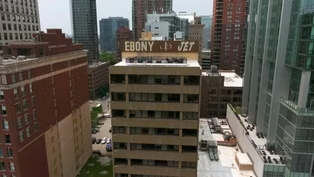
NewJohn Moutoussamy and the Johnson Publishing Building
Video has Closed Captions
The Johnson Publishing building was the first high-rise in Chicago designed by a Black architect. (3m 4s)
 New
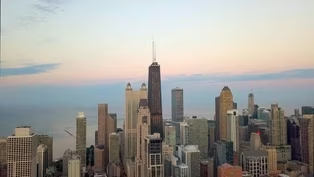
NewThe Rocky Rise of Hancock Tower
Video has Closed Captions
The John Hancock Center was one of the city’s most improbable success stories. (6m 36s)
 New
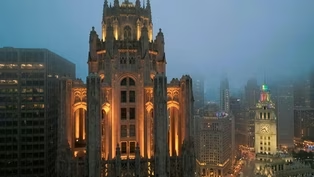
NewThe Wrigley Building and Tribune Tower
Video has Closed Captions
Across Michigan Avenue from one another are two Chicago icons. (4m 50s)
Providing Support for PBS.org
Learn Moreabout PBS online sponsorship










Support for PBS provided by:
Chicago Stories is a local public television program presented by WTTW
Lead support for CHICAGO STORIES is provided by The Negaunee Foundation. Major support is provided by the Abra Prentice Foundation, Inc. and the TAWANI Foundation.