Prairie Sportsman
Fast Forage: Beefsteak Fungus, Harvesting Nature’s Bounty
Clip: Season 17 Episode 12 | 3m 30sVideo has Closed Captions
Forager Nicole Zempel shows us how to identify the Beefsteak Fungus.
Forager Nicole Zempel shows us how to identify the Beefsteak Fungus. This somewhat rare polypore mushroom looks like meat when cut open.
Problems playing video? | Closed Captioning Feedback
Problems playing video? | Closed Captioning Feedback
Prairie Sportsman is a local public television program presented by Pioneer PBS
Production sponsorship is provided by funding from the Environment and Natural Resources Trust Fund and Shalom Hill Farm. Additional funding provided by Big Stone County, Yellow Medicine County, Lac qui...
Support provided by:


Prairie Sportsman
Fast Forage: Beefsteak Fungus, Harvesting Nature’s Bounty
Clip: Season 17 Episode 12 | 3m 30sVideo has Closed Captions
Forager Nicole Zempel shows us how to identify the Beefsteak Fungus. This somewhat rare polypore mushroom looks like meat when cut open.
Problems playing video? | Closed Captioning Feedback
Where to Watch Prairie Sportsman
Prairie Sportsman is available to stream on pbs.org and the PBS app.
Providing Support for PBS.org
Learn Moreabout PBS online sponsorship(upbeat music) (lively music) - Really excited about this mushroom.
It's something that is super common over in Europe, a little less common here in North America.
It's called the beefsteak fungus.
And we'll of course post the scientific name for you, which I of course cannot pronounce, but it's also been called poor man steak, ox's tongue.
And you'll see why once we cut into it.
Okay, so it's a parasitic fungus, so that means it's gonna eat the nutrients if it's on something living, it's basically gonna suck the life out of that living entity and absorb those nutrients.
They grow from usually like wounds in trees and they grow typically alone or just very solitary, which is like what we see here.
And they are so fun to stumble on.
They can get quite large.
Harvesting if you plan to eat them, it's best if you can find them about this size and maybe no bigger than like a softball size if you plan to eat it.
It's just easier to work with that way.
If they get larger it's a little bit tougher and probably too why they call it ox's tongue because it, it's a process right when you're cooking tongue and getting it tender.
So same with this mushroom, unless you harvest it small and it's a polypore, meaning on the underside of this lovely bright red mushroom, you're going to see not gills, but you're going to see pores.
And I think it's so fun.
It's just so pretty.
As it gets bigger or grows, the pore surface is going to go from pink to more of a white and it does drop a pink spore print, which is pretty cool.
Yeah.
And it, it smells good too.
So when you cut open this mushroom, which has been used as a meat substitute, but when you slice into it, it's kind of cool and you'll see why it gets the name beef steak fungus.
Looks like meat, kind of like chicken of the woods looks incredibly like chicken once you slice into it.
And this kind of looks like a slab of marbled meat.
And so it's got a little bit of a kind of a bittery sourness to it.
It is one of the few mushrooms that you could eat raw if you wanted to.
But I always advise cooking wild mushrooms thoroughly before eating them.
So yeah, this is the beef steak fungus.
And I might add, it goes well alongside steak and I think I mentioned it's got a little bit of a sour bitterness to it.
But I mean you can tame that in a variety of ways and some places consider it a choice edible.
To each their own.
But it is a fun mushroom to spot, to admire and also, yeah, cook it up if you so choose.
(light music)
Video has Closed Captions
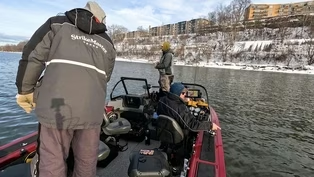
Clip: S17 Ep12 | 9m 57s | Host Brett Amundson's family brave the February cold to go fishing in Pool 2 of the Mississippi. (9m 57s)
Video has Closed Captions
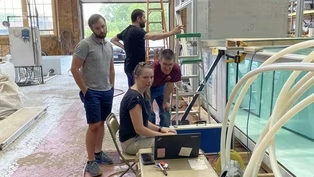
Clip: S17 Ep12 | 11m 52s | Look at the research taking place at the University of Minnesota’s St. Anthony Falls Laboratory. (11m 52s)

On the Great River and Beefsteak Fungus
Video has Closed Captions
Preview: S17 Ep12 | 30s | Mississippi River midwinter fishing; the St. Anthony Falls Laboratory; and the Beefsteak Fungus. (30s)
Providing Support for PBS.org
Learn Moreabout PBS online sponsorship New Episode
- Science and Nature

Explore scientific discoveries on television's most acclaimed science documentary series.

- Science and Nature

Miles O'Brien travels the world searching for solutions to today’s most urgent challenges.


 New Episode








Support for PBS provided by:
Prairie Sportsman is a local public television program presented by Pioneer PBS
Production sponsorship is provided by funding from the Environment and Natural Resources Trust Fund and Shalom Hill Farm. Additional funding provided by Big Stone County, Yellow Medicine County, Lac qui...