Prairie Sportsman
On the Great River and Beefsteak Fungus
Season 17 Episode 12 | 27m 46sVideo has Closed Captions
Mississippi River midwinter fishing; the St. Anthony Falls Laboratory; and the Beefsteak Fungus.
Host Bret Amundson takes to the Mississippi for some midwinter fishing in downtown St. Paul; Prairie Sportsman visits the St. Anthony Falls Laboratory in downtown Minneapolis to learn how the facility harnesses the waters of the Mississippi for scientific research; and Forager Nicole Zempel teaches us about a “meaty” mushroom, the Beefsteak Fungus.
Problems playing video? | Closed Captioning Feedback
Problems playing video? | Closed Captioning Feedback
Prairie Sportsman is a local public television program presented by Pioneer PBS
Production sponsorship is provided by funding from the Environment and Natural Resources Trust Fund and Shalom Hill Farm. Additional funding provided by Big Stone County, Yellow Medicine County, Lac qui...
Support provided by:


Prairie Sportsman
On the Great River and Beefsteak Fungus
Season 17 Episode 12 | 27m 46sVideo has Closed Captions
Host Bret Amundson takes to the Mississippi for some midwinter fishing in downtown St. Paul; Prairie Sportsman visits the St. Anthony Falls Laboratory in downtown Minneapolis to learn how the facility harnesses the waters of the Mississippi for scientific research; and Forager Nicole Zempel teaches us about a “meaty” mushroom, the Beefsteak Fungus.
Problems playing video? | Closed Captioning Feedback
Where to Watch Prairie Sportsman
Prairie Sportsman is available to stream on pbs.org and the PBS app.
Providing Support for PBS.org
Learn Moreabout PBS online sponsorship(light music) - On today's "Prairie Sportsman", we hit the Mississippi for some midwinter fishing in the heart of St.
Paul.
Seeing it from the water down here, it gives you a completely different perspective on this whole area.
Then we travel upstream to visit the St.
Anthony Falls laboratory in downtown Minneapolis.
- There aren't any other labs that are sitting at a 45 foot waterfall that can take water in the building and let it flow through the building through research studies.
- [Bret] And forager, Nicole Zempel, teaches us about a meaty mushroom, the beef steak fungus.
- But when you slice into it, it's kind of cool.
Looks like meat.
- Welcome to "Prairie Sportsman".
I'm Bret Amundson.
We got another great show starting right now.
(light music continues) (uplifting music) - [Announcer] Funding for "Prairie Sportsman" is provided by the Minnesota Environment and Natural Resources Trust Fund, as recommended by the Legislative Citizen Commission on Minnesota Resources, by Mark and Margaret Yackel-Juleen on behalf of Shalom Hill Farm, a retreat and conference center in a prairie setting near Windom, Minnesota.
On the web at shalomhillfarm.org, and by the Friends of "Prairie Sportsman".
To become a friend of "Prairie Sportsman", visit pioneer.org/PrairieSportsman.
- Welcome to "Prairie Sportsman".
I'm Brett Amundson.
It's about 22 degrees out here in February.
And what do we like to do in the winter?
We go fishing.
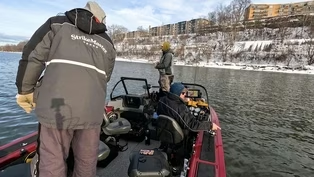
But I'm not gonna need these or these because we're jumping in a boat to hit pool two of the Mississippi River.
(uplifting music) We're doing it.
(uplifting music continues) Well here's something you only see in Minnesota.
This must be a good spot because if we're gonna be in a boat, open water fishing and we're 50 yards away from a guy fishing on the ice right now, this must be the spot.
So I think we're gonna use all artificial today and probably drop the live scope.
Look around for some fish, maybe pitch at 'em or just slowly drag them up through the river here.
(uplifting music continues) All right, so pool two is pretty much right on the south part of the Twin Cities, actually goes into the Twin Cities.
It goes from the Ford Dam all the way down to the dam just north of Hastings.
And it's an interesting body of water because it's part of the Mississippi.
There's a lot of industry here, so you don't really think of it as a recreational fishing area, but it's been a kind of a secret for a long time.
People that walleye fish a lot are here around the metro know about it, but it can be a great place to catch some really big walleyes.
(uplifting music continues) See if Dan can drop his jigs on one of these fish.
We marked about four of 'em, about 20 to 60 feet out in front of the boat.
One's kind of up and suspended up here.
The rest were down on the bottom.
(light music) (wind blowing) - Hey guys.
(lively music) - [Bret] You got Wade.
(Wade laughing) - [Bret] Carpola.
Big ole carpola.
(Wade laughing) (lively music continues) - All right.
I mean, we're just getting started here.
Dan and I haven't dropped a jig in the water yet and my brother Wade's along with us.
We're in his boat, and he looked into the first fish of the day.
We got excited 'cause it was pulling pretty hard.
Carp.
(lively music continues) Now what makes this area really unique is that it's open year round for fishing, so if you want to come out here when it's 20 degrees and deal with your guides icing up like we are right now, you can walleye, sauger, large mouth bass, small mouth bass are all available to catch here.
And because it's catch and release year round, it grows some big fish too, so it can give you an opportunity close to the metro to catch some really nice fish.
(soft music) Well, this is the beginning of pool number two here, right at the Ford Dam.
This is a really neat spot.
This first time I've been up here.
When you go into the Twin Cities and you drive into the metro and you're in that hustle and bustle of rush hour traffic, you just pass over this river.
You don't even really think about it, but seeing it from the water down here, it gives you a completely different perspective on this whole area.
The Ford Dam, or Lock and Dam number one, was built in 1917, making it one of the oldest dams on the Mississippi.
The lock is operated by the United States Army Corps of Engineers.
It allows boats to navigate upstream to St.
Anthony Falls.
On the east side of the dam, there's a hydroelectric power station, which originally was owned by the Ford Motor Company.
Electricity generated from the dam powered their assembly plant just up the hill where Model Ts were being built.
The assembly plant closed in 2011 and the hydro station was sold.
Today, electricity generated here just goes back onto the grid.
The west side of the lock features an observation deck that is open to the public April through November.
(soft music continues) All right, so right now we're gonna stop and fish here at the confluence of the Mississippi and the Minnesota rivers.
Of course, Minnesota flowing from Western Minnesota here, meeting up with the mighty Mississippi.
You can see actually a difference in the water color where the two rivers join.
We're gonna try it here.
See if we can't find a walleye.
(trumpet plays) Just upstream from this main confluence stands one of the most historical sites in the state.
Fort Snelling.
Fort Snelling was built in 1825 right across the river from the American Fur Company headquarters.
Buildings and walls were constructed using limestone from the edge of the river bluff.
The fort was decommissioned in 1857, but quickly reopened at the start of the Civil War in 1861, where it served as a recruitment and training center as well as a primary center for the US military during the US Dakota War of 1862.
Fort Snelling also served as a recruiting center during the Spanish American War and both world Wars before being decommissioned for a final time in 1946.
(soft music) The confluence is also a sacred spot for the Dakota oyate called Bdote, which means where two waters come together.
It's believed by many Dakota people that this spot is where their creator made the first Dakota man and woman.
During the US Dakota War, this spot was also used as a concentration camp where many Dakota people were held before being removed from Minnesota.
(soft music continues) This spot is now a popular spot for walleye anglers.
(upbeat music) The Mississippi River is home to a ton of wildlife and is a major flyway from migratory birds.
Just above Lock and Damn number two is Spring Lake, a popular place for duck hunters to hunt in the fall close to the metro because the water and parts of pool two tends to stay open most of the year.
In addition, providing a fun opportunity for anglers, it's an attractive place for waterfowl and other birds to live all winter.
In our time in the river today, we saw a few different species of ducks, Canada geese and lots and lots of eagles.
(upbeat music continues) (wind blowing) (upbeat music continues) - Small mouth.
Yeah.
Another carp.
(upbeat music continues) - [Wade] Carpola.
(all laughing) (upbeat music continues) - Nice.
- Nice job, Dan.
I mean, you talk to people in Europe, this is one of their favorite fish to catch.
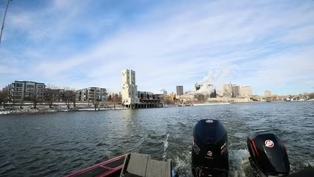
(upbeat music continues) Well, it's not very often that you can get a backdrop of a major metropolitan area while you're sitting in a boat.
Pool two is a really unique opportunity for Minnesota anglers and non-residents that come to this state and wanna enjoy fishing here.
There's a number of accesses up and down the pool where you can launch your boat.
There's also a lot of shore fishing opportunities and then plenty of park space along the way too.
We saw people walking their dogs, people with fat tire bikes and some picnic areas, which they're probably not using this time of year.
But if you wanna come out here and fish this, it's a great opportunity to catch a bunch of fish, maybe some of the biggest fish of your life, make sure you're well aware of all the regulations, including where the no wake zones are, like the one that we're in right now.
And enjoy a great fishing opportunity that might not be very far from where you live.
(upbeat music continues) - The St.
Anthony Falls laboratory is a unique laboratory to study all manner of fluid processes.
- Harvesting, if you plan to eat them, it's best if you can find them about this size and maybe no bigger than like a soft ball.
(soft music) - [Bret] The waterfall in the heart of Minneapolis has many names.
The Dakota call it Owámniyomni, meaning turbulent waters.
The Ojibwe Gakaabikaang, loosely translated to the place of the falls, and in English it's known as St.
Anthony Falls.
This cascade is the only major waterfall on the entire Mississippi River and it's rushing waters were once harnessed by the historic industries that help shape Minneapolis.
While the old mill buildings no longer use water power to process flour, the falls still drive scientific research at the University of Minnesota's St.
Anthony Falls laboratory.
(water falling) (soft music) - The St.
Anthony Falls laboratory is a unique laboratory to study all manner of fluid processes, but probably especially river processes, in all their dimensions that is situated on and is actually in a way part of a living river, the Mississippi River (soft music) - Water is within the building and our site is right on the Mississippi.
We're actually in the Mississippi on Hennepin Island.
There aren't any other labs that are sitting at a 45 foot waterfall that can take water in the building and let it flow through the building, through research studies, (soft music continues) and then let the water back into the river.
(soft music continues) - [Bret] The motivation to create the lab grew out of the occasionally volatile river in which it sits.
- [Reporter] A hundred thousand men to fight the old River.
We sent every branch of the service down the river to help the sleepless engineers hold the old river off the valley.
(soft music) - So in the 20s and 30s, there was a real need for hydraulic modeling and there were a number of issues, big floods down south on the Mississippi, other issues wanting to build structures and not having the know-how.
And actually Europe was farther ahead at the time.
There was a fairly well established in Europe of building hydraulic labs and doing hydraulic research, physical modeling.
(light music) And so the US government established a scholarship to send a number of individuals to Europe for a year to study labs.
And our first director was one of those people.
Lorenz Straub was the first director and he received the Freeman Fellowship, which sent him to Germany and around Europe.
And when he came back here, ended up in Minnesota and Dr.
Straub was able to design, he was actually a structural engineer as well as a hydraulics engineer, and did the design.
He actually oversaw the construction.
He fought for the funding to happen and got the laboratory built and commissioned in November of 1938.
- [Bret] Straubs unique design allowed early researchers to use the waters of the upper Mississippi to devise methods to manage river systems throughout the country.
(lively music) - There was a time when to build structures in and around water bodies like rivers, you made a scale model of the system and there was a, there's a whole art and science to correctly building those and scaling them and translating the measurements that you make in the model into the field, the full reality.
Right below us, there's a floor that we refer to as the model floor.
And the reason we call it that is that it originally housed a scale model of the entire Mississippi River system through the Twin Cities and all of the infrastructure, the locks, the dams, all the construction that was done on the river to manage it was designed using scale modeling techniques in that facility right under our feet, basically.
- [Bret] During its early years, the lab's primary focus was civil engineering, but eventually it began to branch out into other research areas.
- The whole enterprise of solving civil engineering river problems through scale modeling has greatly diminished because it is now cheaper to solve those problems by computation.
(soft music) So we have had to gradually evolve away from that and in the direction of new and, and in my opinion, more interesting areas.
So for example, when I came here, I was the first non-civil engineer to ever be formally a part of the laboratory.
And that was because I had an interest in rivers, but it wasn't so much the engineering of rivers and structures and rivers as the natural processes by which rivers evolved.
It's an indication of the gradual evolution of the lab away from hard civil engineering towards natural processes.
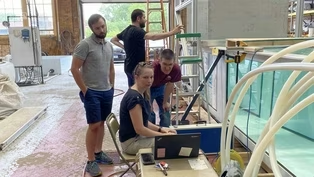
(soft music) - So I am running an experiment here to study how a sediment is transferred from river channels to floodplains.
We have water and sediment entering this channel.
What I'm planning to study is to increase the flow rate and the discharge in the river channel to cause some floods, and then study where the sediment is transferred over the surface of the floodplain and how fast that sediment is deposited.
And then develop theory to predict that in real natural environments (soft music continues) - We study a lot of sediment, mud, dirt.
We think it's so common, we often ignore it, but it plays a critical role in our life and we still cannot not fully understood it after so many decades, even centuries of study.
- [Bret] It's rumored that the complexity of sediment transport intimidated one of history's great physicists.
- Albert Einstein's son, Hans Albert Einstein studied sediment transport and there has been anecdotes saying that Albert once told his son not to study sediment transport because it was too complicated.
(soft music) - [Bret] The intricacies of sediment transport inspired Professor Judy Yang to examine the process at the finest of scales.
- I worked inside a wetlands in Massachusetts and I realized this fine clays and the bacteria, they glue sediment together make it harder to move and they act like a gel.
They're completely different than sand that we usually study.
I get very intrigued.
And in bioengineering there is a technique called micro fluidics.
They are these tiny channels we can fabricate in a clean room and the sizes can be less than the diameter of a hair, and we can inject bacteria, clay, fluids, a different flow condition to visualize what the interact as microscopic scale and how this microscale interaction affect larger scale processes.
There are already a lot of studies showing that when their microbial presents, they can change sediment transport by several orders magnitude.
I'm hoping to combine this different technology to understand how these tiny ecosystem engineers can change our earth.
(soft music) - [Bret] The work being done by Judy and her students may help explain river behavior far beyond our planet.
- People have been hypothesizing that there are microbes in Mars because they observed this meandering patterns on Mars and they hypothesizing microbes.
And recently we have experiments showing that synthetic microbial biofilms can change a braided river into meandering river.
- The rivers that we can find on Mars are pretty similar with this morphology.
So is the the main thing that why we hypothesize that basically the biofilm also can have, play a pivotal role in the surface on Mars.
And recently some researchers found a potential biosignatures on Mars.
So probably those problems are linked also with our project and our research.
(soft music continues) - [Bret] Other research currently underway at the lab includes projects with potential impacts ranging from improved water filtration and algal bloom remediation to improve stormwater treatment and wetland health.
Though the lab has expanded to include a wide array of sciences, it still does work that connects to its earliest days.
A team is starting on a scale replica of the Mississippi River through the Twin Cities.
- So in 1917, Lock and Dam number one, which is located down by the old Ford Motor Company plant was constructed and it created pool one, which is a 28, 30 foot deep pool in the river.
I think if you do the math, there's nobody alive today that has seen the Mississippi River through the Twin Cities as a river.
We've only seen it as a system of pools and locks and dams.
This project was really initiated because the corps of engineers that owns these locks has started a study called the disposition studies where they're evaluating whether those locks and dams fit their mission anymore.
And one of the outcomes could be they, they'll decide they don't.
And so what's important is that's a big change.
This this lock has been lock and damn one, 117 some years it's been there.
What happens if it's removed?
Estimates of three million cubic yards of sands and gravel behind that dam.
Where does it all go?
Can we stabilize it?
What impacts does it have?
If we take the dam out, how long does it take the river to find a new equilibrium?
One where fish and mussels can all grow and expand within that system.
One where we as citizens can come down and go fishing or access or kayak, canoe through that system.
So those are the questions we can answer by doing a model, by doing a study like this.
- [Lab Worker] Watch yourself.
- [Bret] Central to the lab's scientific endeavors is its support staff.
(soft music) - One of the elements of the magic that makes this place work so well is we have fantastic staff who know how to build things, who know how to make things work.
Those are real pragmatic people, but you can't do scientific research without them.
- I've worked here since 1999 as a staff member.
It's just been a fantastic place.
I love the diversity and the international flavor of the people that pass through.
There's been probably hundreds of engineers, graduate students that have come through that I've got to meet from around the world.
And that's wonderful.
The research is very interesting.
It's complicated, water moving, sediment moving, bugs and living things all interacting.
And so it's really stimulating to work here.
- It feels very historic.
It constantly reminds me of the scientists who, who build this knowledge that I can build upon.
(soft music continues) - My hope for the future of the lab is that it will continue to grow and evolve in the same unpredictable and surprising ways that it has for the 40 years I've been here.
I just think it's unbelievable to have been able to make a living, working on natural river processes and also working in a building that is part of a major river.
It's just pure magic.
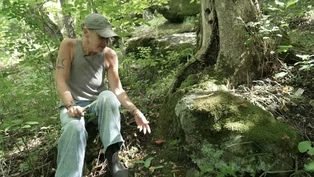
(soft music) (upbeat music) (lively music) - Really excited about this mushroom.
It's something that is super common over in Europe, a little less common here in North America.
It's called the beefsteak fungus.
And we'll of course post the scientific name for you, which I of course cannot pronounce, but it's also been called poor man steak, ox's tongue.
And you'll see why once we cut into it.
Okay, so it's a parasitic fungus, so that means it's gonna eat the nutrients if it's on something living, it's basically gonna suck the life out of that living entity and absorb those nutrients.
They grow from usually like wounds in trees and they grow typically alone or just very solitary, which is like what we see here.
And they are so fun to stumble on.
They can get quite large.
Harvesting if you plan to eat them, it's best if you can find them about this size and maybe no bigger than like a softball size if you plan to eat it.
It's just easier to work with that way.
If they get larger it's a little bit tougher and probably too why they call it ox's tongue because it, it's a process right when you're cooking tongue and getting it tender.
So same with this mushroom, unless you harvest it small and it's a polypore, meaning on the underside of this lovely bright red mushroom, you're going to see not gills, but you're going to see pores.
And I think it's so fun.
It's just so pretty.
As it gets bigger or grows, the pore surface is going to go from pink to more of a white and it does drop a pink spore print, which is pretty cool.
Yeah.
And it, it smells good too.
So when you cut open this mushroom, which has been used as a meat substitute, but when you slice into it, it's kind of cool and you'll see why it gets the name beef steak fungus.
Looks like meat, kind of like chicken of the woods looks incredibly like chicken once you slice into it.
And this kind of looks like a slab of marbled meat.
And so it's got a little bit of a kind of a bittery sourness to it.
It is one of the few mushrooms that you could eat raw if you wanted to.
But I always advise cooking wild mushrooms thoroughly before eating them.
So yeah, this is the beef steak fungus.
And I might add, it goes well alongside steak and I think I mentioned it's got a little bit of a sour bitterness to it.
But I mean you can tame that in a variety of ways and some places consider it a choice edible.
To each their own.
But it is a fun mushroom to spot, to admire and also, yeah, cook it up if you so choose.
(light music) (soft music) - [Announcer] Funding for "Prairie Sportsman" is provided by the Minnesota Environment and Natural Resources Trust Fund as recommended by the Legislative Citizen Commission on Minnesota Resources, by Mark and Margaret Yackel-Juleen on behalf of Shalom Hill Farm, a retreat and conference center in a prairie setting near Windom, Minnesota.
On the web at shalomhillfarm.org, and by the Friends of "Prairie Sportsman".
To become a friend of "Prairie Sportsman", visit pioneer.org/prairiesportsman.
(light music)
Video has Closed Captions
Clip: S17 Ep12 | 9m 57s | Host Brett Amundson's family brave the February cold to go fishing in Pool 2 of the Mississippi. (9m 57s)
Fast Forage: Beefsteak Fungus, Harvesting Nature’s Bounty
Video has Closed Captions
Clip: S17 Ep12 | 3m 30s | Forager Nicole Zempel shows us how to identify the Beefsteak Fungus. (3m 30s)
Video has Closed Captions
Clip: S17 Ep12 | 11m 52s | Look at the research taking place at the University of Minnesota’s St. Anthony Falls Laboratory. (11m 52s)
On the Great River and Beefsteak Fungus
Video has Closed Captions
Preview: S17 Ep12 | 30s | Mississippi River midwinter fishing; the St. Anthony Falls Laboratory; and the Beefsteak Fungus. (30s)
Providing Support for PBS.org
Learn Moreabout PBS online sponsorship New Episode
- Science and Nature

Explore scientific discoveries on television's most acclaimed science documentary series.
 New Episode
- Science and Nature

Capturing the splendor of the natural world, from the African plains to the Antarctic ice.


 New Episode






Support for PBS provided by:
Prairie Sportsman is a local public television program presented by Pioneer PBS
Production sponsorship is provided by funding from the Environment and Natural Resources Trust Fund and Shalom Hill Farm. Additional funding provided by Big Stone County, Yellow Medicine County, Lac qui...