Mountainthology
Full Length Archive Footage from 1976 - "The Late Great American Bicentennial"
Clip: 7/27/2026 | 28m 42sVideo has Closed Captions
The archive footage referenced in "The Late, Great American Bicentennial: 50 Years On"
The archive footage referenced in "The Late, Great American Bicentennial: 50 Years On" Shows WV citizens celebrating, or opposing the ideals of, the bicentennial.
Problems playing video? | Closed Captioning Feedback
Problems playing video? | Closed Captioning Feedback
Mountainthology is a local public television program presented by WVPB
Mountainthology
Full Length Archive Footage from 1976 - "The Late Great American Bicentennial"
Clip: 7/27/2026 | 28m 42sVideo has Closed Captions
The archive footage referenced in "The Late, Great American Bicentennial: 50 Years On" Shows WV citizens celebrating, or opposing the ideals of, the bicentennial.
Problems playing video? | Closed Captioning Feedback
Where to Watch Mountainthology
Mountainthology is available to stream on pbs.org and the PBS app.
Providing Support for PBS.org
Learn Moreabout PBS online sponsorshipThis land is your land, this land is my land From California to the New York Island From the Redwood Forest to the Gulf Stream waters This land belongs to you and me So we decided to pain our bicentennial flag on here.
I figure I have around 15 hours in it.
Cost of the paint was around $30 for it, which I figure is a pretty economical way to show your bicentennial spirit.
In fact, I suppose the best bicentennial thing of all would be a federal statute that requires all of us to read 20 books that are serious, half o which would be autobiographical or biographical, about by people of, you know, of greatness in American history, and the rest of which would be perhaps about American history itself, cultural aspects, different struggles, and probably if people would read and would then get together.
As, for example, my wife does once a week to discuss a book that she' read with 6 or 7 other people.
That would be the best bicentennial celebration.
By Margaret Douglas, Mrs.
J. William Douglas could easily be a favorite daughter.
That you got to thank you for that.
That's why we don't want you to buy out of you.
I want you to find something that.
I. Money and romance my dad.
He could die.
I life.
You are also trained for on the farm to life.
I got and you free part of my arms.
He has to stop writing on a movie.
I know that came into force.
It's wonderful.
Okay, well, we were asked about the music club to do about centennial programs, and we began.
And it just sort of like topsy grew, you know, and it became better as each day went by.
It's a real joy.
Somebody have a follow up down there if you deal with the checkered flag.
All the phones are okay down here.
Okay.
Okay.
I'm getting off of me.
Thank you.
Can you tell us?
Can we interrupt you for a moment?
Can you tell us what' going to take place here today?
We're doing a TV show called the Bicentennial Bowl.
It's a TV show with quiz question to high school students on historic subject as well as some current events.
Questions.
It's the type of show used to encourage student in their intellectual knowledge.
What exactly takes place during the Bicentennial Bowl?
Some kids come in and set out in the judge over here and ask them about a bunch of questions where that lady is now.
And they all just answer, and somebody gets the matches and that's about it.
Who sits over on this side?
Audience.
This is the crowd.
A bunch of people there.
How long will this event last?
As long as the videotaped last.
You've witnessed it.
You've witnessed a number of events similar to this.
How do these things usually come across?
Some of them are very shaky.
Some of them have some interesting little insights and others are just others.
Question or comment.
One country last week signing Commonwealth Agreement with the Mariana Islands one.
This is a bonus question.
Okay.
Define the term dark horse in relationship to politics.
Underdogs would give a little chance to win.
Correct.
You know.
Hey, how are you?
Hurry up ladies.
We have plates.
We have jewelry.
We have a medallion.
Patches.
Our official program.
Sure, it' all white.
And trade souvenirs.
Nothing else.
What does the Bicentennial mean to you?
Well just that we've got 100 years.
Look, I'm looking back on a couple of hundred years.
As a matter of fact, I'm looking forward to try something else than anything else.
I think we've we've blown the last 200 years as it is.
Do you think maybe th bicentennial has become a little too commercial?
Well, not in my opinion.
I think that it's well advertised.
You see it in all of the media.
Everywhere.
I don't think it's overdone, in my opinion.
The more the better.
So how do you feel about the bicentennial?
I think it's a marvelous thing to do, and I think pretty much the America accepted are celebratin all over the country, I think.
Who you folks from channel 24.
Do you think maybe it's become a little bit too commercialized lately?
How can you keep any holiday from being commercialized?
You can't do it.
It's just part of America.
They commercialized everything, and I don't know whether it's good or bad, but it's the way it is.
This display is by students in my classroom.
Each student did a report on president of the United States.
Our big project was the flag, the tissue paper flag.
And we spent about two weeks the children in my classroom.
We have a red, white and blue bicentennial train that should be running nice rainforest.
All right, boys and girls, would you move back a minute, please?
All the way back so they can see.
Okay.
Harvey?
He's back.
And this is this play on transportation with various project events.
This is a display of the shifts that we made.
Every one of our ancestors came over on for some time.
And then we put a lot of things about the different food that we had.
And this is the different sections that we found.
We have staff questions.
We have sections.
We have some more stamp collection, some of them pretty good.
And then we have some kinds of different lines of demarcation on the different states.
And it was done a real good job on that.
And then brought up here is a very good place of letters that we have got from.
The world about our nation's history.
That's what.
And Belgium.
There we go.
Jerry.
Dream, I love you.
Tell the world about 200% last year of this.
And now we're.
Those are mighty fancy book covers.
Sarah.
When do we start?
Why are you all Turpin like Tabor?
They're celebrating to be done.
How about some music and maybe some good old Virginia now?
Come on, barn dance.
The first answer.
Come on.
Tabitha.
Fighter.
More.
No, no, I don't dare.
So.
Okay, bring it out.
All right.
That was a fairly good stage picture, if you remember to keep your position.
But you're going to have to project people over that noise project.
Bring it out and play Simon Girty.
Simon Girty, as you probably know, is a renegade.
A little on the Irish side, not very well liked, not even by the cast.
Woul you tell us what your lines are?
What do you say in the play?
Oh, dad.
Yes you do.
Hello, Mrs.
Smith.
That's all.
Well, I'm head of collecting props for the play.
And this involves calling up just about everybody in Morgantown to see if they have old jugs, old blankets, tree stump logs, anything old that we can possibly use and running around and collecting it, and then hurry up and returning it.
Is it fun to do right?
In every house?
Two cars in the middle of the chance for every kid to become president.
Tell us what your bicentennial booth is all about here.
Well, we feel that God should be in our bicentennial celebration.
And so we have a birthday cake for Uncle Sam, and then we have a gift.
And then we have some correspondence courses, some Bible courses that really can fulfil the ideals of American people.
Because we are a very fast moving society today.
And this fast pace demands that people quickly believe their inner tensions and.
Excuse me, while you're giving change, could I ask you a question?
What does Nile have to do with the bicentennial?
What are you doing today?
No.
I want to ask you, what does now have to do with the bicentennial?
It just it goes to show that women.
Our theme is patchwork.
And women have had to make do with what they've had down through the years, through the 200 years.
And we're just kind of emphasizing that thing.
What did women do of great importance during the Revolutionary War?
While you're waiting for your nickel change, I'm going to ask you a question.
Why do you thin this bicentennial is important?
Why do I think it's important?
Well, because our our civilization depends.
I mean, I'm civilization.
That is the word I use.
But what's the word I want?
This is it depends upon our remembering what our early American answers have done for us.
And do you think that your country store does that?
And if so, how?
Yes, I think it makes people think it's, Or on a rainy day it's bad.
But really, on a nice day, I think it's very fine.
These people are all rememberin and learning about our history by the things they're buying here.
Thank you very much.
That's the.
I'm upstairs.
Oh, let me talk to you.
What?
Are you there?
Excuse me.
What are you looking at here that you think you might purchase?
Well, I don't know yet.
The King of England here.
We all did.
Truths to be self-evident.
That all men are created for their lives.
Life, liberty and the pursuit of happiness.
There was.
The day.
Of course.
He was only three.
Now he's on a battleship.
In his favor.
She just a great big sailor, man.
But he's just this cute little Barnum trout connecting with here to stay.
And he loves to take everywhere.
Sailor.
When she was to give you one day, he sailed away.
Where?
She doesn't know.
How would you like to see Americans celebrate the bicentennial?
Well, I'd like to see people in the United States celebrate the bicentennial by going out and trying to express themselves in much the same way as the people di during the American Revolution.
There's this sort of window display bother you and your organization?
We consider this a typical example here.
This window display of what we know, what we try to say is the boy boy centennial.
What this is, is just the consumerization of wha the bicentennial is all about.
Over there.
Across the street is a depiction of the American Revolution and the Bicentennial.
But we also find in that sign of real, scattered few people and people who have done certain heroic acts, where is the common person, the person who daily is on the streets, walking, walking around Clarksburg, or walking around any of the cities of West Virginia?
They're not just in any of the bicentennial displays that we've seen so far.
Is your group trying to give a kind of Marxist interpretation to the American Revolution?
We don't feel it's a Marxist interpretation.
We think it's a real people's interpretation.
We're not trying to call ourselves Marxist or any other terms like that.
We're just trying to say that we want to become, and we think we are very much the true patriots.
A lot of people have forgotten how we've gotten to this point in history.
They've forgotten that to get the eight hour day, many people had to sit and struggle and strike and do a lot of other things to get that.
A lot of people have forgotten how.
We've gotten a lot of other of our games during the past 200 years.
Oh, I think it's wonderful.
Wonderful.
Really do.
What do you think about thi moment right now in our history?
How's that?
What do you think about thi moment right now in our history?
Doesn't understand what you think of the bicentennial here.
I told him to sign.
That's wonderful.
Wonderful.
Yes, sir.
It's all right.
Glad to have it.
I went and put it in time for this country.
I'm a World War One veteran.
Where'd you put in time, sir?
We're at Rahman's all over the universe.
I finished up at Lantern Georgia.
Quentin White, sergeant commanding the of the George Rogers Clark Illinois Regiment of Virginia troops, which we formed our regiment initially in 1967.
And we've been a regiment with the Brigade of the American Revolution, a national historical organization.
Ever since we perform any place, there's an opportunity.
Well, in the field, the American troops will use fifes and drums.
The military fife is a very shrill instrument, can be heard for a long way.
And when you have a long column or a large group of troops, the music could be heard you know, by most of the troops.
The drummer use the deep tension rope drums.
These are the main music used for signals in the field.
They don't use voice commands to use drum signals.
The fifes were used in addition to the drums to provide spirited music, to encourage the troops in battle or under duress, o to make their humdrum activity a little more enjoyable.
The musket that I carry is a flintlock musket.
It is an original 1816 model.
It's later than the American Revolution, but it is an original weapon, a model of 1816 manufactured in 1838.
There are a lot of interesting phrases that come out o the American Revolutionary War.
And the flint muskets, fo instance, going off half cocked.
You can't you can't do it with one of these muskets, because in the half cocked position, it cannot be fired or flash in the pan.
You've probably seen some of those out here, or you laughed when a man up on the top of the fort went to fire his musket, and only the powder flashed in the pan.
It meant that the powder didn't burn through and didn't ignite the charge.
It was just sort of a half shot.
That's called a flash in the pan.
So a lot of terms like that came out of the early period of American history.
The other equipment that I have on I have a shoulder carriage which has on it a bayonet, a short sword, a short infantry sword, and a long knife, which was quite often carried for use in cutting meat, cutting food or cutting another soldier.
I carry a canteen, which in which a man carries his water, his water supply, or his supply of spirits.
Mine is empty It has a leak in it right now.
We document everything we do.
It was the manual of arms for musket to develop the American forces into a fighting unit, which was developed by Baron von Steuben in 1779, when he trained Washington's troops at Valley Forge.
Before that, they didn't have sufficient training in military tactic to be effective against British.
It was a hard life for the soldier, and it's amazing the amount of dedication that some of the troops of that period had, and some of the things they would undertake without complaining.
They had quite often a shortage of foo and they were on light rations.
Supplies on the frontier were hard to keep up with.
He was usually a long way from home.
He was lonely.
So any any bit of joy tha could be brought into his life, either by music or by by any kind of fun and games.
Why?
Welcome to the Bicentennial House this beautiful morning.
This particular hous is a very beautiful old house.
The community was very gracious and very generous and furnished it with beautiful furnishings.
Family heirlooms.
In many cases, this wa a typical 18th century parlor.
We have beautiful things from the 1700s and the early 1800s.
Well, we have a mini art museum in the house.
We truly do.
This painting over the mantelpiece is called a primitive, and it's a very fine one.
And we think we're so fortunate to have it with the flag.
And it suggests the bicentennial celebration.
Tell us what you think the bicentennial activities meant to West Virginians.
That's a hard question because I have mixed feelings about it.
I think that one could reasonabl expect three types of activity in the bicentennial one, just a celebration parades, picnics, community events.
And I as far as I know, those were went fine in West Virginia.
And like any birthday party, it's it's fun while it lasts and then you forget about it.
The tendency among local history hobbyists is to celebrate something that reflects on their ancestors, who were, or they imagine were more important than the community than they are themselves today.
The most important things in West Virginia history upset a lot of people.
Well, the separation from Virginia was really an unpleasant, bitter, divisive thing.
It's very difficult to celebrate it in any meaningful way because there's by separating for Virginia, we cut ourselves off on a lot of the heroic aspects of our history.
When you saw tha we don't have anybody to compare with George Washington or Thomas Jefferson or James Madison or John Marshall or any of the here, the great man of revolutionary Virginia was the greatest man that any society ever produced at any time in history.
And we simply cannot compete with that.
And although it is part of Western Virginia's heritage, West Virginia somehow has bee cut off emotionally from that.
We can't really take any pride in it.
We strained to get George Washington across the mountains twice in the course of his career, but we really want Virginia style of history.
But we're not in Virginia.
And that makes it very hard.
So we run around trying to compete to create a Fort Randolph, to compete with the Virginia Civil War battlefields, to create an independent sought to compete with Williamsburg.
And it won't wash the mone that the state has to spend on history is generally turned over to amateurs, hobbyists, boosters who want to build, and the only thing they can think of to do is to build a tourist attraction, which may or may not attract tourists.
We don't have the biggest we don't have the most famous.
We don't hav the typical American boosterism always ends up overreaching itself in West Virginia.
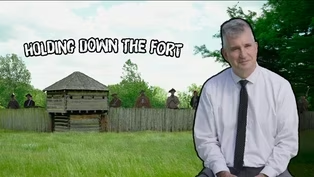
Video has Closed Captions
Producer Ethan Rayment interviewed Craig Hesson of Point Pleasant about “Living History” (8m 19s)
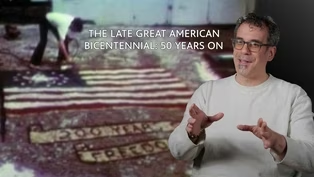
The Late, Great American Bicentennial: 50 Years On
Video has Closed Captions
Producer Troy Rankin joins historian William Hal Gorby to analyze Bicentennial footage (10m 11s)
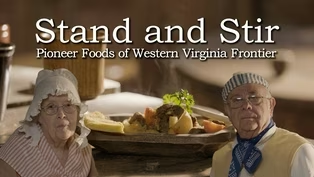
Stand and Stir: Pioneer Foods of the Western Frontier
Video has Closed Captions
Producers Kady Lemons and Conor Martin bring us to the hearth of Fort New Salem. Plus a bonus recipe (9m 21s)
Providing Support for PBS.org
Learn Moreabout PBS online sponsorship












Support for PBS provided by:
Mountainthology is a local public television program presented by WVPB