Mountainthology
The Late, Great American Bicentennial: 50 Years On
Clip: 7/27/2026 | 10m 11sVideo has Closed Captions
Producer Troy Rankin joins historian William Hal Gorby to analyze Bicentennial footage
Producer Troy Rankin joins historian William Hal Gorby to analyze and compare 50 year old footage of the Bicentennial to how Americans are feeling today.
Problems playing video? | Closed Captioning Feedback
Problems playing video? | Closed Captioning Feedback
Mountainthology is a local public television program presented by WVPB
Mountainthology
The Late, Great American Bicentennial: 50 Years On
Clip: 7/27/2026 | 10m 11sVideo has Closed Captions
Producer Troy Rankin joins historian William Hal Gorby to analyze and compare 50 year old footage of the Bicentennial to how Americans are feeling today.
Problems playing video? | Closed Captioning Feedback
Where to Watch Mountainthology
Mountainthology is available to stream on pbs.org and the PBS app.
Providing Support for PBS.org
Learn Moreabout PBS online sponsorshipSo we decided to pain our bicentennial flag on here.
I figure I have around 15 hours in it.
Cost of the paint was around $30 for it, so I figured a pretty economical way to show your bicentennial spirit.
1976 West Virginia was very interesting to me because there are several big factors going on.
The economy.
While it's troubling elsewhere, this is actually the last sort of point when the state's blue collar economy is very strong in the mid 70s.
I'm William Hal Gorby, I'm a teaching associate professor of history here at WVU.
The chemical industry, coal mining, employment, which had dipped in the mid 20th century with mechanization, actually gets up to around 70,000.
Maybe a couple of years after this point.
So economically, it's a good time for people in West Virginia.
I mean, when they're doing these on the street interviews, you can see like every building has a business in it.
Everything seems to be bustling and moving fairly good.
It doesn't seem to be being filmed during.
If it had been filmed five years later, it probably would'v had a completely different tone because the state enters a decad The cynicism in the country at that time obviously was very palpable.
Afte this is right after Watergate.
This is right after the end of the Vietnam War.
Got 100 years.
Look, I'm looking back on a couple hundred years.
As a matter of fact, I'm looking forward to try some on anything else.
I think we've we've blown the last 200 years as it is.
And I think the one gentleman who is saying we screwed up the last 200 years, that's probably kind of the general sentiment of distrust in governmen after Watergate, after a decade or more in Vietnam, you had a stand that was very much about we need to have God in schools, God in the celebration.
Tell us what your bicentennial booth is all about here.
Well, we feel that God should be in our bicentennial celebration.
And so we have a birthday cake for Uncle Sam.
And then we have a gift, and then we have some correspondence courses, some Bible courses.
And then right next or near was the National Organization of Women's Booth.
What does now have to do with the bicentennial?
It just it goes to show that women our theme is patchwork.
And women have had to make do with what they've had down through the years, through the 200 years.
And we're just kind of emphasizing that thing.
So trying to balance this sort of top down history with this sort of bottom up history.
Mike Weber, who's in Clarksburg, kind of critiquing that storefront and talking about we need like a history of the common person.
And, you know, that that does reflect, I think, what was going on within the labor movement in the state.
Well, I'd like to see people in the United States celebrate the bicentennial by going out and trying to express themselves in much the same way as the people di during the American Revolution.
Points that, like some of the murals on one of the buildings and the display case.
We consider this a typical example here.
This window display of what we know, what we try to say is the by by centennial.
What this is, is just the consumerization of wha the bicentennial is all about.
And he ties it into kind of the fight for the eight hour day, almost making a sort of labor union sort of pitch.
Over there, across the street is a depiction of the American Revolution and the Bicentennial.
But we also find in that sign of real, scattered few peopl and people who have done certain heroic acts, where is the common person, the person who daily is on the streets, walking, walking around Clarksburg, or walking around any of the cities of West Virginia?
They're not just in any of the bicentennial displays that we've seen so far.
This is during a couple of summers in 75 and 76, when there's a large number of wildcat strikes in the coal fields of West Virginia.
If we're looking today at the way we're going to be celebrating this two 50th, I mean, there are similar tensions that we saw there in 1976 and then maybe more magnified, but also kind of like, what does this mean for the future?
A kind of economic anxiet that is different in its extreme but is echoed there in 76 as well.
I suppose th best bicentennial thing of all would be a federal statute that requires all of us to read 20 books that are serious, half o which would be autobiographical or biographical, about by people of, you know, of greatness in American history, and the rest of which would b perhaps about American history itself, cultural aspects, different struggles.
It was interesting seeing him say that about we need to be reading mor history and autobiographies of famous people, which in one way it could be read as elitist.
And probably if people would read and would then get together as for example, my wife does once a week to discuss a book that she's read with 6 or 7 other people.
That would be the best bicentennial celebration.
It's this out of stat politician who's telling people, you need to read more.
He's been here since really the mid 60s.
He was a Vista worker, member of the House of delegates, Secretary of state.
He was kind of tied into some of these grassroots organizations, among other issues.
And so I think he's also viewing it that, you know, the state is also kind of improved a lot over the decade or more that I've been here.
We need to keep this going.
We don't have anybody to compare with George Washington or Thomas Jefferson or James Madison or John Marshall, or any of the great men of revolutionary Virginia, which are among the greatest men in any society ever produced at any time in history.
And we simply cannot compete with that.
And although it is part of Western Virginia's heritage, West Virginia somehow has bee cut off emotionally from that.
When I had Doctor Williams says that about boosterism, that historic promotion of the 200th is jus kind of leading to boosterism.
The mone that the state has to spend on history is generally turned over to amateurs, hobbyists, boosters who want to build.
And the only thing they can think of to do is to build a tourist attraction, which may or may not attract tourists.
I think what Doctor Williams is also getting at, it's always tied to tourism, it's tied to economic development.
We run around trying to compete to create a Fort Randolph, to compete with the Virginia Civil War battlefields, to create an independent saw to compete with Williamsburg.
It's got to be frame in a way that it it makes money, it turns a profit.
Whereas I think he's getting at the tension at the time that we're tying ourselves to this creation of the country, which we were part of.
But in a way we were this sort of frontier.
We really want Virginia style of history, but we're not in Virginia.
And so what are we promoting if we're promoting this more consumerist boost image of the national revolution?
The irony being that this is a celebration of 13 colonies rising up against Great Britain.
And the irony being that we basically hav our own revolution against Kenya a few generations later.
We have fewer people going to church.
We don't have those common space, we don't have bowling legs.
You have a variety of these different spaces where people can come together in small ways, but even bigger types of ways that I do think we don't have today.
We're going to have to have a big enough event where it has enough tie in things that can draw enough peopl in, whereas as you saw in 1976, they're able to do like this wide variety of small types of music dance, church, you know, civic events.
And it doesn't need to be this elaborate production.
I mean, the first guy painting an American flag, I mean, the whole I mean, tha probably took days to do that.
That would be like a TikTok, you know, and we just see like a finished product or him like rushing through the end of the day.
People are illogical.
They they're emotional.
They do things that don't follow natural pattern or do what you think is going to happen.
And that's why it's fun to to study what they did and to not try to not to try to say what they did was wrong or right, but just to try to understand where where were they coming from?
It's very neighborly, almost a West Virginia documentary, because it's allowing people to say to get their thoughts out there, but to not critique them, not to criticize them.
Just let me let please share your opinion of this.
Almost like we're sitting on the front porch just having a conversation.
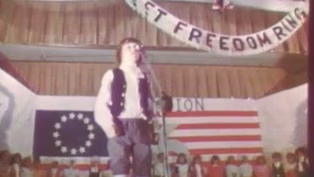
Full Length Archive Footage from 1976 - "The Late Great American Bicentennial"
Video has Closed Captions
The archive footage referenced in "The Late, Great American Bicentennial: 50 Years On" (28m 42s)
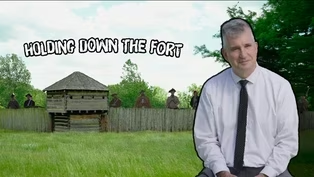
Video has Closed Captions
Producer Ethan Rayment interviewed Craig Hesson of Point Pleasant about “Living History” (8m 19s)
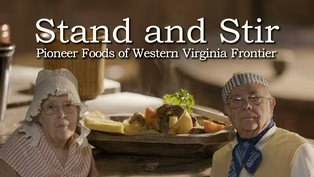
Stand and Stir: Pioneer Foods of the Western Frontier
Video has Closed Captions
Producers Kady Lemons and Conor Martin bring us to the hearth of Fort New Salem. Plus a bonus recipe (9m 21s)
Providing Support for PBS.org
Learn Moreabout PBS online sponsorship












Support for PBS provided by:
Mountainthology is a local public television program presented by WVPB