WQED Horizons
Good Mind Seeds
Clip: Season 3 | 5m 47sVideo has Closed Captions
This segment explores the work of Phil Seneca and his Good Mind Seeds company.
This segment of Horizons, titled 'Good Mind Seeds', was produced by Doug Oster, photographed by Rich “Zoot” Dwyer, and edited by Frank Caloiero. The segment explores the work of Phil Seneca and his company Good Mind Seeds, and highlights the connection between his agricultural practices and cultural heritage as an Onodowaga Haudenosaunee Native American.
Problems playing video? | Closed Captioning Feedback
Problems playing video? | Closed Captioning Feedback
WQED Horizons is a local public television program presented by WQED
WQED Horizons
Good Mind Seeds
Clip: Season 3 | 5m 47sVideo has Closed Captions
This segment of Horizons, titled 'Good Mind Seeds', was produced by Doug Oster, photographed by Rich “Zoot” Dwyer, and edited by Frank Caloiero. The segment explores the work of Phil Seneca and his company Good Mind Seeds, and highlights the connection between his agricultural practices and cultural heritage as an Onodowaga Haudenosaunee Native American.
Problems playing video? | Closed Captioning Feedback
Where to Watch WQED Horizons
WQED Horizons is available to stream on pbs.org and the PBS app.
Providing Support for PBS.org
Learn Moreabout PBS online sponsorship[Music Plays] I'm Onondaga Haudenosaunee, and Americans say Seneca Iroquois.
Onondaga, translated to English, means people of the Great Hill.
Haudenosaunee means people building the longhouse.
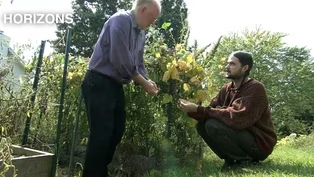
Phil Seneca is a Native American from Wexford who has a passion for growing and sharing unique seeds through his company, Good Mind Seeds!
And when they dry out, here's how it is!
His love of gardening and plant breeding go back to his days as a child.
Some of my first memories are in my mother's garden.
I ate a lot from the garden and I was very fascinated by the growing of plants and especially the breeding of plants.
Since then, it's been an obsession of mine.
He offers seeds which aren't found in many other catalogs, and is driven by his heritage to discover many of the amazing varieties he grows.
So a big part of me getting into farming the way that I do is reclamation of my identity as a native person, and whenever I was researching my particular ancestors crops, the ones that they developed in this region, virtually all of them are extinct.
But he's discovered other varieties which can be substituted and grown easily in varied climates around our region and the country.
Phil wants to help people grow their own food as a way towards independence.
Part of the core of a native person's identity is being able to feed themselves, and reconnecting with the unbroken line of seeds saved by their ancestors since time began.
To be an Indian person, it means to be a sovereign person of sovereign native nation, and sovereignty cannot exist without food sovereignty.
Without the ability to feed oneself, there is no true sovereignty.
One of the rare tomatoe he offers is called Punta Banda.
It produces ping pong ball sized fruit, and Phil has grown it for several seasons without ever having to water the variety.
Here's with the single simple ovaries, two seed sections, two locules, and this one might taste better than the one you just ate.
Since I was looking for tomatoes with superb drought tolerance for the northeast.
I figured that I should try all some of theirs in Punta Banda has never failed me.
It has produced through every week or two weeks of drought that we get in PA, and I think the only thing you could do wrong to Punta Banda is water it too much.
And he offers a pepper that's really, really hot.
Yeah, this is a habanero and the H is silent.
It's not Ha-Banero and it's the hottest pepper other than a ghost pepper.
And it'll make a teenage boy cry.
And the reason I say that is because a grown man smart enough not to eat it.
All the seeds he sells are produced through traditional breeding techniques and are not genetically modified.
Something he feels very strongly about.
Genetically modifying seeds is a controversial practice, which often combines genes of other species with plants.
In addition to these varieties being capable of being saved from generation to generation and being improved, there in!
They are not patented.
Where the genetic modified varieties are, these are free to be grown, sold, saved, gifted.
Whatever you want to do with these seeds, you can do because they're in the public domain.
Getting wonderful fresh food into the hands of people is his main goal.
But he also hopes these varieties will be perpetuated by the gardeners who grow them.
I want people to be free to eat food that is medicine for generation and generations into the future.
I want to protect these varieties for generations yet unborn because it's our responsibility to do so.
We aren't just living in the present.
We're borrowing the present from the past, and we're keeping it for those who are going to be in the future.
[Music Plays] It's very, very fruity.
There are many life lessons to be learned by time in the garden, says Phil.
He sees planting as a way to help families and our culture in general.
I hope that they learn to connect with their source of life, and in so doing, I hope that they connect with themselves, and this is a way that we can be at peace, where we can feed ourselves, we can find the solution to many of the world's problems.
I think that most of the world's problems can be solved in the garden.
Most gardener would certainly agree with that.
Phil is deeply connected to the plants he grows, and is fulfilled by getting them into the hands of gardeners.
See, these crops are people to me, and it's like I have a relationship with each one of them.
And whenever I see one of these beautiful varieties spread to a new region of the world and be cherished by another group of people, then it's one of the most rewarding parts of doing what I do.
[Music Plays]
 Now Playing
Video has Closed Captions
This segment explores the work of Phil Seneca and his Good Mind Seeds company. (5m 47s)
Video has Closed Captions
Horizons segment about Bayard Rustin’s life and legacy discussed with Rev. Deryck Tines. (9m 30s)
Providing Support for PBS.org
Learn Moreabout PBS online sponsorship










Support for PBS provided by:
WQED Horizons is a local public television program presented by WQED