
Healthy aging in the African American community
Season 54 Episode 35 | 26m 46sVideo has Closed Captions
A look at how to address the barriers to health and well-being faced by aging African Americans.
We’re dedicating our entire show to the topic of healthy aging. We’ll talk about the challenging aspects of growing older. Plus, we’ll explore the unique issues faced by African American elders and share stories from caregivers about their experiences caring for others.
Problems playing video? | Closed Captioning Feedback
Problems playing video? | Closed Captioning Feedback
American Black Journal is a local public television program presented by Detroit PBS
Healthy aging in the African American community
Season 54 Episode 35 | 26m 46sVideo has Closed Captions
We’re dedicating our entire show to the topic of healthy aging. We’ll talk about the challenging aspects of growing older. Plus, we’ll explore the unique issues faced by African American elders and share stories from caregivers about their experiences caring for others.
Problems playing video? | Closed Captioning Feedback
Where to Watch American Black Journal
American Black Journal is available to stream on pbs.org and the PBS app.
Providing Support for PBS.org
Learn Moreabout PBS online sponsorship- Just ahead on "American Black Journal," we're dedicating our entire show to the topic of healthy aging.
We'll talk about the positive and challenging aspects of growing older.
Plus we'll explore the unique issues faced by African American elders.
Also coming up, we'll share stories from caregivers about their experiences caring for others.
Stay where you are, "American Black Journal" starts right now.
- [Announcer 1] Across our Masco family of companies, our goal is to deliver better living possibilities and make positive changes in the neighborhoods where we live, work, and do business.
Masco, a Michigan company since 1929.
Support also provided by the Cynthia & Edsel Ford Fund for Journalism at Detroit PBS.
- [Announcer 2] The DTE Foundation is a proud sponsor of Detroit PBS.
Through our giving, we are committed to meeting the needs of the communities we serve statewide to help ensure a bright and thriving future for all.
Learn more at DTEFoundation.com.
- [Announcer 1] Also brought to you by Nissan Foundation, and viewers like you.
Thank you.
(lively music) - Welcome to "American Black Journal."
I'm Stephen Henderson, your host.
September is Healthy Aging Month, a time to promote physical, mental, social, and financial wellbeing among older adults.
This year's theme is curiosity has no age limit.
I love that phrase.
And that simply means you should stay engaged, learn, and embrace new experiences at any age.
Here to talk about healthy aging in the African American community is the President and CEO of the Detroit Area Agency on Aging, Ronald Taylor.
Welcome back to "American Black Journal."
- Thank you so much for having me, Stephen.
- So I do love that phrase about curiosity.
I think that is a key to staying healthy mentally and maybe even physically- - I would agree.
I would agree.
And I would say that, you know, the curiosity has no age is very important.
And when you take a look as far as healthy aging and one of the real key components is regards to like staying mentally-active, mentally-engaged, but also socially-connected.
And so, mentation is one of those areas in which we really focus upon in regards to one of the elements when we take a look as far as the five M's of healthy aging.
- [Stephen] Talk about the five M's.
- So we talk about mobility, we talk about mentation, we talk about meditation and... - Two more.
- Yeah, two more.
So we talk about, we talk about what matters to individuals also.
- Yeah, yeah.
So mobility, that's one that I think is particularly difficult to maintain as you get older.
And I think for a lot of seniors, that's where we see challenges start to crop up.
- Yeah, mobility is a huge issue as far as the just the act, the ability to get around and just to be mobile and to be able to run the errands.
And when we take a look as far as some of the activities of daily living, mobility is one of the key indicators as related to if someone could age successfully within the community.
But then I would also say as far as mobility, it also goes into the ability to have transportation.
And that transportation allows you to have access, whether it's access to healthcare, access to food, or access to be able to attend church or to participate in other social activities.
- Yeah, talk about the challenges that African American seniors face in our community that might look different from what other people are dealing with.
- Yeah, I would say that the challenges in African American community is compounded because of some of the systemic issues in which our community, as far as the disparities that we've had to address and that we've had to deal with.
So when you take a look as far as the systemic issues, whether it's been education, whether it's been healthcare, whether it's been insurance, or just the disparities around income and the like, we have been starting from what I'll say a deficit for a longer period of time in which we've been trying to overcome.
But what I would like to say is that while the disparities are very real, they should not be our destiny and they should not dictate as far as what the real outcome is going to be.
And the reason I really lean into that is because when we take a look as far as within the world, there's what, five or six areas that are considered blue zones.
And those blue zones are, you know, communities in which individuals have a longevity of life and have a propensity to age beyond 100 years of age.
And I think the city of Detroit should have that as an aspiration.
- We should be trying to get there.
- That's correct.
- Yeah.
- That is correct.
- Yeah.
And we're not, I mean, we should make it clear, we're not really there.
- No, we have a long ways to go.
But I think the issue is in regards to, there has to be some individual and also some collective community efforts to really improve lifestyles to address some of the social barriers to care.
Again, whether it's access to healthcare services, whether it's food deserts, whether it's transportation services, whether it's the cadre of medical professionals that can provide services, whether it's solid housing.
So it really crosses the full continuum in the community.
- Yeah.
One of the things I think gets overlooked in the discussion about aging sometimes is the preparation for that stage of life that's necessary, right?
That if you're trying to get to a place where your later years are comfortable and that you can do all of these things, you got to start thinking about it much earlier.
- Yes, you do.
And what I will say is that aging is a journey and that we are aging each and every day in which we're alive.
So as part of that journey, we should think about the, is we take a plan about, you know, what college we want to go to, as we plan about other significant mile markers in our lives.
We also have to plan about a what about when I reach a particular chronological age and what do I want that to look like?
So our lifestyle needs to mirror to some regards as far as what we want.
When I say that a lot of chronic illnesses could be addressed if there were lifestyle changes earlier in life.
Also when we take a look at it from a financial perspective or even from a housing perspective, or even what our social network looks like, there's some real consideration that has to be taken in regards to if we want to age in place with a dignity and a quality of life.
- Yeah.
I think when you say those things, for some people they're thinking about financial planning and that's important.
But it's also some other kind of planning that people need to do.
It's not just money.
- That's correct.
- It's also your physical health.
It's, you know, place, thinking about place, and what matters about place, all kinds of things.
- It really is.
And I would say that in order to age in place, and I think at the end of the day, we all would like to be able to age in the community and age in with our family and our friends.
- A community that's familiar, right?
- That's familiar and also that's our home.
And so, I would, you know, I would offer that you have to take a look, what I offer and what I share with individuals, excuse me, is that you have to take a look as far as what is your family history as related to from a medical perspective.
- Yeah, yeah.
- And also, what does your financial resources look like and what are you able to do?
Can you afford the house in which you're currently in?
What is the housing stock?
And what are the repairs?
And is the house adaptable and can you actually be mobile in it?
What is your social network?
Do you have a resource or do you have a bank of individuals that you can lean into to stay connected, that can check in on you, they can help prepare a meal, or that you can go out to dinner with?
And so, it is really a big continuum that has to be taken into consideration as related to planning to what I would say age in place and also just to grow older.
- Yeah, when you think about Detroit and Metro Detroit, what would you say are the kind of top three burdens or challenges that folks here face when they get to that point where they're aging and need to make a change?
- Yeah.
Some of the biggest issues in which we hear is in regards to health.
You know, what's the health status of that individual?
And then also from a financial perspective, what are their financial limitations or abilities?
And I would also say is in regards to the housing and the housing stock.
And many individuals would prefer to stay at home and there's a lot of activities and efforts to help individuals remain at home.
But, you know, sometimes if we all need, and I would say this for myself, I currently stay in a two-story home where the bedroom is on the second floor.
And I'm really starting to evaluate whether I need to- - Does that work?
- Will this work for me in the next few years?
So those are some of the considerations.
- Yeah.
The idea of that, the thinking about housing, it gets into other challenges we have with housing, with affordable housing, especially in Southeast Michigan and in Detroit, but also adaptable housing.
- Correct.
- And as you point out, it's great if you go out and buy a house, that's part of a financial portfolio that will help you in your older age.
But then you also have to think, can I stay in this place?
Most of us have, if we own a house, we own a two-story house.
- Yep.
Yep.
You know, it's a consideration that I think sneaks up on us.
And it's not something that you really think about as far as what may happen 30, 20 years down the road.
But when that time elapses and you are at that point where you say, "Oh, these steps are getting a little bit more difficult."
- [Stephen] I can't do this every day, right?
- I can't do this all the time, yeah.
Then I think it really comes into consideration.
But I think there is such a large swath or a large continuum of housing options.
But again, the financial resources have to be available for you.
- Yeah.
Yeah.
And then I think, we've only got about a minute and a half left, but I want to talk about the importance of that community.
- Okay.
- When you get older, being able to stay connected to communities that matter to you, and that's your family, but it's also your neighbors or just your friends, or the people who make your life what it is.
So many people, I feel like when they age, they lose a lot of that.
- You know, that is probably one of the biggest issues that I would say individuals face is that social connectedness.
- Yeah.
- And Stephen, what I'll tell you is that in the Metro Detroit area, we anticipate that probably 1/3 of older adults live alone and that those individuals that are living alone, that of the time in which they're awoke, they're probably spending at least 10 hours or more by themselves.
- By themselves.
- And so, that lack of, that loneliness really leads to what we consider to be depression and that depression leads to mental health.
So the issue of social connectivity, it is huge.
And it is one in which we're trying to address and one in which we're trying to really promote for our community and for older adults.
- Yeah.
And it's hard because these other issues, physical mobility, finance, they all affect that too.
- That's correct.
That's correct.
- It's all in one ecosystem.
- That's correct.
- Yeah.
- That's correct.
- Okay.
Ronald, it's always great to talk with you.
Thanks so much for being here.
- And thanks for having me.
Thanks for having me.
- The book titled "Aging While Black" explores the unique challenges and opportunities faced by African Americans when they reach their golden years.
Last year, I spoke with the author, Raymond Jetson, during a Detroit PBS virtual town hall on caregiving.
Here's a part of that conversation.
Let's start here.
"Aging While Black," the title itself intimates the unique circumstances that African Americans face in this space, caregiving.
Of course, I always say that if you take any situation and add race or a racial dimension to it, race is often an aggravator in that situation.
It makes things more difficult, more challenging or worse.
Talk about the unique circumstances here that affect aging for our community.
- So thank you again.
I would say in the book that I just wrote, the top line statement is that aging in America is not a race-neutral experience.
And so, very often, we talk about aging and the critical components of aging as if it is a universally-shared experience.
And the reality is that for African Americans, the American experience has been different in every way.
So why wouldn't it be when it comes to aging?
And in particular, as it relates to caregiving, we first of all find the tension between the systemic inequities that exist and the cultural expectations that are attached to caregiving.
And so, the economic strain that caregiving places, especially on Black women who reduce their work hours or exit the workforce early to provide caregiving services to family members and loved ones, which leads to lower retirement savings and financial insecurity later in life.
We have health disparities, which are well-documented, that Black elders are more likely to experience chronic conditions that require caregiving.
And you couple that with the complex needs in a healthcare system that lacks cultural competency as a general statement, you will see how these things are aggravated.
And then in terms of our community, there is this strong cultural value placed on taking care of our own, which causes people to oftentimes bear circumstances in ways that are not healthy for them or the people in which they seek to provide care.
And then lastly, I would suggest that Black elders and caregivers are often overlooked or underrepresented in mainstream aging services.
And this cacophony of circumstances creates a situation where aging while Black and caregiving while Black is aggravated greatly.
- Yeah, so what's your hope for this book in terms of how it might change the conversation about how we care for the aging population among African Americans, and how we care for those of us who care for the aging in our population?
- So the hope, first of all, for the book is to spark important conversations about what is happening with aging in America and Black aging in particular.
The book is connected to the Aging While Black movement, which rests upon three pillars that we think are appropriate to every aspect of the aging experience.
The first is recalibrate the village.
The village has deep and important roots in the African American tradition.
We must intentionally rebuild and strengthen the community networks so that caregiving is shared and not this noble weight that we carry individually in our communities.
We need to develop cooperative caregiving models and community leadership groups so that we are thinking collectively about how we address this very serious and only exacerbating need.
There are 11,000 people in America who reach the age of 65 every day.
This started a few years ago and will continue until the year 2040.
In the next 20 years, a trend will continue where the number of Black people over the age of 65 will triple from four million to 12 million.
The infrastructure in our community is ill-equipped to deal with this.
And so, we need to be intentionally thoughtful in our families, in our communities, in our anchor institutions, in the organizations that serve Black people.
The second pillar of "Aging While Black" is embracing innovation.
And so, how do we use technology to bridge this gap?
There's a brilliant brother in Aurora, California, I'm sorry, Aurora, Colorado, Brannon Peterkin, who's created an app called finish'd that allows for caregiving services to be secured by aging people and their families to be involved.
And that's just an example of how we need to maximize the use of technology.
And the last pillar of "Aging While Black" is leaning into Sankofa.
How do we view aging Black people as valuable resources rather than someone in need of care?
We are having an increasing number of accomplished, experienced, determined people who are going to be showing up in our communities.
In just nine years, in 2034, there will be more people over the age of 65 than under the age of 18.
How do we turn that into a resource?
How do we create spaces for younger generations to connect with older generations to address the issue impacting them both at the same time?
- Talk about how we find joy and inspiration in this space.
I mean, we have been talking about it as a challenge, which it is, but one of the things that I've experienced over the last three years where I've had to give more care and support to my mom is these little moments where I'm experiencing things that I never experienced with her in my entire life and where our relationship changes, changes for the better in some cases because we're spending more time.
I feel like that's an important dimension of this as well, and it's important for us to take note of those things and to look for them when we're in this situation.
- Yeah.
Stephen, you just mentioned a critical ingredient, which is being intentional about creating these moments of joy.
And I emphasize the word create intentionally.
I was listening to a radio program earlier today and the speaker said something that just really resonated with me.
He said, "Our joy is created, it's not discovered."
And so, we have to be intentional about creating it and recognizing that the relationship is different.
I am seeing a side of my mom now.
I am hearing stories about her childhood and I'm able to ask questions about elders in our family and other things.
And it's a joy to create space for her to share.
And my mom gave me a Father's Day card where she wrote in there how proud she was of me on being a successful author.
And I mean, I have it in the room now.
It's still just something that brings a smile to my spirit.
And so, I think we have to be intentional about creating those moments of joy, leaning into that inner strength and creativity.
- As part of our ongoing coverage on caregiving, Detroit PBS produced a series of conversations with local caregivers.
We've captured their personal stories about the challenges and rewards of caregiving.
Here are some of those stories.
(gentle string music) - I took care of my mom.
When she got sick, my sister asked me to take care of her, who my sister passed away in July 24.
So I stepped in and then at the time came along to developing dementia.
I really didn't know what to do.
So one of her cousins asked me to bring her to a place called St.
Patrick's Senior Citizen Place, which is here.
It was a big help for me to bring her down here every day, you know, we'll get involved with some of the activities that they had.
It was like almost three years after I retired that I had to step in and help my mom.
I'd get up and cook breakfast for her, help her put her clothes on.
You know, then I'd take her out to visit her cousin.
So when she passed away, I just kept going, coming back to St.
Pat.
(gentle string music) - I currently take care of my mom.
I didn't know that I was a caregiver or necessarily taking care of her.
When I retired, I worked for Blue Cross for 40-something years, and when I retired, started hanging out with my mom.
And that's when I realized she wasn't the mom that I thought, that she did need assistance.
I've always known my mother to be so strong and independent, but by being retired, we were one-on-one together, I realized she needed help.
One of my main issues is getting resources, getting help.
I've been trying for the last two years to get a ramp for my mother's front porch because she crawls up the steps to get to our house.
And so, we've been going to different facilities trying to get a ramp.
I've also been trying to get a walk-in tub.
And then the other thing is, my mom's so independent, the biggest obstacle is her allowing me to help her.
The biggest thing for me, I guess, is to be patient.
And I literally say those words when we're driving down to our doctor's appointment, "Be patient.
Be patient.
Things is not going to go the way you think they should.
You can't control another individual.
You need to be patient with yourself and that person."
The biggest reward is me getting to know my mom.
All these stories she tell me now, just think, "I wait till 63 to hear these stories?"
I said, "I didn't know that."
Someone has taken care of you for decades, now I need you.
It's just automatic.
It's like breathing.
So you just automatically start helping.
It's not caregiver for me.
It's being a part of her life.
It's a new stage that we have.
We're at a new chapter.
Sometime it's difficult at this chapter.
We never was.
She was in charge that chapter.
This chapter, we side by side and we're making it work.
- And you can see more caregiving conversations at detroitpbs.org.
That's gonna do it for us this week.
You can find out more about our guests at americanblackjournal.org and you can connect with us anytime on social media.
Take care and we'll see you next time.
(lively music) - [Announcer 1] Brought to you in part by Impart Alliance, Ralph C. Wilson Jr.
Foundation, and by... Across our Masco family of companies, our goal is to deliver better living possibilities and make positive changes in the neighborhoods where we live, work, and do business.
Masco, a Michigan company since 1929.
Support also provided by the Cynthia & Edsel Ford Fund for Journalism at Detroit PBS.
- [Announcer 2] The DTE Foundation is a proud sponsor of Detroit PBS.
Through our giving, we are committed to meeting the needs of the communities we serve statewide to help ensure a bright and thriving future for all.
Learn more at DTEFoundation.com.
- [Announcer 1] Also brought to you by Nissan Foundation, and viewers like you.
Thank you.
(light piano music)
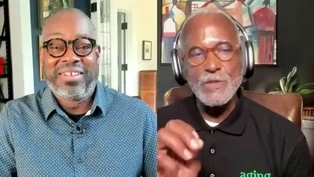
A conversation with the author of “Aging While Black”
Video has Closed Captions
Clip: S54 Ep35 | 8m 58s | Last year, American Black Journal spoke with Raymond Jetson at a virtual town hall on caregiving. (8m 58s)
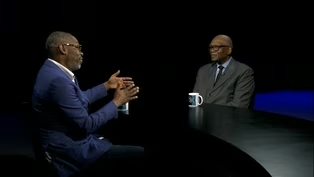
September is Healthy Aging Month
Video has Closed Captions
Clip: S54 Ep35 | 11m 30s | This month is a time to promote physical, mental, social, and financial well-being among older adult (11m 30s)
Providing Support for PBS.org
Learn Moreabout PBS online sponsorship New Episode
- News and Public Affairs

Top journalists deliver compelling original analysis of the hour's headlines.
 New Episode
- News and Public Affairs

Today's top journalists discuss Washington's current political events and public affairs.

 New Episode
 New Episode
 New Episode
 New Episode


 New Episode


Support for PBS provided by:
American Black Journal is a local public television program presented by Detroit PBS