Prairie Sportsman
Hen Houses and Insect Surveys
Season 17 Episode 9 | 27m 46sVideo has Closed Captions
The value of hen houses to duck populations and the University of Minnesota tracks entomology.
Host Bret Amundson connects with Delta Waterfowl to learn the value of hen houses to duck populations and two different surveys by the University of Minnesota department of entomology track the numbers and varieties of harmful ticks and helpful bumblebees, respectively.
Problems playing video? | Closed Captioning Feedback
Problems playing video? | Closed Captioning Feedback
Prairie Sportsman is a local public television program presented by Pioneer PBS
Production sponsorship is provided by funding from the Environment and Natural Resources Trust Fund and Shalom Hill Farm. Additional funding provided by Big Stone County, Yellow Medicine County, Lac qui...
Support provided by:


Prairie Sportsman
Hen Houses and Insect Surveys
Season 17 Episode 9 | 27m 46sVideo has Closed Captions
Host Bret Amundson connects with Delta Waterfowl to learn the value of hen houses to duck populations and two different surveys by the University of Minnesota department of entomology track the numbers and varieties of harmful ticks and helpful bumblebees, respectively.
Problems playing video? | Closed Captioning Feedback
Where to Watch Prairie Sportsman
Prairie Sportsman is available to stream on pbs.org and the PBS app.
Providing Support for PBS.org
Learn Moreabout PBS online sponsorshipMore from This Collection
The Environment and Natural Resources Trust Fund has awarded a billion dollars to more than 2,500 projects that protect, conserve, preserve and enhance Minnesota’s natural resources. This playlist includes many of these projects featured on Prairie Sportsman, an outdoor show produced by Pioneer PBS for all Minnesota PBS stations.
A Decade of Minnesota and Pristine Green
Video has Closed Captions
Host Bret Amundson reflects on 10 years of hosting and researchers investigate cyanobacteria blooms. (27m 46s)
Memorial Park and Powerboat Impacts
Video has Closed Captions
Shakopee’s Memorial Park Mill Pond's waterfowl viewing, and the impacts of powerboats on lakes. (27m 46s)
St. Croix Sturgeon and Aquatic Plant Restoration
Video has Closed Captions
Joins anglers on the St. Croix River to fish for sturgeon and Minnesota aquatic invasive species. (27m 46s)
Rabbit Hunting and Raptor Rehab
Video has Closed Captions
Join a group of long-time friends on their annual rabbit hunt and the Raptor Center cares for birds. (27m 46s)
Alclair Outdoors and Robotic Weed Control
Video has Closed Captions
The story behind Alclair Outdoors and researchers test a weed terminator in a cornfield. (27m 46s)
Tradition on the Water and Spiny Waterfleas
Video has Closed Captions
An annual friend's trip to Lake of the Woods and tracking spiny waterfleas. (27m 46s)
Arrowhead 135 and Bringing Youth Outdoors
Video has Closed Captions
The Arrowhead Ultra 135 winter race and Project Get Outdoors. (27m 46s)
Danny's Deer and Offal Wildlife Viewing
Video has Closed Captions
Danny Thompson manages land for deer while trail cams monitor deer offal scavengers. (27m 46s)
Video has Closed Captions
A Minnesota DNR crappie barotrauma study and problems with dumping baitfish. (27m 46s)
Precision Shots and Green Ammonia
Video has Closed Captions
A precision rifle competition and converting wind energy into green ammonia. (27m 46s)

Bass Classic and Aquatic Research
Video has Closed Captions
The Dick Hiley St. Jude Bass Classic and advances in controlling AIS in Minnesota. (27m 46s)
Video has Closed Captions
A retired conservation officer on a pheasant hunt and conservation can start at home. (27m 46s)
Providing Support for PBS.org
Learn Moreabout PBS online sponsorship(bright music) (gentle upbeat music) - [Bret] On today's "Prairie Sportsman," we visit with Delta Waterfowl to learn about efforts to aid duck populations through the installation of henhouses.
- I have said I'm gonna do my part to make more ducks.
(screen whooshes) - [Bret] Then we check in on two different insect surveys in progress at the University of Minnesota, Department of Entomology, one of a very helpful species- - The way bumblebee's pollinate, it's really special, and we call it buzz pollination.
- [Bret] The other harmful- (screen whooshes) - When you think about ticks, it's not something a lot of people wanna talk about, right?
Ticks are kind of gross.
- Welcome to "Prairie Sportsman."
I'm Bret Amundson.
This show is all about Minnesota's outdoor opportunities, and the science and management behind those opportunities.
Got another great show for you starting right now.
(bright energetic music) (bright energetic music fades) (bright music) - [Announcer] Funding for "Prairie Sportsman" is provided by the Minnesota Environment and Natural Resources Trust Fund, as recommended by the Legislative Citizen Commission on Minnesota Resources, by Mark and Margaret Yackel-Juleen on behalf of Shalom Hill Farm, a retreat and conference center in a Prairie setting near Windom, Minnesota, on the web at shalomhillfarm.org, and by the Friends of "Prairie Sportsman."
To become a Friend of "Prairie Sportsman," visit pioneer.org/prairiesportsman.
(bright music fades) (gentle music) - Welcome to "Prairie Sportsman."
I'm Bret Amundson.
Well, what does the future of waterfowling look like?
Well, for one group of dedicated conservationists, it means sky's full of waterfowl and blinds full of happy hunters.
And today, we're gonna find out the hard work they're doing to help make sure that happens.
(bright music) - I'm the Chairman of our Delta Waterfowl Group in St.
Michael, Minnesota.
Been the chairman for about 14 years.
Our group, this is our 18th year of being together.
Ever since that day I came on as a chapter committee member, I have said I'm gonna do my part to make more ducks and produce more ducks.
When Delta first came up with the idea of putting henhouses out, and we saw some of the research from some of the biologists and the studies that they had been doing, and what the numbers were coming back at us as hunters saying that this is putting more ducks out there, that kinda got me the head to the fire to get that fire burning in me, and I took that fire and brought it to the group and said, "We need to start doing this."
And the guys jumped on board, and they've been going with it ever since.
(bright music) Need a drill, I think, and then the cradle.
- All right, so Lance, the plan is that you're gonna kind of surround this body of water here with henhouses and wood duck boxes.
- Yeah, so putting the hen house out right now, we feel that this is gonna be a good spot.
- [Bret] Why did you pick this spot?
- With a little bit bigger water, We don't want the ice to take out the henhouse, but at the same time, we want to be in an area where we feel that there's gonna be some birds that are gonna use this area, and really, we want 'em to come into the area, and hopefully, see it and say, "I'm nesting there."
- So now that we got a spot picked out, you got a crew of guys walking out there.
What's the next step?
- So right now their job is to get out there.
We try to put the post down into the water in the muck about three to four feet.
- [Bret] So first thing they're doing, they're drilling through the ice.
- Yep, augering down through the ice.
Try to get it away from the cattails, anywhere from five to seven feet away.
Augering a hole in, putting it in, and then we'll try to get it into the muck, you know, like I said, three to four feet into the mud.
We want the pole off of the ice, anywhere from two to three feet, because then the hen structure or the house itself sits above the water that three to four feet.
During, call it the summer months, predators shouldn't be able to get to 'em when they're out in the water.
And that's the whole point of putting 'em out over the water like this, of course, 'cause these birds would normally be nesting in the grass, sometimes a little ways away from the water.
- You get that post in the ground down into that muck, and then what's after that?
- After we've got that set situated, feel like it's a good base, what we'll do is we'll take the cradle, which we have prewelded together and put that in, and we'll usually drill two pilot holes into 'em to hold that secure.
- And then you actually try to point 'em in a certain direction.
- We do.
- Isn't it?
- Yeah, north is there.
- All right.
- We try to stay away from the northwest wind to go right through the tube.
We try to offset 'em a little bit.
Once that cradle is secure and we feel good, put the hen house in there, and then we zip tie 'em with metal, not just plastic, but with metal.
Wind will come.
You know, these prairie areas, 30, 40 mile an hour winds won't push that off into the water.
And once we've got that down, we put a little nesting grass in there for her to come in, and hopefully, she'll bed it down.
Put a little pocket about the size of our fist.
and hopefully, she'll have some eggs.
And we got some mallards down the way.
(gentle music) The biggest thing that we have found and that biologists, whether it be any out there projects that they're doing, those biologists have said, "We gotta keep the raccoons and the skunks and all those predators."
And having that hen house and that tube on water, it's given her a chance.
I think we should put a wood duck house right up here.
- [Jarrod] Okay.
- Because it looks like there's some flat ground there.
- Yep.
- We'll get it in there.
- [Jarrod] Okay.
In the water or?
- Ah, we'll try to get it up on land if we can.
(gentle upbeat music) - Yeah, you don't really need a whole lot of gear, I mean, an auger or an ice chisel and a couple of wrenches, - [Bret] A drill.
- [Chris] And a drill is about all you really need.
- As much as people think it is a lot of work, the spearheading of just getting the guys is the hardest part.
Finding the resources and finding the materials isn't hard in this day and age with the internet and all of that stuff.
And it doesn't take a lot of money.
But if you get the guys that can support it, it doesn't take much.
(gentle upbeat music) - We all look forward to doing it, and it's basically like duck camp without being able to shoot any ducks.
That's basically it.
We have a lot of fun.
We laugh.
We joke.
(gentle upbeat music) - [Bret] All right, so you put up some hen houses around this Waterfowl Production Area.
You're also doing some wood duck boxes.
- Yeah, our group, years ago, was primarily putting wood duck houses up, and when the hen houses came in, then we started doing a combination of about half and half, and we really liked the wood duck house thing.
We think it's a beneficial deal.
So same kind of deal?
They're just gonna put this pole in, but they're putting it actually on the ground, not in the water.
- Yeah.
Yeah, we try to get it close to the water, but again, yeah, we get it right uptight.
We try to get it close to the water, so they can jump off, get in the water as quick as they can, those little ones These are pretty quick, pretty quick insulation for us.
- You know, you're doing something good for the birds.
I've been mentored as a young person hunting and fishing, and it's good to do this when you get older when you can.
- It just ups the nesting success so much from nature.
I mean, they got a rough road out there with all the predators, raccoons, mink, skunks.
It just makes it a little bit easier for 'em.
- About the only metric you can use to quantify any success is when you look in those tubes, and you see broken eggshells.
- Absolutely.
After putting out all the hen houses and the wood duck house or wood duck boxes and the hen houses, our last day, we usually take, and that's kind of our day where we, as a group, go out and we kinda wait, and we get to that house, or we get to that wood duck hut, and we open it.
And when you've seen the shells, or you've seen the little nesting the hen house, I mean all of us kind of get the little kid in us, and jump up and down a little bit, and it makes us feel good.
(bright music) - Well, how's it look?
- [Member] This one's been used.
It's got- - [Bret] Oh, nice.
- [Member] Eggshells in it.
I don't see any feathers in there.
But there are eggshells, and there's the imprint in the middle.
So it's been used.
Duck sitting there.
(gentle upbeat music) - So from what we have out here in Western Minnesota, our success rate on our wood duck houses, I can confidently say that we are 90% or better on our wood duck houses.
Our hen houses were probably more of like that 40 to 50%, which has been awesome for us.
- [Bret] What impacts have you seen from those efforts?
- I think we're seeing more ducks.
It's tough to always tell because of so many different variables, you know, but I do believe we're doing what's right, and I do believe we're seeing more.
Seeing the birds come back at this time and the numbers of birds and knowing that we're putting the henhouses and the wood duck houses out there to hopefully give them a chance of survival for the future, it doesn't get better.
(gentle music) (bright music) - If I have a good time series of a species, I can see where they occur throughout time.
It allows us to create targeted conservation strategies for each different organism.
(screen whooshes) - Ticks carry zoonotic diseases, so it's very important for humans, for pets, and also for our wildlife to know what's out there.
(energetic music) - [Bret] University of Minnesota researchers are on the hunt for some very important insects.
(energetic music) - Bumblebees, I like them 'cause they're big and fuzzy and easy to find and identify.
We're mostly here just to see what's out here, kind of, you know, look for what species are here, look for rare species, anything interesting.
They're very docile.
They'll really only sting you if you, like, grab 'em or if you're like poking around their nest.
But for the most part, like, you can go up.
You can go up to flowers, get really close, and they just, they don't even care.
- The way bumblebee's pollinate, it's really special.
We call it buzz pollination.
There are some flowers where the pollen is not outside to actually have a capsule it.
And the way bumblebees pollinate those flowers is they will attach to that flower, and they'll start vibrating or shaking the whole body and making this sound, this (imitates buzzing), buzz sound.
And what they're doing is just shaking the flower and getting all that pollen out.
Honeybees can't do that, and you know, bumblebees are just big, fuzzy, prettier.
(Cristian laughs) (gentle upbeat music) - [Bret] But these big, fuzzy, pretty insects face an immense array of challenges, as the number of native bumblebees in Minnesota is declining.
- Technically, there are 25 species recorded from the state, but currently, there's only 22 'cause one is extinct, and two are extirpated.
(screen buzzes) They exist but not in Minnesota anymore.
(bright music) There's a lot of reasons, habitat loss, pesticides, climate change.
For the bumblebees especially, a disease came through and wiped out a few species, and that happened in the mid or late 1990s.
- [Bret] The University of Minnesota Bee Lab is using a data-driven approach to help these threatened creatures.
- First of all, we are going into the field, making surveys to see what's out there.
You can't know what you lose if you don't know what you have.
But most importantly, we rely on this historical collection of insects that we have.
(bright music) We are georeferencing, so basically, all of these insects come attached with information of where they were collected and when they were collected.
With those historical data, we can now compare, hey, if 100 years ago, I was in this place, I can go here and find out what bumblebees I found.
I can go out today and see which ones I can find now.
But more important is if I have a good time series of a species, I can see where they occur throughout time.
That information's very important because it allows us to create targeted conservation strategies for each different organism.
(upbeat music) - [Bret] Over the years, the process of collecting this data has become friendlier to the bee, which is especially important as Minnesota is one of the few places on the planet where one can find the federally endangered rusty patch bumblebee.
- Before, in order to have evidence that a species occurred in a place, we'll go, we'll collect them, we'll preserve them, and it'll end up in a slide right here.
Now we have accumulated enough knowledge in bumblebees where now we can try to do monitoring efforts that are what we call non-lethal, so we don't need to kill a specimen.
So we can go out to the field, take the data, place the date and who collected it, write that data, take a picture, and now that picture becomes a specimen.
(upbeat music) - [Bret] Researchers are working to expand their catalog to include specific DNA data of Minnesota bees.
- We're trying to find pieces of the DNA where we see variability within the species.
It's very low, but it's different enough from other species.
Now there are regions on the genome that we can do that, and it's been going on for some time now.
We've called this The Barcode of Life 'cause it's the analogy, right, that a sequence of DNA, so letters A, T, G, and C, that's what DNA is made out of, it can basically tell me what a species is if I knew where it came from.
So we are creating that barcode database, but there is a very important difference that we need to do with those barcodes.
A box of my favorite cereal here is going to have probably the same barcode as in my home country in Guatemala.
So that database is just gonna be very stable.
Now we wish life was that easy, (Cristian laughs) but because this DNA has evolved through time, there's variability that happens within those.
What we are doing here is we are increasing the amount of specimen information from Minnesota.
So if people want to do research in Minnesota, have a way to compare genetic information of Minnesota species, and we're not relying on information from other places.
(gentle upbeat music) - [Bret] Thanks in part to the genetic database that Cristian's team is currently building, the future of population monitoring will leave physical specimens out of the equation entirely, turning instead to a forensic investigation of the scene.
- Just like now, we can go out and take a picture of a bumblebee and know what that bumblebee is just because we have thousands of specimens that we've already compared.
When we build these genetic databases, every insect that has stepped here has left some print.
That print has DNA.
So imagine a place where I can go to a flower, I can just take a swab on the flower or a piece of that flower, extract DNA or all the signatures that things that were there left.
But our vision is being able to ask who was here.
And we don't need direct evidence, or at least in the form of specimens.
(gentle upbeat music) - [Bret] Regardless of the advances in methodology, researchers say knowing what is happening to the bumblebees can be critical to understanding much larger trends.
- There have been something that we call the insect apocalypse and one of the things that scientists have observed is that a number of those insects are reducing.
So the reason we're trying to see what happened with bumblebees, especially here in Minnesota, is because we have a robust enough data set in the form of specimens and history that we can actually measure that decline and put a number on that.
Now there is millions of species out there, and we don't have the luxury of having that data from everything else.
So the name of the research of this project is Overcoming Insect Decline: Bumblebees to the Rescue.
And the way bumblebees are rescuing us is allowing us to understand and sort of serve as an example of what could happen with many of things that we don't even know yet exist.
(gentle upbeat music) - [Bret] One thing the researchers are grateful for is the general public's interest in the plight of these pollinators.
- You see a lot, these days, people wanting to plant pollinator gardens and do other things to help the bees, and that stuff, it makes a difference, you know, especially in urban and suburban areas where there aren't necessarily a lot of good floral resources.
Like, having a pollinator garden can actually do a lot to support bees and bumblebees.
(gentle upbeat music) - Insects, pollinators, they know how to do their job if we just provide them jobs by creating places where they can go, gather, feed.
As simple as saying, "I'm gonna plant some pretty flowers in my garden," preferably if they're native, or, "I'm gonna plant some tomatoes so I have a lot to eat, and my pollinators have something to eat."
- [Bret] On the topic of conservation, Cristian has some parting thoughts on the underlying reason why good stewardship of the environment is so important to us all.
- Nature is out there, and it just occurs.
We are part of it, and it sustained our lifestyle.
What's happening right now is that we are accelerating the loss of that ecosystem.
I have one teacher that told me one time, "Conservation has one objective, conservation of humankind."
(Cristian laughs) Bumblebees probably outlived us.
Insects are definitely gonna outlive us as humans.
Life is resilient.
It has gone through glaciations, through a meteorite, through several extinctions.
So a lot of these conservation efforts are also for us, and we can be here longer here on this planet.
- [Bret] And that sure would bee nice.
(gentle music fades) (gentle upbeat music) - [Bret] No one likes a tick, Sorry, Patrick Warburton.
- Awkward moment.
- [Bret] These arachnids are familiar foe to people enjoying the outdoors, but we know relatively little about their numbers or distribution in the state.
Professor Ben Cull at the University of Minnesota is on a mission to expand our knowledge of these unpopular parasites.
(gentle upbeat music) - The last time someone did a comprehensive survey of all the different tick species that are found in Minnesota was in the 1940s, and at that time, they found that there were seven species known in the state.
Since then, there have been about 15 species of ticks that have been recorded in this state.
Since then, there have been several large surveys for deer ticks, but a lot of the other tick species have received little attention, and this project aims to update our current information on tick species present in Minnesota.
To do this, we are establishing a community science project, which will involve collaborating with wildlife rehabilitation centers, vets, hunters, farmers, and other people that are coming into contact with wildlife as part of their daily activities.
(gentle upbeat music) - This is a big brown bat.
We are in a really unique position to be able to work with Dr.
Ben Cull on these studies.
Because we have such a large amount of patients, and we see so many animals, we get to screen them at intake, we do an exam, and when we find ticks, collect them for Dr cull.
And then especially with our young animals, with our babies that we bring in, we handle them multiple times a day, and at every time when we handle them, we check again for ticks and collect them.
So since 2023, we have collected over 2,100 ticks, spreading eight different species.
- [Bret] The study will also rely on sources that encounter ticks a bit less frequently than the Wildlife Rehabilitation Center.
- And we'll provide people with tick sampling kits, so they can send us ticks in the mail.
People are also welcome to email us photos of ticks they find.
We're also using our existing iNaturalist project to collect data on tick observations in Minnesota.
A major goal of this study is to communicate this information to the public.
So we've also established an online dashboard where people can go and look at this data on ticks, and we'll be regularly updating this.
Throughout the project, people will be able to go onto this website and find information about the different tick species we found and be able to carry out searches.
For example, someone could look at which tick species we found in their county, or they could see when ticks are most active in the state.
(gentle music) It's important to be aware of the different species of ticks we have in Minnesota because only certain species can transmit germs to people that make them sick.
So knowing what species of tick bit you will give you the information you need to get the right disease testing after a bite if you become sick.
- Yeah, when you think about ticks, it's not something a lot of people want to talk about, right?
Ticks are kind of gross and yucky, and you don't wanna find it on your pets.
You don't wanna find it on yourself, but they're everywhere, and they're really, really important to keep an eye out because of zoonotic diseases.
So for Dr.
Cull, it's really interesting that there are some of these tick species that are more prevalent now.
Ultimately, it is an important study for humans, for pets, and also for our wildlife to know what's out there.
- [Bret] In addition to understanding what ticks are currently in Minnesota, the project aims to monitor spec that are knocking on the door of the state.
- There also some ticks that are spreading in the United States.
One of these is the lone star tick, which people may have heard of, and this is easily recognizable by a white dot on its back, which is where it gets its name, the lone star tick, so far, it's not established in Minnesota.
- [Bret] Among the diseases carried by the lone star tick is alpha-gal syndrome, which is an allergy to a carbohydrate found in the meat of mammals and some dairy products.
(gentle music) The disorder is rapidly rising in the United States.
Preliminary findings from a recent study by Virginia Commonwealth University found a 100 fold rise in incident rates among those who were tested from 2013 to 2024.
Notably, former Minnesota Vikings Hall of Fame Defensive End Jared Allen recently announced his battle with alpha-gal.
(gentle music) - There's another tick called the Asian longhorned tick, which is causing problems for cattle in the U.S., and this is an invasive species which has just reached Iowa.
So it's important for Minnesotans, if they recognize these tick species, to report them.
- [Bret] There are precautions people can take to reduce the risk of tick bites and tick-borne diseases.
- If you're going to be spending time outdoors and you want to reduce the risk of being bitten by ticks, there are a few steps you can take.
These include using bug spray.
Treated clothing will repel the ticks.
Keeping into the middle of trails, not going deep into the brush.
Although, you may not be able to avoid this in some recreational activities.
And also check yourself after you've been outside because most of the tick-borne diseases, the tick needs to be attached for a day or more to be able to transmit the germs.
So if you can find ticks and remove them quickly, this greatly reduces the risk of becoming ill from a tick bite.
If a person finds a tick on them, they should keep the tick so that someone can identify it.
This will give them an idea of the potential diseases they might have transmitted.
It's also important that they remove the tick correctly, which is grabbing it at the head and pulling it straight outwards.
And you should monitor the bite site.
For example, if you see a a rash developing, then that's a good time to go and see a doctor.
- [Bret] While most of us would like to limit our exposure to ticks, Dr.
Cull is looking for help getting a closer look at many more.
- If you work with animals or you're regularly coming across ticks on animals or yourself, please reach out to us, and we'll be happy to accept your tick samples.
(gentle music) - [Bret] For more information on the University of Minnesota Tick Biodiversity Program, you can visit z.umn.edu/ticks.
(gentle music) (bright gentle music) - [Announcer] Funding for "Prairie Sportsman" is provided by the Minnesota Environment and Natural Resources Trust Fund, as recommended by the Legislative Citizen Commission on Minnesota Resources, by Mark and Margaret Yackel-Juleen on behalf of Shalom Hill Farm, a retreat and conference center in a Prairie setting near Windom, Minnesota, on the web at shalomhillfarm.org, and by the Friends of Prairie Sportsman.
To become a Friend of Prairie Sportsman, visit pioneer.org/prairiesportsman.
(bright gentle music fades) (bright music)
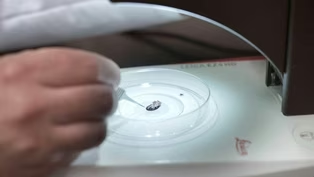
Video has Closed Captions
Clip: S17 Ep9 | 7m 14s | Learn about ongoing research where scientists collect and analyze ticks to better understand them. (7m 14s)
Video has Closed Captions
Clip: S17 Ep9 | 9m 26s | Researchers study bumblebee populations across Minnesota, working to better understand species. (9m 26s)
Video has Closed Captions
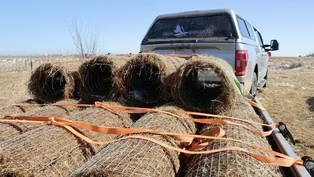
Preview: S17 Ep9 | 30s | The value of hen houses to duck populations and the University of Minnesota tracks entomology. (30s)
Video has Closed Captions
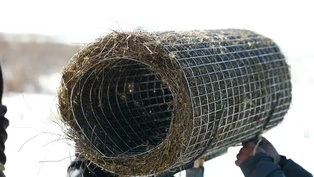
Clip: S17 Ep9 | 8m 32s | In Minnesota volunteers install hen houses designed to protect nesting ducks from predators. (8m 32s)
Providing Support for PBS.org
Learn Moreabout PBS online sponsorship New Episode
- Science and Nature

Explore scientific discoveries on television's most acclaimed science documentary series.





 New Season


 New Season

Support for PBS provided by:
Prairie Sportsman is a local public television program presented by Pioneer PBS
Production sponsorship is provided by funding from the Environment and Natural Resources Trust Fund and Shalom Hill Farm. Additional funding provided by Big Stone County, Yellow Medicine County, Lac qui...