
India: The Sex Workers
Clip: Season 2004 | 21m 3sVideo has Closed Captions
A 2004 examination of India’s AIDS crisis through the eyes of girls and women sold into sex work.
A 2004 examination of India’s AIDS crisis through the eyes of girls and young women sold into sex work, originally aired as part of the FRONTLINE/World series. At the time this FRONTLINE/World documentary was filmed, more than two million women and girls were working in India’s sex trade, and being forced to navigate their country’s AIDS crisis.
Problems playing video? | Closed Captioning Feedback
Problems playing video? | Closed Captioning Feedback
Funding for FRONTLINE is provided through the support of PBS viewers and by the Corporation for Public Broadcasting. Major funding for FRONTLINE is provided by the Ford Foundation. Additional funding...
Support provided by:

India: The Sex Workers
Clip: Season 2004 | 21m 3sVideo has Closed Captions
A 2004 examination of India’s AIDS crisis through the eyes of girls and young women sold into sex work, originally aired as part of the FRONTLINE/World series. At the time this FRONTLINE/World documentary was filmed, more than two million women and girls were working in India’s sex trade, and being forced to navigate their country’s AIDS crisis.
Problems playing video? | Closed Captioning Feedback
Where to Watch FRONTLINE
FRONTLINE is available to stream on pbs.org and the PBS app.
Inside the Scam
Follow scams as they unfold — and examine tactics used to manipulate victims. A collaboration between FRONTLINE and The Associated Press.Providing Support for PBS.org
Learn Moreabout PBS online sponsorship♪ ♪ (people talking in background) (vehicles passing) (horns honking) >> ARONSON: In the heart of the city that used to be called Bombay, now Mumbai, lies one of its poorest districts, Kamathipura.
By day, its alleyways are filled with mostly unemployed men killing time... (bell dings) ...and prostitutes who drag their beds into the street waiting for their night's work to begin.
(man calling in Indian language, car horns honking) Kamathipura is India's largest red light district, home to more than 60,000 sex workers.
(vehicle horns honking) ♪ ♪ It is also the epicenter of India's AIDS crisis.
Now, in a country where even talking about sex has been taboo, the conversation has become open and frank.
Typically, how much would you charge a male client for sex?
>> YELU (speaking Indian language): >> ARONSON: Yelu has been a prostitute for 12 years.
For her and her fellow sex workers, their only defense against H.I.V.
is convincing men to wear condoms.
But most often, the men will simply refuse.
Do most of them just not know about H.I.V.
and AIDS yet?
Is this the situation?
They're just not educated?
>> RUPA (speaking Indian language): >> ARONSON: Rupa is the daughter of a former brothel owner.
>> RUPA: >> YELU: (women laughing) >> Love, love, love... (laughing, speaking Indian language) >> ARONSON: So, so, all of a sudden, if you're in love, it's okay to, to have sex without a condom?
>> WOMAN: Yeah.
>> ARONSON: How many times does it take to fall in love?
(women laughing) >> YELU: >> ARONSON: "I love you" means no condom.
>> YELU: (women laughing) ♪ ♪ >> ARONSON: They laughed about the situation, but the tragic fact is more than half of the sex workers here are H.I.V.-positive, and they are powerless in Mumbai's lucrative sex industry.
For the pimps and brothel owners, it's a multi-million-dollar business, and money, not health, is the bottom line.
Most men will pay more to have unprotected sex... (traffic humming, people talking in background) ...and they'll pay the highest prices for the youngest girls.
>> MAN (speaking Indian language): >> GIRL: >> ARONSON: India's red light districts are filled with young girls.
They are the most valuable commodity in the sex industry.
(car horn honks) Many of them have been kidnapped and trafficked to India.
(car door closes) Some have been sold by their own families.
All of these girls have been rescued from prostitution by a group called Sanlaap.
Most of them were sold into the sex industry between the ages of 13 and 16.
We met them at the shelter where they now live.
>> KHUSHBOO (speaking Indian language): >> ARONSON: Mm-hmm.
>> JHARNA: >> DALI: >> ARONSON: Dali was 13 years old.
She spent five years in Mumbai's red light district.
She remembers the first moments after her father sold her.
>> DALI: Mm.
>> ARONSON: Khushboo was sold into prostitution when she was 16 years old.
She says she had no idea about the danger of AIDS.
>> KHUSHBOO: >> ARONSON: So when you were actually in the brothel, you did not know about H.I.V.?
>> (speaking Indian language) >> KHUSHBOO: >> ARONSON: Is that true for many of you?
>> GIRL: >> ARONSON: Like several of the girls in this group, Dali is H.I.V.-positive.
She tells us how she found out about the disease.
>> DALI: >> ARONSON: No?
♪ ♪ >> Let us put ourself into that 16-years-old girl.
Someone has come and cheated you and sold you here, and you're sitting in the dark where unknown man, stranger is coming, and he's trying to have sex with you.
I mean, do you really, you know, that time, being in that age, do you think of condoms and do you think of health, when you are not aware of anything?
>> ARONSON: Anju Pawar is a social worker.
>> And finally, someone just, uh, forces you to do everything.
>> ARONSON: She works with a small group called ASHA, one of the many in Mumbai struggling to educate women about AIDS.
ASHA is made up of sex workers called peer educators, who go into the brothels talking to women about safe sex.
>> The girl is just not accessible to our peer educators.
By the time the three to six months pass, when the girl gets adjusted in the brothel, then the brothel keepers will tell peer educators that she is suffering from such and such, and, "Can you please take her to the clinic?"
Now, that is too late for the intervention program.
Girl is already infected.
Now, this is what is the real situation is.
(whistle blowing) >> ARONSON: In Mumbai, the sex workers face another challenge... >> (calling) >> ARONSON: ...the police who patrol the red light district.
Rather than being part of the solution, they are, in fact, oftentimes part of the problem.
(people talking in background) Prostitution is officially illegal here, and police raids on brothels are common.
But once arrested, the women told me, they are either forced to have sex or pay bribes for their release.
And the youngest girls are the most vulnerable.
(engine humming) As business continues as usual in the red light district, Mumbai's AIDS rate has soared.
The city now has the largest number of AIDS cases in the country.
This is one of Mumbai's largest public hospitals and one of the only hospitals in India that doesn't turn away AIDS patients.
Over four-and-a-half million people in India are H.I.V.-positive.
(people talking in background) >> ALAKA DESHPANDE (speaking Indian language): >> ARONSON: Every week, Dr.
Alaka Deshpande sees hundreds of AIDS patients.
>> DESHPANDE: >> MOTHER: >> DESHPANDE: >> MOTHER: >> DESHPANDE and SISTER: >> DESHPANDE: This patient has come from a far-off place.
It is another state, Uttar Pradesh.
He is married.
His wife is not staying with him.
The wife is in the native place.
So we do not know what is the status of the wife.
>> ARONSON: While we don't know the status of this man's wife, health experts estimate that one-fifth of all AIDS cases in India are married women who have been infected by their husbands.
>> He used to go to the commercial sex worker because he is staying in Bombay and the wife is far away, in city of Benares.
>> ARONSON: In Mumbai, his story is common.
As the nation's commercial center, the city is full of migrant workers.
>> DESHPANDE (speaking Indian language): >> MOTHER: (Deshpande continues) >> ARONSON: This is the pressing concern of health officials.
Men infected here in Mumbai will travel back home and spread it to their own communities.
♪ ♪ 1,200 miles east of Mumbai, along the banks of the Ganges, India's holiest river, lies the city of Calcutta.
Notoriously poor and overpopulated, Calcutta would seem especially vulnerable to infectious diseases like AIDS.
The city's red light district, the oldest in India, is called Sonagachi, or the Golden Quarter.
It's home to tens of thousands of prostitutes.
(vehicle horn honking) But despite the acute poverty in the city, the red light district has the lowest AIDS rate of any in the country.
That's because of the efforts of people like Putul Singh.
Putul was sold into prostitution by her husband eight years ago, when she was 20.
>> SINGH (speaking Indian language): >> WOMAN: >> ARONSON: Now she works full-time for the Sonagachi Project.
They are the model AIDS prevention group for the rest of India.
>> (speaking Indian language) >> ARONSON: Every day, Putul makes her rounds talking to sex workers.
Part of their strategy to combat AIDS is to offer the sex workers basic healthcare as a way to open the discussion about safe sex.
>> SINGH: >> WOMAN AND SINGH: >> WOMAN: >> SINGH: >> WOMAN: (Singh continues) >> SINGH: >> ARONSON: But even for Putul herself, trying to explain the need for condoms to the area's local men isn't easy.
>> SINGH: >> ARONSON: These men are some of the area's pimps and regular clients, what the locals call babus.
>> (speaking Indian language) >> ARONSON: Putul leads the discussion with Buri, a local brothel owner.
>> MAN: >> SINGH: >> MAN and SINGH: >> MAN: >> SINGH: (man responds) >> ARONSON: The man tells Putul he is certain he has no diseases, and besides, he has a different idea of what causes AIDS.
>> BURI: >> MAN: >> BURI: >> MAN: >> MAN 2: >> MAN 1: >> ARONSON: Buri disagrees and explains how the disease spreads.
>> BURI: >> MAN: >> BURI: >> SINGH: (Buri continues) >> MAN: >> SINGH: (man, Buri, and Singh speaking) >> ARONSON: It's hard to imagine this conversation happening in Mumbai.
The sex workers here seem so much more empowered.
>> SINGH: (people talking in background) >> ARONSON: Is the meeting happening?
The women in Calcutta go beyond aggressive AIDS education.
Every week, they meet to discuss the broader issues they face.
>> (speaking Indian language) >> ARONSON: Just as in Mumbai, the conversation quickly turns to police harassment.
>> RAMA DEBNATH: >> ARONSON: Here, their solution is very different.
Even though prostitution is also illegal in Calcutta, this group is a full-fledged, state-recognized workers' union.
>> (speaking Indian language) >> ARONSON: Rama Debnath is the union's president.
(Debnath continues) She tells them what they should do when they're confronted by the police.
>> DEBNATH: >> ARONSON: She says the only way to change the way the police treat sex workers is to stand up to them and have courage.
>> DEBNATH: >> ARONSON: After the meeting, Rama explains why it's important that the union is led by the sex workers themselves.
>> DEBNATH: >> (speaking Indian language) >> ARONSON: The combination of the sex worker union and the Sonagachi AIDS project is making a difference.
Condom use has soared in Calcutta from an estimated three percent to 90%.
Unlike Mumbai, Calcutta's sex workers have managed to keep AIDS under control.
The rate here is one-fifth that of Mumbai's.
(people talking in background) >> SINGH (speaking Indian language): >> ARONSON: Calcutta has a long tradition of labor activism.
Its state, West Bengal, has been run by a communist government for 25 years.
>> SINGH: (woman responding) >> ARONSON: Health officials are concerned they won't be able to replicate the women's success in other cities.
And even here, Rama worries about their biggest challenge-- reaching the thousands of young girls sold into the sex trade.
They say one way to do it is to legalize prostitution.
>> DEBNATH: >> ARONSON: The youngest girls are the hardest to reach.
We had asked Khushboo, who had been forced to work in Calcutta for two years, what she knew about the union.
>> (speaking Indian language) >> KHUSHBOO: >> ARONSON: Have any of you heard of the sex worker union?
>> No.
>> ARONSON: Nobody's heard of it?
So when you were in the brothels, did anyone from that project come in and talk to you?
>> No.
>> ARONSON: We asked if any of the girls who had worked in Mumbai had been approached by any AIDS prevention groups.
>> RANI: ♪ ♪ >> ARONSON: Although haunted by their memories, these girls are now far from the red light districts from which they were rescued.
After working as prostitutes, most often their families will not take the girls back.
Sanlaap attempts to give them hope for some sort of a future.
These girls are the fortunate ones.
♪ ♪ Thousands of other young girls are left behind.
Carefully guarded by the sex industry, they're virtually unreachable by even the most effective AIDS prevention groups.
What happens to them will affect the future of AIDS in India.
♪ ♪
Video has Closed Captions
Clip: S2004 | 18m 36s | The tragic story of a migrant farmer’s journey to the U.S. in the scorching heat. (18m 36s)
 Now Playing
Video has Closed Captions
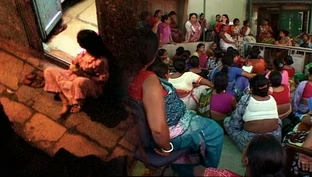
Clip: S2004 | 21m 3s | A 2004 examination of India’s AIDS crisis through the eyes of girls and women sold into sex work. (21m 3s)

"Is Wal-Mart Good for America?" - Preview
Preview: S2004 Ep16 | 55m 9s | An eye-opening look at the power and influence of the world’s largest company. (55m 9s)

Preview: S2004 Ep15 | 31s | An inside look at the business and science of selling us on what we want. (31s)
Providing Support for PBS.org
Learn Moreabout PBS online sponsorship New Episode
- News and Public Affairs

Top journalists deliver compelling original analysis of the hour's headlines.
 New Episode
- News and Public Affairs

Today's top journalists discuss Washington's current political events and public affairs.
 New Episode
 New Episode
 New Episode
 New Episode
 New Episode
 New Episode
 New Episode
 New Episode
 New Episode
Support for PBS provided by:
Funding for FRONTLINE is provided through the support of PBS viewers and by the Corporation for Public Broadcasting. Major funding for FRONTLINE is provided by the Ford Foundation. Additional funding...