WTVP EcoWatch
Inside a Fossil-Fuel-Free Macomb Home
Clip: Season 3 Episode 2 | 6m 5sVideo has Closed Captions
Tour a Macomb home powered by efficient electric appliances, vehicles and rooftop solar.
Macomb resident Gary Freymiller tours the nearly 70-year-old home he converted to run without fossil fuels. He demonstrates electric vehicles, a heat-pump dryer, water heater and home heating system, all supported by rooftop solar. The upgrades have eliminated his natural gas and gasoline bills while keeping most monthly electric bills below $20.
Problems playing video? | Closed Captioning Feedback
Problems playing video? | Closed Captioning Feedback
WTVP EcoWatch is a local public television program presented by WTVP
Support for Ecowatch is provided by the Backlund Charitable Trust
WTVP EcoWatch
Inside a Fossil-Fuel-Free Macomb Home
Clip: Season 3 Episode 2 | 6m 5sVideo has Closed Captions
Macomb resident Gary Freymiller tours the nearly 70-year-old home he converted to run without fossil fuels. He demonstrates electric vehicles, a heat-pump dryer, water heater and home heating system, all supported by rooftop solar. The upgrades have eliminated his natural gas and gasoline bills while keeping most monthly electric bills below $20.
Problems playing video? | Closed Captioning Feedback
Where to Watch WTVP EcoWatch
WTVP EcoWatch is available to stream on pbs.org and the PBS app.
Providing Support for PBS.org
Learn Moreabout PBS online sponsorship- More than 80% of homes in Illinois rely on fossil fuels for home heating.
But Gary Freymiller home isn't one of them, not anymore.
The Macomb resident has converted his home to completely electric.
He gave us a tour that explained that he wants to help preserve the environment first and foremost.
At first glance, there isn't much unusual about this mid-century home in Macomb, but now the nearly 70-year-old house is free of fossil fuels thanks to an owner who was concerned about the environment.
- I can kind of go back to 2003 when I bought my first hybrid vehicle.
And so I've always wanted to do whatever I could to reduce my impact.
And I came across a book called "Electrify," by Saul Griffith, and he kind of mapped out a plan which is get rid of all of your combustion devices and electrify everything and then power your devices with renewable energy from like solar panels on the roof.
So that was kind of the idea.
And within the last five, six, seven years, the technology has advanced to the point where someone like me could even afford it.
- [Mark] The first steps to a cleaner way of living actually took place outside the home.
- We had one EV to begin with and we've later purchased a second.
So we're all electric in transportation.
To charge those EV's, we installed a level two charger in our garage and we can use the same charger to charge both vehicles.
- [Mark] Then purchasing all electric appliances and HVAC system.
- [Gary] The washing machine is normal washing machine.
The dryer here is a heat pump dryer, so that's different from most dryers.
You'll notice that it doesn't have a vent going outside.
That's because, unlike conventional dryers, it doesn't pull in the air and then exhaust it outside.
It just recirculates the air.
And so it uses half the energy of a conventional resistance based dryer and it takes a little longer to dry the clothes because it's not operating on such a high temperature.
So, you know, you are giving up a little bit of time, but we don't even notice that here.
- [Mark] Is there a big price difference between a dryer like this and a "normal" one?
- I don't think so.
We might've paid maybe 10% more than, you know, conventional type dryer.
And I'm sure there's all sorts of different levels of dryers.
So it's in the ballpark.
This is the heat pump water heater, and it looks like a pretty normal water heater.
The difference is it has this basically like an air conditioner sitting on top and instead of rejecting the heat to the atmosphere, it's rejecting the heat that it generates to the water in the tank.
And this is the air handling system for our heat pump, whole house heating.
It looks very similar to a gas furnace and it fits basically in the same space.
We were able to keep all of the same duct work.
All we had to do was replace this unit right here and you'll see up here, this is where the resistance heater is that we need when the temperatures go, you know, very cold and otherwise it's a pretty normal type heating system.
A typical furnace is based on combustion of a fuel.
Probably most homes have natural gas or methane as the fuel source.
So there will actually be a flame in the box and it's heating a heat exchanger and the air is being forced around the heat exchanger and the air is picking up the heat from the combustion.
So you end up, you know, I know that these things are supposedly 90 some percent efficient and we don't even notice it.
And it's, you know, maintaining the temperature that we have on our thermostat set point, just like an ordinary system, except it's not turning on and shutting off as frequently.
It, you know, keeps the temperature pretty constant.
- [Mark] And the final piece of the puzzle was installing solar panels to power the electrical components.
- We became all electric in like August or September of 2022.
So three and a half years basically.
And yeah, it was pretty exciting when we called Ameren and told them to remove the meter and they came and took it away, and you know, at that point we were like, we've done it.
Now there's no turning back.
Our energy bills are super low.
We pay the like monthly service charge for being connected to the grid.
We're still connected.
We don't have battery backup.
So, you know, when the sun isn't shining, kind of like today, we need the grid, but we also then feed back when the sun is shining.
So we have a couple of months a year where our electric bills are over $200 a month.
Otherwise they're, you know, right at the minimum under $20 for the rest of the year.
We don't have any natural gas bill.
We don't pay for any gasoline for our vehicles.
So from from that perspective, it's been great.
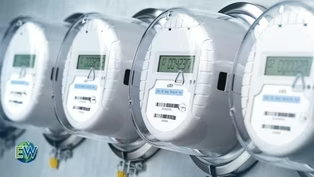
The Benefits of an All-Electric Home
Video has Closed Captions
Clip: S3 Ep2 | 4m 2s | Experts explain the health, environmental and financial benefits of all-electric homes. (4m 2s)
Why Prescribed Burns Need Better Insurance Access
Video has Closed Captions
Clip: S3 Ep2 | 5m 59s | Prescribed fire restores Illinois habitats, but limited insurance puts burns at risk. (5m 59s)
Providing Support for PBS.org
Learn Moreabout PBS online sponsorship New Episode
- Science and Nature

Explore scientific discoveries on television's most acclaimed science documentary series.














Support for PBS provided by:
WTVP EcoWatch is a local public television program presented by WTVP
Support for Ecowatch is provided by the Backlund Charitable Trust