
Inside a Student-Run Grocery Store in Rural Nebraska
Clip: Season 7 | 10m 45sVideo has Audio Description
Students in Cody, Nebraska run a real grocery store that serves their rural community.
Students in Cody, Nebraska run a real grocery store that serves their rural community. The Circle C Market provides hands-on learning and essential food access in a town nearly 40 miles from the nearest store. he Circle C Market is a unique, student-powered business that provides essential food access to a rural community where the nearest grocery store is nearly 40 miles away.
See all videos with Audio DescriptionADProblems playing video? | Closed Captioning Feedback
Problems playing video? | Closed Captioning Feedback
What If is a local public television program presented by Nebraska Public Media
Inside a Student-Run Grocery Store in Rural Nebraska
Clip: Season 7 | 10m 45sVideo has Audio Description
Students in Cody, Nebraska run a real grocery store that serves their rural community. The Circle C Market provides hands-on learning and essential food access in a town nearly 40 miles from the nearest store. he Circle C Market is a unique, student-powered business that provides essential food access to a rural community where the nearest grocery store is nearly 40 miles away.
See all videos with Audio DescriptionADProblems playing video? | Closed Captioning Feedback
Where to Watch What If
What If is available to stream on pbs.org and the PBS app.
Providing Support for PBS.org
Learn Moreabout PBS online sponsorship(upbeat music) [Narrator] "What If..." a school and its students ran a grocery store?
(gentle upbeat music) -(gentle music) -(vehicle beeping) Every Tuesday, a truck arrives with inventory for the Circle C Market, so it's a busy day for the store's workers.
Benji and Wayne, I'm gonna have you guys bagging bread and breadsticks, and then Joe and Isaac, you guys are gonna work on putting frozen stuff away, just the frozen stuff.
Got it?
-Yeah.
-Okay.
Go, team!
(gentle upbeat music) [Narrator] What makes this unusual?
Students and their school, the Cody-Kilgore consolidated district, run the Circle C.
(gentle music) (car engine revving steadily) How did this happen in Cody?
First, a little background.
(gentle music) The village sits atop Cherry County, a sparsely populated chunk of Sandhills ranchland bigger than the entire state of Connecticut.
(gentle upbeat music) Just 170 people call Cody home.
Not a prime location for any retail business.
Cody's previous grocery store closed in the 1990s.
More than a decade later a couple teachers had an idea.
Open a store that's a non-profit business associated with the school.
(keys clicking) Erin Heath was also involved in early planning.
For this to be viable, that was probably the best option, was to go ahead and fund it with some help, with the community, some help from our local governments, and with the labor coming from the students.
Was there ever a point during the discussions where, you know, people were saying, "You wanna do what?"
Yeah, a lot.
(gentle music) [Narrator] In 2013, the idea became reality.
The USDA and other groups helped with funding and planning.
It took a few months and lots of volunteers, including students, to construct the building, which uniquely has walls filled with straw for insulation.
A board comprised of people from the school, village, and broader community oversee the business.
That's really good for everybody to see what's going on and they're all briefed on the same things.
It's an open book.
And it also kind of keeps one or two people from really having a ton of influence over it, right?
Correct.
So today, we're gonna cover the first objective, construct chart of accounts for a service business organized as proprietorship.
[Narrator] Liz spends a lot of time here.
She teaches business classes in a room that's part of the store she manages as its only non-student employee.
You're back there teaching accounting and then you may have to come up and deal with an order or deal with a customer or help some students that are stocking, and then you go back and teach again?
Yeah, it's a lot of stop and go and sometimes it's all a challenge.
But at the same time, it's really good for the kids to see that because not very often do you have a classroom inside of a working business.
(machine beeping) Like in the middle of the class, if a customer comes in, the student can go out here and be like, "Hey, how's it going?"
Greet them, show them what they need, or ask 'em what they need.
And you just can't replace hands-on experience.
$10.33.
Would you like to round up?
[Person] Sure.
So I know all teachers are busy.
You're busy.
But my gosh, Liz?
Oh, yeah, she is.
She never stops.
On the very bottom, behind that prime rib.
Nicely.
[Narrator] During the school day, students work in the store as part of different classes.
Other times, like evenings and weekends, they're paid to work here.
They do everything.
I am checking all of the labels here and seeing if they match up with what's on the shelf.
-Stocking shelves.
-(gentle music) [Person] We're just packaging up on the breadsticks -and- -Bread in general.
[Ashley] I'm just making sure that these boxes go with the right tags.
[Mike] Why do you like working here?
'Cause it's just really fun.
You get a lot of experience with customers and just how to do stuff and work at a store.
-You guys have a good day.
-You too.
(bell dings) (gentle music) [Narrator] We thought we'd have a little fun with a new "What If..." product!
(gentle upbeat music) Let's see what they do with this.
(gentle music) -"What If?"
-(gentle music) -Thank you.
-Yep.
-Have a good evening.
-You're welcome.
-How are you?
-Good.
-Good.
-Kayleigh.
[Narrator] Kayleigh's worked here with her mom for five years.
[Mike] Tell me about working here at the store.
Honestly, it's been a really great opportunity.
At first, I wasn't too sure about it because I was like, "Well, everybody works at the store and I don't really like to do what everybody else does."
But no, it's been a really good icebreaker.
This is where I learned how to count back money.
I used to be very shy like, three years ago, me doing this like probably wouldn't have been asked.
But no, definitely it's been an icebreaker for me.
Okay.
Who's together and who's not?
-I'm buying all these guys.
-Okay.
[Narrator] Kayleigh's now student manager.
She says that's helped her grow as a leader.
I've been a leader on the court.
I've been a leader in the sports, I've been in the classroom, but being a leader in the workplace is a lot different.
Lot more liability.
-(bell ringing) -(gentle music) [Narrator] About 200 kids, K through 12, attend Cody-Kilgore.
Whether taking classes or working, almost all will be involved with the store at some point.
We have students that are interested in being in retail.
We have students that are interested in starting their own businesses.
And this gives them a great snapshot of looking at the numbers, looking at inventory, what stock, what's selling well, what's not selling well.
Real-world experience and real-world problem-solving, right?
Yeah.
These kids, I don't even think realize how many skills they're gaining from just communication at the register when they're ringing up customers or communicating when those customers are coming in.
-(gentle music) -(keyboard clicking) [Narrator] Bentley Jenkins worked in the store for several years, eventually serving a student manager.
Gaining leadership and communication skills she now uses as a bank customer service supervisor.
Here, if you have upset customers or upset employees, kind of knowing the right path that they need to direct them into, and just kind of learning how to diffuse a situation.
Just kinda learning how to navigate some of that stuff has been helpful, and knowing how to word things.
(laughs) (gentle music) Who's excited about stocking groceries?
[Kids] Me!
(people chattering) -Got muscles.
-(people chattering) [Person] Don't put it back on the shelf.
-All right.
-Good job, guys.
You think they'd be by the beans?
What do you think they'd be by the soup?
[Narrator] Liz is getting young Cody-Kilgore students involved in the Circle C. Open the door, give it a good pull.
(kids chattering) It's just mainly so they can get excited -and know how to do it.
-Learn how to do it.
Yeah.
See how this is full, right?
We keep everything else in the storage.
We'll have to figure out what goes in each of those.
[Person] You see how these are kind of similar?
There you go.
Yeah.
[Liz] And I think you have to grow 'em from small, all the way up.
-(gentle music) -(people chattering) [Narrator] From the start, this wasn't viewed as a moneymaking venture.
Back in 2012, what we figured out is if we could get two or 300 families spending $50 a week there, we could make it run.
We would break even at that point.
(gentle music) [Narrator] Now, Circle C does about 18 to 20,000 in sales each month, close to breaking even.
There have been plenty of challenges along the way.
-(horn honking) -(engine revving) One of the biggest getting distributors to bring products to someplace so small, so remote.
(gentle music) But it's working.
A unique business model you might find a couple other places in the country that's serving the people who live here.
Because the next closest grocery store is 40 miles away.
Tell me how important this store is for the town and the area.
It's very crucial.
Without the store, this area would be a food desert.
There's some of our community members that can't get to the grocery store easily, they can't get out, especially in the winter months when we get snow and ice and things like that.
[Narrator] It's a store that's become the identity of a town that calls itself too tough to die.
And it's kind of funny.
I go places and people know who we are and people know what we're doing and they've heard our story and it's really truly special.
When you think about the fact that a community, the size of Cody could pull that off- -Yes.
-What do you think of that?
I just think it's amazing, the community support, and all those people who are willing to donate their time and their money.
It's great.
It's amazing.
I think it's a testament to us keeping our town alive and growing and that we want this school and we want this community here for the next 100 years.
(gentle music) We started out when we opened the store with a 99 year lease on the ground, so we've got a little bit to go.
What's that put you at 87 left or something like that?
-Something like that.
-Okay.
I would say that we're very tenacious people, like we're pretty tough, like we get it done, we persevere, like we push through.
And I think that is true of any Sandhiller, really.
That is at our heart of who we are.
And I think that definitely speaks for these walls.
It wouldn't be here if we didn't have that spirit of pushing through and making it happen.
(gentle music) -(bell dings) -(people chattering)
What If Artists Only Had 20 Minutes To Paint?
Video has Audio Description
Clip: S7 | 5m 32s | Artists have 20 minutes to create a winning painting during Omaha's Art Battle at CULXR House. (5m 32s)
He Builds Guitars from Bleachers & Battleships
Video has Audio Description
Clip: S7 | 6m 19s | Meet Nebraska guitar maker Phil Whitmarsh, founder of Old Market Guitarworks. (6m 19s)
Meet the Entrepreneur Behind Pat on Tap
Video has Audio Description
Clip: S7 | 6m 30s | Abby Miller transformed vintage vehicles into Pat on Tap, a Nebraska mobile beverage caterer. (6m 30s)
How a Family Farm Became a Social Media Business
Video has Audio Description
Clip: S7 | 7m 53s | Nebraska family turned their five-acre hobby farm into a full-time social media business. (7m 53s)
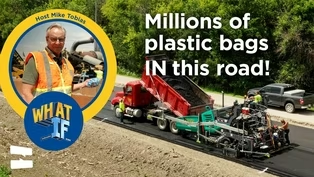
A Nebraska city built a road using 2 million plastic bags
Video has Audio Description
Clip: S7 | 10m 19s | South Sioux City and University of Nebraska researchers test a road made from recycled bags. (10m 19s)
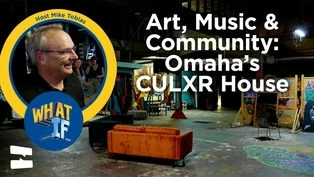
Inside CLUXR House: Where Music Art & Community Collide
Video has Audio Description
Clip: S7 | 8m 53s | A look inside CULXR House in Omaha, a creative hub for music, art, fashion, and community engagement (8m 53s)
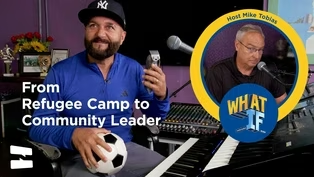
From Refugee Cam to Community Leader
Video has Audio Description
Clip: S7 | 10m 48s | Meet Hasan Khalil, a Lincoln entrepreneur and Yazidi refuge building community and uniting people; (10m 48s)
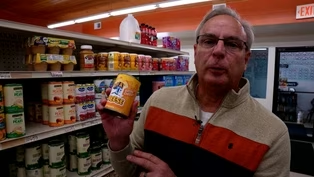 Now Playing
Inside a Student-Run Grocery Store in Rural Nebraska
Video has Audio Description
Clip: S7 | 10m 45s | Students in Cody, Nebraska run a real grocery store that serves their rural community. (10m 45s)
Providing Support for PBS.org
Learn Moreabout PBS online sponsorship












Support for PBS provided by:
What If is a local public television program presented by Nebraska Public Media