
From Refugee Cam to Community Leader
Clip: Season 7 | 10m 48sVideo has Audio Description
Meet Hasan Khalil, a Lincoln entrepreneur and Yazidi refuge building community and uniting people;
Meet Hasan Khalil — a Lincoln-based entrepreneur, Yazidi refugee, and community builder who is using his passions to bring people together. From founding a free soccer camp for immigrant and refugee youth to running a barbershop and creating deeply personal music, Hasan’s story is one of resilience, creativity, and purpose
See all videos with Audio DescriptionADProblems playing video? | Closed Captioning Feedback
Problems playing video? | Closed Captioning Feedback
What If is a local public television program presented by Nebraska Public Media
From Refugee Cam to Community Leader
Clip: Season 7 | 10m 48sVideo has Audio Description
Meet Hasan Khalil — a Lincoln-based entrepreneur, Yazidi refugee, and community builder who is using his passions to bring people together. From founding a free soccer camp for immigrant and refugee youth to running a barbershop and creating deeply personal music, Hasan’s story is one of resilience, creativity, and purpose
See all videos with Audio DescriptionADProblems playing video? | Closed Captioning Feedback
Where to Watch What If
What If is available to stream on pbs.org and the PBS app.
Providing Support for PBS.org
Learn Moreabout PBS online sponsorship(upbeat music) [Mike] What if an entrepreneur and creator uses different passions to build community?
(upbeat music) (keyboard playing) (razor buzzing) What do these three things have in common?
-(gentle music) -(razor buzzing) This guy, Hasan Khalil.
-(gentle music) -(razor buzzing) (gentle music) So make sure you're balancing.
How would you describe yourself?
I would describe myself a really friendly guy that always wants to meet new people and listens to others and take advice from others and share my experience with others.
(gentle music) [Mike] We'd describe him as a wide ranging entrepreneur and creator, with a resilient backstory that led to these different things.
(razor buzzing) (bright music) Raise your hand if you really enjoy these soccer camps.
[Mike] Hasan created Lincoln International Football Club in 2020, to give underserved kids an opportunity to learn and play the sport he loves.
The club puts on a summer-long free soccer camp.
Most of the participants are from refugee and immigrant families.
(whistle blowing) Raise your hand if you speak more than one language.
(bright music) (spectators clapping) -Goal.
-(spectators clapping) -Goal.
-(spectators clapping) -Goal.
-Goal.
(bright music) (spectators groaning) (bright music) -(Mike sighing) -(child laughing) [Mike] It's more than soccer.
Can we use soccer to bring everything together, the families and the kids, but to provide resources to these families and kids that they could benefit from beyond soccer?
(whistle blowing) Which will educational classes.
Okay.
Health resources that we could bring to these neighborhoods, mentoring these kids to be successful in their lives.
Most of these kids, their parents aren't able to afford, like soccer boot camps or summer camps.
They're not able to do it.
[Mike] Like James, who came here from the African country of Burundi less than a year ago.
When I give him these shoes, something that really touched my heart.
He kissed the shoes.
Yeah.
And I say, why are?
Why'd you kiss the shoes?
Because it's my first shoes.
He says, my first soccer shoes ever.
[Mike] Hasan understands these kids because he's also walked in their shoes.
I came from a refugee camp, 11 years in a refugee camp.
[Mike] Hasan lived in a refugee camp when he was the same age as these kids.
During Saddam Hussein's regime, Iraq was dangerous for the often persecuted Yazidi people.
Hasan's family fled Iraq for neighboring Syria in the middle of the night.
We had some shoes on, just our clothes.
No bags, absolutely nothing.
Even our IDs and everything that we had, we throw those away.
I could just feel the fear in my family's faces at that time.
Even though it was a refugee camps, it was poverty.
It was not much going on.
It was like a family jail.
[Mike] With no school and little else to do, Hasan developed a love for soccer in the camp.
Creating the nonprofit Lincoln International Football Club was a way to continue that and help others a lot like young Hasan.
We're having fun, they're having fun.
It's beautiful.
We gain so much from here, I learn so much.
Whoa, great job.
Beautiful.
(bright music) [Mike] Hasan's barbershop is the entrepreneurial side that pays the bills.
Cutting hair wasn't on his mind when an international aid organization helped 15-year-old Hasan and his family relocate from Syria to Buffalo, New York.
This was all these photos taken in 1999, months before we moved to the United States.
So these are our tickets actually.
(speaking foreign language) [Mike] On his third day in Buffalo, Hasan found something else new, a barber shop.
I'm like, wow, what's this?
You know, like, people cutting hair, beautiful cars outside, music is going, people are happy.
Something just really attracted me, like, I wanna work in a place like this.
Yeah.
(bright music) The owners let him clean the shop in exchange for haircuts.
He learned barbering and cut friends' hair for free.
Struggled, quit, then was encouraged to come back by the owner and his mentor.
Barbering became his profession after that.
And when the family moved from Buffalo to be a part of Lincoln's large Yazidi community, Hasan brought skills and scissors with him.
Is there something about barbering that kind of connects with your creative side?
I think so, to be honest.
Just growing up in refugee camps, Mike, we were kind of isolated from social, you know, like being social with others, not talking to so many people.
And I think barbering definitely give me the platform to reach my potential, you know, for who I am, what I can do, and connecting with everyone.
Is there a little extra pressure with this haircut, knowing there's another person in the room that's evaluating what you're doing?
Not at all, I love it.
But you've got somebody watching that has a vested interest in how this turns out.
-Yes, Emily.
-(bell dinging) -Yeah.
-(Hasan chuckling) Look back, here's the fade.
What do you think?
-Uh.
-(customer sighing) (gentle music) (keyboard playing) [Mike] Music is the third part of Hasan's world.
It started listening to his dad singing and playing the saz, a traditional Yazidi string instrument, in the refugee camp.
Music was one of our, to get away from everything, to listen to our elder and the musicians like my father.
And then telling the stories is the way we could learn more about our history and our culture.
(upbeat music) [Mike] Hasan fell in love with keyboards.
What he calls a hobby involves performing at lots of events like Sersal, the Yazidi New Year's celebration.
(upbeat music) Are you self-taught musically?
Yes.
Yes, everything I plays, I'm self-taught.
Wow.
Are there certain sounds or certain things that are specific to Yazidi music?
Yes, it's a saz, it's actually one of the original instrument of Yazidis.
So it comes in acoustic and now we kind of have it even here in this keyboard.
Yeah.
What's a saz sound like?
(keyboard playing) [Hasan] It sounds like Indian, right?
Right, yeah.
(keyboard playing) Like one string at a time or with chords?
It's usually, this sound's usually for solo, one string at a time.
When did you start making your own music?
I've, even when I was little, I always liked to make up words, my own words.
I've always liked the stories.
Every song needs to have like a story for me.
[Mike] This song is called "Lo Dilo Can" or "Heart and Soul" in English.
It shares the personal memories and feelings from his life journey.
The first verse is about arriving in the US.
(speaking foreign language) In a new country, in a new place.
It's like you're saying I'm deaf because you cannot speak the language so you cannot understand, but you are somewhere but you cannot understand or you cannot speak.
(singing in foreign language) (bright music) You're writing your biography in music.
Pretty much, yeah, pretty much.
I think that's for me it's the best way I can express honestly.
Like to talk about things that I've went through.
For me, I'm like, someone might hear this story someday, you know, I could be gone, but someone could listen to this and it could just help them.
(bright music) (singing in foreign language) (gentle music) [Mike] The thread that connects all of the things Hasan the entrepreneur and creator does is community.
Whether it's Yazidis, all refugees or all of Lincoln.
Today is about the unity, it's about every other culture here that calls Lincoln home.
That we can unite together and become as a big family.
Hasan is really critical to our whole community.
He is a natural community organizer.
One of the things that I really appreciate most about Hasan is his ability to build bridges in our community among diverse community members.
(gentle music) [Mike] What can you learn from Hasan?
I think how to give to community.
He always is there for everybody and he's always ready to give to people.
[Mike] Is Hasan somebody who's always wanted to try things and be creative?
(speaking foreign language) She said, Hasan always did adventurous stuff.
Like I was always worried about him when he was younger.
He was never scared to do things.
I think now I do think of myself as an entrepreneur because of all the areas and the impact, I feel like I'm doing it.
Running a barbershop, playing music, and running a youth soccer program isn't gonna make you rich, right?
It's not gonna make me rich, but it's honestly what I love.
Yeah, I've had other opportunities to do other things, but for me personally, it's more of contributing, more of making an impact.
All right, everybody, say bye to the camera.
[Children] Bye.
Thank you guys, thank you guys so much.
(children cheering and clapping) (gentle music)
What If Artists Only Had 20 Minutes To Paint?
Video has Audio Description
Clip: S7 | 5m 32s | Artists have 20 minutes to create a winning painting during Omaha's Art Battle at CULXR House. (5m 32s)
He Builds Guitars from Bleachers & Battleships
Video has Audio Description
Clip: S7 | 6m 19s | Meet Nebraska guitar maker Phil Whitmarsh, founder of Old Market Guitarworks. (6m 19s)
Meet the Entrepreneur Behind Pat on Tap
Video has Audio Description
Clip: S7 | 6m 30s | Abby Miller transformed vintage vehicles into Pat on Tap, a Nebraska mobile beverage caterer. (6m 30s)
How a Family Farm Became a Social Media Business
Video has Audio Description
Clip: S7 | 7m 53s | Nebraska family turned their five-acre hobby farm into a full-time social media business. (7m 53s)
A Nebraska city built a road using 2 million plastic bags
Video has Audio Description
Clip: S7 | 10m 19s | South Sioux City and University of Nebraska researchers test a road made from recycled bags. (10m 19s)
Inside CLUXR House: Where Music Art & Community Collide
Video has Audio Description
Clip: S7 | 8m 53s | A look inside CULXR House in Omaha, a creative hub for music, art, fashion, and community engagement (8m 53s)
 Now Playing
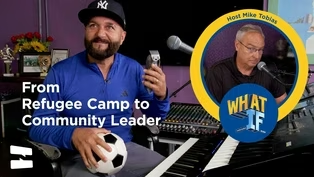
From Refugee Cam to Community Leader
Video has Audio Description
Clip: S7 | 10m 48s | Meet Hasan Khalil, a Lincoln entrepreneur and Yazidi refuge building community and uniting people; (10m 48s)
Inside a Student-Run Grocery Store in Rural Nebraska
Video has Audio Description
Clip: S7 | 10m 45s | Students in Cody, Nebraska run a real grocery store that serves their rural community. (10m 45s)
Providing Support for PBS.org
Learn Moreabout PBS online sponsorship











Support for PBS provided by:
What If is a local public television program presented by Nebraska Public Media