
Into the Fire
Episode 3 | 49m 59sVideo has Closed Captions
Beat the fire-season heat and take to the air with a menagerie of rare species.
Bask in the largest intact savanna on the planet, where mammals and insects fly through the air with the greatest of ease. Study traditional wildfire-management methods, explore a sandstone refuge, and watch a sugar glider try to escape the flames.
Problems playing video? | Closed Captioning Feedback
Problems playing video? | Closed Captioning Feedback
Into the Fire
Episode 3 | 49m 59sVideo has Closed Captions
Bask in the largest intact savanna on the planet, where mammals and insects fly through the air with the greatest of ease. Study traditional wildfire-management methods, explore a sandstone refuge, and watch a sugar glider try to escape the flames.
Problems playing video? | Closed Captioning Feedback
Where to Watch The Kimberley: Australia’s Wild West
The Kimberley: Australia’s Wild West is available to stream on pbs.org and the PBS app.
Share Inspiring Moments From The Film
Explore the PBS Giphy collection for The Kimberley.Providing Support for PBS.org
Learn Moreabout PBS online sponsorship[Birds calling] Mark Coles Smith, narrating: High above the ground in a 100-year-old gum tree, a clan of savanna gliders makes a cuddle puddle.
Some of these bubbas are so young, they've barely opened their eyes.
♪ They don't know it yet, but just outside their cosy tree hollow, a stunning tropical savanna stretches as far as the eye can see.
Soon, they'll get their chance to explore one of the wildest places on Earth.
♪ [Thunder] ♪ [Hissing] [Birds calling] [Music] Smith: The Kimberley is unique on our planet-- a tropical wilderness that spans over 400,000 square kilometres of north-western Australia, an area almost the size of California.
This is a land defined by its extremes... [Thunder] a wild climate, harsh terrain and remarkable biodiversity... [Hissing] Smith: with species found nowhere else on Earth.
But this is more than a wilderness.
This is a human landscape, home to the oldest living culture on Earth.
For First Nations people, this land is more than just our home, it's a living, breathing entity.
We call it Country, and we've cared for it for over 50,000 years.
But the Kimberley is now facing threats from near and far, and these new challenges are making life for the animals here even tougher.
Following their wild lives through six intense tropical seasons, this is the story of a year in one of Earth's last great tropical wildlands.
[Splash nearby] [Growling] [Insects chirping] Smith: Many people in the Kimberley measure the passage of a year in six distinct seasons.
Right now, it's the season Nyikina people call Barrkana.
There's still lots of water remaining from the wet.
The sky is blue, and Country is green and healthy.
With daytime temperatures around 30 degrees, this is as cool as it gets out bush.
The Kimberley is home to huge tracts of the most intact savanna ecosystem on the planet-- over ten times the size of the Serengeti.
The rains have left behind fields of grass bursting with tasty seeds.
And the little ones born over the wet season are growing up fast... thanks to all the crunchy insects.
At this time of year, flowering trees call in an abundance of life.
[Birds calling] Smith: The canopy can get a little crowded.
And if you're looking for a private retreat, it's first come, first served.
It can take a tree hollow like this one over a hundred years to form.
And they are few and far between these days.
So it makes sense for our savanna gliders to share their family home.
Multiple families make up each territorial clan.
And because they're nocturnal, sunset means it's breakfast time-- time for Mum to go on a shopping run.
But it's hard to go anywhere without a little one clinging on.
Wait.
Make that two... two little ratbags always fighting about who gets to sit in the front.
[Squeaking] ♪ Smith: In the world of the canopy, one of the most sought-after snacks is a lerp.
These sugary structures produced by sap-sucking insects make a tasty treat for a hard-working mum, especially one with a couple of mouths to feed.
[Distant howling] [Soft squeaking] Smith: The bigger they grow, the rowdier they get.
But the one time they're good at sharing is when it comes to mum's milk.
[Soft squeaking] Gliders are known for having a wide range of vocalizations, and I think these little squeaks are happy ones.
[Soft squeaking continues] Smith: But the canopy isn't the safest place for feeding time.
A python has caught their scent in the air.
[Barking] But savanna gliders look out for each other... and a bark from a nearby aunty warns her of the approaching danger.
This 3-metre python may be slow, but he's blocking her from going back the way she came.
Mum and bubs are cornered.
♪ Smith: Good thing supermum has her own cape.
♪ Savanna gliders have been known to glide more than 30 metres.
But with two babies on board, mum's just happy to make it to the next tree.
[Soft squeaking] Smith: One day they'll be big enough to fly on their own, but for now, they're just hang gliders.
♪ Smith: The transition from the wet season to the dry season is marked by the emergence of thousands of dragonflies.
They've spent most of their lives as aquatic nymphs, hunting on the bottom of pools and waterholes.
But the time has come to take to the skies.
This aerial stage of their lives is brief but spectacular.
They only live a few months once they have their wings... and they spend most of this time airborne.
They even mate while flying.
It's a complex acrobatic process.
The male uses claspers at the tip of his tail to grip the female's neck.
Flying in tandem, the pair dips to the surface of the water, so the female can deposit her eggs.
In a few weeks, these tiny eggs will hatch on the bottom of the pond.
They won't emerge until the next year.
[Insects chirping] The Kimberley is also home to an incredible variety of plant life.
And the glistening drops of nectar on these plants look like they might be a tasty treat for a hungry insect.
But sundews have a dark side.
They're carnivorous.
Any dragonfly that chooses one of these tentacles as a perch is in for a sticky situation.
These leaves are coated with a powerful adhesive.
And the more the insect wriggles to escape, the more it stimulates the digestive enzymes that coat and dissolve the prey.
And these murderous herbs have tiny accomplices.
Sundew bugs are immune to the adhesive secretions.
They roam freely along the deadly tentacles, adding insult to injury as they feed on dying prey.
Of all the ways to get eaten in the Kimberley, this might be the creepiest.
♪ [Eagle calling] As the season of Barrkana progresses, smoke starts to appear on the horizon.
But these aren't wildfires.
They're carefully conducted traditional burns.
OK, yeah, this is the spot we might do.
Smith: For countless generations, First Nations people have used fire to manage Country.
These burning practices are a conversation between people and the land.
The wind, soil, animals and trees all inform us of when and how to burn, and no two places are the same.
Burning in the cool, dry season keeps the fires low and the burn scars small.
[Bird calling] [Music] Smith: It preserves the food, shelter and nesting trees that so many animals rely on.
The burned areas also create a patchwork of fire breaks.
If we don't reduce the fuel load now, lightning storms will spark catastrophic wildfires later in the year.
[Fire roaring] When Europeans forced our traditional owners from their land, the long-running burning practices were severed.
For decades, late-season wildfires ravaged the landscape, pushing many species towards extinction.
Creatures like the Gouldian finch now hang on by a thread.
These tiny rainbows used to flock all over our savannas in their thousands.
But years of hot fires have destroyed their food source and the old trees with their precious nesting hollows.
Managing fire is key to preserving the ecosystems, and First Nations people have understood this for thousands of years.
[Indistinct radio transmission] Recently, ecologists have studied the traditional burning techniques and recognized how effective they are.
[Helicopter blades whirring] Now they're working with traditional owners, combining modern technology and timeless wisdom to apply these practices on a huge scale.
[Indistinct radio transmission] And the rewards of all this hard work are being seen all over the Kimberley.
[Animals calling] [Wind gusting] Smith: When the wind shifts to the north and temperatures begin to rise, Country starts to bake.
We're entering the season of Wilbooroo.
Animals are faced with increasingly hot and dry conditions.
This burrowing frog has no interest in hanging around to sizzle on the surface.
She's digging her way into the cool, dark soil while it's still moist.
And she's a patient frog.
She's willing to stay there as long as it takes for the rain to come back.
But these brolgas don't need to wait around.
They're on the move to places that will have water and food throughout the dry.
[Cracking] Smith: For animals on Country, surface water is now becoming scarce.
Even the wetlands' mightiest are forced to make a move to get to permanent water.
♪ But as these solitary creatures move back into the main channel of the river, tensions begin to build.
Male salties are territorial animals, and the most powerful individuals don't take kindly to strangers.
These kings of the river banks are known as boss crocs, and they bear the scars of many battles.
Animals like Stumpy here are well over 50 years old.
He's long in the tooth and getting grumpier each season.
At close to 6 metres in length, he won't back down from a fight.
And anyone curious enough to test him soon gets the message.
♪ Stumpy weighs well over a ton and throws a mean headbutt.
[Growling] It's not unusual for crocs to die in these territorial battles.
[Muffled sound of waves breaking] The dry conditions are also tough on new species.
[Cattle mooing] The Kimberley is home to hundreds of thousands of cattle that roam freely across huge pastoral leases.
But moo-cow wasn't built for this Country.
Out here, heavy creatures walking around on small hooves can be a terrible combination.
The mud that lines the tidal reaches of our rivers can be very deep.
It's a deadly trap for a thirsty cow.
She'll be drowned by the incoming tide.
But nothing goes to waste.
A dead cow creates a rare truce amongst the crocs.
[Birds calling] ♪ Smith: Only the largest males dare to join the feast.
And even Stumpy seems willing to share his food.
But the cow won't last long, and these cranky old dinosaurs will be snapping at each other in no time.
[Birds calling] Many young crocs move to the coast to escape the mayhem and competition.
There's plenty of food and space for them out here, even in the dry season.
♪ The Kimberley coast is lined with stunning mangrove systems.
And the creatures that live in these saltwater forests have adapted to the rhythms of an 11-metre tidal range.
The complex underwater root systems offer shelter for many juvenile fish.
And when the water drains away... the creatures of the mud emerge... like our friends the buggle buggles and their industrious neighbours, crabs.
Most of us have seen crabs before, but few realize how essential they are to the mangrove world.
They're involved in everything from waste disposal to large-scale tunneling works that supply nutrients to the mangrove forest.
And after all that hard work, they still have to avoid becoming someone else's snack.
It's not easy being a crab.
The complex tunnels they create can become the hunting ground of a very slippery individual... ♪ a specialized crab killer that moves beneath the mud.
The white-bellied mangrove snake has eyes and nostrils on the top of its head, perfectly adapted for a muddy ambush on a hard-working crab.
♪ With a rapid strike, he pins the crab to the ground.
Most snakes swallow their prey whole, but this one dismembers his dinner.
♪ [Distant howling] ♪ After months without rain, the Kimberley has transitioned into its driest conditions.
We're entering the season of Lalin.
And as temperatures continue to rise, the battle to survive intensifies.
But in our desert regions, there are animals that have long been used to a world without water.
[Sniffing] [Hissing] Smith: This dunnart is a desert-adapted marsupial predator.
She's only about the size of your thumb.
But don't underestimate her.
If you're a grasshopper, this little cutie is basically a T. rex.
♪ Like many desert specialists, dunnarts don't need to drink water.
They get all the moisture they need from their juicy prey.
And after a big meal, everyone needs a good nap.
[Soft squeaking] ♪ But not everyone is a desert specialist.
And for most animals in the Kimberley, survival hinges on having access to the sites that hold our last remaining water... spring-fed creeks, deep gullies and our main river channels.
These oases are few and far between.
And at this time of year, these special places are the lifelines that will see us all through the dry.
[Bird calling] Some places hold water longer than others.
In the north-west Kimberley, the ancient sandstone ranges help capture and store moisture.
Here, at a meeting point of waterways, is Punamii-Uunpuu/ Mitchell Falls.
♪ These are the traditional lands of the Wunambal Gaambera people.
[Wunambal Gaambera singing in native language] And for tens of thousands of years, they have carried the law of this land.
[Wunambal Gaambera singing] ♪ [Laughing] Smith: Jeremy Kowan is a traditional owner of this special place.
And he has the responsibility of passing on its natural, human and spiritual history to the next generation.
Jeremy Kowan: Our Country is real special to us.
Our grandfather told us that there were these three snakes, and they were travelling from inland, and went down towards Mitchell Falls.
[Wunambal Gaambera people singing] Jeremy: They created the creeks and the waterholes.
That's where the fish and turtles and crocodile remains in the living water.
That's where the Rainbow Serpent Ungud remains, too, you know.
Smith: The Ungud serpents are creation beings that formed Country and brought law to the land.
And the Wunambal Gaambera people tell us they still reside in the deep water at the base of these falls.
It's a powerful and sacred place.
Kowan: My grandfather used to roam this Country, you know, and walking all over the place and then passing the knowledge on to us, and now I'm passing it on to the young ones now.
And now my daughter, she's working as a ranger, and I'm imparting the knowledge on to her.
♪ Smith: Jeremy and his daughter Tabitha work with the Uunguu Rangers to look after the unique animals and cultural heritage on their Country.
Today we're doing some camera trapping, where we set the bait three metres away from the camera.
It draws the animals, probably some snakes, if we have any here.
[Hissing] It's exciting.
Smith: Thanks to its complex geology and year-round water, the area around the falls is renowned for its rich biodiversity... [Bird trilling] and many of its animal inhabitants are found nowhere else on Earth.
[Owl hooting] After dark, some of these unique creatures begin to emerge from between the boulders.
♪ This adorable little rock-wallaby is a monjon... living proof that even the roughest landscape can have a soft spot.
Only 30 centimetres in height, they're perfectly adapted to the caves and stone Country.
They're quick, too, and they need to be... because not everyone wants to nibble leaves.
♪ The rough-scaled python is one of Australia's rarest snakes.
It's also only found in this region.
His rigid scales help him grip the rocky surface as he silently hunts mammals in the sandstone maze.
He'd love a monjon if he could catch one, but tonight, he's stalking another endemic mammal-- the Kimberley rock rat.
He's pretty fast on his feet, too.
[Insects chirping] The ancient sandstone in the north-west Kimberley is a precious refuge for extraordinary biodiversity.
And for countless generations, the Wunambal Gaambera people have practiced a culture that preserves this biological ark.
Tabitha: We come out here, and it's nice and quiet, and you can hear the animals.
There's hardly any people around.
You know, you're just healing on your own.
Especially when we're out looking at the art sites, and you can feel that, you know, I have my ancestors here with me.
They're guiding me through the Country.
Smith: The Uunguu Rangers also watch over some of the most extraordinary cultural heritage sites on Earth.
This complex sandstone holds hundreds, if not thousands, of ancient rock art galleries, paintings that offer a glimpse into a living culture that stretches back tens of thousands of years.
But our people will tell you it's not the age that matters, it's the meaning.
Not only do our art, songs and stories define who we are, they connect us to all the other creatures who share Country with us.
Jeremy's totem animal is the bowerbird.
The Wunambal Gaambera people call him Jooweebanj-- the stealing bird.
[Calling] And while the rangers work hard to protect Country, Jooweebanj is busy with his own masterpiece.
It's the end of the dry season, and there might be some ladies coming past soon.
Better tidy up the bachelor pad.
But this isn't a nest, it's a bower-- a stage he'll use to attract a mate.
He needs everything to be perfect... and spends months collecting precious objects, like these smooth white shells.
His most prized finds are kept in the center of the bower.
Diamonds are a girl's best friend, but this quartz gem will have to do.
The dating scene can be rough, and when Jooweebanj goes in search of more fancy bling, a rival seizes the opportunity.
The dodgy neighbor has a go at sabotaging his bower.
And when that doesn't work, he goes for the centerpiece.
It's a low blow, even by "stealing bird" standards.
[Bowerbird squawks] Jooweebanj's going to have to find a new treasure.
[Birds calling] After several days, the Uunguu Rangers collect their camera traps.
And the footage offers a glimpse into the local neighborhood.
[Dog whines] It also catches our resident thief looking for replacement bling.
[Thud] [Thud] [Soft thudding] Too bad for him Tabitha tied the camera down.
[Tweeting] Smith: I hope he finds a lady bird soon, or he might fall in love with himself.
[Squawking] ♪ Tabitha: My father was the reason why I joined the Rangers.
Because he would come back home and tell me a lot of stories about what he would do out on Country... [Wunambal Gaambera people singing in native language] Tabitha: his grandparents teaching him how to sing the Jumba, and the rock paintings, and I would love to carry that on.
Jeremy: All our grandfathers, they told us, you guys got to look after this Country now and pass it on to the next generation.
You got to look after the Country.
You look after the Country, the Country will look after you.
Yeah.
The Country is real special.
[Birds calling, insects chirping] [Didgeridoo music on soundtrack] Smith: A long, long time ago, the Kimberley was a very different place... [Animals calling] a land covered with lush rainforests, full of incredible biodiversity.
But over the last two million years, the climate gradually dried out, and the rainforests were replaced by a sea of savanna.
This huge shift could have spelled the end for many of the rainforest species.
But the Kimberley's rugged terrain offered an evolutionary life raft.
As conditions grew increasingly inhospitable, some moved into the complex networks of caves and crevices... where stable temperatures and constant humidity provided a refuge from the searing heat.
Over time, many of the rainforest animals evolved into cave-dwelling animals.
♪ This nightmare fuel is a whip spider... an arachnid with a flattened body, perfect for scurrying through tight spaces.
It's almost completely blind, but it doesn't need to see to hunt.
Its long front legs can detect the slightest vibrations.
♪ As long as it doesn't move, this cricket is invisible.
♪ Well, that was awful.
Too bad he couldn't sit still.
The Kimberley's labyrinth of caves has become a refuge for many creatures.
They've evolved in isolation for hundreds of thousands of years, which has led to the enormous diversity of species in the region.
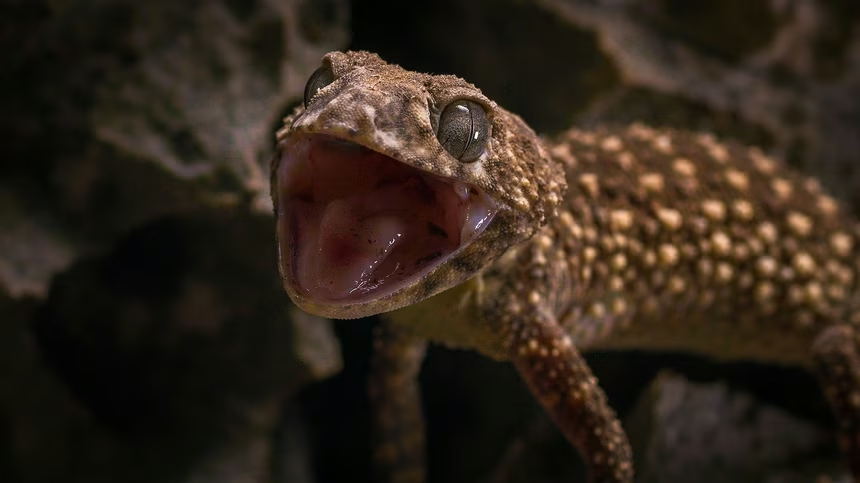
There are around 20 known species of geckos alone.
[Hissing] And when you make your home in a cave, it pays to be able to walk on the ceiling.
Geckos have sticky feet and tail pads capable of gripping the rough sandstone, like built-in anti-gravity boots.
Many of these unique geckos have evolved scales with complex colours and textures that blend in perfectly with the rocks in their environment.
But camouflage doesn't have to be boring.
The fringe-toed velvet gecko likes to step out in style.
Its ornamental tail is the perfect accessory to help get away from predators, like this hungry northern quoll.
[Sniffing] The quoll is a skilled hunter.
And this gecko may have to make a sacrifice.
♪ [Chewing] The quoll gets its feed, but our gecko gets to live another day.
And he'll regrow his tail in time.
♪ [Eagle calling] [Thunder] Rising humidity and distant thunder announce the return of the season of Jirrbal.
The build-up to the wet season has begun, and massive electrical storms now rattle the skyline.
[Thunder] But there's no rain yet, and the savanna is bone dry, a tinderbox just waiting for a spark.
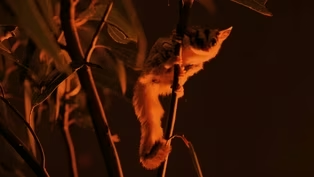
♪ One of the baby gliders born earlier in the year has just begun venturing out on her own.
And she's discovering all the yummy smells and tastes the canopy has to offer.
[Thunder] But this is her first storm season.
[Soft squeaking] And when a bolt of lightning strikes nearby... the surrounding bush ignites.
[Fire crackling] ♪ The first embers quickly become a wall of flame, and a wildfire closes in.
♪ It's one of the hottest years on record, and the fire is moving fast.
♪ As it laps at the base of the tree, her only option is to jump.
Let's hope she's been practicing.
♪ [Glider squeals] Smith: Oh, no!
Ohh, had me worried for a second.
Lucky she takes after Mum.
[Fire crackling nearby] This area was burnt earlier in the year using traditional methods.
With less fuel on the ground, the fire is smaller and cooler.
And the tree canopy is untouched.
The proper management of Country makes all the difference for the animals who live out here.
[Music by Kalaji/ Mark Coles Smith on soundtrack] Smith: As Country reaches its hottest conditions, the smoke from wildfires is replaced by a towering wall of storm clouds.
[Thunder] [Rain pattering] The season of Wilakarra is back, and creatures across the land can at last quench their thirst.
♪ From the desert to the sea, people also celebrate the return of life-giving water.
The six seasons of the Kimberley have now come full circle.
[Birds calling] New life and new stories are emerging.
♪ Mark Coles Smith: You always just feel so blessed to travel through a landscape that's this pristine and that is this intact.
Yeah, I don't think there's many places in the world quite like this.
It's sort of like dropping into the land before time.
Kallum: This Country is a living, breathing thing.
If you listen carefully to the Country, it talks.
[Whale song] Azarnia: It makes me very happy when I see it's healthy and getting looked after.
We need the Country as much as he needs us.
♪ Mark: Some people build cathedrals.
This is our cathedral.
How lucky the whole world is to have a place like this that's still in the state that it's in, and how important it is for us to take care of it on that regard.
[Birds screeching] Smith, narrating: The vision our Elders have for tomorrow is to be able to witness the world we still have today... not just for the next generation... but for all life that has made this place home.
Kalaji: ♪ Ooh ♪ ♪ I'm almost home now... ♪ Smith: The preservation of our natural world can no longer just be a part of our culture.
Now it's a path the whole world must walk together.
Kalaji: ♪ Oooh ♪ ♪ I'm almost home now ♪ ♪ ♪ Ooh ♪ ♪ I'm almost home now... ♪ [Birds calling]
Video has Closed Captions
Clip: Ep3 | 3m 17s | The stormy wet season of Jirrbal returns and a baby glider must escape the wall of flame. (3m 17s)
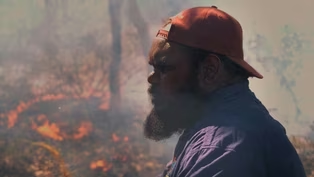
Managing Fire with Traditional Burns
Video has Closed Captions
Clip: Ep3 | 3m 9s | Traditional burns are methods First Nations people have managed for thousands of years. (3m 9s)
Video has Closed Captions
Clip: Ep3 | 1m 58s | With their sticky feet, geckos climb up the Kimberley’s labyrinth of caves in style. (1m 58s)
Providing Support for PBS.org
Learn Moreabout PBS online sponsorship New Episode
- Science and Nature

Explore scientific discoveries on television's most acclaimed science documentary series.











Support for PBS provided by: