
Kentucky and the Disco Ball
Clip: Season 31 Episode 16 | 6m 9sVideo has Closed Captions
Learn about the disco ball's long history in Kentucky.
The disco ball has a long history in Kentucky, from its first patent in Northern Kentucky more than 100 years ago to a Louisville business making more than 100,000 of them a year at its height.
Problems playing video? | Closed Captioning Feedback
Problems playing video? | Closed Captioning Feedback
Kentucky Life is a local public television program presented by KET
You give every Kentuckian the opportunity to explore new ideas and new worlds through KET. Visit the Kentucky Life website.
Kentucky and the Disco Ball
Clip: Season 31 Episode 16 | 6m 9sVideo has Closed Captions
The disco ball has a long history in Kentucky, from its first patent in Northern Kentucky more than 100 years ago to a Louisville business making more than 100,000 of them a year at its height.
Problems playing video? | Closed Captioning Feedback
Where to Watch Kentucky Life
Kentucky Life is available to stream on pbs.org and the PBS app.
Providing Support for PBS.org
Learn Moreabout PBS online sponsorshipBut first, when you think of Kentucky, so many iconic images come to mind.
Horses, bourbon, basketball, but something that was first patented and pretty much exclusively manufactured here for decades should also be on that list, disco balls.
From the vision of a Northern Kentucky entrepreneur to the work of a quiet Louisville company, Kentucky has been the center of the disco ball universe.
Let's look at how all this came to be, and how one artist is keeping the tradition alive in some innovative ways.
[music playing] Odds are pretty solid that no one in Newport, Kentucky, in the early 1900s could have ever imagined the downbeat of a disco song.
But for Bernard Woeste, his fateful decision in February of 1917 to patent what would come to be known as the disco ball would change the dance floor for a generation.
Woeste called his creation a myriad reflector.
He described it in vivid terms.
“My invention is to produce a plurality of reflecting surfaces to be arranged in such a manner that the various several reflections shall be projected at varying angles and the device itself rotated or otherwise moved so that the reflections may produce a scintillating and spectacular effect.” An ad for the myriad reflector in a 1922 electrical merchandising bulletin read, “The newest novelty is one that will change a hall into a brilliant fairyland of flashing, changing, living colors.
A place of a million colored sparks, darting and dancing, chasing one another into every nook and corner, filling the hall with dancing fireflies of a thousand hues.” Woeste and his business partner sold their 27-inch magnificent globe covered in 1,200 small mirrors to ballrooms, dance halls, and skating rinks.
But the device wasn't a hit.
Many dance halls and the like were quiet due to the start of World War I, and the patent expired in 1934.
[music playing] But then, the 1970s happened.
Disco exploded, and the disco ball was its main character.
The center of this universe was a Louisville business called Omega Industries.
The company made mirrors and saw the opportunity to strike while the dance floor was hot.
So it makes perfect sense that they would employ a team of people.
And for a good stretch of time, they had a big staff making disco balls, reflector balls, for up until the 1970s, when it really, really took off.
The Fraser History Museum has one of the original Omega disco balls in their collection.
At one time, from this building in Louisville, Omega produced more than 100,000 disco balls a year.
They moved to a smaller location next door several years ago, where they still make disco balls.
Now, we wanted to show you how they did it, but they politely declined our invitation, saying that to this day, they still get calls weekly from media outlets all around the world who want to come into their shop, and it's just too disruptive.
Louisville celebrates its disco ball heritage in a variety of ways.
That original building where Omega cranked out all those dance floor staples?
It's now been converted into a hotel named the Myriad, after the name Bernard Woeste gave his patented device more than 100 years ago.
The hotel celebrates its heritage with disco balls throughout.
And the old dust collectors that were once used to keep the Omega assembly line free of foreign objects were repainted orange and incorporated into the hotel's swimming pool.
A popular Louisville true crime book was given the title, A Dark Room in Glitter Ball City, which spawned the popular HBO documentary series, Murder in Glitter Ball City.
But the person most keeping this tradition alive works out of a small garage behind his home in Louisville's Clifton neighborhood.
Robert Brown's interpretation of the modern disco ball has him bedazzling all sorts of creatures and objects.
Well, I had a company come by, and they were like, “We hear that you're savvy with metal and welding and glass and art.” And they're like, “We really want a life-size squirrel, which is our logo.
But we want it to be a disco ball, like for Kentucky and Louisville being the disco ball makers of the world.” And so, I sat down with him, I told him the idea, "I would make it out of metal, paper, and then the mirror squares and build it.” And they said, “Great, you do it, and we'll give you a budget.” And so I made a squirrel, and it was a lot of fun.
So far, he's made about 20 of the pieces, everything from rockets to horses like this one hanging in a Louisville gallery, to pigs, and even saddles, which one bride commissioned him to make for her wedding reception.
He was working on a saddle the day we visited him, and he says there's a science to placing the small half-inch mirror pieces, which he buys from Omega Industries, in just the right spot.
Like the seat is going this way, so the sides, I want them to shoot down, and then I'll do an edge around the whole thing to make it█ because, you know, you're recovering the saddle, but you also, you want to make some of the squares a little offset so it catches light and dances more.
If I made it super smooth, the shape of the saddle, it would still talk with lights pointing at it.
But if I change a little bit of the direction of the mirror squares, then it talks more.
Like many things, foreign manufacturers producing inexpensive knockoffs have flooded the disco ball market, diluting Kentucky's dominance of the dance floor.
But for a period in the 1970s, a mirrored orb made in Louisville was the center of the leisure suit scene, and you just can't help but celebrate that.
It's fun.
It's exciting.
It's kind of goofy and kitschy.
Everything about them is great.
I mean, you know, there's no.
I can't imagine anyone being sat around a disco ball.
[music playing]

Video has Closed Captions
Clip: S31 Ep16 | 3m 50s | Chip visits the Cumberland Gap. (3m 50s)
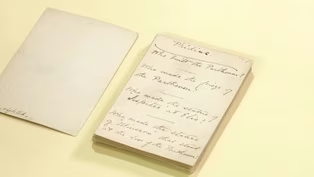
Sadie Price: Bowling Green’s Victorian Pioneer
Video has Closed Captions
Clip: S31 Ep16 | 5m 48s | Sadie Price blazed a trail through Victorian society. (5m 48s)
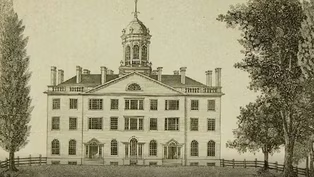
Video has Closed Captions
Clip: S31 Ep16 | 6m 23s | Learn about the historic Transylvania University. (6m 23s)
Providing Support for PBS.org
Learn Moreabout PBS online sponsorship











Support for PBS provided by:
Kentucky Life is a local public television program presented by KET
You give every Kentuckian the opportunity to explore new ideas and new worlds through KET. Visit the Kentucky Life website.