
The Gateway to Kentucky
Clip: Season 31 Episode 16 | 3m 50sVideo has Closed Captions
Chip visits the Cumberland Gap.
Chip visits the Cumberland Gap to learn more about its origin and how integral it is in the history of Kentucky.
Problems playing video? | Closed Captioning Feedback
Problems playing video? | Closed Captioning Feedback
Kentucky Life is a local public television program presented by KET
You give every Kentuckian the opportunity to explore new ideas and new worlds through KET. Visit the Kentucky Life website.
The Gateway to Kentucky
Clip: Season 31 Episode 16 | 3m 50sVideo has Closed Captions
Chip visits the Cumberland Gap to learn more about its origin and how integral it is in the history of Kentucky.
Problems playing video? | Closed Captioning Feedback
Where to Watch Kentucky Life
Kentucky Life is available to stream on pbs.org and the PBS app.
Providing Support for PBS.org
Learn Moreabout PBS online sponsorshipWe've seen a lot of really remarkable sites here in the Cumberland Gap National Historic Park today.
None more so, though, than what's behind us right here.
And I can't wait to learn more about it.
This is Lucas Wilder.
He's an education specialist with the park here.
Lucas, thanks so much for being with us.
I'm always happy to be here and to speak with you.
I love it.
So, what is this behind us now?
Tell us what this is.
This is the Iron Furnace.
This is one of the oldest man-made structures in the park that still stand in today.
It was run by an entrepreneur named John Newley, who occupied what's now the town of Cumberland Gap.
And he ran this iron furnace that would create these 150-pound ingots, and then ship them all over the area for various uses.
How important was a place like this for the development of this area?
It was a huge part of the development of this area, mainly because people are traveling on the Wilderness Road, not too far from us, just up the mountainside here.
And if they needed something along the route, he not only had iron for them, but he had a little shops down here they could get supplies as they were coming through.
So, this was a big part of Westward Settlement.
So, from a geological standpoint tell us where we are.
What's the makeup, and what is it about the gap that makes it so important?
The Cumberland Gap is formed by three factors.
The first one is a fault line, that when the mountains came together, it actually created a weak point and that allowed for an ancient river to run through it.
Then about 300 million years ago, a meteorite come barreling out of the sky and hit where Middlesboro, Kentucky sits today.
That diverted the river, and the rest is created by wind.
So, a factor of fault line, water and wind created the Cumberland Gap, and it created one of the best ways to get through the Appalachian Mountains.
And that's what everybody was going for, was trying to find the easiest way through the mountains into the frontier.
So, to that point, what's the origin story for how all this happened and the role that Dr.
Thomas Walker played in making this available for people to have that westward push?
Dr.
Thomas Walker was a phenomenal man, a surveyor, a physician and a land speculator.
And he wasn't the first person to come through here.
Native Americans came through here way before him, but he was the first one to document it and write it down.
And by him writing it down and his stories proliferating throughout the eastern United States, when everybody's wanting to move west, was a perfect timing because Dr.
Thomas Walker's writings allow people to have an idea of what could be possible on the other side of these mountains.
So, he really helped people dream about what they could potentially achieve if they could just make it through the gap and see what's on the other side.
Absolutely.
Wow.
So then, about 20 years later, Daniel Boone and a company comes through here.
What does that do for the westward expansion?
How important was that?
Daniel Boone becomes a legend in his own time.
So, his first trip through here, as you said, in 1769, is a long hunt.
He's coming through here to hunt animals and to sell the pelts.
He comes back out of Kentucky with wonderful stories about how there's so much game, there's so much plentiful land in the area that people need to come here.
He declared it a paradise.
And so, his word of mouth and stories proliferate again throughout the eastern United States and send people further west.
And why is the gap so integral to Kentucky history?
Why is it so important?
There's two ways to get into Kentucky at the time.
You can come down the Ohio River.
That's dangerous.
You're getting close to Shawnee Territory, where Ohio is today.
And then, you can come through the Cumberland Gap, a much safer route to get into Kentucky.
And so this affords not only one of the best routes, but a safer route.
It really is remarkable to look around here and to think what folks had to experience when they came through and saw this, and to be able to get through the gap.
And we look forward to exploring more here today.
Lucas Wilder, thanks so much for letting us be here today.
You're very welcome.
[music playing]
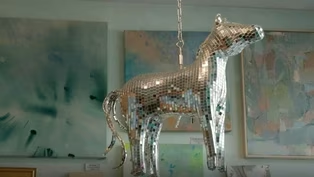
Video has Closed Captions
Clip: S31 Ep16 | 6m 9s | Learn about the disco ball's long history in Kentucky. (6m 9s)
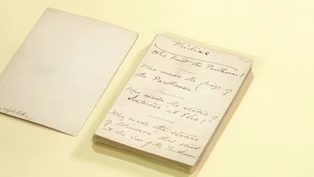
Sadie Price: Bowling Green’s Victorian Pioneer
Video has Closed Captions
Clip: S31 Ep16 | 5m 48s | Sadie Price blazed a trail through Victorian society. (5m 48s)
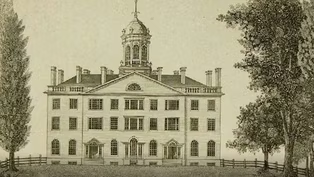
Video has Closed Captions
Clip: S31 Ep16 | 6m 23s | Learn about the historic Transylvania University. (6m 23s)
Providing Support for PBS.org
Learn Moreabout PBS online sponsorship












Support for PBS provided by:
Kentucky Life is a local public television program presented by KET
You give every Kentuckian the opportunity to explore new ideas and new worlds through KET. Visit the Kentucky Life website.