
ARTEFFECTS
Local Feature: Episode 1108
Clip: Season 11 | 10m 19sVideo has Closed Captions
Discover the craft of natural building with Kyle Isacksen of Reno.
In this episode of ARTEFFECTS, discover the craft of natural building with Kyle Isacksen of Reno.
Problems playing video? | Closed Captioning Feedback
Problems playing video? | Closed Captioning Feedback
ARTEFFECTS is a local public television program presented by PBS Reno
ARTEFFECTS
Local Feature: Episode 1108
Clip: Season 11 | 10m 19sVideo has Closed Captions
In this episode of ARTEFFECTS, discover the craft of natural building with Kyle Isacksen of Reno.
Problems playing video? | Closed Captioning Feedback
Where to Watch ARTEFFECTS
ARTEFFECTS is available to stream on pbs.org and the PBS app.
Providing Support for PBS.org
Learn Moreabout PBS online sponsorship- Hello, I'm Beth Macmillan and welcome to "ARTEFFECTS."
In our featured segment, we meet Kyle Isacksen of Reno.
Isacksen is a natural builder who uses nothing more than what's simply beneath our feet.
He takes clay, sand, straw and other materials and creates a variety of structures.
And he takes his work to another level by using techniques of ancient civilizations.
(lively music) - There's some things in life that have these magical qualities that seem to be like rooted in our DNA.
I am Kyle Isacksen.
I live in Reno, Nevada and I am a natural builder.
For me, natural building is kind of this synthesis of, you know, local materials, sustainable materials, non-toxic materials, but then it also brings in connection to place and then a connection to people, which fosters community.
(lively music) But it's also growing food.
It's also providing habitat for the birds and the bees and the insects.
If you look anywhere around the world, people have been building with clay rich soils like forever.
And it's something that resonates with us.
And we've had just generations and generations of connection to these materials.
And when we teach people how to use them, it's almost like a coming home where they, they get it, intuitively get it.
(gentle music) So my wife and I were teaching for a number of years and we had done some really interesting things around the country in different school settings from inner city, San Francisco to kind of rural New Hampshire, small town Minnesota.
We kept teaching, kept trying different things, and finally decided we really need to kind of leave this because we can't do exactly what we want to do with kids and we can't be in the world the way we wanna be.
And so we started looking at other alternatives, living more simply, living in smaller spaces, learning about natural building, organic gardening that we felt aligned more with our values.
(gentle music) This type of lifestyle requires a lot of creativity and it's enlivening and it's enriching.
We're surrounded by, you know, this paradigm of our culture, by kind of the way things are, and we're trying to do things a little differently.
There's a pile of cob and then it's sticky.
It's got the clay all integrated with the sand.
It's got the straw.
The name cob means loaf.
It's a Welsh word and it's a loaf because when you make cob, you're combining sand with clay-rich soil and with some sort of fiber, usually chopped up straw.
It just looks like mud.
When you gather it up into this loaf and you put it on a wall, you put it on a foundation and you start to pack it together, and when it hardens, it's like concrete.
Clay is super small and when you get it wet, it expands.
And so those fine clay particles like slip between all these different sharp sand particles.
As it dries, it pulls everything together and gets really, really tight and really strong.
And when you add straw or fiber, that fiber kinda runs through the whole matrix.
So you have a compressive strength with the clay and the sand, and then you have a tensile strength with the straw.
And it's durable.
It's sculptural.
It's really fun to work with.
Yeah, it lasts for centuries.
(light music) When you have a cob wall, it looks kinda rough.
When you move into the plaster side of things, you're screening the clay, you're screening the sand, you're chopping up the straw into finer and finer pieces and running that through screens.
So you get this really luscious fine material in add water.
- All right, I'll let somebody else do it, but I just love this stuff.
- That you can then spread with a trowel with your hands on top of this wall.
And usually, there's a few layers of plaster.
You're going from very rough and bigger materials to finer, finer, finer, finer till on the very end, you have something that's just like smooth and beautiful.
Clay is amazing in that it can handle rain.
There'll be, you know, the plaster will kinda wear away over time, but there's something about materials that wear well that is also beautiful.
Like when you have a pair of jeans or you have a pair of leather boots or you have an old man.
In their face, you see life there.
You see the passage of time.
You mark the passage of time.
It's something that's, you know, life has happened to it.
To me, that's part of it.
That's beautiful.
(gentle music) - The thing about Kyle is he's just infectious.
He's so much fun to be around.
Kyle and Katie are both such good incubators.
This place is very much had the spark lit by Kyle and Katie.
- So we've known Nate for a long time and when he got this place, one of his goals was to offer workshops.
- [Nate] They knew what I was trying to do.
I wanted to land on some land and build a village.
(bright music) - So you have this group of people that are open to something new, that have a, in a sense, a vulnerability to learning a new way of life is really what it is.
- He's able to see that the community aspect of it is central and bring in just the love for life as you're building that totally eclipses our understanding of what construction's supposed to be about.
- I really like this method.
We call this the Canadian method because we're keeping our shoes on.
We're not like, you know, dancing in the mud itself, which can feel really nice.
(laughs) And you start getting into the materials, you get into the mud, you get dirty you process the things, you dig things up, you screen things.
And the whole time, people are talking to one another.
They're working side by side.
And by the end of the day, everybody is just smiles all around.
Everybody's dirty and then finish it with food.
It's a wonderful way to learn about the materials, to come together as a group, and then to use one of the things that we've created in feeding ourselves.
(bright music continues) It's amazing and it's magical.
There's a quote I like.
It's supposed to be an African proverb that says, "If you want to go fast, travel alone.
If you want to go far, travel in a group."
And I feel like natural building requires that.
There are traditions of natural building.
There have been, but it's kind of fallen away.
But there's been a desire to get back to that.
Like people have seen like, oh my gosh, we've lost something in this transition to this modern living.
We got to go to Kenya.
A Kenyan woman reached out to us and said, "Hey, I've always wanted to build with earth and there's a tradition in the Maasai community of using earth for shelter."
We got to know each other and eventually said, "Yeah, let's go do this."
And so we were there for five weeks and it was amazing because these eight apprentices were from all these different tribes.
(bright music) So we're honoring the techniques and the people and the practices of the past.
We're bringing those into the present.
And then we're also teaching a whole new group of people how to do this that will lead into the future.
So there's lots of entry points to getting into natural building.
You don't have to have, you know, five acres off grid somewhere and you're going to build some straw bale thing.
You just need some clay rich soil, some sand, a little bit of straw and just have at it.
When you're able to surround yourself with the materials that we need and that we use that are beautiful, that have some sort of history, maybe they're connected to a friend who made them, that's lovely.
I mean, that's a beautiful life right there.
- It's super moving.
It's so fun.
- We're lucky.
- [Narrator] Funding for "ARTEFFECTS" is made possible by: Sandy Raffealli with Bill Pearce Motors, Heidimarie Rochlin, in memory of Sue McDowell, the Carol Franc Buck Foundation, and by the annual contributions of PBS Reno members.
(gentle music) (excited music) (excited music continues) (excited music)
Video has Closed Captions
Clip: S11 | 8m 14s | Meet Beck Baumann, a Reno-based artist who creates one-of-a-kind sequin sculptures. (8m 14s)
Video has Closed Captions
Clip: S11 | 6m 7s | In this episode of ARTEFFECTS, we meet natural healer and herbalist Sara LaShelle. (6m 7s)
Video has Closed Captions
Clip: S11 | 6m 42s | In this episode of ARTEFFECTS, we meet artisan Malcolm Tibbetts. (6m 42s)
Video has Closed Captions
Clip: S11 | 7m 46s | In this episode of ARTEFFECTS, we meet Joanna Drakos, the 2026 Reno City Artist. (7m 46s)
 Now Playing
Video has Closed Captions
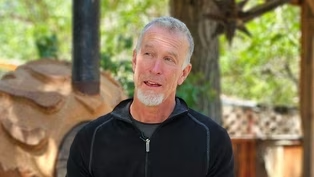
Clip: S11 | 10m 19s | Discover the craft of natural building with Kyle Isacksen of Reno. (10m 19s)
Video has Closed Captions
Clip: S11 | 7m 41s | In this episode of ARTEFFECTS, meet the man behind Reno After Dark. (7m 41s)
Video has Closed Captions
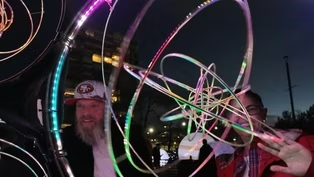
Clip: S11 | 7m 24s | Discover the Western Lights Illuminated Art Festival in downtown Reno. (7m 24s)
Video has Closed Captions
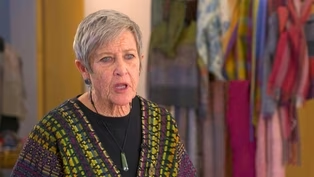
Clip: S11 | 6m 54s | Featuring Jill Altmann, a textile artist from Reno, Nevada, who creates one-of-a-kind pieces. (6m 54s)

Video has Closed Captions
Clip: S11 | 12m 7s | See Nevadans decorate the 2025 U.S. Capitol Christmas Tree with 10,000+ handmade ornaments. (12m 7s)
Video has Closed Captions
Clip: S11 | 9m 41s | The new Charles and Stacie Mathewson Education + Research Center at the Nevada Museum of Art. (9m 41s)
Providing Support for PBS.org
Learn Moreabout PBS online sponsorship New Episode
- News and Public Affairs

Top journalists deliver compelling original analysis of the hour's headlines.
 New Episode
 New Episode
 New Episode






 New Episode

Support for PBS provided by:
ARTEFFECTS is a local public television program presented by PBS Reno