
Ratatouille
Season 6 Episode 8 | 6m 13sVideo has Closed Captions
Maryline Damour’s ratatouille is a proud celebration of late Summer bounty.
Maryline’s ratatouille is a proud celebration of late Summer bounty, showcasing homegrown zucchini, eggplant, tomatoes, peppers, and fresh herbs.
Problems playing video? | Closed Captioning Feedback
Problems playing video? | Closed Captioning Feedback
Ratatouille
Season 6 Episode 8 | 6m 13sVideo has Closed Captions
Maryline’s ratatouille is a proud celebration of late Summer bounty, showcasing homegrown zucchini, eggplant, tomatoes, peppers, and fresh herbs.
Problems playing video? | Closed Captioning Feedback
How to Watch Kitchen Vignettes
Kitchen Vignettes is available to stream on pbs.org and the free PBS App, available on iPhone, Apple TV, Android TV, Android smartphones, Amazon Fire TV, Amazon Fire Tablet, Roku, Samsung Smart TV, and Vizio.
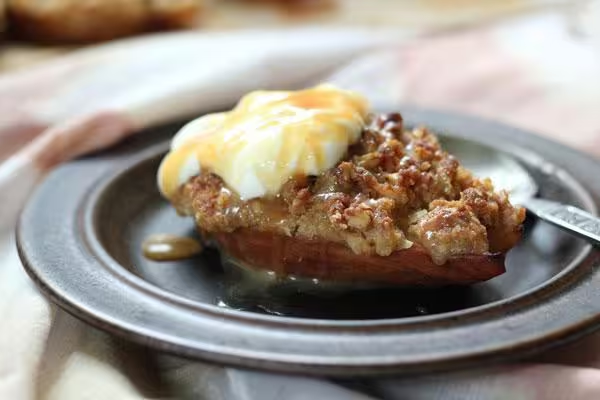
Get More Kitchen Vignettes
Get more recipes on the Kitchen Vignettes blog. Available on PBS Food.Providing Support for PBS.org
Learn Moreabout PBS online sponsorship(birds chirping) (gentle music) - My name is Maryline Damour, and I live here in the Hudson Valley.
I am an interior designer; I own a design and construction company.
I first got into gardening because I basically moved up to the Hudson Valley from Brooklyn, and when I moved up here, I thought, well, you know, I'm in the country, I should be growing vegetables, so I basically just did it.
Growing food, for me, the most fun part has been just to see how things grow.
I never knew that all the different vegetables had different colors of flowers.
And sometimes you can see the vegetable coming out of the flower and the flower sitting on top.
Just that whole sort of process, that's been really cool.
I come to gardening as a cook.
I spent a year in a restaurant cooking.
I had my own catering company for a couple of years, so I love to cook.
So over the years, that love of cooking has naturally led to a love of ingredients and sort of wanting to find the best ingredients.
And so that started out in farmer's markets and kinda specialty food shops, and then, of course, the culmination of it is kind of growing your own.
And so my culinary love has kind of led into my love of gardening, of growing vegetables.
And so I'm an interior designer, so there's a whole sort of, we call it tablescape in interior design, but I do the same thing in my raised beds in terms of having different textures, different colors, different heights of things growing.
I think vegetable gardens are great if you can involve all the senses.
So today I'm harvesting vegetables out of my garden to make ratatouille.
And basically it's a stew, sort of tomato-based dish of various vegetables.
I first discovered it when I lived in Paris.
I spent a couple of years going to school in Paris.
So I have zucchini, tomatoes, eggplant.
I have some hot peppers, and all that stuff kind of grows together and is ready together at the same time, so ratatouille's a perfect, kind of late summer dish to make.
Okay, so we are going to be making ratatouille.
(gentle music) So ratatouille, as most people know, is a French dish, vegetable dish.
So the first thing that we're going to do is to chop some garlic and some onions, pretty finely chopped, so that way will completely melt into the dish.
(onion crunching) (knife scraping) So this is zucchini from the garden.
So the goal here is to cut everything in uniform sizes, and that's really mostly just for visual.
They're gonna go in the pot in the order of what takes the most time to cook.
And you can do whatever size you like.
I'm doing sort of a medium size.
You can do very thick, thick pieces if you wanted.
It's up to you.
Smaller sizes will also cook faster.
So in addition to the garlic and the onions, this is our last kind of big flavoring, which is this red pepper.
I have no idea how spicy it is, so I am going to be a good Caribbean girl and do what my mom taught me, which is to never touch it.
The other thing, if you're not sure of how spicy your pepper is, is to slice it lengthwise and remove the seeds, because that is where all of the heat is.
So the same fine dice, (knife scraping) this time with the aid of a fork.
(vegetable crunching) (knife hitting board) Its a great dish to make, because, unlike some dishes where you have precise sort of ratio, ratatouille can be more tomatoey one day, it can be more zucchini, more eggplant.
I think this might be enough eggplant.
I don't really follow recipes.
In Haiti, we don't follow recipes.
We just learn how to cook by looking, smelling, lots and lots of tasting throughout the process, so I kind of tend to do that.
And then, at the end of the day, what that does, which is really great, is that it allows you to really cook for your palate, 'cause I'm not telling you how much salt, how much heat, how much herbs.
It's really kind of what you want to taste.
(water sloshing) (knife knocks) People get really annoyed with using thyme because what am I supposed to do?
Take off every single leaf one by one?
Well, my mom taught me this.
So you separate them, individual stems, and we just run your finger backwards.
And then you can do the same thing for most herbs.
So we're doing the same thing with the basil.
We're basically just stripping it branch by branch, just taking it apart.
The basil I'm going to leave whole, and I'll just tear it and add it to the very, very end of the process.
Ratatouille's very, very easy to make.
You know, it's really a one-pot dish.
So you start out with onions and garlic.
You know, I like spicy, so I add some hot peppers.
But you can sweat all that stuff in some olive oil and then you're really just dumping in veggies.
And as you add them, you can just add some salt and just kind of taste it, and before you know it, in about 20, 30 minutes you're kind of done.
(pot knocks) Ugh, that peppery smell of the basil when it hits something hot, it's so amazing.
(spoon knocking) I'm not sure what it is about vegetable gardens, but I think the fact that you know that there's life around you, there's just a sense of peace and calm that I find when I sit in here.
And so the vegetable garden in the summer is really our dining room.
Since the pandemic, there's a combination of people sort of grappling with this whole new situation and wanting to be self-sufficient, and so I feel like there's a lot of pull for people to have vegetable gardens.
The fact that people are reconnecting with food on that level is really a great thing, 'cause once you do, it's really hard to go back.
It's hard for your palate to go back, and it's hard for you as an individual to go back once you have that connection.
(birds chirping) (gentle music)


- Food
Christopher Kimball’s Milk Street Television
Transform home cooking with the editors of Christopher Kimball’s Milk Street Magazine.






Support for PBS provided by: