
Northwest Profiles
May 2026
Season 39 Episode 6 | 28m 53sVideo has Closed Captions
Casa Cano Farms, Bonsai in Wire, Calgary's BUMP Festival, and Revolutionary Sons and Daughters.
In the final episode of our 39th season, we’ll meet the Sons and Daughters of the American Revolution, who keep history alive for generations to come. We’ll stop by Casa Cano Farms and see how sustainable farming becomes great food. Watch a North Idaho wire artist create art that celebrates Bonsai. And get an inside look at the BUMP Festival, Calgary's most expansive public art experience.
Problems playing video? | Closed Captioning Feedback
Problems playing video? | Closed Captioning Feedback
Northwest Profiles is a local public television program presented by KSPS PBS
Funding for Northwest Profiles is provided by Idaho Central Credit Union, with additional funding from the Friends of KSPS.
Support provided by:

Northwest Profiles
May 2026
Season 39 Episode 6 | 28m 53sVideo has Closed Captions
In the final episode of our 39th season, we’ll meet the Sons and Daughters of the American Revolution, who keep history alive for generations to come. We’ll stop by Casa Cano Farms and see how sustainable farming becomes great food. Watch a North Idaho wire artist create art that celebrates Bonsai. And get an inside look at the BUMP Festival, Calgary's most expansive public art experience.
Problems playing video? | Closed Captioning Feedback
Where to Watch Northwest Profiles
Northwest Profiles is available to stream on pbs.org and the PBS app.
Providing Support for PBS.org
Learn Moreabout PBS online sponsorshipHey, it's the May edition of Northwest Profiles.
Great to have you here, a we get to know people and places across the Pacific Northwest on KSPS PBS.
I'm Tom McArthur from the top.
What can you make with one box of big ideas and another of spray paint?
Back in 2017, some visionary people up in Calgary thought to create the Beltline Urban Murals project.
Today, the Bump Festival has grown into one of Canada's largest celebrations of public art.
music I think bumps mission beyond making Calgary a more vibrant, connected, artistic city.
That's the baseline.
But I think bumps mission is actually to change the noise of our city.
My name is Priya Mesh.
I am the creative director of BUMP Festival.
We are a public arts festival, an urban arts festival of you will, but really, we're an urban art movement that is disguised as a mural festival that runs for two weeks every summer in Calgary.
BUMP was actually founded by Peter Schreiber and Peter Oliver an urban planner and an engineer.
They went, what if we start slowl changing the way the city looks?
So it begins as kind of a DIY neighborhood festival.
Bump stands for the Beltline Urban Mural Project.
We're on the Beltline right now, so it begins with let's start putting art on walls, and then it kind of explodes into an urban art movement.
We are known for being an artist first festival.
We have a lot of artists coming in here who are major artists from around the world, so we don't want to be like, hey, paint, flowers and a mountain on the side of this building.
But I think what makes us really unique is one side is murals and the other side is placemaking events and activations.
While these muralists are in Calgary painting, we are also activating the city through raves, through a graffiti jam, through an urban art conference.
And equally important is understanding what makes public art a public good.
All of which is accessible free public programing.
Every year we have a new jury.
In 2025, a thousand people, artists from around the world apply to BUMP.
We need a jury who's able to assess each application, understands art, but can also catch applications that are falling in different gaps.
Juries made up of artists, curators, community leaders, programmers, folks who know art but also know the city and people from different communities so that we have a jury that can speak towards different communities advocate for certain artists, and we trickle it dow until we find our ten muralists.
Typically, the jury create a long list of about 40 artists.
Then we pair them up with buildings.
Here's five artists that we think would make sense for your wall, where your building is located, the texture of your building, the length of your building.
You don't want to put an artist who's never painted a mural on a behemoth wall that's 15,000 square feet.
Then the buildings ran the artists that weve sent them to be like These ones will work for us.
And you have our ten muralists.
Well, I'm actually very thankful for BUMP because for me it was a personal goal to be working with them.
Our number right now is at about 152 murals across Calgary.
If you've been aroun Calgary, it's very interesting.
The architecture here, it's a mix of brutalist and strange architecture that has come and stayed with us from the 80s and beyond.
And then now we have a lot of new types of buildings going up to.
Everything about this city.
And its design for a very long time has been, you know, oil and gas energy.
And we are providing an alternative to that.
When you create so much public art, you are creating a lot of non permissive structures.
It puts into public place this idea that there can be structures around you that don't have a transactional commercial purpose.
It also suggests art can belong to everyone.
When bump began, the public was a bit confused, like public art.
Why would I want that?
Why would I want a mural on my wall?
If you're going to paint a mural on my wall, it has to be cowboy boots.
It has to be a mountain.
Now, nine years later, we are actually really quickly becoming a major public art city.
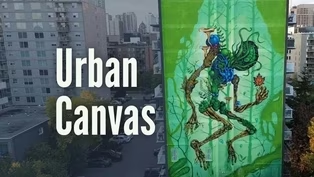
Two years ago, we programed the tallest mural in the world in Calgary by an artist in Berlin named Daim.
We don't want the murals to just be downtown.
We've moved outward.
It's in different neighborhoods now, but ideally it could be more and more and more further out from the downtown and the Beltline.
But tons of people want murals right now.
People want public art.
They understand that when you put public art on your building, it becomes a place that people want to gather.
Peopl become really civically engaged.
People start caring about the outside more.
So now people want murals.
They want their business to become a landmark spot.
They understand the value of it.
We also have a roadworks program, which is a smalle public art installation series.
If you're driving around Calgary, you might see concrete Jersey barriers around different patios.
That is a program that bump also facilitates.
So this year we had 26 roadworks artists, all local.
Over 400 public art installations.
If you count roadworks and some of the other projects we've done, we have a few mural festivals.
The big ones that Canada is known for is Mural Vancouver Mural Festival.
Bump is now one of the big ones too.
I would say we're probably the biggest public art mural festival in Western Canada right now.
We're also a festival that is not actually under the city.
So we're not city funded.
We're not government funded.
So in a way, we get to go rogue.
We get to program art like this, which is interesting.
As festival directors, we are setting themes early and the theme are a little bit more abstract.
They're not like, hey, we wan artists who are painting nature.
So last year, Bump Festivals theme was the electric and the intentional.
The year before was play.
This year the theme is What if BUMP Festival was a place that we were building and creating together.
I think the noise were bringing to Calgary is changing it.
Actually, everything we do, everything we program is a conversation we're trying to have with the public.
Let's think about the cit in a more civically engaged way.
And I think that's a really big part of BUMP.
I've seen entire projects flip the conversation in a neighborhood.
change how people think about where they live.
So right now, the appetite for public art in Calgary is really strong, and I think we've had so much to do with it.
This year bump Festival expands beyond murals, adding large scale public sculptures to the mix.
The 2026 festivities run August 1st through the 17th.
Visit the festival website for schedules, artists and event details.
In our next story, we're heading out to Casa Cano Farms, where sustainable farming is more than a philosophy, it's a way of life.
The folks at Casa Cano are dedicated to building a healthy farm ecosystem, protecting their watershed, and growing food, with the land in mind.
So roll up your sleeves and don't mind a little dirt under your fingernails.
We're headed to the house of Cano.
Farming inspires me because I am able to grow food for my community and for my family, while also taking care of the earth.
It's kind of turne into like my big art project, so everything we've done has become an expression of ourselves.
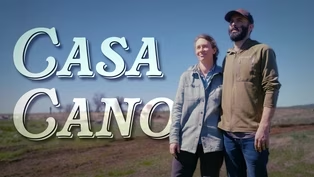
Jorge Cano and Madyson Versteeg are the husband and wife duo behind Casa Cano Farms, located in Valleyford, Washington.
A lot of families come here weekly.
They get to interact with us and walk around the fields and go up to the livestock and get to see it for themselves and ask questions to us.
People are really excited to come out and actually pick what they're eating.
It's just turne into a really nice environment.
Jorge and Madyson met while they were still in high schoo and bonded over a love for food, farming, and living off the land.
I was thinking back, our first date was picking up chicken food at Northwest Seed and Pet for his backyard chickens.
Both of us were inspired in an environmental studies class, and just wanted to know everything about what I was eating and how to make it and where it came from.
So we both went to the University of Montana and graduated with a Bachelor of Arts in their Environmental Studies program.
Our senior year, we started a farm for a nonprofit in Missoula.
And then the Clark Fork flooded that year and washed all the top soil away.
And you can see the pan of where I had roto tilled everything and it's like it was hard as concrete, and you can see the waves from the roto tiller.
And so that was the start of our no till journey.
Tilling allows moisture and air to permeate soil, encouraging seed to germinate and roots to grow.
But long term and frequent tilling can cause a host of problems.
Tilling can make soil vulnerable to wind and water erosion, damaging a farmer's property and polluting the watershed.
No till farming, direct seeding, and other sustainable practices.
Enriches soil with organic matter.
Increases water holding capacity, and protects crops during periods of drought and flooding.
When we terminate the crop, we cut it out, leave the roots in the ground, and then plant our next crop.
The biology that's on the old root system can jump to this new living root system and keep the cycle going.
And over time, it's become exponential the amount of biology we have.
Very good.
This is the garlic.
So we planted this in the fall.
So since this is no till we just drilled holes and then put each bulb and in the hole.
And then we moved to a second cutting alfalfa and gives it the fertilizer it needs for the season.
So this is where a lot of the magic happens.
We start all of our seeds for the plants that we're going to plant out into our own fields.
And then we also start a lot of plants for home gardeners in the spring.
A lot of the microgreen are going to Luna and Wild Sage.
We also sell to Gander and Ryegrass, South Perry Pizza, Latah Bistro.
I can show you some bugs if you want, but you can see right here.
All of these are called aphid mummies.
So they're aphids that wer parasitized by a parasitic wasp.
And so out of each one of these is going to hatch a new parasitic wasp that will go and parasitized more aphids.
So this is like natural bu control that's just native here.
We haven't introduced these.
Which is pretty cool.
To me sustainable farming is being able to farm in an ecosystem and be able to do that, like indefinitely.
To have that sustain.
The fact that people are interested in this on the thousands of acres scale is really exciting.
Having them be able to take some of the stuff that we've been doing for years on our farm and lots of small farms around the country, and apply that to a lot of acres, improves water quality for all of us.
There's just an element of magic.
Planting seeds and seeing them germinate.
It's pretty amazing.
And so I think that continues to give me hope.
I'm excited to see how we keep growing with it, evolving.
The environment we've built here on the farm is is a happy place.
We like to think it's just because of the practices and kind of all the work we've put into it, speaks for itself.
To learn more about Casa Cano Farms, visit the website Casa Cano farms.com.
Living bonsai trees have long symbolized the beauty of imperfection.
Their twisted trunks, weathered textures and asymmetrical shapes.
Tell stories shaped by time and patience.
With careful tending, they can inspire generations.
We visited a north Idaho artist who honors that tradition in an unexpected way.
Transformin simple wire into striking bonsai inspired sculptures.
For her, each piece is both a creative challenge and a deeply rewarding labor of love.
I've been at this now for three and a half.
Four years.
hundreds upon hundreds of hours have gone into trees that I love.
North Idaho artist Morgan McBride is wired.
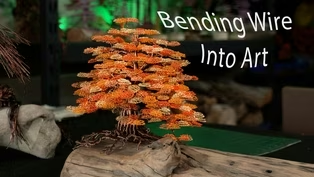
Wired in the sense of her using strands of aluminum colored jewelry grade wire as a medium coupled with wood, moss, and crystals to create reproduced imitations of bonsai.
distinctive sculptures that resemble the real McCoy.
I love the way the light bounces off of the wire, and it just feels lik it gives it that breath of life, which is something I truly enjoy.
Each one of these pieces are mounted on natural wood, because I feel like it's a wa to bring the life into the piece in high school I took Japanese for a few years with some of my family, and then, in college, my teacher told us we had to make something out of line.
He he looked at us all and I still remember he's like, I don't care if you use wire, string or whatever has to be out of a line.
And I always loved Japanese bonsai.
Even my dad for a while tried to do bonsai, but they could never survive years to grow, days to kill.
So the goal was made to try t make one that could truly last, so it's a perfect little picture of nature that is low maintenance.
And I love it.
Morgan loved it so much.
She eventually gave rise to Sennen Creations, where she plans meticulously on creating wire Bonsais that showcase her creative passion.
I want it to be timeless.
That's the meaning behind my name.
Sennen in Japanese is the millennium.
It's a span of time.
So I wanted to create something that would last that span of time, which is what bonsai are.
Over the years.
They grow, they change, but if something happens, it's heartbreaking.
So I wanted to make something that would last, that I wouldn't have to worry about it dying in the future.
While bending wire can take its toll on Morgan's fingers after spending hours at a time working on her pieces, she says it's all worth it.
I've been at this now for three and a half.
Four years.
hundreds upon hundreds of hours have gone into trees that I love.
Ever since I was little.
I still remember sitting down and drawing.
I've always enjoyed art.
Art has always been something that's been a part of my life.
And then I found out in colleg that I also really like to work with my hands and do sculpture work, which is how I've now really been leaning on Bonzais Before I start to bend the wire, I first look at all the wood that I have.
I want to find something that has character that I can either build on, or it already is naturally there.
And then I'll take it to the drawing board.
I'll pull out the sketchbook.
I'll do multiple rundowns of the possibilities of wire and all the different shapes I could do.
Normally, my smallest trees can take me anywhere from 12 to 16 hours.
Well I can spend upward to over 100, depending on the size of the tree.
We're talking hundreds of feet up to over a couple thousand feet of wire in each piece.
Beginning with the trunk of the tree.
Morgan stretches out many strands, which can be hundreds entwined together for thickness from there... I get to the trunks end they come out almost in like, little Ys and from there I will take different colored wire that I've spent hours, even days coiling.
And I'll twist them into the trunk and then I'll shape them into the leaves.
One color it's great to do.
It's simple and easy, but something like the autumn pieces or any of the winter tree I've done, they have four colors so they can take me double to triple the amount of time it takes to finish them.
I gravitate towards the double pink trees because I find that they ar just a gorgeous representation.
But I also love, of course, the natural green because it just it screams bonsai.
And I love that so much.
Once the wire tree is finished, it really isn't.
It must be mounted on the pre-determined wood Morgan has chosen for the piece.
I personally really love to use driftwood.
Driftwood.
I feel already has so much natural character and it's not used for a ton of things, so I just like to give it another life, even though it's been already given one.
I like to use also different kinds of hardwoods with either a really pretty wood grain or bark.
I love to include the natural elements of the piece and not transform it too much, but still make it look polished and refined.
I can't use softwood.
I fear rot, and I want to make sur that the pieces will truly last.
I made a set of bookends a while back, and they were champagne and a bright red.
And I loved those two pieces, but I put them on display and I was like, that one was hard to part with I'll just have to make more.
Morgan regularly shares her work at regional art fairs and online galleries.
She says the creative process never really stops.
She's always shaping new designs and keeping an eye out for the perfect piece of wood to serve as the foundation for each sculpture.
It's shaping up to be a summe filled with fireworks, parades, and a sea of red, white and blue as the United States of America marks its 250th birthday this 4th of July.
But you don't need a semi quin-centennial celebration to stir patriotic pride in the members of the daughters of the American Revolution and the sons of the American Revolution.
As descendants of those who helped win American independence, these groups are dedicated to preserving the stories, values, and sacrifices that shaped the nation and to passing that history along to future generations.
Oh, yeah, I'm in DAR.
And they say, oh, you mean like on the Gilmore Girls?
And I say, no, it's not like that.
[Laughs] On Gilmore Girls, The Daughters of the American Revolution is portrayed as an exclusive high society club, complete with teas, parties and at times, elitist attitudes.
While entertaining for TV, the depiction of the DAR as an organization only for East Coast socialites couldn't be further from reality.
The mission of DAR is, all built on the pillars of, historic preservation, education and patriotism.
With nearly 200,000 members spread across the country, DAR members like Janelle Braithwait volunteer millions of service hours each year.
Even right here in the northwest, thousands of miles from the battles of the American Revolution.
There is something for everybody, no matter what your interests are.
If you like genealogy, DAR for you, if you like patriotism and you like to serve veterans, DAR is for you.
If you like to work with schoolchildren and promote education and literacy, DAR is for you.
It has something for everyone.
it's not an exaggeration.
However, there is an important requirement to join.
They have to prove their lineage clear back to a patriot.
Okay, so maybe it's just a little exclusive.
This is where the work really starts.
You can spend a lot of time on this because this is going back through every generation, back to your patriot, which for me that's eight generations back.
This would be my dad and this would be my patriot.
So this can be a long process to get all the data.
But we've got great people to help you.
So then once it goes off to National and they bless you, then that's your primary patriot, they call it.
You might be surprised to lear there is enough direct lineage to the Revolutionary War here in our region to support four local DAR chapters, as well as a separate organization for the men.
[Stan] I am a member of the Sons of American Revolution and have been for 20 years.
Stan Wills is also the curator of the Spokane Flag Museum.
During the American Revolution, George Washington was elected head of the army, and he had his own flag.
Essex Hopkins was elected the head of the Navy, and he had his own flag.
So we have 13 stripes and 13 stars.
The museum was a labor of love for Wills and the other members of the SAR after seeing a need.
We had a booth set up at a local fair, and we were asking history questions for kids and they couldn't answer the questions.
So we decided we would start a program to educate the community about the history of the American flag.
The Spokane Flag Museum is just one way these organizations help educate youth.
One of their favorite things to do is to show kids what their life would have been like 250 years ago.
Kids are fascinated with the toys that they would have played with.
The toothbrush.
How they made combs, how they made bowls.
They want to know the living history of our country.
So, that's our goal is to teach them about wha it was like to be a kid in 1776.
Members are also passionate about supporting active duty military and veterans and preserving historic sites and monuments.
This is a Patriots Plaza.
Patriot Plaza not only honors our region's patriots.
It was completed at the perfect time to serve as an educational tool for America 250.
Each of these bricks is the name of a patriot.
Mostly of the people in Washington state who are members of the Daughters of the American Revolution.
We did get some extra funding.
So there's like, Andrew Jackson, George Washington, and the ones that we kno who are historically important.
The others are all family members of ours.
These folks do a lot for their local communities.
And as you've probably noticed, they do it in style.
I get a lot of comments.
Oh, I love your dress.
You know, stuff like that.
And these girls at Gonzag we're going, I love your dress.
Oh my God.
And they're running up to me.
And and they just loved it.
Hi.
My name is Joanne Heye.
I am a member of the May Hutton chapter of the DAR.
This is my collection of reenactment clothing from the 18th century, primarily 1775 to about 1790.
What women would have worn during the colonial period in the 13 original colonies.
We'll start at the skin.
The only thing that was worn next to the skin, other tha maybe stockings, was the shift.
And this is a call to stay.
Not a corset, there is a difference.
Corsets came along much later.
Its amazing how much gets tied under your clothes you never see.
But these would go here.
But back in that time, they didn't have purses.
They had pockets and these pockets would be tied around underneath.
Before you put all your petticoats and stuff on, you would put this pocket, tie it around your waist.
You could put your money and stuff or Kleenex or tissues or whatever you need.
But you can see the opening on the side.
That's where you would go for your pocket.
It would be through this.
And then you'd reach in for your stuff, for your money and things.
It's all done very complicated for a very simple purpose, but it works.
It's definitely a learning curve when you start doing this.
But it's more than playing dress up.
Getting noticed is the point.
It actually, attracts attention.
That's that's the truth.
We want them to pay attention to what we're doing there.
We're marching in the parade to get the word out about our 250th anniversary, to get the word out about DAR and SAR, to get the word out about flags and the proper use of flags.
And so if we're just wearin our normal clothes, that's okay.
But they really pay attention to what we're doing if we're dressed in costume.
And there's no better time to pay attention and reflect as we celebrate America's founding.
And look ahead to what the next 250 years might hold.
Our goal, above all else is to make sure that our history is not forgotten that the stories of our patriots stay alive and the stories of their descendants stay alive, so that we can continue to know our history and grow from our history and grow into the future.
The Sons and Daughter of the American Revolution will join KSPS PBS to commemorate the anniversary of America's founding with a day of music, food, trivia, and screenings of the Ken Burns PBS documentary The American Revolution.
All of this happens Saturday, July 11th at the Northwest Museum of Arts and Culture, the Mac.
We hope to see you in Spokane this summer for the America 250 Jubilee Celebration.
Well, it's been a joy to have you with us on this month's edition of Northwest Profiles.
Do you know of someone, somewhere we should feature in a future program?
Well, then get i touch with us here at ksps.org.
I'm Tom McArthur.
See you again soon.
Bye for now.
Video has Closed Captions
Clip: S39 Ep6 | 5m 31s | Watch as North Idaho wire artist Morgan McBride creates art that celebrates Bonsai. (5m 31s)
Video has Closed Captions
Clip: S39 Ep6 | 5m 42s | This husband and wife duo share a love for food and prioritize sustainable farming. (5m 42s)
Video has Closed Captions
Preview: S39 Ep6 | 30s | Casa Cano Farms, Bonsai in Wire, Calgary's BUMP Festival, and Revolutionary Sons and Daughters. (30s)
Video has Closed Captions
Clip: S39 Ep6 | 7m 33s | BUMP is one of Canada’s leading mural festivals and has transformed how Calgary looks and feels. (7m 33s)
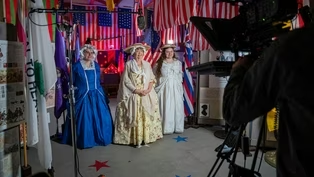
More Than Tea and Costumes: The Real DAR and SAR
Video has Closed Captions
Clip: S39 Ep6 | 6m 55s | Discover the real work of the Sons and Daughters of the American Revolution in the Inland Northwest. (6m 55s)
Providing Support for PBS.org
Learn Moreabout PBS online sponsorship








Support for PBS provided by:
Northwest Profiles is a local public television program presented by KSPS PBS
Funding for Northwest Profiles is provided by Idaho Central Credit Union, with additional funding from the Friends of KSPS.