My Dream, Your Dream, Our Dream -Pedro Trivella-Fourth Grade
6/2/2020 | 56m 13sVideo has Closed Captions
This bilingual lesson prepares students to be successful members of our diverse society.
This bilingual lesson prepares students to be successful members of our diverse society by focusing on ways to protect our natural environment. Additionally, learners will be encouraged to engage civically and think globally.
Problems playing video? | Closed Captioning Feedback
Problems playing video? | Closed Captioning Feedback
NJTV Learning Live is a local public television program presented by NJ PBS
My Dream, Your Dream, Our Dream -Pedro Trivella-Fourth Grade
6/2/2020 | 56m 13sVideo has Closed Captions
This bilingual lesson prepares students to be successful members of our diverse society by focusing on ways to protect our natural environment. Additionally, learners will be encouraged to engage civically and think globally.
Problems playing video? | Closed Captioning Feedback
Where to Watch NJTV Learning Live
NJTV Learning Live is available to stream on pbs.org and the PBS app.
Providing Support for PBS.org
Learn Moreabout PBS online sponsorshipMore from This Collection
NJTV Learning Live is a class for fourth graders taught by NJ public school teachers.
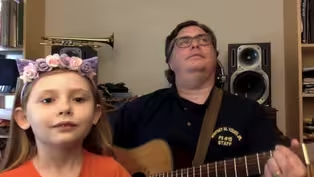
Songs for the Campfire or Couch - Ed Stroh - Fourth Grade
Video has Closed Captions
Students will learn about the history of campfire singing and engage in group singing. (56m 47s)
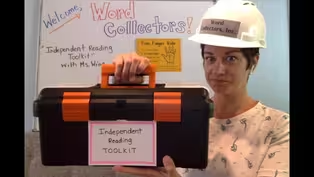
Independent Reading Toolkit - Lauren Wing - Fourth Grade
Video has Closed Captions
Students will practice three independent reading strategies. (55m 25s)

Just the Facts! - Zoila Correa - Fourth Grade
Video has Closed Captions
This lesson explores factors & multiples building upon students’ understanding of arrays. (56m 20s)
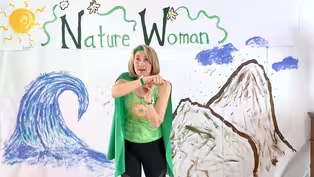
Erosion Avengers - Jill Falk - Fourth Grade
Video has Closed Captions
Mrs. Falk uses her imagination to transform herself into a superhero, Nature Woman! (56m 36s)
Acute and Obtuse Angles - Jill Turner - Fourth Grade
Video has Closed Captions
Students will learn all about lines and angles and how they apply to real-life situations. (57m 13s)
How Do Sounds Become Music - Domenico Zarro - Fourth Grade
Video has Closed Captions
Students will explore the elements of rhythm and beats to understand how music is created. (55m 1s)
Natural Disasters - Michael DeMaio - Fourth Grade
Video has Closed Captions
Follow along as Mr. DeMaio teaches you about incredible types of natural disasters. (55m 10s)
Area & Perimeter Word Problems -Tara Casalunovo-Fourth Grade
Video has Closed Captions
In this math lesson, students will learn how to solve area and perimeter word problems. (56m 5s)
Producers vs. Consumers - Chase Wesley - Fourth Grade
Video has Closed Captions
This lesson introduces the differences between consumers and producers. (57m 6s)
Song Form - Chloe Norell - Fourth Grade
Video has Closed Captions
Students will learn about song form and explore these forms through analysis and dance. (57m 48s)
Become a Geometry PRO! - Lauren Proda - Fourth Grade
Video has Closed Captions
Students will learn about the properties of triangles, squares, and rectangles. (57m 8s)
Rooms in a House (ESL) - Cassandra Shannon - Fourth Grade
Video has Closed Captions
In this lesson, students will learn the vocabulary associated with the rooms in a house. (55m 14s)
Providing Support for PBS.org
Learn Moreabout PBS online sponsorship>> Hello, friends.
Mi name is Mr.
Trivella and I am a K-5 bilingual ESL teacher.
Mi nombre es el Sr.
Trivella y yo soy un maestro de ESL bilingüe de kinder hasta quinto grado.
Where do I work?
I work at Thurgood Marshall Elementary School, which is located in Asbury Park.
¿Dónde trabajo yo?
En la escuela de Thurgood Marshall aquí en la comunidad de Asbury Park.
So, how did I end up all the way from Venezuela here in New Jersey?
Particularly here in Asbury Park.
¿Cómo terminé yo viviendo aquí en el estado de New Jersey, específicamente en Asbury Park viniendo yo desde Venezuela?
Well, the one thing that attracted me the most about New Jersey is that New Jersey is the seventh most diverse state in the United States.
Entonces, una de las cosas que más me atrajo de el estado de New Jersey es que New Jersey es el número siete más diverso -- el estado más diverso -- de los Estados Unidos.
Entonces... Why is that important to me?
Well, guess what?
I can only learn from people who are different than I am, right?
So, how boring would it be if the whole world was made out of people that are exactly the same?
So I feel that by being around people that are from other countries, from other cultures, I can enrich my essence and the individual that I am, right?
Entonces, ¿por qué para mí es tan importante estar alrededor de personas que son diferentes que yo?
Que son de otras culturas, de otros países.
Porque así, yo me enriquezco.
Yo puedo aprender de ellos mucho más que si estuviera yo rodeado de personas igualitas que yo.
Qué aburrido sería vivir en un mundo donde todos fuéramos iguales.
¿Okay?
So, Asbury Park is very well-known for being well-diverse and rich in culture.
¿Verdad?
Asbury Park es una comunidad que es muy rica de culturas y de artistas.
Case in point, I'm gonna show you... ¡Voilá!
I'm taking the Venezuelan flag down.
Hopefully, this will not fall.
And this is my artwork.
I think it's a little crooked.
Okay?
Esto es uno de mis hobbies, ¿verdad?
Que es dibujar.
Entonces... Keep in mind that one of the big symbols that represents Asbury Park is the carousel, which is down the street from me.
And this is my representation of my multicultural background because after all, I was born and raised in Venezuela but I am a product of an Italian father, a Puerto Rican and Venezuelan mom, and my father's parents were from Germany and Italy... and French.
So... Esta es una representación de un símbolo muy importante -- mi representación -- de un símbolo muy importante de esta comunidad de Asbury Park.
Y es el carrusel.
Entonces, yo interpreté mi esencia multicultural en esta obra que hice, ¿verdad?
Porque yo aunque nací en Venezuela y crecí en Venezuela, yo tengo descendencia italiana, alemana, rusa y francesa.
Además que mi mamá también es un poco puertorriqueña.
So our lesson today, amigos y amigas... That's how I'm gonna refer to you guys from now on, okay?
Which is "friends".
Amigos y amigas.
The lesson is going to be about a global hero, a global leader.
La lección de hoy va a ser sobre una persona que nos ha guiado porque ha sido un líder global, un héroe global.
And his name is Dr.
Martin Luther King.
El Dr.
Martin Luther King.
Now, we celebrate him for the whole month of January.
But, I celebrate him every day because he has been instrumental in inspiring me with my advocacy for education and multiculturalism.
Okay?
Entonces, vamos a hablar un poco de este líder global porque este me ha inspirado a mí a seguir compartiendo mi visión y mi misión como educador y como una persona que cree mucho en las diferentes culturas como algo esencial para ayudarnos a nosotros y al mundo completo.
So, I'm going to show you a short video that highlights the legacy of Dr.
King.
El legado de Dr.
King.
Vamos a aprender un poquito de -- I know that most of you know who he is, but we're gonna have a short review and then we're going to talk about how each and every one of you can be inspired by him and bring to the table your individual and unique gifts, okay?
Entonces, vamos a aprender un poquito de él y vamos a repasar un poquito su legado para que nos demos cuenta que tu sueño, mi sueño es nuestro sueño y que cada uno de ustedes tiene un regalo en particular y especial que pueden ofrecer para hacer de este mundo un mejor mundo.
The name -- The title of the lesson is "My Dream, Your Dream, Our Dream."
And I do have a dream!
And I know you do, too!
Okay?
Entonces... Let's watch this short video!
¡Gracias!
>> Michael King, Jr.
is born in Atlanta, Georgia.
After a visit to Germany, his father changes their names.
At 13, King wins an oratorical contest and is ordered to stand on the bus so white passengers could sit down.
This inspires him to join the seminary and fight for social justice.
He earns his doctorate and soon after, leads the Montgomery bus boycott.
In retaliation, the King home is bombed.
He organizes non-violent protests in Albany and Birmingham before the march on Washington.
>> I have a dream today!
>> After winning the Nobel Peace Prize, he organizes the Selma to Montgomery marches and expands his focus to include poverty and opposition to the Vietnam War.
On April 4, 1968, Martin Luther King, Jr.
is assassinated.
King was awarded the Presidential Medal of Freedom, the Congressional Gold Medal and a national holiday is named in his honor.
>> Right, so now, I would like to know how many of you like the video.
Raise your hands.
Awesome!
Déjame ver.
¿A cuántos de ustedes les gustó el video?
¡Fantástico!
Hay muchos.
I don't know about you guys, but when I first learned about Dr.
King, I told myself, "Dr.
King, gracias..." Thank you.
"...for inspiring us to achieve our American Dream."
"Dr.
King, gracias por inspirarnos a poder alcanzar nuestro Sueño Americano".
So, I want to take an opportunity to remind you that later on, we're going to dance some merengue and salsa, so any adults with you at home, invite them, too, okay?
To dance.
A bailar dentro de un rato -- salsa y merengue.
Entonces, pueden invitar también a los adultos que estén con ustedes.
I'm also going to take this as an opportunity to inform you that you guys already know 20,000 words in Spanish.
Los amiguitos que hablan español, ustedes saben 20.000 palabras en inglés.
Because English and Spanish have 20,000 words that they share, that they have almost the same spelling and the same meaning.
El inglés y el español tienen 20.000 palabras que se llaman cognates, que comparten casi el mismo deletreo y el mismo significado.
So let me give you an example related to this theme, all right?
This global leader.
"Leader."
Dr.
King was a leader.
Right?
El es un líder.
Same in English and Spanish.
Dr.
King was an important leader.
"Importante".
Okay?
Un líder muy importante.
Un líder global.
Right?
A global -- "global" -- leader.
Because he fought against intolerance.
He fought against intolerance... "Intolerancia" in Spanish.
...and violence... "Violencia".
...to protect... Para proteger -- "protect".
...us against discrimination, against people that discriminate.
En contra de personas que discrimina.
Now, what I have over here, friends -- amigos -- are some of the quotes that Dr.
King wrote.
And with the help of my bilingual students, I was able to have them in both languages.
Aquí tengo muchos dichos de parte de Dr.
King en varios idiomas -- en ambos idiomas.
En inglés y en español.
So, let's review them.
I'll do it in Spanish first.
"Amor es la clave para solucionar los problemas del mundo".
Right?
In English.
"Love is the key to the problems of the world."
I want you to start thinking about which one of these quotes you prefer.
Quiero que vayan pensando de estos dichos que hizo el Dr.
King, cuál es tu favorito.
So, that's number one.
El que acabo de leer.
Número dos.
Number two.
"Tarde o temprano, todas las personas del mundo tendrán que descubrir cómo vivir juntos".
In other words, "Sooner or later, all of the people of the world will have to discover a way to live together."
Okay?
So this is number two.
Número dos.
And number three.
Número tres.
"Yo he decidido amar.
Odiar es una carga muy pesada".
"I have decided to stick with love.
Hate is too great a burden to bear."
And last but not least... I love this one.
"Everyone is great."
"Todo el mundo es maravilloso".
Okay?
So, I want you to start thinking which of these is your favorite quote.
Quiero que piensen cuál de estos es tu favorito.
Then, we're going to write... We're going to use paper and pencil -- papel y lápiz -- y vamos a hacer una actividad.
We're going to do this following activity.
So there are three steps to follow.
"How did Dr.
King say it?"
"¿Cómo lo dijo Dr.
King?"
¿Cómo lo dijo?
De esta manera.
¿Okay?
Ese es el quote.
That's the quote.
That's how he said it.
Este es el dicho y como él lo dijo.
Number two.
"How else can you say it?".
"¿De qué otra manera lo puedes decir?"
And number three.
"How can you foster the message to help your family and friends, neighbors and community, state and nation, and lastly, the world?"
Entonces, la primera.
Let's do a quick review.
First one is how he said it.
You're gonna write the quote that you prefer.
Lo primero que tienen que hacer es escribir cuál es el dicho que a ustedes les gusta.
Number two is how else can you say it.
¿Cómo de otra manera lo puedes decir?
And number three is how can that message help you, your friends, your community, your state, your nation, and the world.
Okay?
¿Cómo ese mensaje te puede ayudar a ti, a tu familia, a tus amigos, a tu comunidad, a tu estado, tu país y el mundo?
So let me give you an example.
I'm gonna show you, okay?
So, in case you didn't notice, my favorite saying was, "Everyone is great."
"Todo el mundo es maravilloso".
So, I'm going to write on a piece of paper... Voy a escribir en el papel eso.
"Everyone is great"... o: "Todo el mundo es maravilloso".
That's the first step.
Ese es el primer paso.
El segundo paso... "How else can you say it?"
"¿De qué otra manera lo puedes decir?"
Un ejemplo... An example... I celebrate everybody for who they are.
I not only accept them, but I celebrate them.
Yo celebro a las personas como son.
No únicamente los acepto, sino los celebro.
Y aprendo de ellos.
And I learn from them.
And last... "How can I foster the message and help my friends, community, nation, and world?"
"¿Cómo puedo aplicar ese mensaje y ayudar a mi familia, a mi comunidad, etcétera?"
Well, if I accept and I celebrate everyone the way they are, I will be able to gain more friends, which will enrich me as an individual.
I can help my family because then I can bring those people over to my house and help them also share their unique gifts and cultural backgrounds with my family members.
How can I help my community?
The more that we celebrate everyone, each and every one of our community members, the better our community will be to live in.
Same with our nation.
And then, people from all over the world will feel that they're not alone.
They are accepted, they're celebrated, and they're welcome.
Okay?
Entonces, este es el último paso que si yo acepto y quiero a las personas como son, me va ayudar a mí porque me va enriquecer como persona.
A mi familia también porque mis amigos van a venir a la casa, ¿verdad?
¿Cómo ayudo a mi comunidad?
Es porque si todas las personas de la comunidad se sienten aceptadas, queridas y bienvenidas, va a ser una comunidad mejor para vivir.
Igual con el mundo, donde todo el mundo se va sentir como que son importantes y tienen valor.
¿Okay?
So, now you have five minutes to write your thoughts and your reflections.
Tienen cinco minutos para escribir sus reflexiones y sus pensamientos.
>> Yes, this is Pedro...and I'm reporting from Asbury Park, New Jersey.
Pedro Primera reportando desde la comunidad de Asbury Park.
The votes are just about to come in.
Los votos ya van a venir.
Oh!
What?
They're in, guys.
Amigos, sí, aquí están los votos.
And here they are.
You voted, each and every one of your votes counted.
Todos votaron, cada uno de sus votos fueron contados y aquí están.
Las -- oh, the quotes one, two, three, and four.
Aquí están los dichos de Dr.
King, uno, dos, tres y cuatro.
So you guys tell me.
Which one was the most popular vote?
El más -- el favorito de todos.
¿Cuál de esos dichos fue el favorito de todos?
One, two, three, four.
Which one got the greatest number of votes?
¿Cuál de ellos adquirió la mayor cantidad de los votos?
Thank God I'm not a singer, and if you chose quote number one, you are correct.
With 109 votes.
Si escogieron el dicho número uno con 109 votos, ganó.
And here it is.
"Amor es la clave para solucionar los problemas del mundo".
"Love is the key to the problems of the world."
Speaking of problems of the world... Y lo prometido es deuda.
What's promised is debt.
Who's ready now to have some fun, and dance some merengue and salsa?
Go get your adult supervisor, and join me, and dance some salsa and merengue... Come on!
Let's go!
Alright, here's some music.
And... instruments.
So we're going to do salsa first.
Vamos a hacer la salsa primero, ¿okay?
Uno, dos, one, two.
One, two.
Three, four, three, four.
Uno, dos, tres, cuatro.
Uno, dos, tres, cuatro.
Uno, dos, tres, cuatro.
Are you ready for the next one?
Merengue!
This is easier.
Espérate, espérate.
Alright, guys.
Vamos a hacer merengue.
Uno, dos, uno, dos.
Uno, dos, uno, dos, uno, dos, uno, dos.
Tres, cuatro, cinco, seis.
Tres, cuatro, cinco, seis.
One, two, one, two.
Three, four, five.
I'm going to start, okay.
One, two, uno, dos, uno, dos, uno, dos.
One, two, three, four.
One, two, three, four.
Show you from the side, you know.
Uno, dos.
Uno, dos, uno, dos, tres, cuatro, cinco, seis.
Uno, dos, uno, dos, tres, cuatro, cinco, seis.
Uno, dos, uno, dos.
Tres cuatro, cinco, seis.
Con Guadalupe.
Going to dance with my chihuahua.
Claro que sí.
Of course.
He's from Mexico, he loves to dance salsa.
Now moving to leave you alone with your adult supervisor.
Para que sigan bailando, ¿okay?
Continúen bailando con los adultos que los cuidan por los próximos dos minutos.
So the next two minutes.
Yes, you can do it!
Ah!
You can do it!
¡Claro que puede!
Pasito pa' adelante, uno para atrás.
Uno de lado y para el otro lado.
One step forward, one step back.
To the side, to the other side.
Alright!
¡Muy bien!
¡Un aplauso para todos!
¡Bravo!
Let's hear it for the kids, let's hear it for the adults.
Muy bien.
Bienvenidos, Global Citizens.
Y les doy la bienvenida a todos los ciudadanos globales, ¿okay?
Del globo, de la tierra.
So let's just recap a little bit what we have done so far.
We talked about our legacy which I wanted to give clarification on that.
It is our goals, right?
Our goals that we will engage in, and take action.
Because for every choice that we make, we exercise our voice, and we use our power to take action.
That way we can leave a legacy.
My fifth graders that are watching, you're moving on to the Middle School, right?
So what kind of legacy you want your younger peers to remember you by?
Your teachers at the Elementary School.
Entonces vamos a hacer un resumen de lo que estábamos haciendo hasta ahora.
Hablamos de dejar un legado.
Un legado es los objetivos que tenemos para poder ayudarnos a nosotros y a la comunidad y al mundo, siendo inspirados, ¿verdad?, por un líder.
En este caso Dr.
Martin Luther King.
Y lo que hacemos es que lo que escojamos, ¿verdad?, todas las acciones, las decisiones que tomamos tienen consecuencias.
Vamos a abrazar esa voz, a utilizar nuestra voz para apoderarnos y poder ayudar al mundo.
Because after all, yes, we are global citizens, right?
Entonces, on that note, this is something that I embrace each and every day.
Read our GLOCAL.
Members of our society.
What does that mean?
That is a combination between global and local.
Entonces esta es una frase que yo utilizo mucho que se llaman "GLOCAL", que es una combinación de nuestra comunidad global y nuestra comunica -- comunidad local.
What do I mean by that?
We are Global Leaders Of our Community Advocating for Love without borders.
Nosotros somos Líderes Globales De nuestra comunidad que estamos Compartiendo un Amor sin fronteras.
So we have to think globally, and act locally.
Tenemos que pensar globalmente y actuar localmente.
We also talk about being kind.
That's key in embracing love without borders.
¿Verdad?
Hablamos de ser gentiles.
Gentiles con las otras personas, con el medio ambiente, porque eso es clave para lograr el amor sin fronteras.
Entonces, we are going to go over here because I want to show you something about our globe.
Is this a globe?
No, it's not.
This is now a map.
And in this map we can see one thing that unites all of us that all of these different countries are becoming.
Entonces aquí no tenemos un globo, sino tenemos un mapa donde están todos los países que nos representan y una de las cosas que nos une a todos es esto azul que es el océano.
So, let me go in here, and I'm going to put my glasses on so I can have my super power vision.
Who can remember, uh... Let's cover this.
Barcelona.
Is Barcelona a country or a city?
Entonces, Barcelona, ¿es una ciudad o es un país?
Guess what?
It's a city, a big city of the country named Spain.
And Spain es un país que se encuentra en España.
España está en Europa.
Right?
Entonces yo lo busco.
This is the continent of Europe, el continente de Europa y estoy buscando a España.
Here's France, here's Italy, oh, there it is, Spain, España.
En Barcelona, en una ciudad.
Okay, who can remember, I was wearing t-shirts from other countries.
Who can remember what countries were there?
You got it, guys.
Two other countries.
And they are Argentina.
Argentina.
Vamos a ver, let's see where Argentina.
Argentina is in the continent of South America.
El continente de Sudamérica.
Vamos a ver.
Ah, aquí está Venezuela, that's where I'm from.
Venezuela, we see ocean here.
Argentina is in South America.
That's the continent.
Oh, here it is, it's a big country, Argentina.
Y aquí está rodeado también de agua.
And the other country that you guys mentioned is... Mexico.
México.
Okay, and where's Mexico located?
¿México dónde está localizado?
En el continente de Norte América, right?
The North American continent.
So here it is.
México es un vecino de los Estados Unidos.
Mexico is a neighbor of the United States.
Let me show you something really cool.
Déjame mostrales algo muy chévere como decimos nosotros en Venezuela.
These are my students that I had last year Oh, Jorel.
Jorel: "I love France."
France is a country located in the continent of Europe.
Oh, and there it is.
Francia es un país que se encuentra en el continente de Europa.
Oh, this is so cool.
"My teacher is from Venezuela."
"Mi maestro es de Venezuela", y ya como yo les dije, aquí está Venezuela.
In South America.
Venezuela is in South America.
That's the continent of South America.
Let me see.
Who can read it?
Let me see if somebody can read this.
That's correct.
Nicaragua.
Nicaragua is located in the continent of North America.
Nicaragua is right here, aquí está Nicaragua en el continente Norte Americano.
Let's see, who would like to read the next one?
Yes, you.
Tú lo puedes leer también.
We can read them together, okay?
Vamos a leerlo juntos.
Haiti.
Yes.
My friend is from Haiti, and her name is Christelle.
Now Haiti es una isla.
It's an island, right?
And here it is.
It's right next to Dominican Republic.
And as you see, surrounded by water.
So, friends, I want you to think, now that you can actually see how we are collectively united... Ahora que ustedes ven que estamos todos juntos... I want you to think about what other problems, other challenges, affect all of us.
¿Cuáles son otros problemas que nos afectan a todos?
And I want you to think of our oceans, right?
We share the oceans.
Estamos compartiendo los océanos.
So I want you to think about what is going on with our oceans that you have heard in the news.
Think about it.
Yes.
You got it.
Tenemos una crisis, we have a crisis.
We have a lot of pollution in our oceans.
We have contaminación, in Spanish.
Oh...yes!
Contamination.
All you have to do is put the "T" instead of the "C," and then you got it.
Contamination.
So now I want you to stay tuned because I'm going to show you a video about our wonderful oceans, and what's going on with our friends, our ocean friends, our animals, and their homes, their habitat.
Hope you enjoy the video.
>> Hey.
I'm Emily, and I'm here to talk about recycling.
Did you know that over $400 million worth of recyclable materials en up in Michigan landfills every year?
If those items were recycled, they could be turned into new products, conserving resources, and supporting jobs.
But it's important to put the right things in the cart.
Starting with me.
I'm getting out of here.
Start the clock.
[ Beeping ] Recycling improves Michigan's environment and economy everyday.
But what things should go in the cart?
After all, items accepted at home may not be the same at school or work.
All you need to do is look at your city or school web site, or if a sign is posted nearby.
At the recycling facility, everything is sorted into piles.
Different types of plastics, metals, glass, and so on.
That stuff is then turned into new products.
When you put unwanted or dirty items in your cart, it lowers the quality of the recycled product.
It's like when you're making cookies -- You mix in the bag of chocolate chips, but then when you get them out of the oven, you discover there are... in the bag and dish soap left in the mixing bowl.
Yuck!
That's why you always have to clean and empty what you put in your cart.
Containers with leftovers can spill, ruining paper products.
Bottles with cleaners and pesticides can hurt employees, as can items like needles or diapers.
When in doubt, just throw it out.
Want more tips?
Check out our recycling 101 booklet, or visit our web site and subscribe to our Youtube channel for more MDEQ minutes.
Thanks for watching!
Woo!
>> Okay, friends, so, did you enjoy the video?
Let's see.
Okay.
Unfortunately, the video highlighted that we have a... problema.
We have a problem.
¿Quiénes de ustedes disfrutaron del video?
Yo digo que desafortunadamente el video demostró que tenemos un problema.
So, we have a problem.
What kind of a problem do we have?
¿Qué tipo de problema tenemos?
Yeah, we have a crisis, right?
We're having an environmental crisis.
And we are at fault.
Our human actions.
Tenemos un problema con las acciones de las personas que no están cuidando el medio ambiente.
Entonces... What do we need to do?
We need to reduce, reuse, and recycle.
Tenemos que reducir, reusar y reciclar.
What products, what materials, can we reduce, reuse, and recycle?
Well, here they are.
¿Qué tipo de material podemos reusar, reducir y reciclar?
Aquí son los cuatro ejemplos.
Número uno.
Paper.
Papel.
Número dos.
Plastic.
Plástico.
Número tres.
Metal.
Metal.
Número cuatro.
Glass.
Vidrio.
Now, let me give you an example.
I love coffee.
A mí me encanta el café.
So, what do I do when I buy coffee?
I buy one can of coffee, okay?
And what's one way that I can reuse?
Cuando yo compro café, compro una lata, ¿cómo la puedo reusar?
I bring this can to school for my students to play.
[ Beats can like a drum ] Instruments, right?
Un tambor.
Lo puedo usar de esa manera.
That's reuse.
Reduce... ¿Cómo puedo --?
Esa es la manera de reusarla.
Ahora, reducirla -- yo voy al mercado y compro los granos de café la próxima vez y los pongo aquí.
So, next time I go to buy coffee, I buy the coffee beans, and I put the beans here or I bring my recycling bag so I don't have to buy more of these cans.
And recycle.
¿Verdad?
Y reciclar.
Yo puedo reciclar... I can recycle the plastic, right, and the metal.
So, that's an example.
But what I want you guys to do right now, I want you to go around your house and find one of each.
I want you to find something made out of paper, something made out of plastic, something made out of metal, and something made out of glass.
Lo que yo quiero que ahora hagan es que vayan en sus casas y busquen un material de cada uno -- de papel, de plástico, de metal y de vidrio, ¿okay?
And you can dance.
[ Upbeat music plays ] And go ahead!
And get your materials.
Pueden bailar, y a buscar los materiales.
¡Así es!
[ Upbeat music continues ] Alright!
[ Upbeat music plays ] Now... I'm here.
Amiguitos, estoy aquí de vuelta.
Y aquí tengo los productos, los materiales que busqué en mi casa.
These are the products that I found at home.
So, I have paper -- papel -- plastic -- plástico -- metal, or aluminum -- aluminio, metal.
Y por último, vidrio -- glass.
...that I touched on before.
Amigos, please.
Plastic -- plástico -- is something that is affecting our ocean.
It's affecting our animal's habitats.
Our dolphins, our whales, our sharks.
Their homes are being... affected significantly because we're not taking care of their environment.
Okay?
Entonces, el plástico, por favor, pendientes, porque el plástico está... haciéndole mucho daño a los océanos y a los animales que viven ahí, a los delfines, a las ballenas, a los tiburones, a todos estos animales bellísimos que viven en el océano.
So, I'm gonna show you a short video about what we can do to help our oceans, right?
I'm two block away.
I want my oceans to be preserved.
Un video cortico donde vamos a hablar un poco de cómo podemos prevenir tanto uso de plástico y en lugar de en nuestras playas, nuestras hermosas playas.
Aquí está.
Hope you enjoy the video.
Disfruten el video.
[ Piano music plays ] Okay, amigos, I hope that you had a lot of fun.
Our global citizens.
Pancho and I would like to say goodbye and take a little review of what we covered.
Remember, we must always be inspired by our leaders, we must embrace our American dreams, where we're taking care of each, our community, our country, our world, and our environment.
Acuérdense que vamos a... lograr nuestro sueño americano siempre y cuando seamos inspirados y tomemos acción para ayudarnos unos a otros, ayudar a nuestra comunidad, a nuestro país y a nuestro planeta.
Okay?
Pancho, one of my two Chihuahuas, is here to say goodbye.
And I want you to think what of these initiatives that you watched in the video would you like to embrace.
Del video que vieron, ¿cuál de esas iniciativas les gustaría a ustedes abrazar, practicar?
So that we can prevent plastic from reaching our oceans.
Para que el plástico no llegue a los océanos.
Muchas gracias.
Molte grazie.
Thank you very much.
Y hasta luego.
Goodbye, friends.

 New Season
- Home and How To

Hit the road in a classic car for a tour through Great Britain with two antiques experts.
 New Episode
 New Episode
 New Episode




 New Episode


Support for PBS provided by:
NJTV Learning Live is a local public television program presented by NJ PBS