
October 6th, 2026 | Carolina Impact
Season 14 Episode 1405 | 27m 34sVideo has Closed Captions
CLT Airport Lost & Found; Duke LKN: A Century of Healing; A Clearer Future; & More Than Shakespeare
Inside Charlotte Douglas Airport's Lost & Found team, where lost items find their way home; Duke Health / Lake Norman regional medical center celebrates it's 100th Anniversary; Central Piedmont students learn to capture medical images and care for the people in them; & Shakespeare helps young actors find confidence, community and a place to belong.
Problems playing video? | Closed Captioning Feedback
Problems playing video? | Closed Captioning Feedback
Carolina Impact is a local public television program presented by PBS Charlotte
October 6th, 2026 | Carolina Impact
Season 14 Episode 1405 | 27m 34sVideo has Closed Captions
Inside Charlotte Douglas Airport's Lost & Found team, where lost items find their way home; Duke Health / Lake Norman regional medical center celebrates it's 100th Anniversary; Central Piedmont students learn to capture medical images and care for the people in them; & Shakespeare helps young actors find confidence, community and a place to belong.
Problems playing video? | Closed Captioning Feedback
Where to Watch Carolina Impact
Carolina Impact is available to stream on pbs.org and the PBS app.

Introducing PBS Charlotte Passport
Now you can stream more of your favorite PBS shows including Masterpiece, NOVA, Nature, Great British Baking Show and many more — online and in the PBS Video app.Providing Support for PBS.org
Learn Moreabout PBS online sponsorship(upbeat orchestral music) - [Narrator] This is a production of PBS Charlotte.
(upbeat orchestral music) - [Narrator] "Carolina Impact" is brought to you in part by Bragg Financial.
Serving high net-worth families with portfolio management and planning advice, Bragg Financial is committed to our clients and our community.
Braggfinancial.com.
- Just ahead on "Carolina Impact," Charlotte Douglas Airport ranks third in the country for reuniting passengers with lost items.
We'll show you how they do it.
Plus, a small healthcare company makes a big impact across our region, and a couple turns their love for theater and each other into inspiration for actors.
"Carolina Impact" starts right now.
(upbeat guitar music) (upbeat guitar music continues) Good evening, thanks so much for joining us, I'm Amy Burkett, more than 53 million passengers traveled through Charlotte Douglas International Airport last year, and that heavy traffic leaves plenty of lost items behind.
Phones, wallets, laptops, even passports can disappear as travelers rush to catch their next flight, but a new ranking of the nation's busiest airports ranks Charlotte Douglas third in the nation for reuniting travelers with lost stuff.
"Carolina Impact's" Heather Burgess and videographer Doug Stacker take us inside the airport to meet the dedicated team that earned this distinction.
- That's right, Amy, there's some good news for travelers heading out of Charlotte Douglas.
A new study shows that the airport actually ranks number three when it comes to reuniting owners with their mishandled or lost belongings, and we've found that it takes a lot of teamwork and precision and some detective work to get the job done.
(plane roaring) (relaxed piano music) With over 160,000 passengers on average flying in and out of Charlotte Douglas International Airport every day, hundreds of items get left behind.
- I've learnt my lesson 'cause I think I've left a few things on the plane and even maybe sitting beside me while I was waiting for luggage just walking away, so yes, of course.
- [Heather] And each morning, those items end up in this small office, bins upon bins of mysteries to solve.
(relaxed piano music) - We log everything in from TSA, parking, curbside, concession stands, anywhere in the airport, we log 'em in daily.
- When you walk in the door, it doesn't really look like much, but behind the scenes, there's shelves and drawers and all these things are labeled by day, by time.
If it's not organized like that, we wouldn't be able to find the item.
- [Heather] But keeping track of what's lost is only the beginning, finding who it belongs to can take some serious detective work.
- They're able to hunt down things that the normal person would not do, like, they call pharmacies, they call the stores, if they have a card for a cleaner, they call the cleaners so that they can get in contact with people, they're looking for clues all through the bag when... From the minute they open it.
- [Heather] And once this team starts investigating a bag or an item, they don't slow down until they've looked for all the clues to find its owner.
- I'll say I went to Facebook, looked up the first and last name.
How we got the name at first, we hold... It was iPhone, so you could hold down the power button to call... To talk to Siri, and then, you could just ask Siri, "Hey, Siri, call mom," or, "Hey, Siri, call sister," and so, that's what we did, we was able to get in contact with the owner's sister, and then, we went on Facebook to find the owner, we did lots of scrolling, I'll say it took us about, like, a few hours.
- [Heather] And it's that curiosity and tenacity that makes this team incredibly successful at the found part of their job.
So tell me how you find the owners of the cell phones.
- He made a claim and... But we don't have his name on our site, so I found his phone and he listed his cell phone, this phone number in his claim.
I used our number to call his phone... - [Heather] And it's a match, and just like that, another lost phone can head home.
The owner gets shipping information, pays the cost, and the team sends it back.
(uplifting piano music) - As long as you have a available phone number and an email, as of right now, I could take that down, add it to the claim and send you our return options via email.
- [Heather] Of course, not everything that turns up here is a phone.
Laptops, AirPods, glasses, jackets and suitcases are fairly routine.
Keys are the most popular.
Then there are the lost belongings nobody would expect.
- I came in one morning and I was like, "We have an urn?"
(laughs) - [Heather] That's right, an urn.
Inside were the ashes of a loved one the family called Grandma Susie.
Her grandson had been traveling with the urn, but arrived at the funeral without it.
- [Shantia] He had the urn in his backpack, went to security and he forgot the urn.
The son got to the funeral, he was like, "It was here."
- [Heather] So they picked up Grandma Susie?
- So they made a joke about, like, she... They knew she gonna be late for her own funeral.
- [Heather] But the things that land here aren't always valuable because of what they cost, sometimes they're irreplaceable because of what they mean.
- A woman lost her cat.
- [Heather] Her cat?
- Yes, she was going through security and the cat has to come out of the kennel.
We actually found it, like, two and a half hours later in one of the equipment rooms behind and underneath something, they were, like, on their hands and knees, like, it was insane.
- We had a blanket that was their mother's blanket, their mother had recently passed away, they wanted to hug everyone in the office, they were really excited, and that really warmed our hearts, to be able to make someone feel that way again.
- [Heather] Lost-and-found at Charlotte Douglas is standing out in a new national survey.
Holafly looked at mishandled baggage and lost-and-found complaints at the nation's 20 busiest airports over a 10-year period.
Charlotte Douglas had the third-lowest rate, with over 1,900 complaints.
That's 6.47 complaints per million passengers.
Only San Francisco and Denver ranked better.
"Our amazing lost-and-found team, just a note to let you know that we appreciate you here..." And for the people doing the searching, the accolades aren't really what keeps them at it, it's the moment a lost item finally finds its person.
- You see people come in, they crying, sad, and then, we come around the corner and we have their items and just to see the... Their face lights up.
We have some unhappy, some tears.
- [Heather] It's part customer service, part detective work, and oftentimes, what this team calls moments of magic.
- 'Cause if it was me, I would want my items back, so we just wanna do the same for people.
(uplifting piano music) - And Amy, the team tells us that during peak travel times, they can get so many items it makes it hard to go through all of it, but rest assured, they are always trying to reunite that property with its owner, and they really would love to be number one, and I can't see why that's not possible.
Amy.
- Thank you, Heather, if you think people only leave behind phones and sunglasses, think again, travelers have also left some pretty unusual items, including false teeth, a vacuum cleaner, a record player, and even a voodoo doll.
Well, from helping people find what they've lost to helping people live healthier lives, next, we learn about a healthcare organization celebrating a century of service.
Atrium Health employs nearly 70,000 people, Novant Health employs more than 43,000, both giants lead our region's healthcare industry, but smaller providers also make their mark.
"Carolina Impact's" Jason Terzis introduces us to one provider that has served generations.
- A simple idea launched the organization in 1926, provide healthcare to a small growing community.
100 years later, that idea has grown into a major healthcare organization.
That organization has changed names and locations over the last century, but its core mission, serving the community, has remained steady.
The local library even marking this 100th birthday with a special exhibit.
(upbeat jazz music) It began, as most things do, with a simple idea.
- Samuel Alexander Lowrance, he was a farmer, a successful businessman.
- [Jason] The year?
1925.
With an exploding textile industry, the small community of Mooresville was booming, more than tripling its population since the turn of the century.
- And the only hospital that was in Iredell County at the time was up in Statesville.
- [Jason] And that's when Samuel Alexander Lowrance came up with his idea.
- He decided, "This is ridiculous, Mooresville needs a hospital."
- [Jason] Lowrance donating $10,000 of his own money, his home and his land to see his vision through.
- And so, they created Lowrance Hospital Inc.
And then, of course, he died though in... Before it was built, so he never saw the hospital come to fruition.
- [Jason] So popular so quick, Lowrance Hospital outgrew its small home in just a few years.
- The hospital took off, but got so big it needed more land.
- [Jason] In 1930, moving to what would become its home for the next seven decades, as well as the tallest building in town.
- They built that hospital by selling stock at $24 a share.
- [Jason] Over the years, Lowrance Hospital serving its core mission of providing quality care to those in Mooresville and the surrounding region.
With a community vibe so strong, two employees have been working here for, get this, 53 years.
- I started working at the old hospital, Lowrance Hospital, 1973.
It was family 'cause there weren't that many employees and you knew everybody.
- [Jason] Pam Brewer has spent most of her time here working in medical records.
- I've evolved from doing medical transcription, on a manual typewriter, by the way, which I could never go back to doing, I can't believe I ever did, all the way up to the way the modern technology is now, I mean, you know, the paperless records, the, you know, the computers and just that total evolution.
- [Jason] And since starting here as a teenager, Frankie Stewart has done a little bit of everything.
- 15-year-old, we started out in housekeeping.
I worked in the kitchen, I helped with autopsies.
I worked for about every department.
I'm a transporter now.
- [Jason] So what's kept Frankie and Pam here all these years, five-plus decades?
The answer is simple, the hospital family and community feel.
- Talking to friends of mine who'd moved over here and come back, and moved here and come back, it really wasn't any greener any place else, I liked the smallness of the hospital, I think at Lowrance, it was maybe 300 employees, so you knew everybody.
- I had other job offers even for more money, but I liked where I was and the liked the people.
- [Jason] So that makes you what now?
68, 69, 70, what...?
- 69.
- [Jason] 69.
How much longer do you wanna work?
- Probably 'til about 105.
(people laughing) - [Jason] In the 1980s, after being sold, Lowrance Hospital was rebranded as Lake Norman Regional Medical Center, and in 1999, the hospital was again on the move, this time to its current campus just off Interstate 77.
- The building, of course, was outdated, it, you know, as all buildings, it reaches a point to where it can't be really upfitted for modern use, it was not built, you know, to get a CAT scanner in.
(laughs) - [Jason] In April of last year, after being acquired by the Duke University healthcare system, there was another rebrand, this time, the hospital becoming the Duke Health Lake Norman Hospital.
- They have a really good reputation in their medical and their research and all... And in the community of North Carolina, so it's been a blessing to have them wanna be a part of our little corner of North Carolina.
- We didn't come in and, you know, throw a Duke playbook at the organization, I think that the hospital was resource-constrained and they had very innovative ways as to how they were delivering care that Duke Health could learn from, and we didn't wanna lose that, so as we came in, it was more of a partnership in learning.
- I'm glad we're doing it 'cause, you know, medicine evolves, you've gotta evolve too or you close down, and I didn't want us to close down.
- [Jason] Duke Health's arrival comes right as the hospital celebrates its 100th anniversary from small house to major medical campus.
- And continuous service, that's the most amazing thing, is it's one of the very few hospitals around that has, in all of the transitions, it has never shut its doors, it's never stopped.
- And that's special, for a hospital to be able to say that is something most can't do.
- [Jason] And now, Duke is looking to take the hospital into its next generation and next century.
- We are bringing in subspecialties, we are upgrading the facilities, we're investing in our people.
You're going to start to see some of our differentiating services like our heart and vascular service line, oncology, bringing clinical trials to the area, that is all going to come in the next few years.
- [Jason] Mooresville is also celebrating the hospital's 100th anniversary with a special exhibit ongoing at the town library titled "Lowrance Hospital: 100 Years of Community Centered Service."
- As we were processing it, going through the collection and all, it came up with, "Let's do a display, let's actually do a display for..." "That tells the history of the hospital," 'cause we had it, you know, we... It's here, and so, it's been sort of a joint effort that just kinda... One of those "aha" moments that just happened.
- [Jason] And while no one around today personally knew Samuel Alexander Lowrance, guessing it's pretty safe to say he'd be pleased to know that his little idea not only came to fruition, but is still going strong 100 years later.
- I love those stories.
You know, how many people can work at one job for over 50 years?
I thought that was extraordinary.
- I know, when they told me about them and I got to meet them, I'm like, "This is insane," I mean, for 53 years, working at one spot, quite an accomplishment, spending all 53 years with the same organization, even more remarkable, and they're not the only ones, Lee Whitfield, the chief public affairs officer and my host during my visit, she joined the hospital in 1988, so I'm learning all these different... "Oh, I've been here since the 80s, I've been here since the 70s," I'm like, "Oh, my gosh!"
Like, and it's crazy, and they've been there through all these various changes from Lowrance to Lake Norman, and now, to Duke, it's quite the feat to see.
- And beautiful community service.
- Absolutely.
- Thank you so much, Jason.
A century of service leaves quite a legacy, next, a new in-demand program trains the next generation of healthcare professionals.
When you need an X-ray, you'll probably think about what that image might reveal, not everything required to capture it.
Central Piedmont Community College recently launched a radiography program that trains students while local healthcare employers seek more skilled professionals in that area.
"Carolina Impact's" Chris Clark shows us how students master the equipment while developing skills that extend beyond the classroom.
- Everybody was super hesitant, especially me, I was like, "I do not wanna touch this at the moment."
- [Chris] David had worked construction, then spent a year and a half studying architecture.
His mother, who worked in a hospital, suggested he consider something else.
- I was thinking about how could I interact with people more, be in the daily lives of people?
- [Chris] That brought him to Central Piedmont's new radiography program.
Here, the person on the table is a classmate, and he's preparing for the day that it's a patient.
- That's right about there.
- [Chris] For the college, it all started with a request.
- Our industry partners reached out to us because there's a severe shortage in healthcare.
- [Chris] Radiologic technologists produce the images doctors use to diagnose injuries and illness.
- So Central Piedmont just stepped forward and said, "Okay, what do you need?"
- [Chris] The result is a two-year associate degree built around classroom instruction, lab practice and supervised clinical training.
- So she's almost kind of, like, putting this pressure on her ribs because she's like, "No, no, no, my..." 'Cause now she knows what we're doing.
- [Chris] Starting the program and outfitting a lab with new equipment, David still remembers being told what one of these machines costs.
- This is a $200,000 machine, and I was just like, "Whoa, this is a house right here."
Like, "We gotta be careful around this thing."
But I was really impressed with the kind of equipment that they had there, knowing that it was all brand new because they just installed it all.
14 by 17.
- [Chris] But it's here for him to use.
(tray clattering) - It makes me feel like I actually have something to work with here, you know?
- [Chris] Learning to operate, it starts with anatomy, radiation protection and patient care, then students put those lessons to work.
- So now what do we have her do?
What is...?
What are my...?
What's my technique?
- The lab is supervised by our faculty that are experts from the field, and a lot of them are still practicing in the hospitals.
- [Chris] For Virginia Phannareth, even the smallest adjustment has a purpose.
- We don't have X-ray vision, we can't, you know, see inside of people, but it's almost like we have to pretend we do to make sure that we're not obscuring any sort of anatomy, because in real life, someone is looking at these images and making a real life diagnosis.
- [Chris] She checks the patient's position, making sure the anatomy will be clearly shown.
- I look at it from standing it up upright, now, I'm gonna be able to see how much water's in, right?
- [Chris] The college's simulation center adds another layer of practice using life-like mannequins.
- Our simulation center uses multiple scenarios to be able to walk the students through that experience, so it gives them an opportunity to fail and fail safely.
- [Chris] The instructors help students think through what they could do differently next time.
- The shadow that's being projected is projecting the anatomy.
- [Chris] Students must demonstrate their skills in the lab, clinical rotations then take their training beyond campus.
- But once they get out there and start dealing with real patients, that's different.
- [Chris] Experienced professionals supervise them, and for David, it's also a chance to start building relationships.
- You get to deal with a lot of hospitals in your clinical times, and that kind of lets you build the connections that you have.
- [Chris] Completing the degree prepares students to take their national certification exam.
- In this case, we have given the patient contrast, and that's why it's so white.
- [Chris] Virginia first explored healthcare careers at Butler High School.
She didn't see medical school as her route into the field though.
- But I did want something that would be financially stable as well as something that I would really be interested in.
- [Chris] Central Piedmont estimates starting salaries in the Charlotte region at roughly $53,000 to $71,000 a year, and its continuing education courses give working technologists a way to train in CT, MRI, and mammography.
Dr.
Moran says the college is also preparing students to work alongside artificial intelligence.
- They're great out right now, but if we were to take an exposure, what are all of these called?
- The AI is just simply a tool that we're going to work alongside with to help with the diagnosis for the patients.
People ask a lot, "Is that going to be one of those jobs that disappears with AI?"
Absolutely not, there's no way.
- [Chris] She points to what these students are practicing, positioning patients, protecting their safety and thinking through what each person needs.
- The human-centered patient care is always gonna be there.
- [Chris] In a hospital, even asking someone to move can be complicated.
- You're gonna have patients that are gonna come in with all types of conditions, whether it be something that's a physical condition, it could be a fear, any type of thing, so motion is very important.
- [Chris] They may be hurting, unable to move comfortably or difficult to work with.
- Radiography is actually a unique blend of science, technology and patient-centered care, so that individual has to be not only technically good, but they also have to be able to be a compassionate person.
- [Chris] Virginia's worked in restaurants and she's learning how to bring that experience into healthcare.
- Some people, they can be a little frustrating, so when it comes to dealing with people's bedside manner or things like that, really it's just, like, don't take it personally, like, they're not mad at you, they're either in pain or they have something going on, it's really easy to make it personal, I feel like my big thing is just don't make it personal.
- [Chris] David is finding his footing too.
- Nowadays, I just go confidently straight into it, move the equipment around, I know exactly where it needs to go.
I deal with a lot of tools, this is just another tool that I can use.
- [Chris] Central Piedmont is preparing this class for people they haven't met yet, and Virginia already knows how she hopes those patients will remember her.
- I hope they would remember that I was nice to them, that I made them laugh, that I made their experience comfortable.
- [Chris] For "Carolina Impact," I'm Chris Clark.
- Thank you, Chris.
Graduates can continue their training and pursue specialties such as CT or MRI.
Well, shared passion can build a business and a family.
Finally tonight, theater sparked a local couple's romance that inspired an even bigger dream.
"Carolina Impact's" Dara Khaalid and videographer Russ Hunsinger bring us the story.
(dramatic whooshing) - Oh, Romeo.
Romeo.
(relaxed orchestral music) Wherefore art thou, Romeo?
- [Dara] Shakespeare wrote about love, loss, family and finding your place.
(upbeat funk music) More than 400 years later, Chester and Katie Shepherd help a new generation find theirs.
- Shepherd Shakespeare Company is a theater company that is focused on making Shakespeare accessible and available to as many people as possible.
Here we go.
- [Dara] Their story started long before their company.
Theater first brought them together during college.
Friendship turned into love, marriage, a son, then a shared dream.
- We celebrated our 13th wedding anniversary last December, and I said to my husband that our company was like a love letter to him, honestly.
- [Dara] That love letter started taking shape in 2022.
Katie handled the business, Chester brought a lifelong love for the bard, together, they built Shepherd Shakespeare Company.
- [Chester] Shakespeare's been my favorite playwright since high school at least, and the chance to live my life doing his work, constantly performing it, teaching it, directing it is... It's a dream come true.
- [Dara] That dream reaches far beyond the stage.
The company tours libraries, partners with schools and hosts "Bard at the Barn," a free Shakespeare production that welcomes everyone.
(indistinct) - You let me in!
- [Dara] Katie says two roles never change... (audience cheering) Pay the artist and never charge the audience.
- And if we can't do that, then we don't wanna do it at all.
That's what this is, this is what this needs to feel like, so... - [Dara] Their biggest impact may show up here.
Each summer, teens spend weeks learning Shakespeare, stage combat, movement and performance.
- A horse, a horse, my kingdom for a horse!
(people grunting in exertion) - [Dara] 17-year-old Avery White says the words may sound old, but the stories still hit home.
(people grunting in exertion) - And I think that's just so beautiful, that even though it was written hundreds of years ago, you can still relate it to right now.
(upbeat hip-hop music) - For Richard!
- [Dara] Graham Bryant returned three years straight.
He says the people keep pulling him back.
- The thing that keeps me coming back every year is Chet, Katie, all the new people, all the old people, everyone is just so great, so amazing and it's just this place where I can be myself.
Kiss me, Kate.
(loud slapping) (people laughing) - [Dara] His parents have watched that experience follow him and his brother beyond the stage.
- It's helped them both in school.
Graham had, in one of his English classes, they did something on Shakespeare and the teacher said, "Whoever gets Graham as a partner is very lucky," 'cause Graham already knew the role.
- They've developed these great relationships with the other players and just kind of self-confidence, it's really good to see them work together and develop as performers.
- [Dara] Rachael Husak also returned three years straight.
- I find a really beautiful community with all the people here, and I really just learn something new every time I come back.
Now, must the world point at poor Katherina and say, "Lo, there is Mad Petruchio's wife.
If it would please him, come and marry her!"
(Rachael mimicking crying) - [Dara] Her mom, Judy, once signed her up without telling her.
Rachel didn't wanna spend the summer studying Shakespeare, but that changed.
- So she was not looking forward to it, but after the first day, I dropped her off, I said, "If you don't like it, you don't have to come back," and then, I came back to pick her up, beaming, I mean, just beaming, and the rest was history.
- For Leon Hilton, the stage unlocks something even deeper.
Leon calls himself an introvert and says, "Social anxiety can make connecting with others tough."
Theater changed that too.
- The community's really great, I mean, there's not much judgment, it's just everybody just working together to be their best self.
(indistinct) I have social anxiety, so it really helps me, like, push to be, like, more social and creative and everything.
- [Dara] Leon also found family through theater.
He met Quinn Ultra during Middle School Drama Club, their friendship grew, eventually, Quinn's family welcomed Leon.
- He is my foster brother, and so, we've been supportive of each other, we're always very supportive of the other person.
- [Dara] Camp helped Leon open up even more.
- To get a husband for her sister!
- A husband?
A... (indistinct) - I say a husband!
- I say a... (indistinct) - Leo is definitely a little bit more introverted, shy, but boy, when you see him on stage, he opens right up, he has a ball.
- [Dara] The company works with children of all ages, but the summer camp is for rising eighth-graders through 12th graders.
Julian Starkey spent three summers here, then he aged out, but rather than walk away, he came back.
Now an acting major at Western Carolina University, Julian helps co-direct the same program that once taught him.
- They said I could do this internship with co-directing, and I've learned so much with this and I really appreciate how much trust they kinda put into me and to everyone here, and there's just so much support.
- [Dara] Chester and Katie started with a love story of their own.
Now, every curtain call reveals another one.
Love for theater, love for community and love for people who need a place to grow.
(audience cheering) For "Carolina Impact," I'm Dara Khaalid.
- Thank you so much, Dara, the Shepherds still have more performances ahead, their annual Bard at the Barn continues through October 11th.
I always say the best stories are hidden in plain sight, do you know one we should share?
Please email us details to stories@wtvi.org.
Well, that's all the time we have this evening, thank you so much for joining us, we always appreciate your time and I look forward to seeing you back here again next time on "Carolina Impact."
Goodnight, my friends.
(upbeat guitar music) (upbeat guitar music continues) (upbeat guitar music continues) (upbeat orchestral music) - [Narrator] A production of PBS Charlotte.
(upbeat orchestral music)
 New
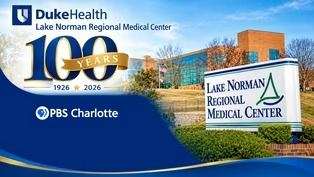
NewA Century of Service: The Story of Lake Norman Regional | Carolina Impact
Video has Closed Captions
Clip: S14 Ep1405 | 7m 6s | Duke Health / Lake Norman regional medical center celebrates it's 100th Anniversary. (7m 6s)
 New
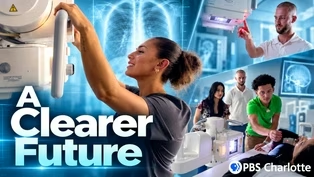
NewA Clearer Future | Carolina Impact
Video has Closed Captions
Clip: S14 Ep1405 | 6m 4s | Central Piedmont students learn to capture medical images and care for the people in them. (6m 4s)
 New
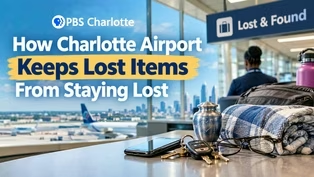
NewHow Charlotte Airport Keeps Lost Items From Staying Lost | Carolina Impact
Video has Closed Captions
Clip: S14 Ep1405 | 6m 7s | Meet Charlotte Airport's Lost & Found, ranked #3 among the nation’s 20 busiest airports. (6m 7s)
 New
NewMore Than Shakespeare | Carolina Impact
Video has Closed Captions
Clip: S14 Ep1405 | 6m | Shakespeare helps young actors find confidence, community and a place to belong. (6m)
 New
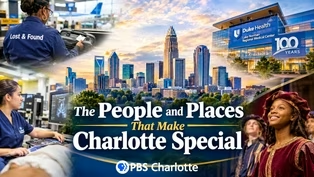
NewOctober 6th, 2026 Preview | Carolina Impact
Video has Closed Captions
Preview: S14 Ep1405 | 30s | CLT Airport Lost & Found; Duke LKN: A Century of Healing; A Clearer Future; & More Than Shakespeare (30s)
Providing Support for PBS.org
Learn Moreabout PBS online sponsorship New Episode
- News and Public Affairs

Top journalists deliver compelling original analysis of the hour's headlines.
 New Episode
- News and Public Affairs

Today's top journalists discuss Washington's current political events and public affairs.
 New Season
 New Episode
 New Episode
 New Episode
 New Episode



 New Episode
 New Episode
Support for PBS provided by:
Carolina Impact is a local public television program presented by PBS Charlotte