
Outdoor Elements
South Bend Venues, Parks & Arts
Clip | 9m 39sVideo has Closed Captions
No description
<p data-start="42" data-end="236">Bringing nature back to its roots! Along the St. Joe River, <strong data-start="107" data-end="142">South Bend Venues, Parks & Arts</strong> is working to restore native plant life and create a healthier ecosystem for the community. <p data-start="238" data-end="454">In this episode of <strong data-start="257" data-end="277"> Outdoor Elements</...
Problems playing video? | Closed Captioning Feedback
Problems playing video? | Closed Captioning Feedback
Outdoor Elements is a local public television program presented by PBS Michiana
Outdoor Elements
South Bend Venues, Parks & Arts
Clip | 9m 39sVideo has Closed Captions
<p data-start="42" data-end="236">Bringing nature back to its roots! Along the St. Joe River, <strong data-start="107" data-end="142">South Bend Venues, Parks & Arts</strong> is working to restore native plant life and create a healthier ecosystem for the community. <p data-start="238" data-end="454">In this episode of <strong data-start="257" data-end="277"> Outdoor Elements</...
Problems playing video? | Closed Captioning Feedback
Where to Watch Outdoor Elements
Outdoor Elements is available to stream on pbs.org and the PBS app.
Providing Support for PBS.org
Learn Moreabout PBS online sponsorshipThere's some beautiful things happening along the Saint Joseph River in South Bend, Indiana, and we're going to learn all about them with Mary and Mary.
You are the horticulturist for South Bend venues, Parks and arts.
Yes.
So it's a beautiful day.
You're working along the river here.
Tell me first, though, what does the horticultural team horticultural team do?
What do they do for the parks?
Our work is pretty seasonal.
We.
In the wintertime, we spend our time mostly killing invasive plants on parks and city property.
And then we'll go into planting and mulching season in the spring.
And in the summer, we'll try to keep up with watering and weeding, and we'll go back to our invasive removal and then back to planting in the fall.
So it just kind of a continuous cycle, right?
Never, never really ends.
And you might be at like buildings sometimes.
Right.
You landscape around buildings.
We have parks properties and then downtown.
And then we come here out into the trails and the natural areas as well.
So it's a mix of ornamental and native plants and native plants.
And we're going to talk a little bit more now about this particular project.
So we are on a stretch on North Side Boulevard.
So lots of traffic going by.
And so people are kind of seeing you throughout the seasons now working along here.
And I stumbled upon you I think in February.
Right.
I was I was out on a walk and I'm like, Mary and Maddie, the other part of the team, you were out here working.
What were you doing then?
So in February, we were cutting down honeysuckle, bittersweet, privet, any woody invasive.
And we were dabbing the stems with an approved aquatics herbicides.
Okay, so they don't.
Yeah.
So they don't come back.
And that's kind of the the important part here is what you were removing.
And you had mounds of it as I recall, you were being moving plants that aren't native to our region.
And why do we want to get rid of those?
Because probably in some part they were holding the bank a little bit from erosion.
But why do we want to remove those?
So when we removed them, the reason that we cut them instead of pull them out was to keep their roots in.
So nothing erodes further.
But we want to get rid of those because they're not very beneficial to any of the wildlife, and they're also not very pleasing.
Yeah.
So we want to get rid of those and replace them with the native plants.
And if we left them in place, they would just take over and the native plants wouldn't thrive.
And many of those shrubs, they just shade out, crowd out everything and nothing else gets.
And some of them have allopathic properties, so nothing will grow in them anyway.
Allopathic, meaning that they release chemicals into the soil and that inhibits the growth of other plants, especially our native.
So there's a nice variety here and maybe we can let's just walk up here.
Maybe we can just mention some of these varieties married that you are actually Mattie at the moment way down there is working on.
So this looks like a is that a sedge or.
Yes, we have some character stretching and some lobelia syphilitic.
So that'll have blue flowers.
Yes.
And this will kind of the character or the sedge will fill in the spaces.
Right.
So we have some plants for wetter areas which we're going to plant closer to the bank.
And then along the top we have some more flowering dry plants for esthetic value.
We have a lot of requests for more flowers along our trails.
Sure.
So we're also working on the Colon Trail on the East Bank trail to check those out.
This looks like Columbine, right?
Columbine.
Okay, so that will have actually pretty soon.
A mature plant will have little cute little spring pink and yellow flowers that dangle.
Right.
Yeah.
And how about this?
This is like a wild rye.
We have some Elymus virginica.
Okay, good.
That's nice.
That's a good bill.
Fills the space, holds the soil.
And then I believe we have Lobelia cardinalis over here.
I think we tried to keep them separate.
Okay okay.
And then we have some rudbeckia Loba okay.
And so this will have like red flowers.
This will have yellow flowers.
So you'll have a mix of colors eventually when they all get right.
And we also plan to put down after we're finished planting some quick blooming seed just to get.
So it takes 3 to 5 years to see flowers from plugs and seeds.
So we wanted something to pop up right away.
Hopefully that people can enjoy.
And you know, I also think you mentioned that wildlife was an important factor in terms of using native plants and eliminating the non-native plants.
So I mentioned the columbine.
That's going to have some flowers for hummingbirds.
Exactly right.
And then some of these others, what are like some of the things that the animals might use, like the probably the cardinal flower is good for hummingbirds too, right.
Yes.
Tubular flowers usually.
Yeah.
We have lots of things for bees.
And we're going to have a lot of milkweed in here for caterpillars.
Oh good.
And we like to have a variety of plants.
So things that bloom spring, summer, fall just so we can catch all the pollinators and all the insects and the birds and different stages of their life cycles are spent on different plants.
So, you know, oftentimes we think you're exactly right.
We often think of just the flower, and just the flower is going to help the insects, which are very important for other wildlife to feed on.
Other wildlife feed on the insects.
But we forget about the fact that, yeah, caterpillars need to eat too, and they don't drink nectar from the flowers.
They need, they need leaves and things.
Right.
So so that's a good reason for using a variety of plants.
I also think that sometimes if there's a disease or something that attacks one species, you have others that will.
Yeah.
That's especially true with the woody plants and the trees.
Yeah, yeah, it will it will attack those.
So these plants all in their nice little plants, do you buy them, do you grow them.
What do you do.
Right now we have a space next to our forestry building that we've makeshift made a nursery out of.
And it holds about 40,000 plugs.
We can grow ourselves so we grow our native plants.
We feed them in the winter, and then they'll grow throughout the year because they're not indoors in a greenhouse.
They usually root out in the summer.
So we'll plant them in the fall, and then we'll do our ornamental plantings in the spring, but we'll leave a little chunk of them to overwinter so we can get a head start.
Okay, okay.
And it is interesting that many native plants do need what we call cold stratification, right?
They need to be seeds touching the soil in really cold temperatures.
Right?
Yes.
They the freeze thaw breaks open the seed coat and it mimics natural conditions.
Yeah, yeah.
So even though you don't have a greenhouse, these plants do just great.
Outside their second year plants.
So they were ready to go okay.
That was going to be my next question.
Second year.
And you mentioned that sometimes we don't see the flowers or the really pretty nice till like three, five, 3 to 5 years.
Now once you get the this stretch planted and we should mention how long is this stretch that we are working from Sample street to Twyckenham.
Okay.
And the IUSB Botany Club has been working from Twyckenham onward towards campus.
And then we have Joe Kernan and Howard Park beyond sample streets.
And just like to mention that the North Side Riverwalk Homeowners Association helped us plant a lot of native plants along the bank of Joe Kernan a couple of years ago.
Nice.
And we're hoping that some of those will flower this year, flower this year.
What is going to be so beautiful?
So we just wanted to connect everything together, which is also important for wildlife.
Right.
Having having connectivity long long stretches.
So once these plants are all in the ground, do you just walk away and you're done or what happens?
I wish.
Yeah, right.
No, we will come back.
This was our first round of invasive removal, so we will definitely have to come back and spot treat things as they come back up.
And if there's any areas that maybe wash out or things didn't do so well there, we'll have to replant or maybe reseed.
And then as we clear more invasives, we'll reseed in those spaces.
Okay, so it's not a one and done.
No.
It keeps the horticulture team busy though right.
So that's that's great.
Well I for one because I walk here often.
I'm looking forward to seeing all the beautiful flowers.
And kudos to the city of South Bend and venues, Parks and Arts for thinking about native plants, getting rid of invasives because we often all of us that are working on land management and care about the land have to spend a lot of time removing those invasives.
So getting rid of them in any place, whether it's our backyard gardens or public spaces, is good work.
And I appreciate your good work.
And thanks so much for sharing this story with us.
Thank you.
Remember, you can find your own outdoor elements when you visit area parks and natural areas.
We'll see you soon.
 New
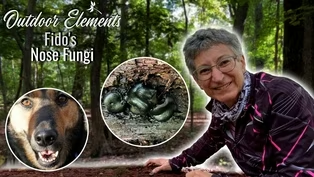
NewA Fungus that Looks like Fido's Nose
Video has Closed Captions
Clip | 4m 49s | A Fungus that Looks like Fido's Nose (4m 49s)
Video has Closed Captions
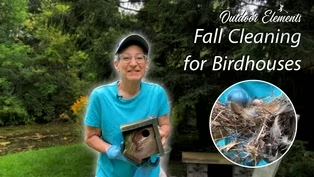
Clip | 9m 22s | It’s time for a little late summer cleaning! Evie cleans out her birdhouses and takes a (9m 22s)
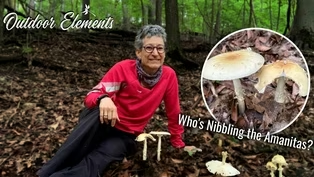
Clip | 2m 58s | Evie takes a closer look at the Veiled Amanita and discovers the unique feature that gives (2m 58s)
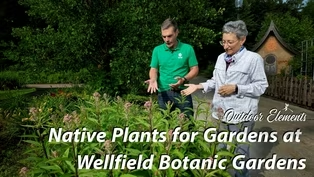
Native Plants for Gardens at Wellfield Botanic Gardens
Video has Closed Captions
Clip | 27m 58s | Native plants are thriving at Wellfield Botanic Gardens! (27m 58s)
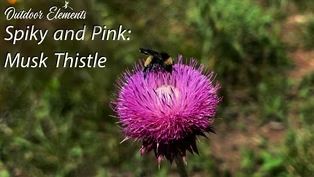
Video has Closed Captions
Clip | 3m 15s | Spiny and Pink: Musk Thistle (3m 15s)
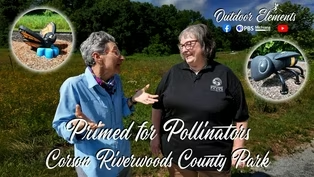
Primed for Pollinators - Corson Riverwoods County Park
Video has Closed Captions
Clip | 12m 22s | No description (12m 22s)
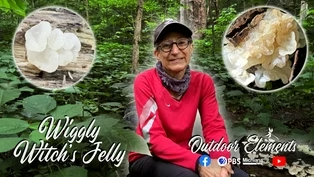
Video has Closed Captions
Clip | 2m 42s | Evie takes a closer look at some unusual fungus. (2m 42s)
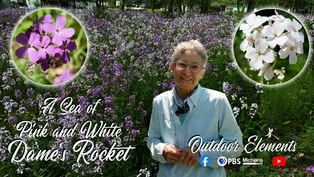
A Sea of Pink and White-Dame's Rocket
Video has Closed Captions
Clip | 4m 34s | Evie takes a closer look at Dame's Rocket, a non-native plant that can crowd out native wi (4m 34s)
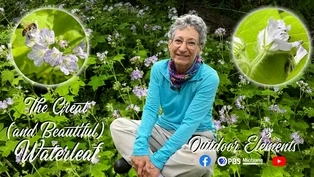
The Great (and Beautiful) Waterleaf
Video has Closed Captions
Clip | 4m 28s | The Great (and Beautiful) Waterleaf is putting on quite a show! (4m 28s)
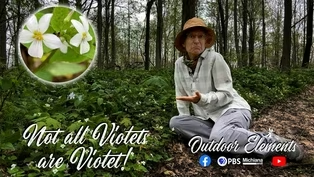
Video has Closed Captions
Clip | 3m 27s | 🌸🤔 Are all violets actually violet? Not quite! (3m 27s)
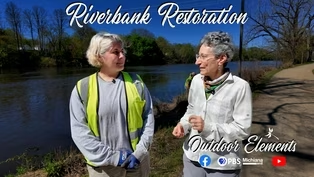 Now Playing
South Bend Venues, Parks & Arts
Video has Closed Captions
Clip | 9m 39s | No description (9m 39s)
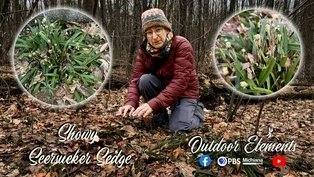
The Sedge with Edges: Discovering the Seersucker Sedge 🌿
Video has Closed Captions
Clip | 3m 10s | Even in late winter and early spring, some plants really stand out along the trail! Evie c (3m 10s)
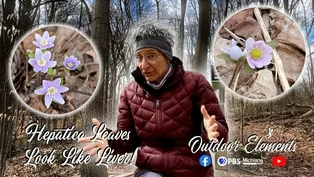
Why This Flower is Named After a Human Organ
Video has Closed Captions
Clip | 3m 3s | Early spring hikes are full of hidden gems! While out on the trail, Evie discovered some S (3m 3s)
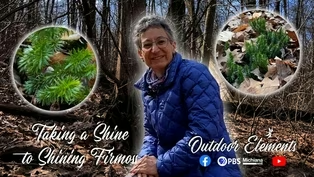
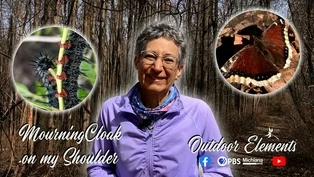
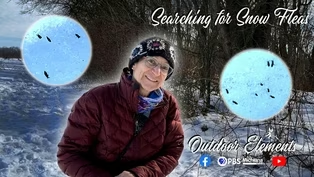
Video has Closed Captions
Clip | 4m 42s | Looking for a tiny sign that winter is on its way out? Evie hit the snow-covered trails in (4m 42s)

Video has Closed Captions
Clip | 6m 54s | 🦆❄️ When winter tightens its grip, the waterways tell a different story. (6m 54s)
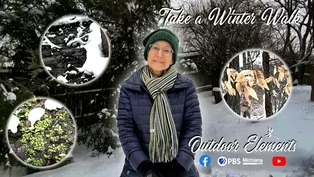
Video has Closed Captions
Clip | 3m 2s | Take a winter walk with us at Fernwood Botanical Garden! (3m 2s)
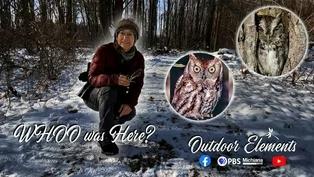
Video has Closed Captions
Clip | 4m 20s | 🦉🌲 WHOO was here? While walking along a wooded path, Evie came across a mysterious p (4m 20s)
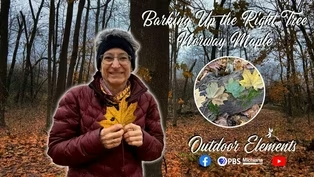
Barking Up the Right Tree: Norway Maple
Video has Closed Captions
Clip | 4m 30s | No description (4m 30s)
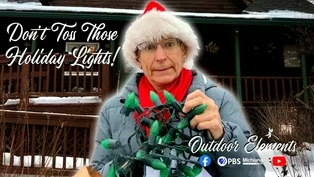
Don't Toss Those Holiday Lights! | OE
Video has Closed Captions
Clip | 8m 25s | 🎄✨ Got holiday lights that no longer sparkle? Don’t toss them! ♻️ In this ep (8m 25s)
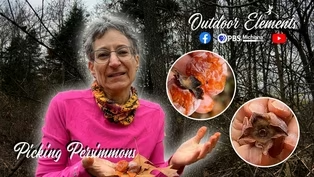
Video has Closed Captions
Clip | 3m 38s | 🍂✨ Out on a fall walk in the woods, Evie stumbled upon a sweet seasonal surprise — (3m 38s)

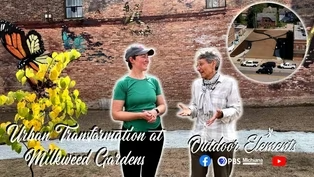
Urban Transformation at Milkweed Gardens
Video has Closed Captions
Clip | 17m 11s | No description (17m 11s)
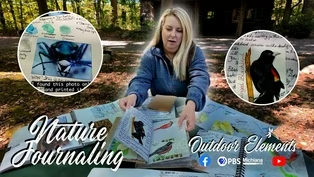
Video has Closed Captions
Clip | 11m 50s | 🌿🖊️ It’s time to slow down and connect with nature! In this episode of Outdoor E (11m 50s)
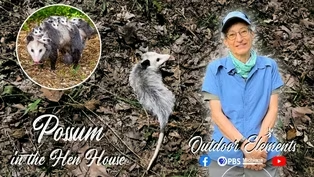
Video has Closed Captions
Clip | 3m 20s | 🐔👀 There’s a possum in the hen house! 🐾 On this episode of Outdoor Elements, E (3m 20s)
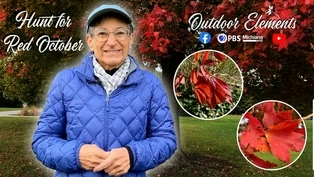
Video has Closed Captions
Clip | 2m 57s | 🍁 It’s that time of year when nature puts on its most colorful show! 🌳 In this epi (2m 57s)
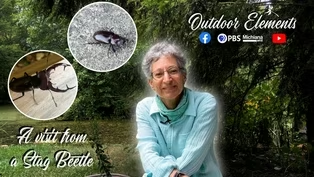
Video has Closed Captions
Clip | 3m 36s | 🌿🪲One of our awesome viewers spotted a beetle making its way across the driveway and (3m 36s)


Video has Closed Captions
Clip | 3m 24s | A viewer shared a fascinating video of a Paintedhand Mudbug, and Evie dives into the detai (3m 24s)
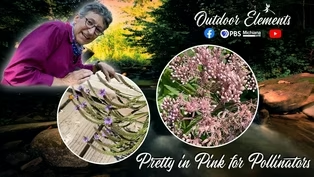
Pretty in Pink for Pollinators
Video has Closed Captions
Clip | 5m 3s | At Lydick Bog Nature Preserve, Evie spots a burst of pink in a wetland. She explores these (5m 3s)
Another Milkweed Specialist: Milkweed Tussock Moth
Video has Closed Captions
Clip | 4m 36s | No description (4m 36s)
Video has Closed Captions
Clip | 3m 43s | Evie spotted Pointed-leaf Tick-Trefoil and shares how to identify this plant. (3m 43s)
The Unique Flowers of Buttonbush
Video has Closed Captions
Clip | 3m 58s | Evie finds Buttonbush at Spicer Lake Nature Preserve (3m 58s)
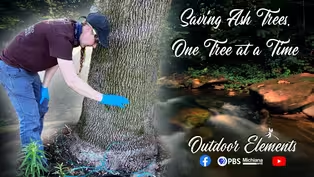
Saving Ash Trees, One Tree at a Time
Video has Closed Captions
Clip | 11m 16s | No description (11m 16s)
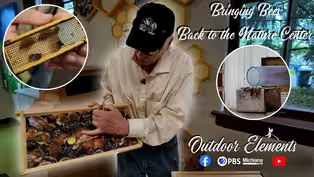
Bringing Bees Back to the Nature Center
Video has Closed Captions
Clip | 6m 10s | No description (6m 10s)
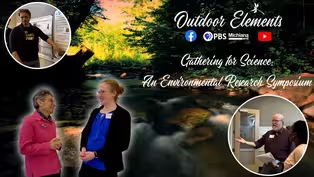
Gathering for Science: An Environmental Research Symposium
Clip | 10m 27s | Evie stops by the St. Joseph County Public Library during their Earth Day celebration to c (10m 27s)
Surprising Color in the Woods: Blue Stain Fungi
Video has Closed Captions
Clip | 3m 48s | No description (3m 48s)
Maple Sweet Treat for Ants | Outdoor Elements
Video has Closed Captions
Clip | 1m 34s | A sweet surprise in the woods! (1m 34s)
Evil Greens of Spring with Garry Harrington
Video has Closed Captions
Clip | 12m 56s | Things are greening up in the spring woods, but it’s not necessarily a welcome sight. (12m 56s)
Providing Support for PBS.org
Learn Moreabout PBS online sponsorship New Episode
- News and Public Affairs

Top journalists deliver compelling original analysis of the hour's headlines.
 New Episode
 New Episode
 New Episode







 New Episode

Support for PBS provided by:
Outdoor Elements is a local public television program presented by PBS Michiana